The $10 Question: Are Aftermarket Blind Spot Mirrors Still Useful on a Modern EV?
If you drive a 2026 Tesla Model Y, Hyundai Ioniq 5, or Ford Mustang Mach-E, your car likely came from the factory with radar-based blind spot monitoring (BSM), rear cross-traffic alert, and camera-based side views. Yet search volume for aftermarket blind spot mirrors — those small convex stick-on mirrors that widen your field of view — remains steady. The reason is simple: not every EV includes BSM as standard equipment, not every driver trusts electronics alone, and some owners of older EVs (a 2018 Nissan Leaf, a 2020 Chevy Bolt) are looking for a low-cost safety upgrade.
This guide breaks down exactly what aftermarket blind spot mirrors do, how they compare to the radar- and camera-based BSM systems built into modern EVs, and whether you actually need one, the other, or both.
What Aftermarket Blind Spot Mirrors Actually Do
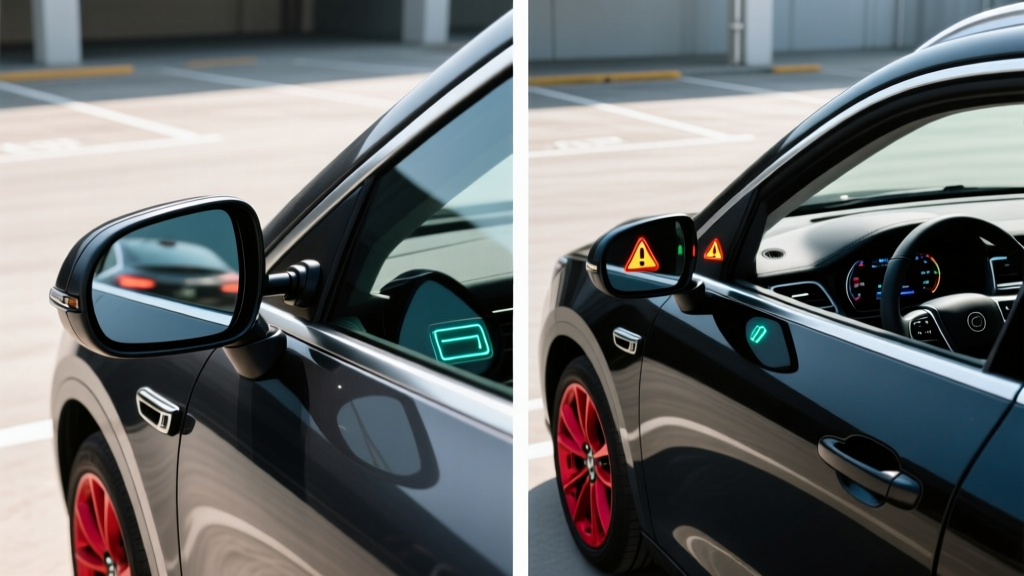
Aftermarket blind spot mirrors are convex (curved outward) glass or acrylic discs, typically 2–3 inches in diameter, that adhere to your existing side mirrors with double-sided tape. The convex curvature expands the reflected field of view from roughly 15–20° (flat mirror) to approximately 30–45°, allowing you to see vehicles tucked alongside your rear quarter panels without turning your head as far.
How they work technically: Pure optics. No sensors, no wiring, no software. Light hits the curved surface and reflects a wider angle at the cost of making objects appear smaller and farther away than they are — which is why these mirrors carry the warning "Objects in mirror are closer than they appear."
Typical specs for popular aftermarket options:
- Size: 2" (50mm) to 3.5" (89mm) diameter
- Material: Tempered glass or shatterproof acrylic
- Curvature: 2R to 4R convex radius (higher = wider view, more distortion)
- Mounting: 3M VHB adhesive or suction cup
- Cost: $6–$18 per pair on Amazon or at auto parts stores
- Installation time: Under 2 minutes, no tools
How Factory EV Blind Spot Monitoring Works
Modern EV blind spot monitoring systems use entirely different technology. Rather than optics, they rely on 24 GHz or 77 GHz millimeter-wave radar sensors mounted behind the rear bumper fascia or inside the rear quarter panels. Some systems supplement radar with side-repeater cameras (like Tesla's side fender cameras) or ultrasonic sensors for low-speed proximity detection.
Technical Breakdown of Factory BSM
| Parameter | Typical EV BSM Spec |
|---|---|
| Sensor type | 77 GHz radar (most 2024+ EVs) or 24 GHz radar (older models) |
| Detection range | ~10–70 meters laterally, ~3–5 meters behind bumper |
| Detection zone width | One full lane (~3.5 m) on each side |
| Speed activation threshold | Typically above 6–12 mph (varies by OEM) |
| Alert type | LED indicator in side mirror housing + audible chime + haptic steering vibration (brand-dependent) |
| Rear cross-traffic alert | Yes — same radar sensors, active in reverse up to ~5 mph |
| Integration with ADAS | Some systems apply brake intervention or resist steering during lane change (e.g., Hyundai HDA2, Toyota Safety Sense 3.0) |
The radar continuously scans the adjacent lanes and calculates relative speed and distance. When a vehicle enters the blind zone and your turn signal is activated, the system escalates from a passive indicator light to an urgent flashing alert and audible warning. According to IIHS research, BSM systems reduce lane-change crashes by approximately 14% and lane-change injuries by 23%.
Brand-by-Brand: Which 2026 EVs Include BSM, and What Does It Cost?
Blind spot monitoring availability varies dramatically by automaker and trim level. Some brands include it on every EV; others gate it behind higher trims or subscription packages.
| Brand | Feature Name | Standard on EV Trims | Cost / Notes |
|---|---|---|---|
| Tesla | Blind Spot Camera + Monitoring (vision-based, no radar) | All Model 3/Y/S/X (standard) | Included. Camera feed displays on center screen when turn signal activated. No dedicated radar sensor since HW4.0 transition. |
| Hyundai / Kia | Blind-Spot Collision-Avoidance Assist (BCA) | SEL and above (Ioniq 5, EV6, EV9) | Included on mid/high trims. Can apply corrective braking. Base SE trim: BSM warning only, no intervention. |
| Ford | BLIS (Blind Spot Information System) with Cross-Traffic Alert | Standard on Mach-E Premium; optional on Select | Part of Co-Pilot360 2.0 package (~$1,200 on lower trims). |
| Chevrolet | Side Blind Zone Alert | Equinox EV 2LT and above; Blazer EV standard | Included. Trailer-tow BSM extension available on Silverado EV. |
| Toyota | Blind Spot Monitor with Rear Cross-Traffic Alert | bZ4X XLE and above | Included. Part of Toyota Safety Sense 3.0 suite. |
| Rivian | Blind Spot Warning | All R1T/R1S trims (standard) | Included. Uses camera + radar fusion. |
| BMW | Active Blind Spot Detection | Standard on i4, i5, iX (all trims) | Included. Steering intervention on models with Driving Assistant Professional. |
Aftermarket Blind Spot Mirrors vs. Factory BSM: Head-to-Head
These two solutions operate in completely different domains. One is an optical aid; the other is an electronic warning system. Here is how they stack up across the dimensions that matter to EV owners.
| Criterion | Aftermarket Blind Spot Mirrors | Factory EV BSM System |
|---|---|---|
| Cost | $6–$18 one-time | $0 (included) to ~$1,200 (package add-on) |
| Installation | Peel-and-stick, 2 min | Factory-installed; no retrofit option for most EVs |
| Works without power | Yes — pure optics | No — requires vehicle electrical system |
| Active alerts (lights/sound) | No — passive only | Yes — visual, audible, haptic |
| Night performance | Poor — relies on ambient light / headlights | Excellent — radar works in total darkness |
| Rain / fog performance | Degraded — water on mirror surface | Radar largely unaffected; camera-based systems may degrade |
| Distance estimation | Distorted (objects appear farther) | Accurate — radar calculates real distance and speed delta |
| Rear cross-traffic (reversing) | No | Yes — on most systems |
| Trailer/tow extension | No | Available on some trucks/SUVs (Silverado EV, F-150 Lightning) |
| Brake/steering intervention | No | Yes — on select brands (Hyundai BCA, BMW Active BSM) |
| Works on any vehicle | Yes — universal fitment | No — vehicle-specific, not retrofit-friendly |
Real-World Limitations of Both Solutions
- Neither aftermarket mirrors nor factory BSM steer or brake the car autonomously to avoid a collision (with narrow exceptions like Hyundai BCA, which can apply light corrective braking but is still Level 1 — not autonomous).
- Neither eliminates the need for a physical shoulder check before changing lanes.
- Neither detects motorcycles, bicycles, or pedestrians reliably in all conditions.
- Neither is a substitute for attentive driving — you are always the responsible party.
Aftermarket Blind Spot Mirror Limitations
- Distance distortion: The convex surface makes vehicles appear 20–30% farther away than they actually are. New users frequently misjudge gap distances until they adapt.
- Reduced main mirror area: Stick-on discs cover a portion of your flat mirror, slightly reducing the standard rearward view.
- Weather vulnerability: Rain, snow, and road grime accumulate on the small convex surface faster than on a heated main mirror (most aftermarket mirrors lack heating elements).
- Night driving: Without illumination, you are relying entirely on the other vehicle's headlights reflecting off a 2-inch surface — significantly harder to see than a factory BSM LED indicator that actively illuminates in your mirror housing.
- Aesthetics: Subjective, but many EV owners find stick-on mirrors visually incongruous on vehicles with flush, aerodynamic mirror housings.
Factory BSM Limitations
- Speed threshold: Most systems deactivate below 6–12 mph, offering no protection in stop-and-go traffic or parking-lot lane changes.
- Sensor obstruction: Heavy mud, ice, or bumper wraps can block radar. Tesla's camera-only approach is particularly susceptible to lens dirt, rain occlusion, and direct sun glare.
- False positives: Guardrails, concrete barriers, and parked cars on tight curves can trigger phantom alerts — a nuisance on winding roads.
- Camera-only systems (Tesla): Without radar redundancy, camera-based BSM can miss fast-approaching vehicles in low-contrast conditions (dark car on dark road at dusk). NHTSA has logged consumer complaints about Tesla's vision-only BSM reliability.
- No retrofit path: If your EV didn't ship with BSM (e.g., base-trim 2023 Chevy Bolt EV, early Nissan Leaf S), there is no OEM-approved way to add it after purchase.
Cost Breakdown: Aftermarket Mirrors vs. Factory BSM vs. Aftermarket Electronic BSM
There is a third option worth considering: aftermarket electronic blind spot monitoring kits. These are radar-based systems from brands like Brandmotion, Rydeen, and EchoMaster that mount behind your bumper and provide LED mirror indicators similar to factory BSM. Here is the full cost picture:
| Solution | Equipment Cost | Installation Cost | Total | Subscription? |
|---|---|---|---|---|
| Aftermarket convex mirrors (stick-on pair) | $6–$18 | $0 (DIY) | $6–$18 | No |
| Factory BSM (included on mid/high EV trims) | $0 (built in) | $0 | $0 | No (on most brands) |
| Factory BSM (trim upgrade or package add-on) | $800–$1,500 (package) | $0 (factory) | $800–$1,500 | No |
| Aftermarket electronic BSM kit (radar-based) | $200–$500 | $150–$350 (professional) | $350–$850 | No |
Key takeaway: If your EV already has factory BSM, the $10 aftermarket mirror is redundant for blind-spot detection but can still serve as a wide-angle aid for parking and curb visibility. If your EV lacks BSM entirely (base-trim older models), an aftermarket electronic kit is a meaningful safety upgrade — but it costs 20–50× more than stick-on convex mirrors and requires professional installation involving bumper removal and wiring into the turn-signal circuit.
Decision Framework: Which Option Fits Your EV?
Choose aftermarket blind spot mirrors ($6–$18) if:
- Your EV already has factory BSM but you want extra wide-angle visibility for tight parking, curb checks, or spotting cyclists at intersections.
- You drive an older EV without BSM and want a zero-cost baseline improvement while saving for an electronic kit.
- You frequently tow and need to see alongside a trailer where factory BSM doesn't reach (and your EV lacks trailer-aware BSM).
Choose an aftermarket electronic BSM kit ($350–$850 installed) if:
- Your EV was not equipped with factory BSM (e.g., 2020–2022 Chevy Bolt EV base, early Nissan Leaf S) and you want active radar-based warnings with LED indicators.
- You drive high-mileage highway commutes where passive mirrors alone are insufficient.
Choose neither (rely on factory BSM alone) if:
- Your 2024–2026 EV already includes BSM with rear cross-traffic alert on a mid-or-higher trim — the factory system is superior in every measurable way to stick-on mirrors.
- You are purchasing a new EV: prioritize a trim that includes BSM rather than buying base and retrofitting.
Frequently Asked Questions
Do aftermarket blind spot mirrors interfere with EV cameras or sensors?
Generally no. Tesla's side-repeater cameras are mounted on the front fenders, not the mirror housings, so a stick-on convex mirror on the side mirror does not obstruct them. However, if your EV has a camera embedded in the mirror housing itself (some BMWs and Mercedes with surround-view systems), a poorly placed aftermarket mirror could partially block the camera lens. Always check your mirror housing for embedded cameras before applying adhesive discs.
Are aftermarket blind spot mirrors legal in all US states?
Yes. No US state prohibits adding convex auxiliary mirrors to your existing side mirrors. Federal Motor Vehicle Safety Standard (FMVSS) 111 governs the required flat mirror field of view, and adding a supplementary convex mirror does not violate it as long as the original flat mirror remains functional and unobstructed in its primary viewing area.
Can I get factory BSM added to my EV after purchase?
In nearly all cases, no. Factory BSM requires radar sensors embedded in the rear bumper or quarter panels, wiring harnesses routed to the mirror housings for LED indicators, and ECU software integration. Dealerships generally will not retrofit this, and third-party shops cannot access OEM software coding. Your best option for a base-trim EV without BSM is an aftermarket electronic kit from a brand like Brandmotion or Rydeen.
Is Tesla's camera-only blind spot monitoring as reliable as radar-based BSM?
Real-world data is mixed. Tesla removed radar from Model 3 and Model Y in 2022 (transitioning to Tesla Vision), relying solely on side cameras for blind spot detection. While the camera feed displayed on-screen is useful, multiple NHTSA consumer complaints have cited delayed or missed BSM alerts in low-light and high-glare conditions compared to radar-based systems. Radar operates independently of lighting conditions, giving it a physical advantage for this specific use case. If you own a Tesla and find BSM alerts inconsistent, aftermarket convex mirrors can provide a useful analog backup.
How long do aftermarket blind spot mirrors last?
Glass convex mirrors with quality 3M VHB adhesive typically last 3–5 years before adhesive degradation or surface pitting from road debris requires replacement. Acrylic mirrors scratch more easily and may need replacement every 1–2 years. Heated aftermarket mirrors (available for $25–$40, wired into your mirror defroster circuit) last longer in cold climates by preventing ice buildup that degrades the adhesive bond.
Do I still need to do a shoulder check if I have both BSM and aftermarket mirrors?
Yes. According to IIHS, even the best BSM systems have detection gaps — particularly for fast-approaching motorcycles, vehicles two lanes over cutting across your path, and low-profile objects. The shoulder check remains the final verification step. Aftermarket mirrors and BSM reduce the frequency and duration of shoulder checks needed, but neither eliminates the requirement.
Sources: IIHS Blind Spot Detection Research, SAE J3016 Automation Levels, NHTSA Vehicle Safety. Pricing and trim availability reflect 2026 model-year data at time of publication; verify with your local dealer.