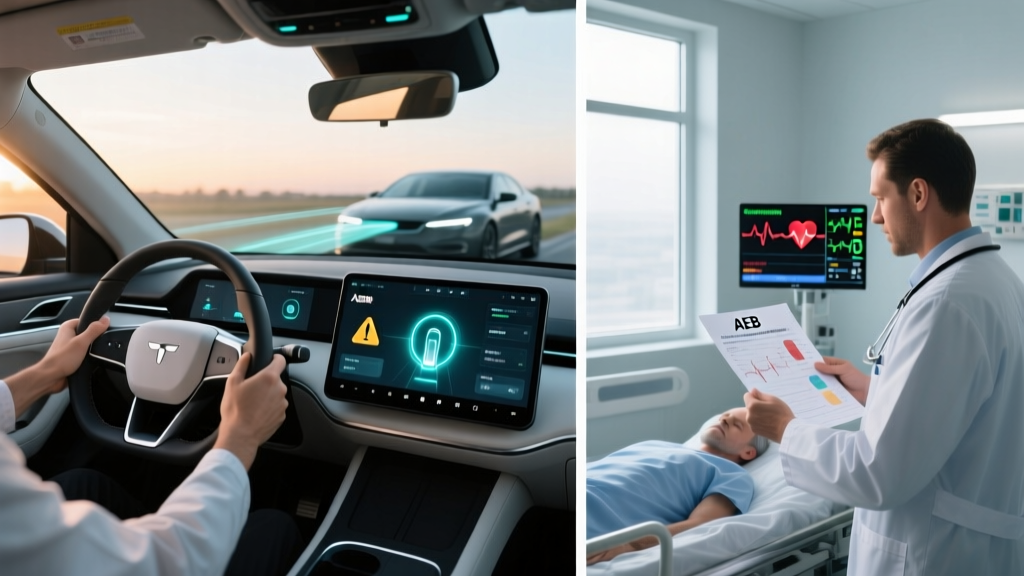
If you've ever searched for AEB medical acronym and ended up reading about cars instead of emergency rooms, you're not alone. "AEB" lives a double life: in healthcare it can refer to clinical terms (most commonly Acute Exacerbation of Bronchitis or, in some literature, Atypical Endometrial Bleeding), while in the automotive world it stands for Automatic Emergency Braking — one of the most important active-safety features on every modern electric vehicle.
This guide focuses on the automotive meaning. We'll explain exactly what AEB does on today's EVs, how the sensor stack works, what it costs, which models include it, and — critically — what it cannot do. If you landed here from a medical search, consider this your friendly redirect.
What Automatic Emergency Braking (AEB) Actually Does
Automatic Emergency Braking is a forward-collision mitigation system. It continuously monitors the road ahead and, when it determines a collision with a vehicle, pedestrian, or cyclist is imminent, it either warns the driver or applies the brakes autonomously to reduce impact speed — or avoid the crash entirely.
On modern EVs, AEB is rarely a standalone feature. It's bundled into a broader ADAS (Advanced Driver Assistance Systems) suite alongside Forward Collision Warning (FCW), pedestrian detection, intersection assist, and rear automatic braking. The Insurance Institute for Highway Safety (IIHS) has required AEB performance testing for its Top Safety Pick awards since 2020, pushing the feature from premium-option to near-universal standard equipment.
How AEB Works Technically
AEB relies on sensor fusion — combining data from multiple hardware types to build a real-time model of what's ahead:
- Forward-facing camera(s): Mounted behind the windshield, these classify objects (car, truck, pedestrian, cyclist) and read lane markings. Most 2026 EVs use stereo or multi-lens setups with 8-megapixel+ sensors.
- Millimeter-wave radar: Typically a 77 GHz unit in the lower grille or bumper. Radar excels at measuring distance and relative speed, even in rain, fog, or glare where cameras struggle.
- Ultrasonic sensors: Short-range (under ~10 meters) parking and low-speed assist, used for rear AEB and cross-traffic braking.
- Lidar (select models): Some higher-end EVs — like the Lotus Eletre, certain Volvo EX90 trims, and vehicles equipped for advanced pilot features — add lidar for precise 3D mapping up to 200+ meters.
An onboard domain controller (often an NVIDIA DRIVE Orin or Qualcomm Snapdragon Ride chip in 2026 vehicles) fuses these inputs at 20-60 Hz. When time-to-collision drops below a threshold (typically 1.0–1.5 seconds at highway speeds), the system first triggers an audible/visual Forward Collision Warning, then pre-charges the brake hydraulics, and finally applies full braking force if the driver doesn't react.
SAE Automation Level: Level 1–2, Not Self-Driving
AEB is classified as an SAE Level 1 feature (single-axis intervention — braking only). When bundled with lane-centering steering assist, the combined ADAS suite is Level 2. In both cases, the driver must remain fully engaged, eyes on road, hands available to take over. AEB does not make any EV autonomous. True driverless operation (Level 4) is currently limited to geofenced robotaxi services like Waymo in select metro areas.
Real-World Capabilities: Where AEB Shines — and Where It Struggles
AEB performs best in the scenarios it was engineered for: rear-end collisions with stopped or slowing vehicles at speeds up to about 50 mph, and pedestrian crossings at lower urban speeds. IIHS testing shows modern AEB systems can reduce rear-end crashes by roughly 50% and injury-causing rear-end crashes by about 56%, according to IIHS research data.
But real-world conditions introduce variables that no lab test fully captures.
AEB Limitations Every EV Owner Should Know
- Weather degradation: Heavy rain, snow accumulation on sensors, and dense fog can reduce camera and radar effectiveness. Most systems will display a "sensor blocked" warning and disable AEB — check your mirrors and increase following distance.
- Low sun / glare: Direct sunlight at low angles (dawn, dusk, winter) can temporarily blind forward cameras, delaying detection.
- Stationary object edge cases: AEB is tuned primarily for moving targets. High-speed encounters with stationary objects (a stopped truck in a travel lane, a concrete barrier) may not trigger full braking. NHTSA's 2024 rulemaking on AEB performance (FMVSS 21-A) tightened stationary-vehicle requirements, but gaps remain above ~62 mph.
- Cut-in scenarios: A vehicle swerving into your lane at close range often leaves too little time for AEB to react before the driver must intervene.
- Phantom braking: Overly aggressive AEB activation — slamming the brakes when no obstacle exists — has been reported on certain Tesla, GM, and Subaru models. Always report phantom-braking events to the manufacturer and NHTSA.
- Cyclist/pedestrian at night: Camera-based pedestrian detection degrades significantly in darkness without supplemental infrared or lidar. Expect reduced performance after sunset.
Brand-by-Brand AEB Naming and Availability in 2026
Every major automaker markets AEB under its own branding. The underlying function is similar, but packaging, standard-vs-optional status, and sensor hardware vary significantly.
| Brand | ADAS Suite Name | AEB Feature Name | Standard on (2026) | Notable Hardware |
|---|---|---|---|---|
| Tesla | Autopilot / FSD (Supervised) | Automatic Emergency Braking | All models, all trims | Camera-only (Tesla Vision, 8 cameras, HW4/AI5) |
| Ford | Co-Pilot360 | Pre-Collision Assist with AEB | All EVs (Mustang Mach-E, F-150 Lightning) | Camera + radar fusion |
| Hyundai / Kia / Genesis | SmartSense / Highway Driving Assist | Forward Collision-Avoidance Assist (FCA) | All trims (Ioniq 5, Ioniq 6, EV6, GV60) | Camera + radar; lidar on Genesis G90 |
| GM (Chevy, Cadillac) | Super Cruise / Chevy Safety Assist | Automatic Emergency Braking | All EVs (Equinox EV, Blazer EV, Lyriq, Silverado EV) | Camera + radar; lidar on Super Cruise-equipped models |
| BMW | Driving Assistant Professional | City Collision Mitigation / Frontal Collision Warning | Standard base; Pro package adds enhanced detection | Camera + radar; optional lidar (iX, i7) |
| Mercedes-Benz | Driver Assistance Package | Active Brake Assist | Standard on EQE, EQS; base Active Brake Assist on all | Camera + radar; lidar on Drive Pilot-equipped S-Class/EQS |
| Volvo / Polestar | Pilot Assist | City Safety (AEB + intersection brake) | All trims, all models | Camera + radar; lidar standard on EX90 |
| Rivian | Driver+ | Forward Collision Warning + AEB | All R1T and R1S trims | Camera + radar; lidar on Gen 2 (R2 upcoming) |
The takeaway: AEB is standard equipment on virtually every 2026 EV sold in the U.S. You don't need to upgrade to a premium trim to get the core braking function. However, enhanced AEB — with pedestrian/cyclist detection, intersection assist, and rear cross-traffic braking — may require a mid-level trim or ADAS package on some brands.
Cost Breakdown: AEB vs. Full ADAS Subscriptions
Basic AEB is included in your vehicle's purchase price at no additional cost. The expense question arises when you look at the broader ADAS ecosystem that wraps around AEB — lane-centering, adaptive cruise, automatic lane changes, and conditional hands-off driving.
| System | AEB Included? | Full ADAS Cost (2026) | Pricing Model |
|---|---|---|---|
| Tesla Autopilot (base) | Yes | $0 (included) | Standard |
| Tesla FSD (Supervised) | Yes | $8,000 one-time or $99/month | Purchase or subscription |
| GM Super Cruise | Yes | $2,500–$3,000 (package); 3-year trial then ~$25/mo | One-time + subscription |
| Ford BlueCruise | Yes | $2,100 (2-year) or $75/month | Purchase or subscription |
| BMW Driving Assistant Pro | Yes | $1,700–$2,500 (one-time package) | One-time purchase |
| Mercedes Drive Pilot (Level 3) | Yes | $2,500/year (NV/CA only) | Annual subscription |
| Hyundai/Kia HDA2 | Yes | $0 (included on most trims) | Standard |
| Volvo Pilot Assist | Yes | $0 (included) | Standard |
AEB itself is free. You're paying extra for the convenience layer — hands-off-lane-centering on highways, automated lane changes, and in Mercedes' case, conditional Level 3 liability coverage in traffic jams under 40 mph on approved highways.
How AEB Stacks Up Across Competing EVs
Not all AEB systems perform equally. The IIHS rates AEB on a scale from Basic to Superior based on stopping performance at 12 mph, 25 mph, and (increasingly) 37 mph in vehicle-to-vehicle tests, plus pedestrian detection at various speeds and lighting conditions.
| Vehicle (2026) | IIHS V-to-V Rating | Pedestrian Detection | Night Pedestrian | Rear AEB | Sensor Stack |
|---|---|---|---|---|---|
| Tesla Model Y (refresh) | Superior | Standard | Limited (camera-only) | Yes | 8 cameras, no radar |
| Hyundai Ioniq 5 | Superior | Standard | Good (camera + radar) | Yes (with parking collision-avoidance) | Camera + front radar |
| Ford Mustang Mach-E | Superior | Standard | Good | Yes | Camera + radar |
| Volvo EX90 | Superior | Standard | Excellent (lidar-assisted) | Yes | Camera + radar + lidar |
| Cadillac Lyriq | Superior | Standard | Good | Yes | Camera + radar |
| BMW iX | Superior | Standard (Pro package enhanced) | Good | Yes | Camera + radar (optional lidar) |
The Volvo EX90's lidar gives it a measurable advantage in nighttime pedestrian scenarios — a category where camera-only systems like Tesla's Vision stack have historically underperformed. If nighttime AEB reliability is a priority for your commute, sensor hardware matters.
NHTSA Mandates and the Regulatory Push for Stronger AEB
In 2024, NHTSA finalized a new Federal Motor Vehicle Safety Standard requiring all new light vehicles to include AEB that can:
- Stop the vehicle to avoid a collision with a lead vehicle at speeds up to 50 mph
- Apply brakes to mitigate crashes at speeds up to 62 mph
- Detect and brake for pedestrians in both daylight and darkness
The compliance phase-in runs through 2029, but most 2026 EVs already meet or exceed these thresholds. The regulation effectively guarantees that even budget EVs will carry competent AEB as standard — eliminating the need to pay up for a safety package just to get automatic braking.
FAQ: AEB, ADAS, and the Medical Acronym Mix-Up
What does AEB stand for in a medical context?
In medical literature, AEB most commonly refers to Acute Exacerbation of Bronchitis — a sudden worsening of chronic bronchitis symptoms. It can also appear as Atypical Endometrial Bleeding in gynecological contexts. Neither has anything to do with vehicles. If you're researching a health concern, consult a medical professional and sources like the NIH or Mayo Clinic.
Is AEB the same as self-driving?
No. AEB is an SAE Level 1 safety intervention — it only brakes, and only in emergencies. Even when combined with lane-centering and adaptive cruise (making the full suite Level 2), the driver must remain fully attentive. No consumer EV sold in 2026 is self-driving. The only Level 4 vehicles operating in the U.S. are Waymo robotaxis in geofenced zones of Phoenix, San Francisco, and Los Angeles.
Can I turn off AEB in my EV?
Most vehicles allow you to disable AEB through the infotainment settings, and NHTSA regulations require the system to default to "on" every time you start the car. We strongly recommend leaving it enabled — the 50%+ crash-reduction benefit far outweighs the occasional false-positive phantom brake event. If you experience repeated phantom braking, report it to NHTSA's complaint portal and your dealer.
Does AEB work in snow and heavy rain?
Partially. Radar penetrates rain and fog reasonably well, but cameras can be blinded by precipitation, road spray, or snow buildup on the windshield sensor housing. In severe weather, your EV may display a "Forward Collision System Unavailable" message. Treat this as a prompt to increase following distance and drive as though AEB doesn't exist.
Do I need to pay a subscription to keep AEB working?
No. Basic AEB is included with your vehicle permanently and does not require a subscription. Subscriptions (like Tesla FSD at $99/month or Ford BlueCruise at $75/month) cover advanced features like automated lane changes and hands-off highway driving — not the core emergency braking function.
Which EV has the best AEB system in 2026?
Based on IIHS crash-avoidance testing and sensor hardware, the Volvo EX90 (lidar-equipped) and Hyundai Ioniq 5 (camera-radar fusion, standard on all trims) represent the current high-water marks for AEB performance across price segments. Tesla's camera-only system earns a Superior IIHS rating but has historically shown more phantom-braking reports in NHTSA complaint data.
The Bottom Line: AEB Is the Feature You Hope to Never Notice
Whether you searched for "AEB medical acronym" and took a detour, or you're an EV shopper evaluating safety tech, the automotive takeaway is straightforward: Automatic Emergency Braking is standard, effective, and potentially life-saving. It works best as a silent co-pilot — there when you need it, invisible when you don't. Pair it with attentive driving, clean sensor surfaces, and realistic expectations about its limitations, and it will earn its place as the most important safety feature you never paid extra for.