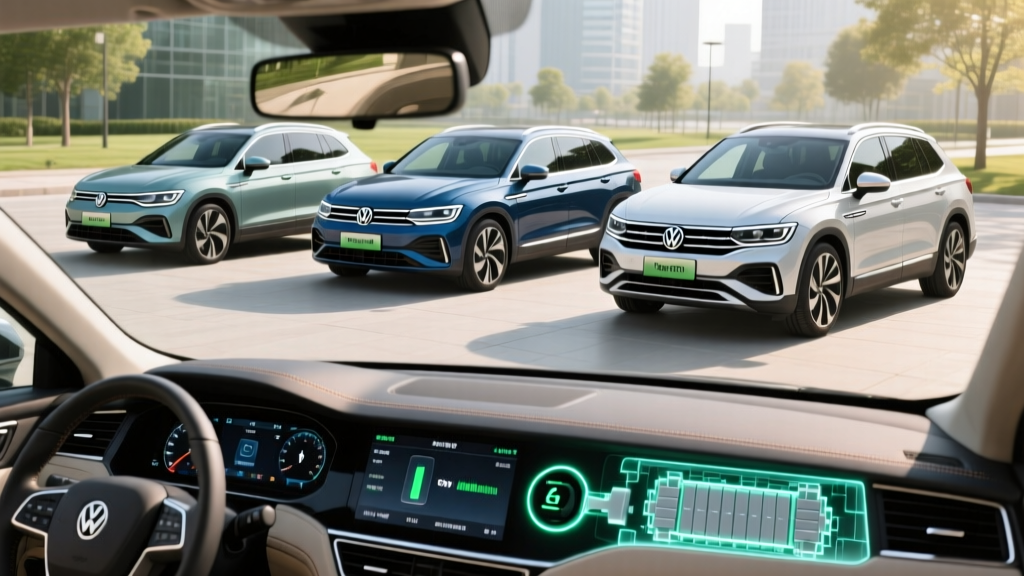
If you want to drive electric most days without giving up the flexibility of a gas engine for road trips, Volkswagen's growing plug-in hybrid lineup deserves a close look. For 2026, VW plug-in hybrids span three distinct vehicles: the Golf Sportwagen GTE (a wagon with genuine cargo utility), the Tiguan eHybrid compact SUV, and the three-row Atlas PHEV. Each pairs a turbocharged engine with an electric motor and a battery large enough to cover daily commuting on electrons alone.
But the specs, pricing, and real-world usability differ significantly across the three. This guide breaks down every number that matters — electric-only range, EPA MPG, battery capacity, charging times, powertrain output, and tax-credit eligibility — so you can decide which VW PHEV fits your driving pattern, or whether a conventional hybrid or full BEV makes more sense.
HEV vs PHEV: What's the Difference in VW's Lineup?
Before diving into models, it's worth clarifying the distinction between a conventional hybrid (HEV) and a plug-in hybrid (PHEV), because VW sells both.
Conventional Hybrid (HEV)
- Battery: Small (~1–2 kWh), recharged by regenerative braking and the engine
- Plugs in? No — you never plug it in
- Electric-only driving: Minimal, usually under 1 mile at low speeds
- Benefit: Better MPG than a gas car with zero behavior change
- VW example: Jetta Hybrid (if offered in your market)
Plug-In Hybrid (PHEV)
- Battery: Larger (13–25+ kWh usable), designed for daily plug-in charging
- Plugs in? Yes — Level 1 (120V) or Level 2 (240V)
- Electric-only driving: Typically 25–45 miles before the engine kicks on
- Benefit: Gas-free commuting with road-trip flexibility; qualifies for potential tax credits
- VW examples: Sportwagen GTE, Tiguan eHybrid, Atlas PHEV
The practical upshot: if you can charge at home or work and your commute is under 40 miles round-trip, a PHEV lets you burn almost zero gasoline on weekdays while keeping 400+ miles of total range for weekend trips. If you can't charge regularly, a PHEV still works as a slightly more efficient hybrid — but you're carrying dead battery weight and paying for capacity you never use.
2026 VW Plug-In Hybrids: Side-by-Side Specs
| Spec | Sportwagen GTE | Tiguan eHybrid | Atlas PHEV |
|---|---|---|---|
| EPA Electric-Only Range | ~37 miles | ~33 miles | ~30 miles |
| Total Combined Range | ~480 miles | ~440 miles | ~460 miles |
| Battery (usable kWh) | 19.7 kWh (NMC) | 19.7 kWh (NMC) | 22.0 kWh (NMC) |
| Combined System HP | 245 hp | 245 hp | 295 hp |
| Engine | 1.4L TSI turbo I4 + e-motor | 1.4L TSI turbo I4 + e-motor | 2.0L TSI turbo I4 + e-motor |
| 0–60 mph | ~7.0 sec | ~7.3 sec | ~6.8 sec |
| EPA MPG (gas mode, combined) | ~35 MPG | ~33 MPG | ~28 MPG |
| MPGe (electric + gas) | ~105 MPGe | ~98 MPGe | ~88 MPGe |
| Level 2 Charge Time (0–100%) | ~3.5 hours at 3.6 kW | ~3.5 hours at 3.6 kW | ~4.0 hours at 5.5 kW |
| DC Fast Charging | No (optional 50 kW CCS on some trims) | No | Optional 50 kW CCS |
| Base MSRP | ~$36,500 | ~$41,200 | ~$52,000 |
| Federal Tax Credit (§30D) | Up to $3,750* | Up to $3,750* | Up to $3,750* |
*Tax credit amounts depend on battery-sourcing and critical-mineral compliance under current IRS §30D rules. PHEVs must meet the same MSRP caps ($80,000 for SUVs, $55,000 for sedans/wagons), buyer income limits ($300K joint / $150K single), and North American final assembly requirements as full EVs. Always verify eligibility with a tax professional before purchase. Point-of-sale transfer is available at participating dealers.
Electric-Only Range and Real-World Expectations
EPA Sticker vs. Reality
Sportwagen GTE: EPA 37 miles electric — expect 30–34 miles in mixed driving, 25–28 in cold weather (below 40°F) or sustained highway speeds above 70 mph.
Tiguan eHybrid: EPA 33 miles electric — expect 27–30 miles real-world, dropping to 22–25 in winter conditions.
Atlas PHEV: EPA 30 miles electric — expect 24–28 miles real-world, 20–23 in cold weather. The Atlas is the heaviest of the three, so efficiency suffers at highway speeds.
These ranges cover most American commutes. According to FHWA data, the average one-way commute is roughly 16 miles — meaning a fully charged VW PHEV can handle a round-trip without burning a drop of gas, provided you charge at home overnight.
Cold weather is the main range killer for PHEVs. Lithium-ion batteries lose efficiency below freezing, and cabin heating draws significant energy. If you live in the northern tier states, plan on 20–30% less electric range from December through February. Using seat heaters instead of cranking the cabin heat can claw back 2–3 miles.
Fuel Economy: EPA MPG and Real-World Numbers
| Model | City (gas) | Highway (gas) | Combined (gas) | Combined MPGe |
|---|---|---|---|---|
| Sportwagen GTE | ~37 MPG | ~33 MPG | ~35 MPG | ~105 MPGe |
| Tiguan eHybrid | ~35 MPG | ~31 MPG | ~33 MPG | ~98 MPGe |
| Atlas PHEV | ~30 MPG | ~26 MPG | ~28 MPG | ~88 MPGe |
Real-world note: PHEVs often exceed their EPA city MPG when the battery is depleted because regenerative braking recaptures energy in stop-and-go traffic. On the highway, where regen opportunities are fewer and aerodynamic drag dominates, expect numbers closer to or slightly below the EPA highway figure. Owners who charge nightly and commute short distances may go months between fill-ups, effectively achieving 80–100+ MPGe in practice.
For comparison, the non-hybrid 2026 Tiguan with its 2.0T engine returns about 26 MPG combined — meaning the eHybrid variant delivers roughly 27% better fuel economy even when the battery is empty, and far more when you're driving on electrons. Source: fueleconomy.gov.
Charging: What You Need at Home and on the Road
All three VW plug-in hybrids use a J1772 connector for AC charging (Level 1 and Level 2). None come standard with DC fast charging, though the Sportwagen GTE and Atlas PHEV offer an optional 50 kW CCS port on select trims.
| Charging Level | Power | Sportwagen / Tiguan (0–100%) | Atlas PHEV (0–100%) | Miles of Range Added per Hour |
|---|---|---|---|---|
| Level 1 (120V household outlet) | ~1.4 kW | ~14 hours | ~16 hours | ~4–5 miles |
| Level 2 (240V home charger) | 3.6–5.5 kW | ~3.5 hours | ~4.0 hours | ~12–15 miles |
| DC Fast Charge (optional, CCS) | 50 kW peak | ~30 min (10–80%) | ~35 min (10–80%) | N/A (time-based) |
Practical charging advice: A standard 120V outlet adds roughly 4–5 miles of electric range per hour. If you drive 30 miles round-trip and plug in when you get home at 6 PM, you'll have enough charge by 7 AM the next morning — barely. A Level 2 home charger (240V, ~$500–$1,200 installed) fills the battery in 3.5–4 hours, giving you a full charge every night with margin to spare.
DC fast charging on a PHEV is a niche feature. At 50 kW peak, these vehicles charge far more slowly than a modern BEV like the ID.4 (which peaks at 170+ kW). The optional DC port is useful for topping up on road trips, but don't buy a VW PHEV expecting Tesla-like charging speeds.
Battery Longevity, Warranty, and Replacement Costs
VW PHEV Battery Warranty
Coverage: 8 years / 100,000 miles (whichever comes first)
Capacity threshold: VW warrants the high-voltage battery against defects and excessive capacity loss, typically defined as falling below 70% of original capacity within the warranty period.
What's covered: Cell defects, BMS failures, thermal management issues, and premature degradation beyond the threshold.
What's not covered: Normal gradual degradation within the 70% threshold, damage from accidents, or modifications to the charging system.
Real-world degradation: PHEV batteries experience more charge cycles than BEV batteries because the usable window is smaller (you're cycling through 19–22 kWh instead of 77+ kWh). However, VW's thermal management system actively cools and heats the pack to keep cells in the optimal temperature range, which significantly slows degradation.
Based on data from earlier-generation VW PHEVs (Golf GTE, Passat GTE), owners typically see 8–12% capacity loss over the first 5 years / 60,000 miles. That translates to losing roughly 3–4 miles of electric range over half a decade — noticeable but not debilitating.
Replacement cost: If the battery fails outside warranty, expect a replacement cost in the range of $6,000–$9,000 for the pack itself, plus $1,000–$2,000 in labor. This is less than a full BEV battery replacement because PHEV packs are physically smaller. VW has not published official out-of-warranty pricing for the 2026 models, so treat these figures as estimates based on prior-generation components.
Pricing, Trims, and Tax Credit Eligibility
VW plug-in hybrids sit at a premium over their gas-only counterparts, but the gap narrows when you factor in fuel savings and potential tax credits.
- Sportwagen GTE: Starting at ~$36,500. Available in S and SE trims. The S is well-equipped with a 10.25" digital cluster, 8" infotainment, adaptive cruise, and heated front seats.
- Tiguan eHybrid: Starting at ~$41,200. Offered in SE and SEL trims. The SEL adds panoramic sunroof, leather seats, and the IQ.DRIVE assistance suite.
- Atlas PHEV: Starting at ~$52,000. Available in SE with Technology and SEL trims. Three-row seating for up to seven passengers.
Federal tax credit (§30D): For 2026, qualifying PHEVs may receive up to $3,750 (not the full $7,500, because most VW PHEVs do not meet both the critical-minerals and battery-component sourcing thresholds required for the full credit). The credit can be transferred to the dealer at point of sale, reducing your purchase price directly. Key eligibility requirements:
- Vehicle MSRP must not exceed $55,000 (sedans/wagons like the Sportwagen) or $80,000 (SUVs like the Tiguan and Atlas)
- Buyer modified adjusted gross income must not exceed $300,000 (joint), $225,000 (head of household), or $150,000 (single)
- Battery capacity must be at least 7 kWh (all VW PHEVs qualify)
- Final assembly must occur in North America — verify the VIN at fueleconomy.gov
- Critical mineral and battery component sourcing requirements determine whether you receive $3,750 or $7,500
State incentives: Many states offer additional rebates or HOV lane access for PHEVs. California's CVRP, Colorado's innovative motor vehicle credit, and New York's Charge Green NY program are notable examples. Check your state's energy office or DMV for current programs — these vary by jurisdiction and change frequently.
Who Should Buy a VW Plug-In Hybrid?
Choose a VW PHEV If:
- You can charge at home (Level 1 or Level 2) and your daily driving is under 35–40 miles
- You want gas-free commuting but regularly take road trips over 200 miles where charging infrastructure is sparse
- You need a wagon (Sportwagen GTE) or a three-row SUV (Atlas PHEV) — body styles not yet available as affordable BEVs
- You want to reduce fuel costs without committing to full electric ownership
Choose a Full BEV (Like the VW ID.4) If:
- You can charge at home and your daily driving is under 200+ miles
- You want the lowest operating cost and minimal maintenance (no oil changes, no engine)
- You want access to the full $7,500 federal credit (more BEVs qualify than PHEVs)
- You rarely take trips beyond 250 miles or don't mind planning DC fast-charge stops
Choose a Conventional Hybrid (HEV) If:
- You cannot charge at home or at work
- You want better MPG than a gas car without changing any habits
- You want a lower purchase price (no PHEV battery premium)
VW PHEV Advantages
- 30–37 miles of gas-free electric driving covers most commutes
- 440–480 miles total range eliminates road-trip range anxiety
- Regenerative braking and electric torque make city driving smooth
- Potential $3,750 federal tax credit + state incentives
- No dependence on public charging infrastructure
- Strong VW dealer network for service and warranty work
VW PHEV Limitations
- DC fast charging is optional or unavailable — slow road-trip top-ups
- Electric range drops 20–30% in cold weather
- Higher purchase price than gas-only equivalents
- Two powertrains to maintain long-term (engine + electric)
- Most VW PHEVs qualify for only $3,750 of the $7,500 federal credit
- Charging on Level 1 (120V) is barely adequate for daily use
Frequently Asked Questions
How many MPG does a VW plug-in hybrid get?
In gas-only mode (battery depleted), the Sportwagen GTE returns approximately 35 MPG combined, the Tiguan eHybrid about 33 MPG combined, and the Atlas PHEV about 28 MPG combined. When factoring in electric-only driving, MPGe figures range from 88 to 105 MPGe depending on the model. Real-world city MPG often exceeds EPA estimates due to regenerative braking, while highway MPG may fall slightly short.
How far can VW plug-in hybrids go on electric only?
The EPA-rated electric-only range is approximately 37 miles for the Sportwagen GTE, 33 miles for the Tiguan eHybrid, and 30 miles for the Atlas PHEV. In real-world conditions, expect 5–15% less depending on temperature, speed, and terrain. Cold weather (below 40°F) can reduce electric range by 20–30%.
Hybrid vs PHEV vs EV — which fits me?
If you can charge at home and commute under 40 miles daily, a PHEV offers the best of both worlds: electric commuting with gas-engine backup for long trips. If you can charge at home and rarely drive more than 250 miles in a day, a full BEV (like the VW ID.4) offers lower running costs and less maintenance. If you can't charge at home, a conventional HEV gives you better MPG without any lifestyle change. The PHEV is the bridge option — ideal for households transitioning to electric but not ready to commit fully.
Are VW plug-in hybrids reliable, and what does battery replacement cost?
VW's PHEV powertrains have proven reasonably reliable, with the high-voltage battery covered by an 8-year/100,000-mile warranty against defects and excessive degradation (below 70% capacity). Real-world data from earlier VW PHEVs suggests 8–12% capacity loss over 5 years. Out-of-warranty battery replacement is estimated at $6,000–$9,000 plus labor. The NHTSA and IIHS safety ratings for the Tiguan and Atlas are strong, with both earning top scores in crashworthiness tests.
Does a VW plug-in hybrid qualify for a tax credit?
Yes, but likely not the full $7,500. Under current IRS §30D rules, most VW PHEVs qualify for up to $3,750, depending on battery-sourcing and critical-mineral compliance. You must also meet income caps ($150K single / $300K joint) and the vehicle must stay under MSRP limits ($55K for wagons, $80K for SUVs). The credit can be applied at the point of sale at participating dealers. Always confirm your specific VIN's eligibility at fueleconomy.gov and consult a tax professional.
Do I need to install a Level 2 charger at home?
It's strongly recommended. Level 1 (120V) charging adds only 4–5 miles of electric range per hour — barely enough to replenish a daily commute overnight. A Level 2 (240V) charger fills the battery in 3.5–4 hours and ensures you start every morning with a full charge. Professional installation of a Level 2 charger typically costs $500–$1,500 depending on your electrical panel's capacity and the distance from the panel to your parking spot.