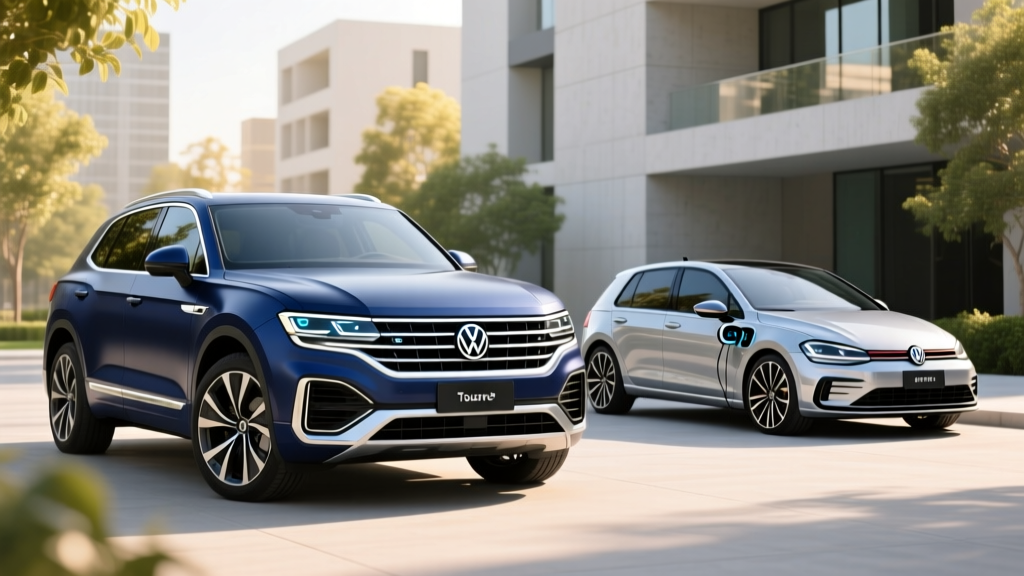
Volkswagen's plug-in hybrid strategy in 2026 centers on two distinct vehicles: the upscale Touareg eHybrid SUV and the sporty Golf GTE hatchback. Both pair turbocharged engines with electric motors and batteries large enough for meaningful daily electric commuting, yet neither abandons the gas engine for longer trips. This guide breaks down exact specs, real-world efficiency, charging logistics, and whether a VW PHEV makes sense versus going full electric or sticking with a conventional hybrid.
HEV vs PHEV: What Volkswagen Actually Sells in 2026
Conventional Hybrid (HEV): Volkswagen discontinued most of its mild-hybrid and full-hybrid offerings in the US market. If you see a VW labeled "e-Hybrid" in older model years, that's a PHEV, not a self-charging hybrid. VW's current US lineup does not include a traditional HEV like a Toyota Prius or Honda Accord Hybrid. The 48-volt mild-hybrid systems on some VW models (labeled eTSI in Europe) are not sold stateside and provide only marginal efficiency gains — they cannot drive on electric power alone.
Plug-In Hybrid (PHEV): Both the Touareg eHybrid and Golf GTE require plug-in charging to access their full electric-only range. You plug them into a Level 2 home charger (or standard 120V outlet) to refill the high-voltage battery. Once the electric range is depleted, the gas engine takes over seamlessly — you never have to plug in if you don't want to, but you'll lose the efficiency and cost benefits.
2026 VW Touareg eHybrid: Full-Size SUV With Electric Commute
| Specification | 2026 Touareg eHybrid |
|---|---|
| Powertrain | 3.0L turbo V6 + electric motor |
| Combined Output | 456 hp / 516 lb-ft torque |
| Battery Capacity | 17.9 kWh (usable) |
| Battery Chemistry | NMC (nickel-manganese-cobalt) |
| EPA Electric-Only Range | ~28 miles |
| MPGe (Electric + Gas) | 56 MPGe combined |
| Gas-Only MPG | 20 city / 24 hwy / 22 combined |
| Total Combined Range | ~480 miles (full tank + full battery) |
| Level 2 Charge Time (10-100%) | ~2.5 hours at 7.2 kW |
| DC Fast Charging | Not supported |
| 0-60 mph | 5.0 seconds |
| Starting MSRP | $63,990 |
| Drivetrain | AWD (4Motion) |
The Touareg eHybrid is VW's most powerful PHEV sold in the US. The 3.0-liter V6 and electric motor combine for genuine performance-SUV acceleration while still delivering roughly 28 miles of electric-only driving. That's enough for most daily commutes under 30 miles round-trip, meaning many owners will burn little to no gasoline on weekdays.
Real-World MPG vs EPA Estimates
The EPA's 56 MPGe figure assumes you're regularly charging and blending electric and gas driving. In practice:
- Daily commuters who charge nightly: Expect 60-80 MPGe equivalent, as most miles are electric. Gas consumption drops to near zero on short commutes.
- Road trips (gas-only): Expect 20-22 MPG combined, matching the EPA gas-only estimate. Highway cruising at 75 mph may drop this to 19-20 MPG.
- Neglecting to charge: If you never plug in, you're carrying 400+ pounds of battery dead weight. Gas-only MPG stays around 20-22 — worse than a conventional V6 SUV of similar size.
The real value of the Touareg eHybrid depends entirely on your charging discipline. Plug in every night and you'll visit gas stations rarely. Ignore the plug and you've paid a premium for a slightly less efficient Touareg.
2026 VW Golf GTE: Hot Hatch With a Plug
| Specification | 2026 Golf GTE |
|---|---|
| Powertrain | 1.5L turbo I-4 + electric motor |
| Combined Output | 245 hp / 295 lb-ft torque |
| Battery Capacity | 15.6 kWh (usable) |
| Battery Chemistry | NMC (nickel-manganese-cobalt) |
| EPA Electric-Only Range | ~35 miles |
| MPGe (Electric + Gas) | 92 MPGe combined |
| Gas-Only MPG | 35 city / 38 hwy / 36 combined |
| Total Combined Range | ~470 miles |
| Level 2 Charge Time (10-100%) | ~2.0 hours at 7.2 kW |
| DC Fast Charging | Not supported |
| 0-60 mph | 6.3 seconds |
| Starting MSRP | $37,500 |
| Drivetrain | FWD |
The Golf GTE returns to the US market for 2026 after a hiatus, and it's a compelling package. With 35 miles of EPA-rated electric range, it covers most daily commuting without the engine ever starting. The 1.5-liter turbo four-cylinder (VW's latest EA211 evo2) is efficient even in gas-only mode, delivering 36 MPG combined — competitive with a Toyota Prius when the battery is depleted.
Real-World MPG vs EPA Estimates
The Golf GTE's real-world efficiency is where PHEVs shine versus EPA stickers:
- City commuting with nightly charging: Most miles are electric. Gas usage drops to 1-2 gallons per week for errands beyond 35 miles. Effective "MPG" exceeds 100 MPGe.
- Highway road trips: Expect 36-40 MPG at steady 65-70 mph speeds. Hybrids often beat EPA highway estimates because the engine runs at optimal RPM and regen assists on rolling terrain.
- Cold weather (below 32°F): Electric range drops 20-30% due to cabin heating demands and reduced battery efficiency. Expect ~25 miles electric instead of 35.
Charging Your VW PHEV: What You Need at Home
Neither VW PHEV supports DC fast charging — this is typical for plug-in hybrids, as their smaller batteries don't justify the cost and weight of DC hardware. All charging happens via AC:
| Charging Level | Power | Touareg eHybrid (10-100%) | Golf GTE (10-100%) | Miles of Range Added/Hour |
|---|---|---|---|---|
| Level 1 (120V household) | 1.4 kW | ~12 hours | ~10 hours | ~3-4 miles |
| Level 2 (240V, 32A) | 7.2 kW | ~2.5 hours | ~2.0 hours | ~14-18 miles |
| DC Fast Charge | N/A | Not supported | Not supported | N/A |
A Level 2 home charger is strongly recommended. With a 240V/32A circuit, both vehicles fully recharge overnight in 2-3 hours. Level 1 (standard 120V) works but takes 10-12 hours — feasible only if you park for extended periods. The onboard charger in both models is capped at 7.2 kW, so installing a 48A or 80A charger provides no additional speed benefit.
Home installation costs: A basic Level 2 charger (ChargePoint Home Flex, Emporia Vue) runs $400-$700 for equipment. Professional electrician installation typically adds $500-$1,500 depending on panel proximity and conduit runs. If your home's electrical panel needs an upgrade to 200A, budget an additional $1,500-$3,000. Consult a licensed electrician for a site-specific quote.
Federal Tax Credit Eligibility for VW PHEVs
Under the IRS §30D Clean Vehicle Credit, plug-in hybrids with batteries of at least 7 kWh can qualify — but eligibility depends on multiple conditions that change frequently:
- MSRP Cap: SUVs (Touareg) must be under $80,000 MSRP; sedans/hatchbacks (Golf GTE) must be under $55,000. The Touareg eHybrid at $63,990 clears the SUV cap. The Golf GTE at $37,500 clears the sedan cap.
- Buyer Income Limits: Modified AGI must not exceed $300,000 (joint), $225,000 (head of household), or $150,000 (single).
- Battery Component Sourcing: A percentage of battery components must be manufactured or assembled in North America, and critical minerals must be sourced from the US or free-trade-agreement partners. These percentages increase annually. VW's PHEV battery supply chains may or may not meet current-year thresholds — verify with your dealer at purchase.
- Point-of-Sale Transfer: You can transfer the credit to the dealer at purchase for an immediate price reduction, rather than claiming it on your tax return.
Bottom line: The Golf GTE has a realistic path to a partial or full credit (up to $7,500) if sourcing requirements are met. The Touareg eHybrid is less likely to qualify fully due to battery sourcing complexities, but may be eligible for a partial $3,750 credit. Always confirm current-year eligibility with your dealer and a tax professional before relying on the credit in your purchase decision. Check the latest rules at IRS.gov.
Reliability, Battery Warranty, and Replacement Costs
Reliability track record: Volkswagen's PHEV systems have proven reasonably durable in European markets where the Golf GTE has been sold since 2015. The NMC battery chemistry degrades predictably — expect roughly 10-15% capacity loss over 8-10 years under normal use. Because PHEV batteries are smaller than full EV batteries, they experience more frequent charge cycles, which can accelerate degradation slightly. However, VW's thermal management system (liquid cooling) mitigates this.
Battery replacement cost: If the high-voltage battery fails outside warranty, expect a replacement cost of $5,000-$8,000 for the Golf GTE and $8,000-$12,000 for the Touareg eHybrid, including parts and labor. These figures are estimates based on current VW parts pricing and may vary by region and model year.
Conventional hybrid comparison: Toyota's hybrid batteries (in the Prius, RAV4 Hybrid) have demonstrated 15-20 year lifespans in many cases, with replacement costs around $2,000-$4,000. VW's PHEV batteries are larger, more complex, and more expensive to replace — a trade-off for the electric-only driving capability.
VW PHEV vs Full EV vs Gas Car: Which Fits You?
Choose the VW Golf GTE PHEV if:
- Your daily commute is under 35 miles round-trip and you can charge at home
- You take 4+ road trips per year exceeding 200 miles and don't want to plan around charging stations
- You want electric commuting without committing to a full EV's range limitations
- You live in an area with limited public DC fast-charging infrastructure
Choose the VW Touareg eHybrid PHEV if:
- You need a three-row-adjacent luxury SUV with towing capability (7,700 lbs) and AWD
- You want performance (456 hp, 5.0s 0-60) with daily electric efficiency
- You can charge at home and your daily driving is under 28 miles
- You're not ready to trust a full-electric SUV for family road trips
Choose a full EV (like the VW ID.4 or Tesla Model Y) if:
- You can install a Level 2 home charger and your daily driving is under 200 miles
- You want zero maintenance on the powertrain (no oil changes, no gas engine)
- You want the lowest per-mile fuel cost and access to HOV lanes in many states
- You're comfortable planning road trips around DC fast-charging stops
Choose a conventional gas car if:
- You cannot charge at home (no garage, no driveway, apartment without charging)
- Your budget is under $30,000 and you need the lowest upfront cost
- You drive over 30,000 miles per year and want simplicity
Golf GTE Pros
- 35 miles electric covers most commutes
- 36 MPG gas-only when battery is depleted
- Fun to drive — 245 hp in a compact hatch
- Lower MSRP, more likely to qualify for tax credit
- Practical hatchback cargo space
Golf GTE Cons
- No DC fast charging
- FWD only — less capable in snow vs AWD competitors
- PHEV premium over gas Golf (~$7,000 more)
- Smaller cargo area than ID.4 or RAV4
- Electric range drops significantly in cold weather
Touareg eHybrid Pros
- 456 hp — genuine performance SUV
- 7,700-lb towing capacity (rare for PHEVs)
- Luxury interior with premium materials
- AWD standard
- 28 miles electric reduces daily fuel cost
Touareg eHybrid Cons
- $64K starting price — expensive entry point
- Tax credit eligibility uncertain due to sourcing
- Only 22 MPG combined on gas alone (heavy vehicle)
- Limited VW dealer network vs Toyota/Ford
- No third-row seating despite large footprint
Frequently Asked Questions
How many MPG does the VW Golf GTE get?
The EPA rates the 2026 Golf GTE at 35 city / 38 highway / 36 combined MPG when running on gasoline alone. When blending electric and gas driving (with regular charging), it achieves 92 MPGe combined. Real-world city driving often exceeds the EPA estimate by 2-4 MPG because regenerative braking is most effective in stop-and-go traffic.
How far can the VW Touareg eHybrid go on electric only?
The EPA rates the Touareg eHybrid at approximately 28 miles of electric-only range. In mild weather with gentle acceleration, expect 30-32 miles. In cold weather or at highway speeds, expect 20-24 miles. Once the battery depletes, the V6 engine takes over seamlessly and delivers 22 MPG combined.
Does the VW Golf GTE qualify for the $7,500 federal tax credit?
It may qualify for up to $7,500 under IRS §30D rules, but eligibility depends on battery component sourcing, critical mineral requirements, your income level, and the vehicle's MSRP (which at $37,500 clears the $55,000 sedan cap). These sourcing rules tighten annually. Confirm current eligibility with your VW dealer and review the latest guidance at IRS.gov before finalizing your purchase.
Is the VW PHEV battery reliable and what does replacement cost?
VW covers the high-voltage battery for 8 years / 100,000 miles, warranting it against defects and capacity loss below 70%. Real-world degradation data from European Golf GTE owners suggests 10-15% capacity loss over 8-10 years. Out-of-warranty replacement costs range from $5,000-$8,000 (Golf GTE) to $8,000-$12,000 (Touareg eHybrid).
Can I charge a VW PHEV at a DC fast charger?
No. Neither the Golf GTE nor the Touareg eHybrid supports DC fast charging. Both use a standard J1772 connector for AC Level 1 (120V) and Level 2 (240V) charging. The onboard charger is limited to 7.2 kW, so a full charge takes about 2-2.5 hours on Level 2.
Hybrid vs PHEV vs EV — which VW should I buy?
VW doesn't sell a conventional hybrid (HEV) in the US — your choice is between a PHEV (Golf GTE or Touareg eHybrid) or a full EV (ID.4). If you can charge at home and want electric commuting without range anxiety on road trips, the PHEV is ideal. If you want the lowest operating costs, zero powertrain maintenance, and don't mind planning road-trip charging stops, the ID.4 or another full EV is the better long-term bet. If you cannot charge at home, a PHEV's benefits diminish significantly — consider a conventional hybrid from Toyota or Honda instead.
What happens if I never plug in the VW PHEV?
The car functions normally as a conventional hybrid, but you'll get worse fuel economy than EPA gas-only estimates because you're carrying battery weight you never use. The Golf GTE will still return ~33-36 MPG on gas alone, but you've paid a $7,000 PHEV premium for electric capability you're not accessing. PHEVs only make financial sense with regular plug-in charging.
Sources: EPA fuel economy data via fueleconomy.gov, Volkswagen of America official specifications, IRS §30D Clean Vehicle Credit guidelines at IRS.gov. All specifications reflect 2026 model year data available at time of publication. Tax credit eligibility rules are subject to change — verify current requirements before purchase.