Is a VW Hybrid SUV the Right Move in 2026?
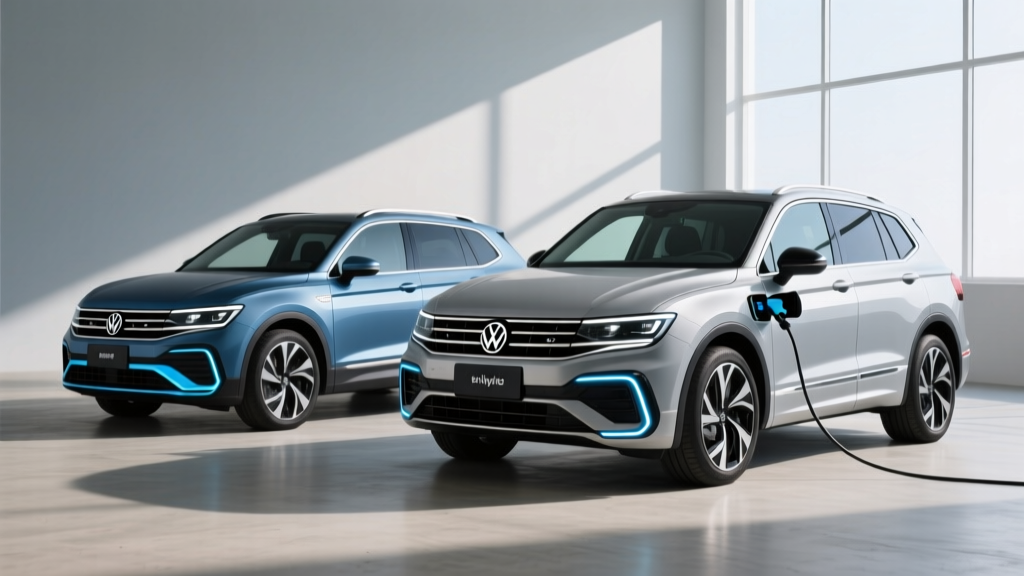
Volkswagen has committed heavily to full battery-electric vehicles with its ID.4 and upcoming ID. models, but for buyers who aren't ready to abandon the gas pump entirely, the 2026 VW hybrid SUV lineup — anchored by the Tiguan plug-in hybrid (PHEV) and the larger Touareg PHEV — offers a pragmatic bridge. You get meaningful electric-only commuting range, strong combined fuel economy once the battery depletes, and zero range anxiety on road trips.
This guide breaks down every current VW hybrid SUV available in the U.S. market for the 2026 model year, with exact EPA figures, battery specs, real-world MPG expectations, pricing, and whether any of them qualify for federal tax credits under current IRS §30D rules.
HEV vs. PHEV: What VW Actually Offers
Before diving into specs, it's critical to understand the distinction, because Volkswagen does not sell a conventional hybrid (HEV) SUV in the United States for 2026. Every VW hybrid SUV available stateside is a plug-in hybrid (PHEV).
Conventional Hybrid (HEV)
- Small battery (~1–2 kWh), recharged by regenerative braking and the engine
- Never plugs in — no charging cable or outlet needed
- Electric motor assists the gas engine; electric-only driving is limited to very low speeds
- Example: Toyota RAV4 Hybrid
Plug-In Hybrid (PHEV)
- Larger battery (~13–25 kWh), rechargeable via plug (Level 1 or Level 2)
- Delivers 20–50+ miles of electric-only range before the gas engine engages
- Functions as a conventional hybrid after battery depletion
- Example: 2026 VW Tiguan eHybrid
If you see references to a "VW hybrid SUV" that doesn't plug in, those are typically European-market mild-hybrid (MHEV) variants not sold in the U.S. For American buyers, VW's hybrid SUV strategy is plug-in only.
2026 VW Tiguan eHybrid: Specs, Range & MPG
The redesigned Tiguan arrived for the 2025 model year on Volkswagen's MQB Evo platform, and the eHybrid plug-in variant carries into 2026 with a substantially larger battery than its predecessor. Here are the numbers that matter.
| Specification | 2026 VW Tiguan eHybrid |
|---|---|
| Powertrain | 1.5L turbo I-4 + electric motor (PHEV) |
| Combined Horsepower | 245 hp |
| Combined Torque | 295 lb-ft |
| Battery (Gross / Usable) | 19.7 kWh / ~17.5 kWh (NMC lithium-ion) |
| EPA Electric-Only Range | ~38 miles |
| EPA Combined MPGe (Electric + Gas) | ~80 MPGe |
| EPA MPG (Gas Only, Battery Depleted) | 35 city / 38 hwy / 36 combined |
| Total Combined Range | ~440 miles |
| Level 2 Charging (0–100%) | ~2 hours 45 minutes (7.2 kW onboard charger) |
| DC Fast Charging | Not available |
| 0–60 mph | ~6.8 seconds |
| Drivetrain | FWD (6-speed DSG automatic) |
| Cargo Volume (rear seats up) | 33.5 cu ft |
| Base MSRP (SE R-Line eHybrid) | $40,990 |
Real-World Range vs. EPA Sticker
EPA electric range: ~38 miles. In real-world mixed driving (55–70 mph, moderate climate), expect 32–36 miles on a full charge. In cold weather (below 35°F), that figure drops to roughly 25–30 miles due to reduced battery efficiency and cabin heating demands. Once the battery is depleted, the Tiguan eHybrid operates as a conventional hybrid and delivers close to its EPA-rated 36 MPG combined — though aggressive highway driving at 80+ mph can pull that down to 32–33 MPG.
2026 VW Touareg PHEV: The Premium Alternative
For buyers who need more space, towing capability, and a luxury-tier interior, the Touareg plug-in hybrid (badged as the Touareg eHybrid or Touareg PHEV depending on market) continues into 2026. It's a significantly more expensive proposition but offers more power and standard all-wheel drive.
| Specification | 2026 VW Touareg eHybrid |
|---|---|
| Powertrain | 3.0L turbo V6 + electric motor (PHEV) |
| Combined Horsepower | 375 hp |
| Combined Torque | 516 lb-ft |
| Battery (Gross / Usable) | 17.9 kWh / ~14.8 kWh (NMC lithium-ion) |
| EPA Electric-Only Range | ~28 miles |
| EPA MPG (Gas Only, Battery Depleted) | 22 city / 26 hwy / 24 combined |
| Level 2 Charging (0–100%) | ~2 hours 30 minutes (7.2 kW onboard charger) |
| DC Fast Charging | Not available |
| 0–60 mph | ~5.5 seconds |
| Drivetrain | AWD (4MOTION, 8-speed automatic) |
| Towing Capacity | 7,700 lbs |
| Base MSRP | $61,990 |
The Touareg PHEV trades electric range for brute force. With 516 lb-ft of torque and 7,700-lb towing capacity, it's the choice for boat owners and trailer haulers who still want some electric commuting capability. The smaller usable battery relative to the Tiguan eHybrid means shorter electric-only range, but the V6 PHEV powertrain is genuinely quick.
How Many MPG Does the VW Hybrid SUV Get?
This is the question most shoppers search for. Here's the consolidated fuel economy breakdown, sourced from fueleconomy.gov EPA data:
| Model | City MPG | Highway MPG | Combined MPG | Combined MPGe |
|---|---|---|---|---|
| 2026 Tiguan eHybrid (gas mode) | 35 | 38 | 36 | 80 MPGe |
| 2026 Touareg eHybrid (gas mode) | 22 | 26 | 24 | 50 MPGe |
Real-world MPG note: Plug-in hybrids often exceed their EPA city rating in stop-and-go traffic because regenerative braking recaptures more energy at low speeds. Tiguan eHybrid owners who charge nightly and drive primarily in urban environments report gas-mode city figures of 37–40 MPG. Highway cruising at 75+ mph is where efficiency dips — expect 33–35 MPG for the Tiguan and 22–24 MPG for the heavier Touareg.
If you charge daily and your commute falls within the electric-only range (under 38 miles for the Tiguan, under 28 for the Touareg), you may go weeks without visiting a gas station. The engine will still start periodically for maintenance cycles, but your fuel consumption approaches zero on short, electrified commutes.
Battery Warranty, Reliability & Replacement Cost
VW PHEV Battery Warranty
Volkswagen covers the high-voltage hybrid battery in both the Tiguan eHybrid and Touareg eHybrid for 8 years or 100,000 miles (whichever comes first), with a capacity retention threshold of 70%. In California and states that follow CARB emissions standards, that warranty extends to 10 years or 150,000 miles.
Hybrid battery reliability has improved dramatically over the past decade. The NMC (nickel manganese cobalt) chemistry used in VW's PHEV batteries is well-proven, and the relatively small battery size (compared to a full EV's 75–100+ kWh pack) means less thermal stress and slower degradation. VW's thermal management system actively cools and heats the battery to keep it in its optimal operating window.
Replacement cost: If the high-voltage battery fails outside of warranty, expect a replacement cost between $5,000 and $8,000 for the Tiguan eHybrid and $6,500 to $10,000 for the Touareg, including parts and labor at a VW dealer. However, out-of-warranty failures on modern PHEV batteries remain uncommon — most data suggests 10–15+ year lifespans with gradual capacity loss rather than catastrophic failure.
The 12V auxiliary battery (which powers electronics and starts the system) is a separate component and follows standard replacement intervals of 4–6 years, typically costing $200–$350.
Pricing & Tax Credit Eligibility
Here's where the math gets nuanced. The federal IRS §30D clean vehicle credit offers up to $7,500 for qualifying new plug-in hybrids, but eligibility hinges on multiple requirements that change frequently:
- MSRP cap: SUVs must have an MSRP at or below $80,000 (both VW PHEVs qualify)
- Buyer income cap: AGI must not exceed $150,000 (single), $225,000 (head of household), or $300,000 (joint)
- Battery component sourcing: A percentage of battery components must be manufactured or assembled in North America (threshold increases annually)
- Critical minerals: A percentage of critical minerals must be sourced from the U.S. or FTA partners
- Point-of-sale transfer: Eligible buyers can transfer the credit to the dealer at purchase for an immediate price reduction
For 2026: The Tiguan eHybrid's eligibility for the full $7,500 credit depends on whether VW's battery sourcing meets the 2026 critical-mineral and component thresholds. Many VW PHEVs assembled in Europe have faced partial or zero credit eligibility in recent years due to battery-sourcing rules. Always verify current eligibility on the fueleconomy.gov tax credit lookup tool before purchasing, and consult a tax professional for your specific situation.
If the Tiguan eHybrid qualifies for even a partial credit (say $3,750), the effective price drops from $40,990 to roughly $37,240 — a compelling number for a compact PHEV SUV with 38 miles of electric range.
The Touareg eHybrid, at $61,990, clears the $80,000 MSRP cap, but its European-sourced battery has historically limited its credit eligibility. Check the latest IRS guidance before counting on the incentive.
VW Hybrid SUV vs. Full EV vs. Gas: Which Fits You?
Choose the VW Tiguan eHybrid PHEV if:
- Your daily commute is under 35 miles round-trip and you can charge at home (Level 1 or 2)
- You take road trips where charging infrastructure is sparse or unreliable
- You want EV-like commuting without committing to a full BEV
- You need an SUV with cargo versatility and available AWD alternatives in the segment
Choose a full EV (like the VW ID.4) if:
- You have reliable home Level 2 charging
- Your daily driving is under 200 miles and you rarely exceed 300 miles between stops
- You want to eliminate oil changes, gas station visits, and exhaust-system maintenance entirely
- You qualify for the full $7,500 federal credit (ID.4 is U.S.-assembled and generally qualifies)
Choose a conventional gas SUV if:
- You cannot charge at home or at work (apartment/condo without EV infrastructure)
- Your budget is strictly under $30,000
- You drive very high annual miles (20,000+) on highways where hybrid advantages diminish
Tiguan eHybrid Pros
- 38 miles electric range covers most commutes
- 36 MPG combined in gas mode beats most compact SUVs
- Strong 245 hp combined output
- Redesigned interior with modern infotainment
- No range anxiety on road trips
Tiguan eHybrid Cons
- FWD only (no AWD option on eHybrid trim)
- No DC fast charging — Level 2 only
- Premium over gas Tiguan (~$8,000+ more)
- Tax credit eligibility uncertain due to sourcing rules
- Cargo space slightly reduced vs. gas Tiguan
Charging the VW PHEV at Home: What You Need
Neither VW PHEV supports DC fast charging. This is standard for most plug-in hybrids — the smaller battery doesn't justify the added cost and weight of DC fast-charge hardware. Here's what charging looks like in practice:
| Charging Level | Power | Time (0–100%) | Use Case |
|---|---|---|---|
| Level 1 (120V household outlet) | ~1.4 kW | ~12–14 hours (Tiguan) | Overnight top-up if no Level 2 available |
| Level 2 (240V, 32A) | 7.2 kW | ~2 hours 45 min (Tiguan) | Recommended daily charging setup |
| DC Fast Charge | N/A | Not supported | N/A |
For most PHEV owners, a standard 120V outlet is actually sufficient. Plug in when you get home, and 12+ hours overnight easily refills the ~17.5 kWh usable battery. A Level 2 home charger (typically $500–$1,200 installed for a basic setup) is a luxury for PHEVs, not a necessity — unlike full EVs where Level 2 is essentially mandatory.
Important kW vs. kWh distinction: The Tiguan's 7.2 kW onboard charger refers to the maximum power it can accept (rate of charging). The battery holds 19.7 kWh of energy (total capacity). Think of kW as the speed of water flowing through a hose and kWh as the size of the bucket.
Frequently Asked Questions
Does VW make a conventional hybrid SUV that doesn't plug in?
Not in the U.S. market. Volkswagen's hybrid SUV offerings stateside are exclusively plug-in hybrids (PHEVs). If you want a conventional hybrid SUV that never plugs in, you'll need to look at competitors like the Toyota RAV4 Hybrid, Honda CR-V Hybrid, or Hyundai Tucson Hybrid.
How far can the VW Tiguan eHybrid drive on electric only?
The EPA rates the 2026 Tiguan eHybrid at approximately 38 miles of electric-only range. In real-world driving, expect 32–36 miles in moderate temperatures and 25–30 miles in cold weather (below 35°F). Highway speeds above 70 mph will also reduce electric range.
Does the VW hybrid SUV qualify for the $7,500 federal tax credit?
Eligibility is not guaranteed. Under current IRS §30D rules, the vehicle must meet battery component sourcing and critical mineral requirements, the buyer must fall under income caps, and the MSRP must be under $80,000 for SUVs. VW's European-built PHEV batteries have faced sourcing challenges. Verify current eligibility at fueleconomy.gov and consult a tax professional before relying on the credit.
What happens when the PHEV battery runs out of charge?
The gas engine seamlessly takes over, and the vehicle operates as a conventional hybrid — similar to a Toyota Prius. You'll get the EPA-rated 36 MPG combined (Tiguan) without needing to plug in. The transition is nearly imperceptible; most drivers notice only a subtle engine start.
How long will the VW hybrid battery last?
VW warranties the high-voltage PHEV battery for 8 years/100,000 miles (10 years/150,000 miles in CARB states) with a 70% capacity retention guarantee. Industry data on modern NMC PHEV batteries suggests 10–15+ year lifespans with gradual degradation. Out-of-warranty replacement costs $5,000–$8,000 for the Tiguan.
Is the VW Tiguan eHybrid available with all-wheel drive?
No. The 2026 Tiguan eHybrid is front-wheel drive only. If AWD is essential, you'll need to choose either the gas-powered Tiguan 4MOTION or look at the Touareg eHybrid (standard AWD but significantly more expensive). Alternatively, the Toyota RAV4 Prime PHEV offers AWD with 42 miles of electric range.
How does the VW hybrid SUV compare to the Toyota RAV4 Prime?
The RAV4 Prime offers 42 miles of electric range, standard AWD, 302 combined hp, and a lower starting MSRP (~$44,500). It also has a stronger track record for federal tax credit eligibility. The Tiguan eHybrid counters with a more refined interior, slightly better gas-mode fuel economy (36 vs. 38 combined MPG is comparable), and VW's driving dynamics. The RAV4 Prime remains the segment benchmark, but the Tiguan eHybrid is a credible alternative for VW loyalists.