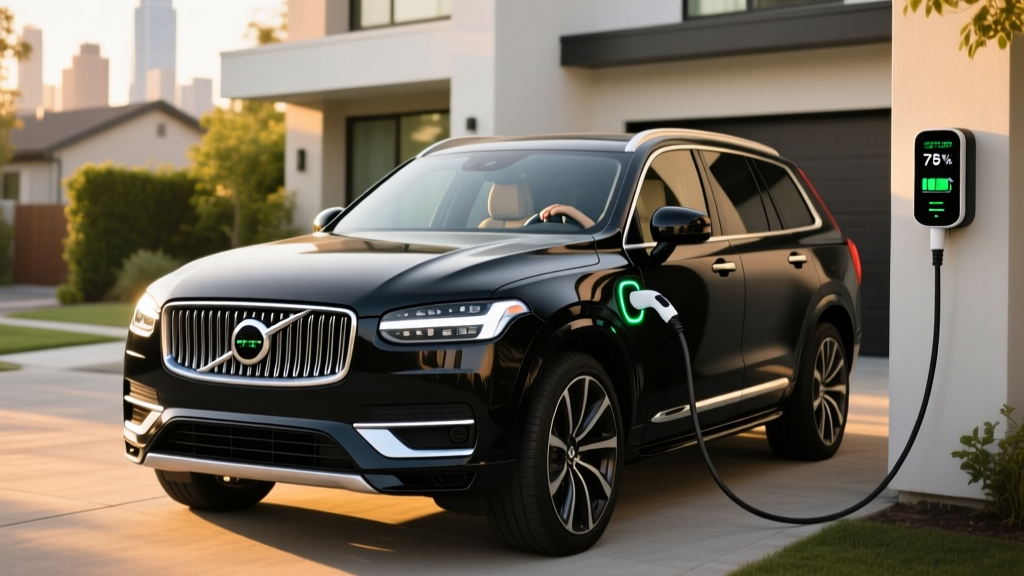
The Volvo XC90 has been a staple of the luxury three-row SUV segment for two decades, but for buyers who want electric driving without range anxiety, the Volvo XC90 plug-in hybrid (now wearing the Recharge T8 badge) is the version that demands attention. It pairs a turbocharged and supercharged four-cylinder engine with a rear-axle electric motor and an 18.8 kWh battery pack, delivering 455 combined horsepower and roughly 35 miles of electric-only range.
For 2026, Volvo continues to refine the XC90 Recharge with updated infotainment running Google built-in, an exterior refresh first introduced for 2025, and the same proven eAWD powertrain. If you're weighing this PHEV against a full battery-electric SUV like the BMW iX or a conventional hybrid like the Toyota Grand Highlander Hybrid, this guide gives you the exact numbers you need to decide.
Volvo XC90 Plug-In Hybrid: Core Specifications at a Glance
| Specification | Value |
|---|---|
| Combined Horsepower | 455 hp / 523 lb-ft torque |
| Engine | 2.0L turbo + supercharged I-4 (312 hp) + rear electric motor (143 hp) |
| Battery (usable) | 18.8 kWh, NMC lithium-ion |
| EPA Electric-Only Range | 35 miles |
| Total Combined Range | ~430 miles (electric + gas) |
| MPGe (electric + gas) | 58 MPGe combined |
| Gas-Only MPG (charge-sustaining) | 27 city / 28 hwy / 27 combined |
| 0–60 mph | 4.5 seconds |
| Level 2 Charging (onboard) | 3.7 kW (approx. 5 hours 0–100%) |
| DC Fast Charging | Not available |
| Drivetrain | eAWD (engine drives front wheels, motor drives rear) |
| Seating | 6 or 7 passengers |
| Starting MSRP | $78,695 (Core trim, plus $1,195 destination) |
| Battery/Powertrain Warranty | 8 years / 100,000 miles (hybrid components) |
HEV vs PHEV vs Full EV: Where Does the XC90 Recharge Fit?
Before we get into real-world efficiency, it's critical to understand the distinction between the three electrification levels available in this class:
- Conventional Hybrid (HEV): A small battery recharged only by regenerative braking and the engine. You never plug it in. Example: Toyota Grand Highlander Hybrid (36 MPG combined, no electric-only range).
- Plug-In Hybrid (PHEV): A larger battery you can plug in to charge, giving you a meaningful electric-only range (typically 20–45 miles) before the gas engine takes over. Example: Volvo XC90 plug-in hybrid (35 miles EV, then 27 MPG gas).
- Battery Electric (BEV): No gas engine at all — runs entirely on a large battery (typically 75–120 kWh). Example: BMW iX xDrive50 (324-mile EPA range, 0 MPG, MPGe only).
The XC90 Recharge is squarely a PHEV. If you can charge at home nightly and your daily commute is under 35 miles round-trip, you may go weeks without burning a drop of gasoline. On longer road trips, the gas engine seamlessly takes over — no charging stops required. This is the core value proposition: EV-like daily driving with the safety net of a 15.9-gallon fuel tank.
Fuel Economy: EPA Numbers vs Real-World MPG
| Mode | City | Highway | Combined |
|---|---|---|---|
| Charge-Sustaining (gas only, battery depleted) | 27 MPG | 28 MPG | 27 MPG |
| Blended (electric + gas, full charge start) | 58 MPGe combined | ||
The EPA rates the XC90 Recharge at 27 MPG combined once the battery is depleted and the vehicle operates as a conventional hybrid. According to fueleconomy.gov, that splits to 27 city and 28 highway — respectable for a 5,100-pound luxury SUV.
In real-world driving, PHEV fuel economy is entirely dependent on your charging habits. Owners who plug in every night and drive less than 35 miles daily report averaging 80–120 MPGe equivalent over thousands of miles because the gas engine rarely engages. Conversely, owners who never plug in effectively own a heavy, somewhat less efficient conventional hybrid — expect 24–26 MPG in mixed driving, slightly below the EPA sticker, because the vehicle carries the weight of a battery it never uses.
Real-World Range Note: The EPA's 35-mile electric range assumes moderate temperatures and mixed driving. In cold weather (below 32°F), expect that to drop to roughly 25–28 miles due to battery resistance and cabin heating demands. At sustained highway speeds (75+ mph), electric range also decreases to approximately 28–30 miles. In ideal spring/fall conditions with city driving, some owners report 38–40 miles before the engine engages.
Charging: What You Need to Know About Plugging In
The XC90 Recharge uses a standard J1772 connector for Level 1 and Level 2 AC charging. Here's what to expect:
| Level | Power | Time (0–100%) | Miles of Range per Hour |
|---|---|---|---|
| Level 1 (120V household outlet) | ~1.4 kW | ~13 hours | ~3 miles/hr |
| Level 2 (240V home charger) | 3.7 kW (vehicle-limited) | ~5 hours | ~7 miles/hr |
| DC Fast Charging | N/A — not supported | — | — |
The XC90 Recharge's onboard charger is capped at 3.7 kW. Even if you connect it to a 48-amp Level 2 home charger capable of delivering 11.5 kW, the vehicle will only accept 3.7 kW. This means a full charge takes about 5 hours on Level 2 — perfectly fine for overnight charging, but it means you can't quickly "top up" at a public charger during a lunch stop.
No DC fast charging is available on the XC90 Recharge. This is typical for PHEVs — the relatively small battery doesn't justify the cost and weight of DC fast-charge hardware. For the target use case (charge overnight at home, drive electric all day), this isn't a meaningful limitation.
Home charging setup: A standard 120V outlet (Level 1) will fully recharge the battery in about 13 hours, which works if you park for extended periods. For the best experience, a 240V Level 2 home charger is recommended. Expect to pay $500–$1,500 for a quality Level 2 unit (ChargePoint Home Flex, Emporia Level 2, or similar) plus $500–$2,000 for professional electrician installation, depending on your panel capacity and run length.
Performance and Powertrain: 455 Horsepower in a Family Hauler
The XC90 Recharge T8 powertrain is one of the most potent in the three-row luxury PHEV segment. Here's the breakdown:
- Front axle: 2.0-liter four-cylinder engine, both turbocharged and supercharged, producing 312 hp and 295 lb-ft of torque, mated to an 8-speed automatic transmission.
- Rear axle: Permanent-magnet electric motor producing 143 hp and 228 lb-ft, directly driving the rear wheels.
- Combined output: 455 hp and 523 lb-ft of torque.
The result is a 0–60 mph time of 4.5 seconds — genuinely quick for a vehicle that weighs over 5,100 pounds and seats up to seven. The eAWD system provides confident all-weather traction, with the electric rear axle enabling torque-vectoring-style behavior in corners.
In everyday driving, the XC90 Recharge defaults to Pure mode (electric-only) for quiet, zero-emission operation up to about 80 mph. Switch to Hybrid mode and the system intelligently blends electric and gas power for maximum efficiency. Power mode unleashes the full 455 hp for aggressive acceleration and highway merging.
Pricing, Trims, and Federal Tax Credit Eligibility
The 2026 Volvo XC90 Recharge is offered in three trim levels:
- Core: $78,695 (plus $1,195 destination) — includes panoramic roof, Google built-in navigation, 12.3-inch driver display, 9-inch center touchscreen, Pilot Assist (Level 2 ADAS), heated front seats, power tailgate.
- Plus: ~$83,000 — adds head-up display, 360-degree camera, Harman Kardon audio, ventilated front seats, heated rear seats, heated steering wheel.
- Ultra: ~$87,000 — adds Bowers & Wilkins premium audio, Nappa leather, air suspension, rear-window sunshades, advanced cabin air purification.
Federal Tax Credit: Does the XC90 Recharge Qualify?
Under IRS §30D Clean Vehicle Credit rules for 2026, PHEV eligibility requires meeting all of the following:
- Battery capacity: ≥ 7 kWh (XC90 Recharge's 18.8 kWh pack qualifies ✓)
- GVWR: Under 14,000 lbs (XC90 qualifies ✓)
- MSRP cap: SUVs must be ≤ $80,000 — the XC90 Core trim at $78,695 qualifies, but Plus and Ultra trims exceed the cap ✗
- Buyer income cap: AGI ≤ $150,000 (single) / $225,000 (head of household) / $300,000 (joint)
- Critical minerals & battery component sourcing: Must meet phased-in percentages that tighten annually; Volvo's supply chain compliance varies by production batch
- Final assembly: Must occur in North America — the XC90 is assembled in Gothenburg, Sweden, which disqualifies it from the federal credit ✗
Bottom line on tax credits: The 2026 Volvo XC90 plug-in hybrid does not qualify for the $7,500 federal §30D tax credit because it is assembled outside North America. Some states offer separate incentives for PHEVs regardless of assembly location — check your state's energy office or AFDC state incentive database for local programs. A qualified tax professional can advise on your specific situation.
Battery Longevity, Warranty, and Replacement Costs
Volvo Hybrid Battery Warranty: The high-voltage battery and all hybrid-specific powertrain components (electric motor, power electronics, onboard charger) are covered for 8 years or 100,000 miles, whichever comes first. California-emissions states extend this to 10 years or 150,000 miles for certain components. The warranty guarantees the battery will retain at least 70% of its original capacity during the coverage period.
NMC (nickel-manganese-cobalt) batteries in PHEVs like the XC90 Recharge typically experience moderate degradation over time. Because the battery is relatively small (18.8 kWh) and is cycled more frequently than a large BEV battery, expect approximately 10–15% capacity loss over the first 8–10 years under normal use. That translates to electric-only range dropping from 35 miles to roughly 30–32 miles over that period — still functional for most daily commutes.
Battery replacement cost: If the high-voltage battery requires replacement out of warranty, expect a cost in the range of $8,000–$12,000 (parts and labor) based on current Volvo dealer pricing for T8 Recharge battery modules. However, outright battery failure within the first decade is rare; most degradation is gradual and linear.
To maximize battery lifespan, Volvo's software manages charge limits and thermal conditioning automatically. Avoid leaving the vehicle at 100% state of charge for extended periods in hot weather, and use the built-in charge scheduling feature to time charging completion close to your departure time.
Reliability and Safety
The XC90 platform has been in production since 2015 (with a major refresh for 2025), giving Volvo extensive real-world data on the T8 powertrain. Owner-reported reliability for the Recharge variant is generally solid, with most complaints centering on infotainment software quirks rather than powertrain issues. The hybrid system itself — engine, motor, and battery — has proven durable across Volvo's Recharge lineup (XC60, S60, V60, and XC90).
The IIHS has historically rated the XC90 as a Top Safety Pick, and the refreshed model continues that tradition with strong crash-test performance. Standard Pilot Assist provides Level 2 driver assistance (adaptive cruise + lane centering), but the driver must remain fully engaged — this is not a hands-off or self-driving system.
Pros
- 35-mile electric range covers most daily commutes gas-free
- 455 hp delivers genuinely quick acceleration (4.5s to 60)
- Three-row seating for 6–7 passengers in a luxury cabin
- No range anxiety — gas engine provides 430+ total miles
- Standard eAWD for confident all-weather traction
- Google built-in with native Google Maps, Assistant, and Play Store
Cons
- Does not qualify for $7,500 federal tax credit (assembled in Sweden)
- 3.7 kW onboard charger limits Level 2 speed — no DC fast charging
- Core trim MSRP near $80K cap; upper trims are expensive
- Gas-only MPG (27 combined) is merely average for the class
- Cargo space slightly reduced vs non-hybrid XC90 due to battery placement
- Competitors like BMW X5 xDrive50e offer similar PHEV range at lower starting prices
Who Should Buy the Volvo XC90 Plug-In Hybrid?
Choose the XC90 Recharge PHEV if:
- You can charge at home (Level 2 preferred) and your daily round-trip commute is under 35 miles.
- You need three rows of seating but want to minimize fuel consumption on school runs and local errands.
- You take regular road trips where a full EV's charging logistics would be inconvenient.
- You value Scandinavian design, safety credentials, and a premium cabin.
Choose a full EV (like the BMW iX or Rivian R1S) if:
- You have reliable home charging and rarely drive more than 250 miles in a single day.
- You want zero tailpipe emissions and lower per-mile fuel costs long-term.
- You want to avoid all engine maintenance (oil changes, spark plugs, transmission fluid).
Choose a conventional hybrid (like the Toyota Grand Highlander Hybrid) if:
- You cannot charge at home or at work — a conventional hybrid requires no plug-in infrastructure.
- Your budget is under $55,000 and you prioritize value over luxury.
- You want simpler long-term ownership with no high-voltage battery concerns.
Frequently Asked Questions
How many MPG does the Volvo XC90 plug-in hybrid get?
The EPA rates the XC90 Recharge at 27 MPG combined (27 city / 28 highway) in charge-sustaining mode (battery depleted, running on gas). When starting with a full charge, it achieves 58 MPGe combined. Real-world MPG varies dramatically based on how often you plug in — daily chargers may burn almost no gas, while those who never charge will see 24–26 MPG in mixed driving.
How far can the XC90 Recharge go on electric only?
The EPA rates it at 35 miles of electric-only range. In real-world conditions, expect 28–30 miles at highway speeds and 25–28 miles in cold weather (below 32°F). In mild temperatures with city driving, some owners achieve 38–40 miles before the engine engages.
Does the Volvo XC90 plug-in hybrid qualify for a tax credit?
No. The XC90 Recharge is assembled in Gothenburg, Sweden, which disqualifies it from the federal §30D Clean Vehicle Credit regardless of trim or buyer income. Some states offer separate PHEV incentives that don't require North American assembly — check your state's programs.
Is the XC90 Recharge reliable, and what does battery replacement cost?
The T8 eAWD powertrain has proven reliable since its 2016 introduction, with most issues relating to software rather than mechanical components. The high-voltage battery is warrantied for 8 years/100,000 miles (10 years/150,000 miles in CARB states). Out-of-warranty battery replacement runs approximately $8,000–$12,000, but full battery failure within the first decade is uncommon.
Can the XC90 plug-in hybrid DC fast charge?
No. The XC90 Recharge only supports AC charging via a J1772 connector at up to 3.7 kW (Level 2). A full charge on Level 2 takes approximately 5 hours. This is standard for PHEVs — the small battery makes DC fast charging unnecessary for the intended overnight-charging use case.
How does the XC90 Recharge compare to the BMW X5 xDrive50e?
The BMW X5 xDrive50e is the closest competitor, offering a similar ~38-mile electric range, 483 combined hp, and a starting MSRP roughly $10,000 less than the XC90 Core. However, the X5 only seats five (no third row), while the XC90 offers three-row seating. If you need three rows in a luxury PHEV, the XC90 Recharge has few direct rivals. The Lincoln Aviator Grand Touring is another three-row PHEV option, though it trails on electric range (about 21 miles).