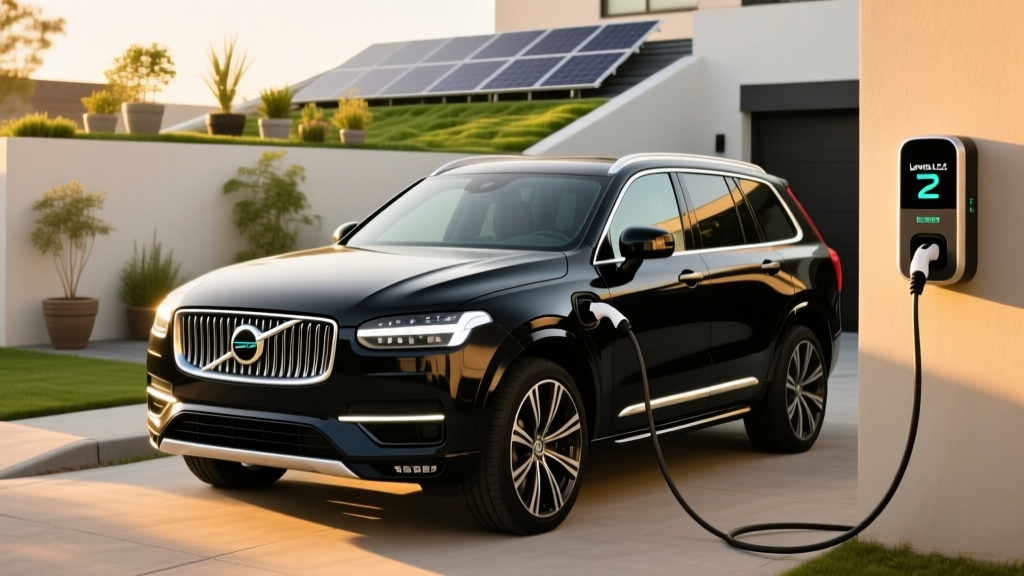
The three-row luxury SUV segment is crowded with electrified options, but the Volvo plug-in hybrid XC90 — officially the XC90 Recharge — occupies a specific niche: families who want electric commuting during the week and gas-powered road-trip flexibility on weekends, without committing to a full battery-electric vehicle. For 2026, Volvo continues to refine the Recharge powertrain with a larger battery and more electric range than earlier model years, making it one of the more practical PHEVs in its class.
This guide breaks down the exact numbers — EPA range, MPGe, battery capacity, charging times, horsepower, MSRP by trim, and federal tax credit eligibility — so you can decide whether the XC90 Recharge fits your driving pattern or whether a conventional hybrid or full EV makes more sense.
HEV vs. PHEV: What the XC90 Recharge Actually Is
Before diving into specs, it's worth clarifying the terminology, because Volvo sells multiple electrified powertrains and the naming can confuse buyers.
| Feature | Conventional Hybrid (HEV) | Plug-In Hybrid (PHEV) — XC90 Recharge | Full EV (BEV) — e.g., EX90 |
|---|---|---|---|
| Plugs in to charge? | No — charges via regen & engine | Yes — Level 1 or Level 2 | Yes — Level 1, 2, or DC fast |
| Electric-only range | ~1 mile or less at low speed | ~32 miles EPA | 300+ miles EPA |
| Battery size | ~1-2 kWh | 18.8 kWh (usable ~14.9 kWh) | 77-111 kWh typical |
| Gas engine? | Yes | Yes (2.0L turbo+supercharged) | No |
| Tailpipe emissions | Reduced vs. gas-only | Zero on electric; gas when engine runs | Zero at tailpipe |
The XC90 Recharge is a PHEV, not a conventional hybrid. That means you can plug it in to gain meaningful electric-only driving range. If you never plug it in, it still functions as a hybrid — the engine and regenerative braking keep the battery charged — but you'll sacrifice most of the efficiency advantage and effectively drive a heavier, more expensive conventional hybrid.
Powertrain Specs: 455 Horsepower from a 2.0L and Two Electric Motors
The 2026 XC90 Recharge uses Volvo's T8 eAWD powertrain, which pairs a 2.0-liter turbocharged and supercharged four-cylinder engine with an electric motor on each axle. The result is all-wheel drive and substantial output for a three-row SUV.
| Specification | 2026 Volvo XC90 Recharge |
|---|---|
| Combined horsepower | 455 hp |
| Combined torque | 523 lb-ft |
| Gas engine | 2.0L turbo + supercharged I4 (312 hp / 295 lb-ft) |
| Front electric motor | Integrated starter-generator (ISG), ~46 hp assist |
| Rear electric motor | 143 hp / 228 lb-ft (rear axle drive) |
| Transmission | 8-speed automatic |
| Drivetrain | eAWD (electric rear axle) |
| 0-60 mph | 4.9 seconds (manufacturer est.) |
| Towing capacity | 5,000 lbs |
The rear electric motor is the primary electric-drive unit and can propel the XC90 Recharge on electricity alone at highway speeds. The front ISG assists during acceleration and handles engine start-stop seamlessly. Total system output of 455 hp puts the XC90 Recharge ahead of most three-row PHEV competitors and makes highway merging effortless even at full passenger capacity.
Electric-Only Range and Battery: 32 Miles EPA, 18.8 kWh Pack
The 2026 XC90 Recharge carries an 18.8 kWh lithium-ion battery pack (NMC chemistry). Usable capacity is approximately 14.9 kWh, with the remainder reserved as a buffer to protect long-term battery health.
Real-World Expectation: 26-30 miles in mixed driving; as low as 22-24 miles in cold weather (below 35°F) or sustained highway speeds above 70 mph. In mild city driving with regen braking, some owners report 34-35 miles before the engine kicks on.
For context, 32 miles of electric range covers the average American one-way commute (roughly 16 miles each way, per Census Bureau data) with margin to spare. If you can charge at home overnight and at work, daily gas consumption drops to near zero on weekdays.
The battery sits low in the chassis between the axles, preserving interior and cargo space — a common PHEV concern that Volvo handles well. Total combined range (electric + full gas tank) is approximately 430-450 miles, eliminating range anxiety on road trips entirely.
Charging: Level 2 Only, No DC Fast Charging
This is a critical limitation to understand before purchasing. The XC90 Recharge supports Level 1 (120V) and Level 2 (240V) AC charging only. There is no DC fast-charging capability — no CCS, no NACS, no CHAdeMO port.
| Charging Level | Power (kW) | Time (0-100%) | Miles of EV Range per Hour |
|---|---|---|---|
| Level 1 (120V household outlet) | ~1.4 kW | ~10-12 hours | ~5-6 miles/hr |
| Level 2 (240V, 3.7 kW onboard charger) | 3.7 kW | ~4-5 hours | ~18-20 miles/hr |
| DC Fast Charge | Not supported | ||
The onboard charger is rated at 3.7 kW, which is modest by PHEV standards. A full charge from empty on a Level 2 home charger takes roughly 4-5 hours. Most owners plug in overnight and wake to a full battery every morning — the intended use case. However, if you were hoping to top up at a public DC fast charger during a road trip, that's not an option here. The gas engine handles long-distance driving instead.
Home charging setup: A standard NEMA 14-50 outlet (240V, 50A circuit) installed by a licensed electrician will handle the XC90 Recharge easily. Expect $500-$1,500 for a basic Level 2 home installation depending on panel proximity and local permit requirements. Always consult a licensed electrician for final specifications.
Fuel Economy: EPA MPG, MPGe, and Real-World Results
The EPA rates the XC90 Recharge using two metrics: MPGe (miles-per-gallon equivalent) when operating on electricity, and standard MPG when the gas engine is running.
| Metric | City | Highway | Combined |
|---|---|---|---|
| MPGe (electric + gas blended) | 58 | 52 | 55 MPGe |
| MPG (gas engine only, battery depleted) | 26 | 27 | 27 MPG |
Source: EPA Fuel Economy Guide.
Real-world MPG observations: When the battery is depleted and you're driving on gas alone, expect 24-26 MPG combined in mixed driving — slightly below the EPA sticker, which is common for heavier luxury SUVs. On highway trips at 75+ mph, some owners report 25-27 MPG. In city driving with frequent stops and regenerative braking, gas-only MPG can reach 27-28.
The critical variable is how often you charge. If you plug in nightly and your daily driving stays under 32 miles, you may use only 5-10 gallons of gas per month. If you never plug in, you're getting 24-27 MPG in a $70,000+ vehicle — at which point the PHEV premium over a conventional hybrid or mild-hybrid Volvo is harder to justify economically.
Pricing, Trims, and Federal Tax Credit Eligibility
The 2026 Volvo XC90 Recharge is offered in three main trims. Pricing reflects manufacturer MSRP before any incentives or dealer adjustments:
| Trim | MSRP (est.) | Key Features |
|---|---|---|
| Core | $73,100 | Leatherette, 9" touchscreen, panoramic roof, Pilot Assist |
| Plus | $76,600 | Leather, 360° camera, Harman Kardon audio, head-up display |
| Ultra | $81,100 | Nappa leather, Bowers & Wilkins audio, air suspension, ventilated seats |
Destination charges add approximately $1,395.
Does the XC90 Recharge Qualify for the Federal EV Tax Credit?
Under IRS §30D rules, plug-in hybrids with sufficient battery capacity can qualify for up to $7,500 in federal tax credits — but eligibility depends on multiple factors that change regularly:
- Battery sourcing: Critical minerals and battery components must meet increasing domestic-content thresholds. Volvo's supply chain for the XC90 Recharge battery has faced scrutiny under these rules.
- MSRP cap: SUVs must have an MSRP at or below $80,000. The Core and Plus trims qualify; the Ultra trim at ~$82,500 with destination may exceed the cap.
- Buyer income limits: Modified AGI must not exceed $300,000 (joint), $225,000 (head of household), or $150,000 (single).
- Point-of-sale transfer: Eligible buyers can apply the credit as an immediate rebate at the dealer rather than waiting for tax filing.
- Final assembly: Must occur in North America. The XC90 is assembled in Gothenburg, Sweden — this likely disqualifies it from the §30D new-vehicle credit.
Battery Warranty, Reliability, and Replacement Cost
Hybrid and PHEV battery longevity is consistently the top concern among buyers considering an electrified vehicle. Here's what Volvo provides:
Coverage threshold: Battery must retain at least 70% of original capacity during the warranty period
Powertrain warranty: 4 years / 50,000 miles
Limited vehicle warranty: 4 years / 50,000 miles
Is the XC90 Recharge reliable? Volvo's T8 PHEV powertrain has been in production since 2016 with iterative updates. The 18.8 kWh battery pack in the current generation is a mature design. Real-world degradation data from earlier T8 models (2016-2022 with smaller batteries) shows typical capacity loss of 8-12% over 5-6 years and 60,000-80,000 miles — well within the 70% warranty threshold. The larger 18.8 kWh pack should show even less noticeable range loss because daily use cycles represent a smaller percentage of total capacity.
Battery replacement cost: If the high-voltage battery requires replacement out of warranty, expect $8,000-$12,000 for the pack plus labor, based on current Volvo PHEV battery pricing. However, individual module replacement (rather than the full pack) is sometimes possible and significantly cheaper. Most PHEV batteries outlast the vehicle's economic life when properly maintained — avoiding frequent 100% charges and extreme heat exposure extends longevity.
For broader reliability context, IIHS crash-test ratings and Consumer Reports reliability surveys are worth checking before purchase, as Volvo's electronics and infotainment systems have drawn more complaints than the powertrain itself.
Who Should Buy the Volvo XC90 Recharge — And Who Shouldn't
Choose the XC90 Recharge (PHEV) if:
- Your daily round-trip commute is under 30 miles and you can charge at home nightly
- You regularly take road trips of 200+ miles where EV charging infrastructure is sparse
- You need three rows of seating but don't want a full-electric SUV like the EX90
- You want 455 hp and eAWD for mountain driving or inclement weather
- You value Scandinavian interior design and Volvo's safety reputation
Choose a full EV (like the Volvo EX90) if:
- You have reliable home Level 2 charging and your daily driving rarely exceeds 250 miles
- You want zero tailpipe emissions and minimal maintenance (no oil changes, no gas engine)
- DC fast charging matters to you for road trips
- You want the lowest per-mile energy cost
Choose a conventional hybrid (HEV) if:
- You cannot install a Level 2 charger at home (apartment, street parking)
- You want simpler ownership with no plug-in routine
- Your budget is below $55,000 and you need three rows (consider the Toyota Grand Highlander Hybrid)
Pros
- 32 miles electric-only covers most daily commutes
- 455 hp / 4.9-second 0-60 is genuinely quick for a 3-row SUV
- 5,000-lb towing with eAWD capability
- Premium interior with Bowers & Wilkins option
- No range anxiety — 430+ total miles
- Strong 8-year/100,000-mile battery warranty
Cons
- No DC fast charging — AC only at 3.7 kW
- Assembled in Sweden — likely ineligible for federal §30D credit
- $73K+ starting price is steep for a PHEV
- 32-mile EV range trails rivals like the BMW X5 xDrive50e (~40 mi)
- Gas-only MPG (27 combined) is modest for a hybrid
- Infotainment (Google Built-in) can be laggy
Frequently Asked Questions
How many MPG does the Volvo XC90 plug-in hybrid get?
The EPA rates the 2026 XC90 Recharge at 55 MPGe combined when operating in blended electric-gas mode. Once the battery is depleted and you're running on the gas engine alone, it returns an EPA-estimated 27 MPG combined (26 city / 27 highway). Real-world gas-only driving typically yields 24-27 MPG depending on conditions.
How far can the XC90 Recharge go on electric only?
The EPA rates the XC90 Recharge at 32 miles of electric-only range. In real-world conditions, expect 26-30 miles in mixed driving, dropping to 22-24 miles in cold weather or sustained highway driving above 70 mph. City driving with regenerative braking can push it to 34-35 miles.
Does the XC90 plug-in hybrid qualify for a tax credit?
Likely not at the federal level. Because the XC90 is assembled in Gothenburg, Sweden, it does not meet the North American final-assembly requirement of the IRS §30D new clean vehicle credit. State incentives may still apply — check your state's energy office or IRS.gov for current rules. Consult a tax professional for personalized guidance.
Is the Volvo XC90 Recharge reliable?
The T8 PHEV powertrain has been in production since 2016 with progressive refinements. The high-voltage battery is covered by an 8-year/100,000-mile warranty with a 70% capacity retention guarantee. Real-world degradation data from earlier T8 models suggests 8-12% capacity loss over 5-6 years. Volvo's electronics and software have drawn more owner complaints than the hybrid powertrain itself.
What does it cost to replace the XC90 Recharge battery?
Out-of-warranty high-voltage battery replacement runs approximately $8,000-$12,000 including labor. Module-level repair may be cheaper. Given the 8-year warranty and typical PHEV battery longevity of 10-15 years, most owners will never face this cost. Proper care — avoiding frequent 100% charges and prolonged heat exposure — extends battery life.
Can I charge the XC90 Recharge at a Tesla Supercharger or public DC fast charger?
No. The XC90 Recharge does not support DC fast charging of any kind — no CCS, NACS, or CHAdeMO. It charges exclusively via Level 1 (120V) or Level 2 (240V) AC power. Plan to charge at home or at Level 2 public stations. On road trips, the gas engine handles long distances.
Hybrid vs. PHEV vs. EV — which is right for me?
A conventional hybrid (HEV) is best if you can't charge at home. A PHEV like the XC90 Recharge is ideal if you can charge nightly and commute under 32 miles but still take gas-powered road trips. A full EV (BEV) is best if you have home charging, rarely exceed 250 miles between stops, and want the lowest operating cost and zero tailpipe emissions. The XC90 Recharge sits in the middle — electric for weekdays, gas for weekends.
Specifications based on Volvo USA 2026 model-year data and fueleconomy.gov EPA estimates. Pricing subject to change. Verify tax credit eligibility with a qualified tax professional and the latest IRS guidance before purchasing.