If you've been searching for a Volvo XC70 plug-in hybrid, you're not alone — the XC70 remains one of the most beloved wagons ever built, combining rugged crossover styling with car-like dynamics. But here's the critical fact every buyer needs to know upfront: Volvo never produced a plug-in hybrid version of the XC70, and the model was discontinued after the 2016 model year, replaced by the V90 Cross Country.
That doesn't mean you're out of options. Volvo's current plug-in hybrid wagon — the V60 Recharge — carries the torch with a modern PHEV powertrain, legitimate electric-only range, and available Cross Country styling. This guide breaks down exactly what the XC70 lineup offered, why Volvo's PHEV wagon strategy shifted, and whether the 2026 V60 Recharge is the spiritual successor you're actually looking for.
What Was the Volvo XC70 (and Why No PHEV?)
The Volvo XC70 started life as the V70 XC in the late 1990s and evolved into Volvo's quintessential raised wagon — a vehicle that practically invented the premium crossover-wagon segment. It offered all-wheel drive, increased ground clearance (roughly 8.3 inches), and protective body cladding, all riding on a car unibody platform.
When Volvo began its electrification push under Geely ownership, it prioritized its SUV lineup (XC90, XC60) for plug-in hybrid technology using the T8 Twin Engine powertrain. The XC70, nearing the end of its lifecycle on the aging P2 platform, never received the SPA (Scalable Product Architecture) platform required for Volvo's PHEV system. The final XC70 model years (2014–2016) were offered only with conventional gasoline engines — primarily the 3.0L inline-six or 2.5L turbocharged five-cylinder.
HEV vs. PHEV: A Quick Refresher
Conventional Hybrid (HEV): Uses a small battery recharged by regenerative braking and the engine. No plug, no electric-only range to speak of. Think Toyota Prius.
Plug-In Hybrid (PHEV): Carries a larger battery (typically 15–20+ kWh) that you plug in to recharge. Offers 20–45 miles of electric-only driving before the gas engine engages. Think Volvo Recharge models.
The XC70 was never offered as either. Its successors, however, are a different story.
The Real Alternative: 2026 Volvo V60 Recharge PHEV
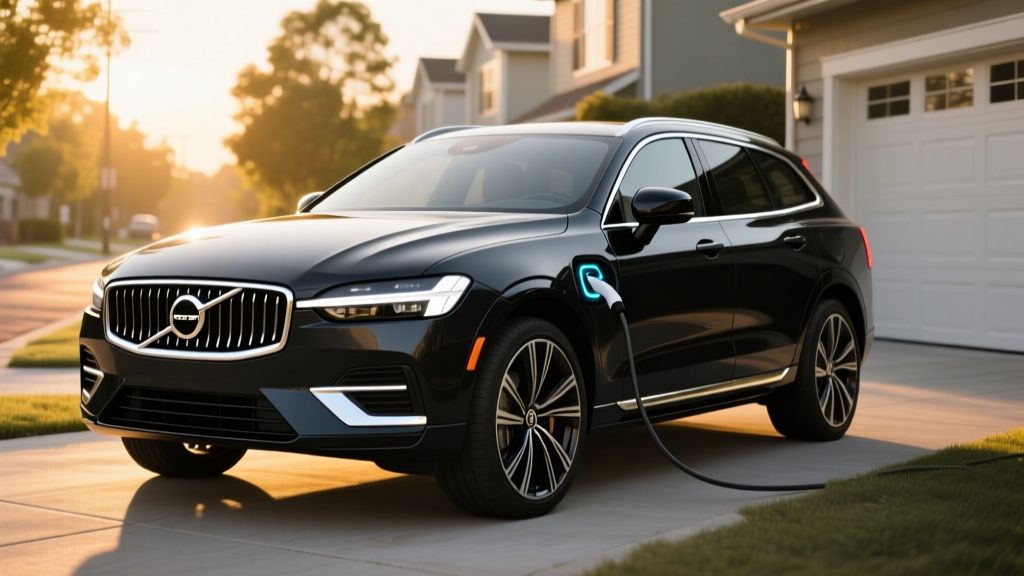
Volvo's current plug-in hybrid wagon is the V60 Recharge (also badged as the V60 T8 eAWD in prior model years). Available in standard and Cross Country trims, it's the closest vehicle to a "Volvo XC70 plug-in hybrid" that exists in the 2026 lineup. Here are the exact numbers.
| Spec | Value |
|---|---|
| Powertrain | 2.0L turbo + supercharged I-4 + rear electric motor (eAWD) |
| Combined Output | 455 hp / 523 lb-ft torque |
| Battery (usable) | 18.8 kWh (NMC lithium-ion) |
| EPA Electric-Only Range | 41 miles |
| Total Combined Range | ~490 miles (gas + electric) |
| EPA MPGe (electric mode) | 74 MPGe combined |
| EPA MPG (gas-only, combined) | 31 MPG combined (30 city / 33 hwy) |
| 0–60 mph | 4.3 seconds |
| AC Charging (Level 2) | ~3.7 kW onboard charger; 0–100% in ~5 hours |
| DC Fast Charging | Not supported |
| Starting MSRP | ~$52,350 (Ultimate trim); Cross Country ~$56,000 |
| Federal Tax Credit (§30D) | Not eligible — assembled in Sweden (foreign manufacture) |
Sources: EPA fueleconomy.gov, Volvo Cars USA specifications.
⚡ Real-World Electric Range vs. EPA
The EPA rates the V60 Recharge at 41 miles electric-only. In real-world mixed driving at moderate temperatures (60–75°F), expect 35–39 miles. On the highway at 75 mph, that drops to roughly 28–32 miles. In freezing weather (below 30°F), plan for 25–30 miles — cold saps battery efficiency and cabin heating draws heavily from the pack.
How Many MPG Does the V60 Recharge Get?
| Mode | City | Highway | Combined |
|---|---|---|---|
| Charge-Sustaining (gas only) | 30 MPG | 33 MPG | 31 MPG |
| Electric Mode | 74 MPGe | 72 MPGe | 74 MPGe |
Once the battery is depleted and the V60 Recharge operates as a conventional hybrid, 31 MPG combined is respectable for a 455-hp all-wheel-drive wagon. However, it won't match a dedicated HEV like the Toyota Prius (57 MPG combined). The key advantage: if your daily commute is under 35 miles and you charge nightly, you may burn almost no gasoline on weekdays.
Charging the V60 Recharge: What to Expect
The V60 Recharge comes with a J1772 AC charging port. Here's how charging breaks down across levels:
| Level | Power | Time (0–100%) | Practical Use |
|---|---|---|---|
| Level 1 (120V outlet) | ~1.4 kW | ~13–14 hours | Overnight top-up; slow but works |
| Level 2 (240V home) | ~3.7 kW (onboard limit) | ~5 hours | Ideal daily charging; full overnight |
| DC Fast Charge | N/A | Not supported | No DC port on V60 Recharge |
A critical detail: the V60 Recharge's onboard charger is limited to 3.7 kW. Even if you plug into a 48-amp Level 2 wall connector capable of delivering 11.5 kW, the car will only accept 3.7 kW. This is typical for PHEVs — their smaller batteries don't require high-speed charging — but it means upgrading your home charger beyond a basic 16-amp Level 2 unit provides no speed benefit for this vehicle.
Battery Warranty, Reliability, and Replacement Cost
🔋 Volvo PHEV Battery Warranty
8 years or 100,000 miles (whichever comes first) for the high-voltage battery pack. Volvo warrants the battery against defects and excessive capacity loss — typically defined as dropping below 70% of original capacity during the warranty period.
The conventional 12V auxiliary battery carries a separate warranty (typically 3 years/36,000 miles).
Volvo's PHEV powertrains (the T8/Twin Engine family) have been in production since 2015, and long-term reliability data is increasingly favorable. The 18.8 kWh NMC battery uses proven chemistry, and because PHEV batteries undergo shallower discharge cycles than full EVs (you're rarely draining from 100% to 0%), degradation tends to be modest.
If the battery does require out-of-warranty replacement, expect a cost between $8,000 and $14,000 including parts and labor at a Volvo dealer. This is a significant sum, though it's worth noting that PHEV battery failures remain uncommon within the first 10–12 years of ownership.
Tax Credits and Pricing: The Hard Truth
Here's where the V60 Recharge story gets complicated for US buyers:
- Federal §30D credit: NOT eligible. Under current IRS rules, the vehicle must undergo final assembly in North America. The V60 Recharge is built in Gothenburg, Sweden, disqualifying it entirely.
- State incentives: Some states offer rebates for PHEVs regardless of assembly location. California's CVRP, for instance, has historically offered up to $1,000–$2,000 for qualifying PHEVs — check your state's current program.
- Utility rebates: Many electric utilities offer $250–$500 rebates for purchasing a Level 2 home charger, which applies regardless of vehicle origin.
At a starting MSRP of roughly $52,350 for the Ultimate trim and $56,000+ for the Cross Country, the V60 Recharge commands a premium. Without the federal $7,500 credit, the effective cost is significantly higher than PHEV competitors assembled in North America (like the Jeep Wrangler 4xe or Chrysler Pacifica Hybrid).
Hybrid vs. PHEV vs. Full EV: Which Fits You?
Decision Framework
Choose a conventional HEV (like the Toyota RAV4 Hybrid) if you have no home charging access, drive long highway miles daily, and want maximum MPG without plugging in. Expect 35–41 MPG combined.
Choose a PHEV (like the V60 Recharge) if you can charge at home, your daily commute is under 40 miles, but you still need the freedom for road trips without range anxiety. You get EV-like daily driving with a gas safety net.
Choose a full BEV (like the Tesla Model Y or Volvo EX30) if you have reliable home charging, your typical trips stay under 250 miles, and you want the lowest per-mile fuel cost plus eligibility for the $7,500 federal credit on qualifying models.
If you were hoping for a Volvo XC70 plug-in hybrid because you love the wagon form factor but want electrified efficiency, the V60 Recharge Cross Country is your best current option. It's not cheap and it doesn't qualify for the federal credit, but it delivers 41 miles of electric commuting with a 455-hp turbocharged engine and Volvo's hallmark safety suite.
Pros and Cons at a Glance
✓ Pros
- 41 miles EPA electric-only range covers most commutes
- 455 hp with eAWD — genuinely quick (4.3s to 60)
- Cross Country trim offers XC70-like raised wagon styling
- Top-tier safety (IIHS Top Safety Pick+ historically)
- 31 MPG combined even after battery depletion
- 8-year/100,000-mile battery warranty
✗ Cons
- No federal tax credit (Sweden-assembled)
- Starting MSRP above $52,000 — expensive for a wagon
- 3.7 kW onboard charger limits Level 2 speed
- No DC fast charging capability
- Cold weather cuts electric range by ~25–30%
- XC70 nameplate discontinued — this is the successor, not the original
Frequently Asked Questions
Was there ever a Volvo XC70 plug-in hybrid?
No. Volvo discontinued the XC70 after the 2016 model year before its PHEV (T8 Twin Engine) powertrain was adapted for wagons. The XC70 was only ever sold with conventional gasoline engines. The closest equivalent today is the V60 Recharge PHEV.
How far can the V60 Recharge go on electric only?
The EPA rates it at 41 miles electric-only. Real-world results range from roughly 28 miles (highway, cold weather) to 39 miles (city, moderate temps). For most daily commutes under 35 miles, you'll rarely use gasoline on weekdays if you charge nightly.
Does any Volvo PHEV wagon qualify for the federal tax credit?
Currently, no. Volvo's PHEV wagons (V60 Recharge) are manufactured in Sweden and do not meet the IRS §30D North American final assembly requirement. Check your state for separate PHEV incentives.
Is the V60 Recharge reliable? What about battery replacement cost?
Volvo's T8 PHEV powertrain has been in production since 2015 with generally positive reliability outcomes. The high-voltage battery is warranted for 8 years/100,000 miles. Out-of-warranty replacement runs approximately $8,000–$14,000, though full pack failures remain rare in the first decade of ownership.
Should I just buy a used XC70 instead?
A used XC70 (2014–2016) is an excellent wagon, but it's a conventional gas vehicle averaging 19–23 MPG combined. If fuel economy and electrified driving matter to you, the V60 Recharge is a fundamentally different (and far more efficient) proposition — albeit at a much higher price point than a depreciated XC70.