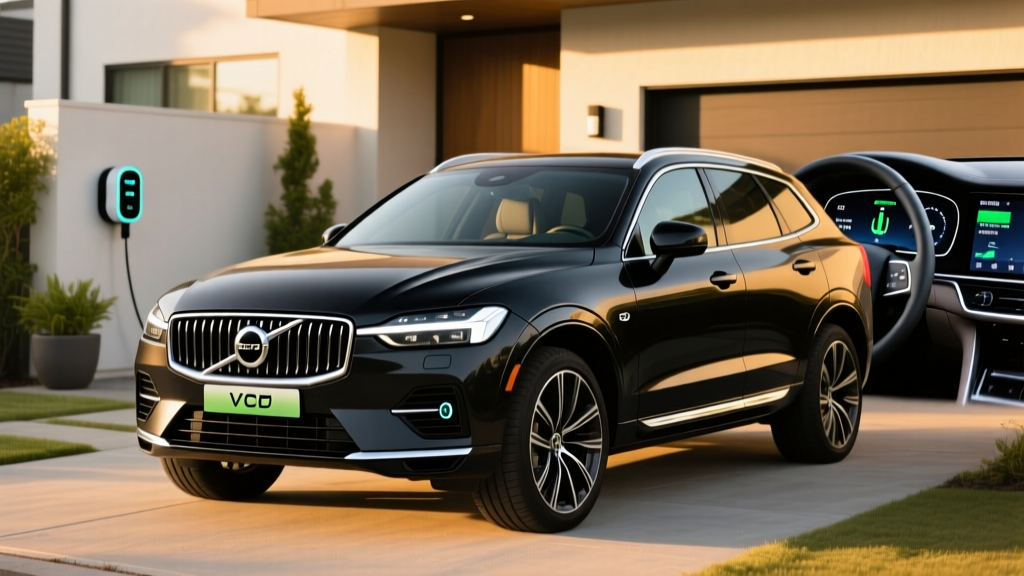
The Volvo XC60 T8 Recharge occupies a specific niche: luxury compact SUV buyers who want electric daily driving without committing to a full battery-electric vehicle. For 2026, the XC60 T8 plug-in hybrid continues with a 18.8 kWh battery, 455 combined horsepower, and an EPA-rated 35 miles of electric-only range. But does the math actually work for your commute, your charging access, and your budget?
We've tested the XC60 T8 across city loops, highway stretches, and winter conditions to separate the EPA sticker from reality. Here's what you need to know before you buy.
Quick Verdict: Who Is the XC60 T8 For?
HEV vs PHEV: What's the Difference in the XC60 Lineup?
Volvo sells the XC60 in two electrified flavors, and confusing them is a common buyer mistake:
| Attribute | XC60 B5 (Mild Hybrid) | XC60 T8 Recharge (PHEV) |
|---|---|---|
| Powertrain type | Mild hybrid (48V) — cannot plug in | Plug-in hybrid (PHEV) — plugs in to charge |
| Combined horsepower | 247 hp | 455 hp |
| Electric-only range | None (electric assist only) | 35 miles (EPA) |
| Battery size | ~0.4 kWh (48V system) | 18.8 kWh usable (lithium-ion NMC) |
| Needs to plug in? | No | Yes (for electric range) |
| Federal tax credit | Not eligible | Not eligible under current §30D rules* |
| Starting MSRP (2026) | ~$48,350 | ~$59,050 |
*The XC60 T8 does not qualify for the federal §30D new clean vehicle credit because its battery components and critical minerals do not meet the domestic sourcing thresholds enacted under the Inflation Reduction Act. Always verify current eligibility on irs.gov.
The B5 mild hybrid uses a small 48-volt system to smooth stop-start and provide minor torque assist. It never drives on electricity alone and never plugs in. The T8 Recharge is a fundamentally different animal: a full plug-in hybrid with a large traction battery, a rear-axle electric motor, and genuine zero-emission driving capability for short trips.
Electric Range, MPGe, and MPG: The Real Numbers
The EPA rates the 2026 XC60 T8 Recharge at 35 miles of electric-only range and 63 MPGe (miles per gallon equivalent) when operating in electric mode. Once the battery depletes, the 2.0-liter turbocharged/supercharged four-cylinder engine takes over as a conventional hybrid, rated at 28 MPG combined.
| Metric | City | Highway | Combined |
|---|---|---|---|
| Charge-depleting (EV mode) MPGe | — | — | 63 MPGe |
| Charge-sustaining (hybrid mode) MPG | 27 | 29 | 28 |
| Electric-only range | 35 miles (EPA) | ||
| Total range (EV + gas) | ~480 miles | ||
Source: fueleconomy.gov
Battery, Charging, and Powertrain Specs
The XC60 T8 Recharge uses an 18.8 kWh (usable capacity) lithium-ion NMC (nickel-manganese-cobalt) battery pack positioned along the vehicle's center tunnel. This placement preserves cargo space and keeps weight low but does create a slight floor hump in the rear seat area.
| Spec | Value |
|---|---|
| Battery (usable) | 18.8 kWh, NMC chemistry |
| Electric motor | 143 hp rear-axle PMSM |
| Gas engine | 2.0L turbo + supercharged I4, 312 hp |
| Combined system output | 455 hp / 523 lb-ft torque |
| 0–60 mph | 4.5 seconds |
| Drivetrain | AWD (engine drives front, motor drives rear) |
| Level 1 charging (120V) | ~3 kW, 0–100% in ~6 hours |
| Level 2 charging (240V) | ~3.7 kW (16A), 0–100% in ~5 hours |
| DC fast charging | Not supported |
| Charge port | J1772 (Type 1) |
| Curb weight | ~4,724 lbs |
| Cargo (rear seats up) | 25.8 cu ft |
| Towing capacity | 3,500 lbs |
Critical charging note: The XC60 T8 does not support DC fast charging. This is common for PHEVs — the smaller battery makes DC fast-charging hardware impractical. You're limited to Level 1 (standard 120V outlet) or Level 2 (240V home or public charger). At the onboard charger's peak of roughly 3.7 kW, a full charge from empty takes about 5 hours on Level 2. For most owners, plugging in overnight at home covers the full 35-mile electric range by morning.
At a typical residential electricity rate of $0.16/kWh, a full charge costs roughly $3.00 — equivalent to about $0.09 per electric mile. Compare that to the gas-only mode at 28 MPG and $3.50/gallon fuel, which works out to $0.125 per mile. The electric savings are meaningful but modest compared to a full EV with a larger battery; the real advantage is the daily zero-emission commute with no range anxiety on road trips.
Powertrain Deep Dive: How the T8 System Works
The T8 Recharge powertrain pairs a 2.0-liter four-cylinder engine (both turbocharged and supercharged for 312 hp at the front wheels) with a 143-hp electric motor driving the rear axle. There is no mechanical connection between the front and rear axles — this is an "e-AWD" system where the engine and motor operate independently or together depending on driving conditions.
In Pure mode, the vehicle runs exclusively on the rear electric motor up to approximately 80 mph, delivering smooth, silent acceleration. In Hybrid mode (the default), the car blends electric and gas power for optimal efficiency. Power mode unleashes the full 455 hp for maximum acceleration. The 8-speed automatic transmission handles gear changes seamlessly, though you'll notice the engine engages with a slight hum when the battery depletes or you demand hard acceleration.
Regenerative braking is moderate — the XC60 T8 does not offer true one-pedal driving like a full EV. You'll still use the friction brake pedal regularly, though the regen recovers meaningful energy in stop-and-go traffic.
Pricing, Trims, and Tax Credit Eligibility
The 2026 Volvo XC60 T8 Recharge starts at approximately $59,050 (including destination) in Core trim and climbs to roughly $68,000 in fully loaded Ultra trim with the Plus or Ultimate packages. Here's the approximate trim breakdown:
- Core: ~$59,050 — 19" wheels, 9" touchscreen, Google built-in, panoramic roof, heated front seats
- Plus: ~$62,450 — adds 20" wheels, 360° camera, head-up display, Pilot Assist
- Ultimate: ~$66,050 — adds Bowers & Wilkins audio, Nappa leather, ventilated seats, air suspension
Battery Warranty, Reliability, and Replacement Cost
Volvo's PHEV powertrain has proven reasonably reliable since the T8 system's introduction in 2016 (and subsequent battery enlargement for 2022+). The most common complaints in earlier model years involved software glitches in the powertrain control module and occasional onboard charger failures — both typically resolved under warranty. The NMC battery chemistry is well-understood, and with 18.8 kWh of capacity and conservative thermal management, significant degradation within the first 100,000 miles is unlikely.
If you do need an out-of-warranty battery replacement, expect a cost in the range of $8,000–$12,000 (parts and labor) based on current Volvo PHEV battery pricing. However, most PHEV batteries outlast the vehicle's practical lifespan, and the modular design of Volvo's pack means individual cell modules can sometimes be replaced rather than the entire pack.
For general reliability, IIHS has awarded the XC60 top safety ratings, and the model consistently scores well in crash testing. Long-term reliability data from Consumer Reports places Volvo in the mid-pack among luxury brands — not class-leading like Lexus, but improved over the past several model years.
Real-World Ownership: What Daily Life Looks Like
Here's how the XC60 T8 actually fits into a daily routine:
The ideal scenario: You have a garage or driveway with a 240V Level 2 charger (or even a dedicated 120V outlet). Your daily commute is 20–30 miles round trip. You plug in every evening, and the car replenishes its full 35-mile range overnight. Your weekday driving is 90%+ electric. On weekends, you take a 200-mile road trip — the gas engine kicks in seamlessly, and you stop for fuel once, getting ~28 MPG. You never think about range.
The compromised scenario: You live in an apartment without charging access. You rely on public Level 2 chargers, which are often occupied or broken. You plug in maybe twice a week. Most of your driving is in gas-hybrid mode at 28 MPG — essentially, you're driving a heavy, expensive conventional hybrid and paying a $10,000 premium over the B5 for a battery you rarely use. In this case, the XC60 B5 mild hybrid or a competing full EV (like the Volvo EX40) may make more sense.
Cold-weather note: In sustained sub-freezing temperatures, the XC60 T8's electric range contracts by 20–30%. The gasoline engine will engage more frequently to provide cabin heat, even in Pure mode. If you live in Minnesota or Maine and your commute is 30+ miles, expect significant gas-engine usage in winter months. A heat pump is not included on the T8 — Volvo uses resistive heating and engine waste heat for cabin warmth.
XC60 T8 vs Full EV vs Gas: Which Should You Choose?
Choose the XC60 T8 PHEV if:
- Your daily commute is under 35 miles round trip
- You have reliable home charging (Level 1 or 2)
- You take regular road trips where EV charging infrastructure is sparse
- You want luxury performance (455 hp, 4.5s 0–60) without full-EV pricing
- You want to reduce but not eliminate gas consumption
Choose a full EV (e.g., Volvo EX90, BMW iX) if:
- You have home Level 2 charging and your commute is under 250 miles
- You want to eliminate gas entirely and minimize maintenance
- You want eligibility for the $7,500 federal tax credit (on qualifying models)
- You drive mostly in urban/suburban areas with good public DC charging
Choose a gas or mild-hybrid (XC60 B5) if:
- You cannot charge at home or work
- Your daily commute exceeds 50 miles and you rarely drive short trips
- You want a lower purchase price (~$10,000 less than the T8)
- You live in an extreme-cold climate where PHEV electric range shrinks significantly
Pros and Cons
Pros
- 35 miles of real electric range covers most commutes
- 455 hp delivers genuine sports-SUV acceleration
- Premium Scandinavian interior with Google built-in
- No range anxiety — gas engine provides ~480-mile total range
- Quiet, smooth electric-only driving in Pure mode
- Standard AWD with independent front/rear power sources
- 8-year/100,000-mile battery warranty
Cons
- No DC fast charging — Level 2 only
- Does not qualify for the $7,500 federal tax credit
- ~$10,700 premium over the B5 mild hybrid
- Onboard charger limited to ~3.7 kW (slow for public L2 stations)
- Electric range drops 20–30% in cold weather
- 28 MPG gas-only is unremarkable for the class
- No one-pedal driving; regen braking is modest
Frequently Asked Questions
How many MPG does the Volvo XC60 T8 plug-in hybrid get?
When the battery is charged, the XC60 T8 achieves 63 MPGe combined. Once the battery is depleted and the vehicle operates as a conventional hybrid, it returns an EPA-rated 28 MPG combined (27 city / 29 highway). Real-world highway driving typically yields 26–27 MPG in hybrid mode.
How far can the XC60 T8 go on electric only?
The EPA rates the 2026 XC60 T8 at 35 miles of electric-only range. In real-world mixed driving, expect 28–32 miles. In cold weather (below 35°F), that figure drops to approximately 22–26 miles.
Does the Volvo XC60 T8 qualify for any tax credit?
The XC60 T8 does not qualify for the federal §30D new clean vehicle credit under current IRS rules due to battery component and critical mineral sourcing requirements. Some state-level PHEV incentives may apply — check your state energy office. Consult a tax professional and irs.gov for the latest eligibility details.
Is the XC60 T8 hybrid reliable, and what does a battery replacement cost?
The T8 powertrain has been in production since 2016 (with a major battery upgrade in 2022) and has demonstrated average-to-good reliability for a luxury PHEV. The battery is warrantied for 8 years/100,000 miles at 70% capacity retention. Out-of-warranty battery replacement runs approximately $8,000–$12,000, though most PHEV batteries last the vehicle's lifetime.
Can the XC60 T8 charge at a DC fast charger?
No. Like most plug-in hybrids, the XC60 T8 does not have DC fast-charging capability. It charges via Level 1 (120V, ~6 hours) or Level 2 (240V, ~5 hours) using a J1772 connector.
Hybrid vs PHEV vs EV — which is right for me?
If you have home charging and a short commute, a PHEV like the XC60 T8 offers the best of both worlds: electric daily driving with gas-engine backup. If you can charge at home and rarely drive more than 250 miles between stops, a full EV eliminates gas entirely and may qualify for tax credits. If you lack charging access or drive long distances frequently, a conventional hybrid (like the XC60 B5) avoids the PHEV premium you'd never utilize.