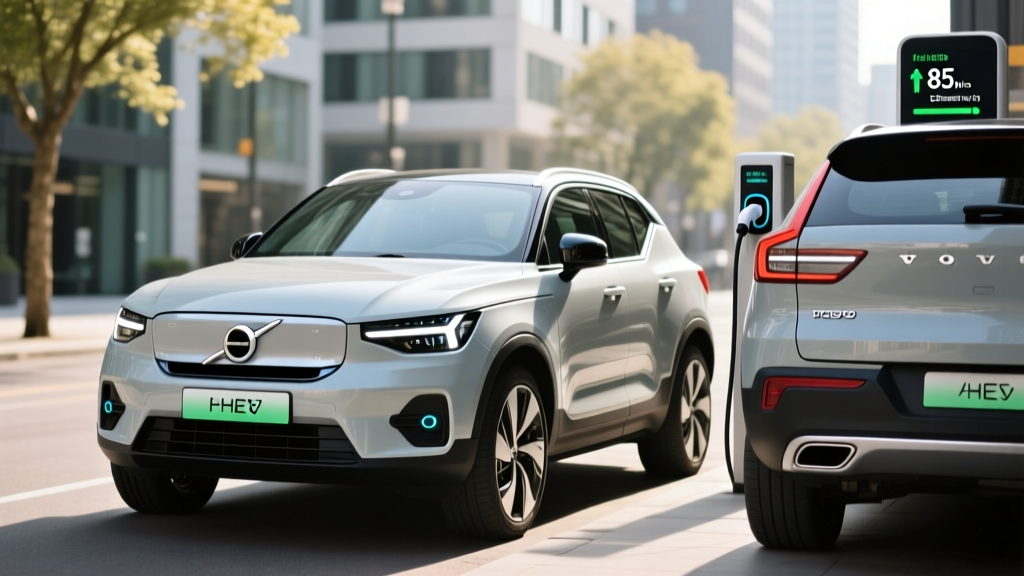
Quick Verdict: The XC40 Recharge PHEV in 2026
The Volvo XC40 has been one of the most popular compact luxury crossovers for years, and for 2026, the plug-in hybrid variant — officially badged as the XC40 Recharge Plug-In Hybrid (formerly known as the T8 Recharge) — remains the electrified choice for buyers who want some electric driving without fully committing to a battery-electric vehicle. With an EPA-estimated 35 miles of electric-only range, a combined 262 horsepower, and roughly 30 MPG once the battery is depleted, the XC40 PHEV occupies a practical middle ground.
But the naming gets confusing: Volvo dropped the XC40 mild-hybrid (B4/B5) in the US market after 2024 to focus on the fully electric EX40 (the renamed pure-EV XC40 Recharge) and the XC40 PHEV. So when you search for a "Volvo XC40 hybrid" in 2026, you're looking specifically at the plug-in hybrid model. There is no conventional (non-plug) hybrid XC40 available new in the US.
This guide breaks down exactly what the 2026 XC40 Recharge PHEV offers — electric range, fuel economy, charging logistics, pricing, tax credit eligibility, and whether it's the right fit versus a full EV or a conventional hybrid from a competitor.
HEV vs PHEV: What "XC40 Hybrid" Actually Means
Before diving into specs, it's critical to understand the distinction between hybrid types, because Volvo's lineup can confuse shoppers:
Conventional Hybrid (HEV)
- No plug — charges itself via regenerative braking and the engine
- Small battery (~1-2 kWh), electric motor assists the gas engine
- Cannot drive on electric power alone for meaningful distances
- Example: Toyota RAV4 Hybrid (up to 39 MPG combined)
- Not available in the 2026 Volvo XC40 lineup in the US
Plug-In Hybrid (PHEV)
- Plugs in to charge — has a larger battery (18.8 kWh usable in the XC40)
- Can drive 35 miles on electricity alone before the engine starts
- After battery depletion, operates like a conventional hybrid (~30 MPG)
- Example: 2026 Volvo XC40 Recharge Plug-In Hybrid
- Qualifies for partial federal tax credit (up to $7,500 depending on sourcing)
Bottom line: The 2026 Volvo XC40 hybrid is exclusively a PHEV. If you want a conventional (no-plug) hybrid in a compact luxury SUV, you'll need to look at competitors like the Lexus NX 350h or the BMW X1 xDrive28i (which is not a hybrid, however).
Specs at a Glance: 2026 Volvo XC40 Recharge PHEV
| Specification | 2026 XC40 Recharge PHEV |
|---|---|
| Powertrain | 2.0L turbocharged 4-cylinder + electric motor (rear axle) |
| Combined Horsepower | 262 hp (engine: 197 hp / motor: 65 hp approx.) |
| Combined Torque | ~295 lb-ft |
| Drivetrain | AWD (engine drives front wheels, motor drives rear) |
| Battery Capacity | 18.8 kWh usable (lithium-ion, NMC chemistry) |
| EPA Electric-Only Range | 35 miles |
| EPA MPG (gas-only, battery depleted) | 30 combined (29 city / 31 highway) |
| MPGe (electric + gas combined) | 63 MPGe |
| Total Combined Range | ~470 miles (35 electric + ~435 gas) |
| 0–60 mph | 6.5 seconds |
| AC Charging (Level 2) | 3.7 kW (full charge in ~5 hours) |
| DC Fast Charging | Not supported |
| Fuel Tank | 12.6 gallons |
| Towing Capacity | 3,500 lbs |
| Cargo Volume | 20.7 cu ft (rear seats up) / 47.2 cu ft (folded) |
| Base MSRP | $47,350 (Plus trim) — $52,150 (Ultimate trim) |
| Federal Tax Credit | Up to $7,500 (subject to §30D sourcing and income rules) |
| Battery Warranty | 8 years / 100,000 miles |
| Powertrain Warranty | 4 years / 50,000 miles |
Electric-Only Range & Real-World MPG
EPA Electric Range: 35 Miles — Real-World Expectation: 28–33 Miles
The EPA rates the 2026 XC40 Recharge PHEV at 35 miles of pure electric driving. In practice, expect 28–33 miles in mixed driving. Highway speeds above 65 mph and cold weather (below 40°F) can reduce electric range by 15–25%. In summer city driving with moderate regen, some owners report hitting or slightly exceeding the EPA figure.
Once the battery is depleted, the XC40 PHEV transitions to hybrid mode. The EPA rates it at 30 MPG combined (29 city / 31 highway). Real-world hybrid-mode efficiency depends heavily on driving style:
| Driving Scenario | Expected MPG (Battery Depleted) |
|---|---|
| City stop-and-go (regen helps) | 31–34 MPG |
| Suburban mixed | 29–31 MPG |
| Highway 70+ mph | 27–29 MPG |
| Cold weather (below 32°F) | 25–28 MPG |
For context, a conventional gas-only compact luxury SUV like the Audi Q3 gets around 25 MPG combined, so the XC40 PHEV in hybrid mode still delivers a meaningful efficiency advantage even when you never plug it in.
How Far Can It Go Total?
With a full charge and a full 12.6-gallon tank, the XC40 PHEV offers approximately 470 miles of total range. That eliminates range anxiety entirely — you can drive cross-country on gas alone, with the electric portion serving as a bonus for daily commutes.
Charging the XC40 PHEV: What You Need to Know
Charging a PHEV is simpler than a full EV, but there are still specifics worth understanding:
| Charging Level | Power | Time (0–100%) | Miles Added per Hour |
|---|---|---|---|
| Level 1 (120V household outlet) | ~1.4 kW | ~13 hours | ~5 miles of EV range/hr |
| Level 2 (240V home charger) | 3.7 kW | ~5 hours | ~12 miles of EV range/hr |
| DC Fast Charging | N/A | Not supported | N/A |
kW vs kWh reminder: kW (kilowatts) measures charging power — how fast energy flows into the battery. kWh (kilowatt-hours) measures battery capacity — how much energy it stores. The XC40 PHEV has an 18.8 kWh battery and accepts up to 3.7 kW of AC charging power.
Do you need a Level 2 home charger? Not necessarily. Because the battery is small (18.8 kWh), even a standard 120V outlet can replenish the battery overnight. If you drive less than 30 miles per day and plug in when you get home, Level 1 charging will typically restore enough range by morning. However, a Level 2 charger ($500–$1,500 installed) provides a full charge in about 5 hours, giving you more flexibility for multiple trips per day.
No DC fast charging: Unlike the fully electric EX40, the XC40 PHEV does not support DC fast charging. This is standard for most PHEVs — the battery is small enough that AC charging is sufficient. You won't be able to top up at highway fast-charging stations.
Pricing, Tax Credits & Ownership Costs
2026 XC40 Recharge PHEV Pricing
| Trim | MSRP | After Potential Tax Credit |
|---|---|---|
| Plus | $47,350 | As low as ~$39,850* |
| Ultimate | $52,150 | As low as ~$44,650* |
*Tax credit amounts vary. See eligibility details below.
Federal Tax Credit (§30D) Eligibility
The 2026 Volvo XC40 Recharge PHEV may qualify for up to $7,500 under the IRS §30D Clean Vehicle Credit, but eligibility depends on multiple factors:
- MSRP cap: SUVs must be under $80,000 — the XC40 PHEV qualifies ✓
- Buyer income cap: AGI must not exceed $150,000 (single) / $300,000 (joint) ✓
- Battery sourcing: Critical minerals and battery components must meet phased-in domestic-content thresholds — Volvo's supply chain partially qualifies; the exact credit amount ($3,750 or $7,500) depends on current-year sourcing compliance. Check the IRS's eligible vehicles list before purchasing.
- Point-of-sale transfer: As of 2024, you can transfer the credit to the dealer for an upfront price reduction rather than waiting to claim it on your tax return.
- Final assembly: Must be assembled in North America — the XC40 is built in Ghent, Belgium, which may disqualify it from the new-vehicle §30D credit. Verify on fueleconomy.gov before relying on this credit.
Critical note on assembly: The XC40 is manufactured in Belgium. Under current §30D rules, new vehicles must undergo final assembly in North America to qualify for the federal credit. This has historically disqualified the XC40 PHEV from the new-vehicle credit. However, Volvo has been evaluating production shifts. Always verify current eligibility at fueleconomy.gov or with your dealer before assuming credit availability.
State incentives: Several states offer additional rebates for PHEVs regardless of assembly location. California's Clean Fuel Reward, Colorado's state EV credit, and New York's Drive Clean Rebate may apply. Check your state's energy office for current amounts.
5-Year Ownership Cost Snapshot
| Category | Estimated 5-Year Cost |
|---|---|
| Purchase (Plus trim, after $0 credit) | $47,350 |
| Fuel (12,000 mi/yr, 60% electric) | ~$4,200 |
| Electricity (home charging, 60% of miles) | ~$1,800 |
| Insurance (avg.) | ~$9,500 |
| Maintenance | ~$3,200 |
| Depreciation (est. 5-yr) | ~$22,000 |
| Total estimated 5-yr cost | ~$66,050 |
Compared to a gas-only compact luxury SUV averaging 25 MPG, the XC40 PHEV can save $2,000–$4,000 in fuel costs over five years if you charge regularly. If you rarely plug in, savings shrink considerably.
Battery Longevity, Warranty & Reliability
Volvo PHEV Battery Warranty
Volvo covers the XC40 Recharge PHEV's high-voltage battery for 8 years or 100,000 miles, whichever comes first. The warranty guarantees the battery will retain a minimum of 70% of its original capacity during that period. If capacity drops below this threshold due to a defect or abnormal degradation, Volvo will repair or replace the battery at no cost.
Real-World Battery Degradation
PHEV batteries experience less stress than full-EV batteries because they operate in a narrower state-of-charge window (the system maintains a buffer and never fully depletes or fully charges the cells). Based on data from earlier Volvo T8 PHEV models (2019–2023), most owners report 5–8% degradation over the first 5 years / 60,000 miles. This is modest and well within the warranty threshold.
Battery Replacement Cost
If the battery needs replacement out of warranty, expect a cost in the range of $8,000–$12,000 including parts and labor. However, PHEV battery failures before 150,000 miles are rare. The 18.8 kWh pack uses NMC (nickel-manganese-cobalt) chemistry, which is well-proven in the industry.
Overall Reliability
Volvo's reliability ratings have been mid-pack among luxury brands in recent years. The XC40 platform is mature (introduced in 2018, refreshed for 2025), and the PHEV powertrain has been in production since 2019 in various Volvo models. The most common complaints from owners relate to infotainment software glitches (the Google-based system) rather than powertrain issues. The hybrid system itself — engine, motor, and battery — has proven durable in Volvo's T8 architecture.
Who Should Buy the XC40 PHEV vs a Full EV or Gas Car?
Choose the XC40 Recharge PHEV if:
- You have a short commute (under 30 miles) and can charge at home — you'll drive mostly on electricity
- You take road trips regularly and don't want to plan around charging infrastructure
- You want a luxury compact SUV with AWD and 3,500-lb towing capacity
- You live in an apartment or area where public charging is unreliable, but you can install a home outlet
- You want to reduce emissions without the full-EV commitment
Choose a full EV (like the Volvo EX40) if:
- You can reliably charge at home and your daily driving is under 200 miles
- You want to eliminate gas station visits and oil changes entirely
- You want access to DC fast charging for road trips (the EX40 charges at up to 200 kW)
- You want lower per-mile fuel costs — electricity is typically 40–60% cheaper per mile than gas
Choose a conventional hybrid (like the Lexus NX 350h) if:
- You cannot charge at home at all (no garage, no outlet access)
- You want maximum fuel efficiency without plugging in (the NX 350h gets 39 MPG combined)
- You want a simpler ownership experience with no charging cables or apps
- Lower purchase price matters — conventional hybrids typically cost $5,000–$10,000 less than PHEVs
Pros
- 35 miles of electric range covers most daily commutes
- AWD with 262 hp — genuinely quick for a compact SUV (6.5s 0–60)
- 3,500-lb towing — best in its class for a PHEV
- No range anxiety — 470 total miles with gas + electric
- Volvo's standard safety suite (Pilot Assist, run-off-road protection)
- Level 1 (120V) charging sufficient for overnight top-ups
- Google Built-in infotainment with native Google Maps and Assistant
Cons
- Belgian assembly likely disqualifies it from the $7,500 federal tax credit
- No DC fast charging — road trips are gas-only
- 3.7 kW Level 2 charging is slow compared to rivals (some PHEVs accept 7.2 kW)
- Cargo space reduced slightly vs gas-only XC40 due to battery placement
- Insurance premiums 10–15% higher than gas-only equivalents
- Volvo's Google infotainment can be sluggish; no Apple CarPlay on some model years
- Competing PHEVs (RAV4 Prime, NX 450h+) offer more electric range or better MPG
Frequently Asked Questions
How many MPG does the 2026 Volvo XC40 hybrid get?
The 2026 XC40 Recharge PHEV is rated at 30 MPG combined (29 city / 31 highway) when operating in hybrid mode with a depleted battery. When factoring in electric driving, it achieves 63 MPGe combined. In real-world city driving with frequent regenerative braking, some owners see 32–34 MPG in hybrid mode.
How far can the XC40 PHEV go on electric only?
The EPA rates it at 35 miles of electric-only range. In real-world conditions, expect 28–33 miles depending on temperature, speed, and terrain. Highway driving at 70+ mph and cold weather below 40°F will push range toward the lower end.
Does the Volvo XC40 hybrid qualify for a tax credit?
Under current IRS §30D rules, the XC40 PHEV's eligibility is uncertain because it is assembled in Ghent, Belgium, and the credit requires North American final assembly. Always verify on the IRS eligible vehicles page before purchasing. State-level incentives may still apply regardless of assembly location.
Is the XC40 PHEV reliable, and what does battery replacement cost?
The XC40 PHEV's hybrid powertrain has been in production since 2019 and is generally reliable. The battery is warrantied for 8 years / 100,000 miles with a 70% capacity retention guarantee. Out-of-warranty battery replacement costs approximately $8,000–$12,000, though failures before 150,000 miles are uncommon.
Do I need to plug in the XC40 PHEV?
You don't have to — the car will operate as a conventional hybrid if you never plug it in. However, you'll miss the entire benefit of the 35-mile electric range and the associated fuel savings. To get value from the PHEV premium, plan to plug in at least once daily, ideally at home.
How does the XC40 PHEV compare to the fully electric EX40?
The EX40 (formerly XC40 Recharge pure electric) offers 223 miles of EPA range, 402 hp, DC fast charging at 200 kW, and zero gas use. It starts at $53,550 and may qualify for the full $7,500 federal credit (depending on battery sourcing). If you can charge at home and don't regularly drive more than 200 miles between charges, the EX40 is the more efficient and lower-maintenance choice. The PHEV makes sense only if you need the extended range for frequent long trips.
What is the difference between kW and kWh?
kW (kilowatts) measures power — the rate at which energy flows during charging. kWh (kilowatt-hours) measures energy capacity — how much the battery stores. The XC40 PHEV has an 18.8 kWh battery and charges at up to 3.7 kW. Think of kW as the width of a hose and kWh as the size of the bucket.
Can the XC40 PHEV tow?
Yes. The 2026 XC40 Recharge PHEV is rated to tow up to 3,500 pounds when properly equipped, which is competitive for the compact luxury SUV segment and sufficient for a small trailer, jet skis, or a light boat.
Final Assessment
The 2026 Volvo XC40 Recharge PHEV is a competent plug-in hybrid for luxury SUV buyers who want electric commuting capability without sacrificing long-trip flexibility. Its 35-mile electric range is adequate for most daily driving, and the 262-hp AWD powertrain delivers confident acceleration. The main drawbacks are the likely ineligibility for the federal tax credit due to Belgian assembly, the relatively slow 3.7 kW charging rate, and strong competition from the Toyota RAV4 Prime (42 miles electric, 94 MPGe) and the Lexus NX 450h+ (37 miles electric, 84 MPGe) — though neither of those rivals matches the XC40's Scandinavian design, Google-based tech, or 3,500-lb towing rating.
If your daily commute is under 30 miles and you can charge at home, the XC40 PHEV will run mostly on electricity during the week and seamlessly switch to gas for weekend road trips. That versatility is exactly what PHEVs are designed for — and the XC40 executes it well, even if the financial incentives don't fully align in 2026.