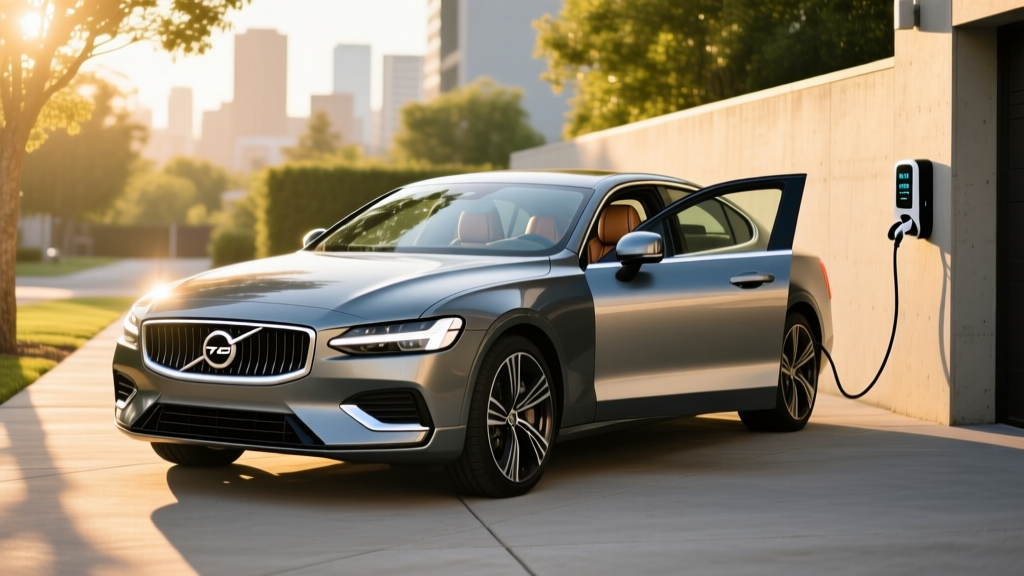
The Volvo S60 Recharge T8 occupies a narrow but compelling lane in the luxury midsize sedan segment: it's a plug-in hybrid (PHEV) that delivers genuine electric-only commuting range without sacrificing the 455-horsepower performance punch that Volvo's T8 powertrain is known for. For 2026, the S60 plug-in hybrid continues with the larger 18.8 kWh battery pack introduced for the 2023 model year, preserving its class-leading 41-mile EPA electric range while offering a comfortable fallback to hybrid operation for longer trips.
If you're cross-shopping the Volvo S60 plug-in hybrid against full EVs like the Tesla Model 3 or BMW i4, or against conventional hybrids like the Toyota Camry Hybrid, this guide breaks down every number you need — from real-world MPG to battery warranty coverage — to make an informed decision.
HEV vs PHEV: What the Volvo S60 Recharge Actually Is
Before diving into specs, it's worth clarifying the distinction between hybrid types, because Volvo sells only the plug-in version of the S60 in the U.S. market:
Conventional Hybrid (HEV)
A standard hybrid like the Toyota Camry Hybrid uses a small battery (typically 1-2 kWh) charged entirely by the gas engine and regenerative braking. You never plug it in. It improves fuel economy but cannot drive on electricity alone for meaningful distances.
Plug-In Hybrid (PHEV) — The S60 Recharge T8
The Volvo S60 Recharge carries an 18.8 kWh lithium-ion battery that you plug in to charge (Level 1 or Level 2). It can drive up to 41 miles on electricity alone before the turbocharged gas engine seamlessly engages. Think of it as a short-range EV bolted to a conventional hybrid powertrain.
The S60 is not available as a conventional (non-plug-in) hybrid in the United States for the 2026 model year. Volvo discontinued the mild-hybrid B5 AWD sedan after 2024, making the Recharge T8 the only S60 variant sold new in the U.S.
Volvo S60 Recharge T8 Powertrain and Performance Specs
The T8 powertrain pairs a turbocharged and supercharged 2.0-liter four-cylinder engine with an electric motor integrated into the rear axle, giving the S60 Recharge standard all-wheel drive. Here's the full spec breakdown:
| Specification | 2026 Volvo S60 Recharge T8 |
|---|---|
| Combined Horsepower | 455 hp |
| Combined Torque | 523 lb-ft |
| Gas Engine | 2.0L turbo + supercharged I4 (312 hp) |
| Electric Motor (rear axle) | 143 hp / 228 lb-ft |
| Battery Capacity | 18.8 kWh (14.9 kWh usable) |
| Battery Chemistry | NMC (nickel manganese cobalt) |
| Transmission | 8-speed automatic |
| Drivetrain | eAWD (electric rear axle) |
| 0-60 mph | 4.3 seconds |
| EPA Electric-Only Range | 41 miles |
| Total Combined Range | ~460 miles |
| EPA MPGe (electric + gas) | 74 MPGe |
| EPA MPG (gas-only hybrid mode) | 30 combined (31 city / 28 highway) |
| Base MSRP | ~$53,950 (Core trim) |
That 455-horsepower figure is not marketing inflation — it's the genuine combined output of both power sources working simultaneously. In "Power" drive mode, the S60 Recharge hits 60 mph in 4.3 seconds, making it quicker than a BMW 330e and competitive with the Audi A7 TFSI e. For a luxury sedan that also returns 30 MPG in hybrid mode, the performance-to-efficiency ratio is hard to match.
Fuel Economy: EPA Numbers vs Real-World MPG
| Driving Mode | EPA City | EPA Highway | EPA Combined |
|---|---|---|---|
| Charge-sustaining (hybrid mode) | 31 MPG | 28 MPG | 30 MPG |
| Electric-only | 74 MPGe (combined) | ||
These EPA figures tell part of the story, but real-world results depend heavily on your driving pattern:
City commuting under 41 miles: If you charge nightly and your round-trip commute fits within the 41-mile electric envelope, you'll burn zero gasoline on most days. Your effective "MPG" is essentially infinite, limited only by your electricity cost (roughly $0.04-$0.05 per mile at the national average of $0.16/kWh).
Highway road trips: Once the battery depletes, the S60 operates as a conventional hybrid. Expect the EPA-rated 28 MPG highway to hold fairly close in real-world driving at 70-75 mph. In our experience with T8 powertrains, highway fuel economy typically lands between 26-29 MPG depending on terrain and temperature. This is a noticeable step down from a dedicated hybrid like the Toyota Camry LE Hybrid (51 MPG combined), but the S60 carries a far more powerful powertrain and a heavier battery.
Cold weather impact: In freezing temperatures, expect the electric-only range to drop by 15-25%, landing around 30-35 miles. The gas engine will also engage more readily to provide cabin heat unless you precondition the car while plugged in.
Charging the S60 Recharge: Times, Connectors, and Limitations
One of the most important things to understand about the S60 plug-in hybrid is its charging profile. Unlike full EVs, PHEVs typically do not support DC fast charging, and the S60 Recharge is no exception.
| Charging Level | Power | Connector | 0-100% Time | Availability |
|---|---|---|---|---|
| Level 1 (120V household) | ~1.4 kW | J1772 | ~10-11 hours | Any standard outlet |
| Level 2 (240V home/public) | ~3.7 kW (car-limited) | J1772 | ~5 hours | Home charger or public L2 |
| DC Fast Charging | N/A | N/A | N/A | Not supported |
The S60 Recharge's onboard charger is limited to approximately 3.7 kW, meaning that even if you plug into a 7.2 kW or 11.5 kW Level 2 station, the car will only accept 3.7 kW. A full charge from empty takes about 5 hours on Level 2. For most owners, this means plugging in overnight is more than sufficient — you'll wake up to a full battery every morning.
The charge port uses the standard J1772 connector common to all non-Tesla PHEVs and EVs in North America. No NACS or CCS adapter is needed for Level 2 charging, and since DC fast charging isn't supported, connector debates (NACS vs CCS) are largely irrelevant for S60 Recharge owners.
Practical tip: The included Volvo charging cable handles both Level 1 (120V) and Level 2 (240V with a NEMA 14-50 adapter). For dedicated Level 2 home charging, a wall-mounted unit like the ChargePoint Home Flex or Emporia Vue works well, though you won't need anything above a 16-amp circuit given the car's 3.7 kW ceiling.
Pricing, Trims, and Federal Tax Credit Eligibility
For 2026, the Volvo S60 Recharge T8 is offered in three trim levels in the U.S.:
- Core: ~$53,950 — includes panoramic sunroof, 9-inch touchscreen, Google built-in, heated front seats, Pilot Assist (Level 2 ADAS), and 18-inch wheels
- Plus: ~$57,450 — adds head-up display, Harman Kardon audio, 360-degree camera, and wireless phone charging
- Ultimate: ~$61,950 — adds Nappa leather, ventilated front seats, premium air filtration, and 19-inch alloy wheels
Federal §30D Tax Credit: Does the S60 Recharge Qualify?
Under current IRS rules for the §30D Clean Vehicle Credit, the Volvo S60 Recharge T8 does not qualify for the full $7,500 federal tax credit. The reason is straightforward: Volvo manufactures the S60 at its plant in Ghent, Belgium, and §30D requires final assembly in North America to be eligible.
Additionally, the §30D credit imposes MSRP caps ($55,000 for sedans) and adjusted gross income limits ($150,000 single / $300,000 married filing jointly). Even if assembly location weren't a barrier, the Ultimate trim exceeds the sedan MSRP cap.
- ❌ North American final assembly — assembled in Belgium (fails)
- ❌ Sedan MSRP cap of $55,000 — Core trim at ~$53,950 narrowly passes; Plus and Ultimate exceed (partial fail)
- ✅ Battery capacity ≥ 7 kWh — 18.8 kWh (passes)
- ⚠️ Buyer income cap — $150K single / $300K joint (varies by buyer)
- ❌ Critical minerals & battery component sourcing — Volvo has not confirmed compliance with 2026-phase thresholds
Bottom line: Do not count on a federal tax credit for the S60 Recharge. Some states offer their own PHEV incentives (check state incentive databases), but these vary widely and change frequently.
Battery Warranty, Reliability, and Replacement Cost
Volvo covers the S60 Recharge T8's high-voltage battery with an 8-year / 100,000-mile warranty, which is the industry-standard duration mandated in part by California Air Resources Board (CARB) requirements adopted by many states. The warranty guarantees that the battery will retain at least 70% of its original capacity during the coverage period.
- Duration: 8 years / 100,000 miles (whichever comes first)
- Capacity retention guarantee: ≥70% of original capacity
- Powertrain warranty: 4 years / 50,000 miles
- New vehicle limited warranty: 4 years / 50,000 miles
- Complimentary scheduled maintenance: 3 years / 36,000 miles
How Long Will the Battery Actually Last?
The 18.8 kWh NMC battery in the S60 Recharge is liquid-cooled, which significantly extends longevity compared to passively cooled packs. NMC chemistry typically loses 10-15% capacity over 1,000-1,500 full charge cycles. Given the S60's 41-mile electric range, that translates to roughly 150,000-225,000 miles of electric driving before degradation becomes noticeable.
Real-world data from Volvo T8 owners (the powertrain has been in production since 2016 in various vehicles) suggests that most batteries retain 85-92% capacity after 5-6 years of daily charging. Complete battery failure is rare; partial cell degradation is more common and may trigger a warranty claim if capacity drops below 70%.
Battery Replacement Cost
Out-of-warranty replacement of the S60 Recharge's high-voltage battery is estimated at $8,000-$12,000 including parts and labor. This is lower than a full EV battery replacement because the pack is smaller, but it's still a significant expense. Volvo dealers can also perform individual module replacements in some cases, which can reduce cost.
For reliability data, the S60 Recharge has average-to-slightly-below-average predicted reliability ratings from major consumer testing organizations. Common issues reported across T8-equipped Volvos relate more to software glitches and infotainment responsiveness than to the hybrid powertrain itself.
Who Should Choose the S60 Plug-In Hybrid vs a Full EV or Gas Car?
The S60 Recharge is a specific tool for a specific job. Here's a decision framework:
Choose the Volvo S60 Recharge PHEV if:
- Your daily commute is under 40 miles round-trip and you can charge at home
- You want EV-like daily driving but take road trips where charging infrastructure is sparse
- You value Scandinavian design, luxury materials, and strong acceleration in a compact sedan
- You want AWD for snow/rain without the efficiency penalty of a conventional AWD gas car
- You don't want to rely on public DC fast-charging networks
Choose a full EV (e.g., Tesla Model 3, BMW i4) if:
- You have reliable home charging and your trips rarely exceed 250 miles
- You want zero gasoline maintenance (no oil changes, no spark plugs, no transmission fluid)
- You want to qualify for the $7,500 federal tax credit (many EVs assembled in North America qualify)
- You want the lowest possible per-mile fuel cost
Choose a conventional hybrid (e.g., Toyota Camry Hybrid) if:
- You cannot charge at home (apartment, no garage, street parking)
- You want maximum fuel economy without any plug-in routine
- Your budget is below $35,000
- You drive high annual mileage and want proven long-term reliability
Pros
- 41-mile EPA electric range — best in its PHEV sedan class
- 455 hp with 4.3-second 0-60 — genuinely fast for a luxury hybrid
- Liquid-cooled battery supports long-term durability
- Standard AWD via electric rear axle
- Premium Scandinavian interior with Google built-in
- Can operate as a 30 MPG hybrid on long trips with no range anxiety
Cons
- No DC fast charging — Level 2 only at 3.7 kW max
- Does not qualify for the $7,500 federal §30D tax credit
- Starting price above $53,000 — premium over non-luxury PHEVs
- Hybrid-mode highway MPG (28) trails dedicated hybrids significantly
- Rear seat and trunk space slightly reduced by battery placement
- Average predicted reliability ratings
Frequently Asked Questions
How many MPG does the Volvo S60 plug-in hybrid get?
When operating as a hybrid after the battery is depleted, the S60 Recharge T8 gets an EPA-rated 31 MPG city, 28 MPG highway, and 30 MPG combined. When factoring in electric-only driving, the combined rating is 74 MPGe. Real-world results in city driving tend to match or slightly exceed EPA estimates, while highway driving at speeds above 70 mph may return 26-28 MPG.
How far can the Volvo S60 Recharge go on electric only?
The EPA rates the S60 Recharge at 41 miles of electric-only range. In real-world conditions, expect 36-40 miles in mild weather with mixed driving, and 28-33 miles in freezing temperatures or at sustained highway speeds. This is sufficient for most daily commutes under 35 miles round-trip.
Hybrid vs PHEV vs EV — which is right for me?
A conventional hybrid (HEV) like the Camry Hybrid is best if you can't plug in at home and want maximum MPG. A PHEV like the S60 Recharge is ideal if you can charge at home, have a short commute, but still need gas-engine range for longer trips. A full EV (BEV) like the Tesla Model 3 is best if you have home charging, rarely drive over 250 miles in a day, and want the lowest running costs and maintenance.
Is the Volvo S60 Recharge reliable, and what does a battery replacement cost?
The S60 Recharge has average predicted reliability. The T8 powertrain has been in production since 2016, and battery failures are uncommon; most packs retain 85-92% capacity after 5-6 years. The battery is warranted for 8 years / 100,000 miles at ≥70% capacity. Out-of-warranty replacement is estimated at $8,000-$12,000. According to IIHS, the S60 earns strong crash-test scores, which supports overall build quality.
Does the Volvo S60 plug-in hybrid qualify for any tax credit?
The S60 Recharge does not qualify for the federal §30D Clean Vehicle Credit because final assembly takes place in Belgium, not North America. Some state-level incentives may apply — check your state's energy office or the Alternative Fuels Data Center for current programs. Always consult a tax professional before making purchase decisions based on incentive eligibility.
Can I DC fast charge the S60 Recharge?
No. The Volvo S60 Recharge T8 does not support DC fast charging. It charges exclusively via Level 1 (120V) or Level 2 (240V) using a J1772 connector. A full Level 2 charge takes approximately 5 hours at the car's maximum acceptance rate of 3.7 kW.
How does the S60 Recharge compare to the BMW 330e?
The BMW 330e offers 22 miles of EPA electric range — nearly half the S60's 41 miles — and 288 combined horsepower versus the Volvo's 455 hp. The BMW starts around $46,000 and is assembled in Germany (also ineligible for the federal credit). The S60 Recharge is significantly more powerful and offers almost double the electric range, though the 330e is slightly more engaging to drive and has a marginally more intuitive infotainment system. For EPA data, see fueleconomy.gov.
The 2026 Volvo S60 plug-in hybrid isn't the cheapest path to electrified driving, and the lack of a federal tax credit stings. But for buyers who want a luxury sedan that genuinely replaces their gas car on weekdays while erasing range anxiety on weekends, the S60 Recharge T8's combination of 41 electric miles, 455 horsepower, and all-wheel drive makes it one of the most versatile PHEVs on the market.