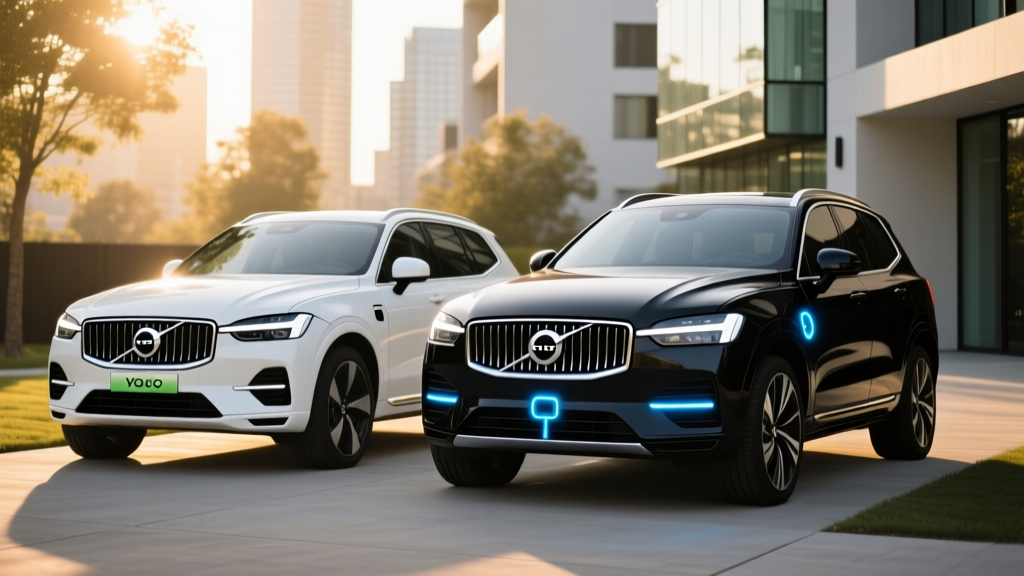
Volvo has committed fully to plug-in electrification across its SUV lineup, dropping mild-hybrid-only options in favor of two distinct powertrain paths: the conventional hybrid (what Volvo calls "B" models with a 48-volt system) and the plug-in hybrid ("Recharge" or T8 models). If you're researching a Volvo plug in hybrid SUV, you're looking at the XC60 Recharge and XC90 Recharge — both pairing a turbocharged and supercharged 2.0-liter four-cylinder with a rear-axle electric motor and an 18.8 kWh (usable) lithium-ion battery.
This guide breaks down exactly what each model delivers in electric-only range, fuel economy, charging behavior, and total cost — with the real-world caveats that spec sheets omit.
Volvo's Plug-In Hybrid Powertrain: What You're Getting
Both the XC60 Recharge and XC90 Recharge share Volvo's T8 eAWD powertrain architecture. Here's how it works in practice:
- Gas engine: 2.0L turbocharged + supercharged inline-4, producing 312 hp and 295 lb-ft of torque, driving the front wheels
- Electric motor: 143 hp / 228 lb-ft, mounted on the rear axle
- Combined output: 455 hp and 523 lb-ft of torque
- Battery: 18.8 kWh usable (longitudinal "T8" pack in the center tunnel), lithium-ion NMC chemistry
- Drivetrain: eAWD — the gas engine powers the front wheels, the electric motor powers the rear. No mechanical connection between axles.
The result is a powertrain that can operate as a pure EV for short commutes, a series-parallel hybrid for longer trips, and a performance vehicle when you demand full power. The 455 hp figure is real — these SUVs hit 0-60 mph in roughly 4.5 seconds (XC60) and 4.9 seconds (XC90).
HEV vs PHEV: How Volvo's "B" and "Recharge" Models Differ
Before diving deeper, it's essential to separate Volvo's two hybrid offerings, because buyers frequently confuse them:
| Feature | Volvo B5/B6 (HEV) | Volvo T8 Recharge (PHEV) |
|---|---|---|
| Plug-in charging | No — regenerates only | Yes — plug in to charge battery |
| Battery size | ~0.4 kWh (48V mild-hybrid) | 18.8 kWh usable |
| Electric-only driving | No (assist only) | Yes, up to ~35 miles |
| Combined horsepower | 247 hp (B5) / 295 hp (B6) | 455 hp |
| Fuel economy benefit | Modest (1-2 MPG over non-hybrid) | Significant when charged daily |
| Price premium | Base model | +$10,000-$14,000 over B5/B6 |
The conventional hybrid (HEV) "B" models use a small 48-volt battery and integrated starter-generator to smooth stop-start and provide minor torque assist. They never drive on electric power alone and never plug in. The Recharge PHEV models are fundamentally different vehicles — they can commute on electricity alone and offer dramatically more power.
If your goal is to reduce fuel consumption without changing your habits, the HEV works. If you want electric-only commuting and are willing to plug in at home, the PHEV is the clear winner.
EPA Range, MPG, and Real-World Efficiency
Here's where the numbers matter most. Below are the EPA figures for the 2026 model-year Recharge lineup, pulled from fueleconomy.gov:
| Metric | XC60 Recharge | XC90 Recharge |
|---|---|---|
| Electric-only range (EPA) | 35 miles | 32 miles |
| MPGe (electric + gas) | 63 MPGe | 58 MPGe |
| MPG combined (gas only, battery depleted) | 28 MPG | 27 MPG |
| MPG city (gas only) | 27 MPG | 26 MPG |
| MPG highway (gas only) | 29 MPG | 28 MPG |
| Total range (electric + gas) | ~470 miles | ~460 miles |
Real-world expectations: The EPA electric-only range of 35 miles (XC60) and 32 miles (XC90) assumes moderate temperatures and mixed driving. In practice:
- Summer city driving (65-75°F): Expect 33-38 miles on a full charge. City driving favors the electric motor, and regenerative braking recaptures energy efficiently.
- Highway driving (70+ mph): Electric range drops to roughly 25-28 miles. Aerodynamic drag at highway speed drains the battery faster.
- Cold weather (below 35°F): Expect 22-27 miles electric-only. Battery chemistry becomes less efficient, and cabin heating draws significant energy. The XC60 and XC90 Recharge use a heat pump, which helps — but cold-weather loss of 20-30% is normal for PHEVs.
Once the battery is depleted, the gas-only MPG of 27-28 combined is respectable for a 4,700-5,200 lb luxury SUV, but it's not class-leading. The Toyota RAV4 Prime, for example, delivers 38 MPG combined in gas-only mode. The trade-off is that the Volvo T8 produces 455 hp versus the RAV4 Prime's 302 hp.
Battery, Charging, and the No-DC-Fast-Charge Limitation
The 18.8 kWh usable battery sits in the center tunnel between the front seats — a design choice that preserves cargo space but limits pack size compared to competitors with under-floor batteries.
| Charging Method | Power | 0-100% Time | Notes |
|---|---|---|---|
| Level 1 (120V household) | ~1.4 kW | ~13-14 hours | Overnight top-up only; won't fully charge from empty in 8 hours |
| Level 2 (240V home/public) | ~3.7 kW (16A) | ~5 hours | Onboard charger limited to 3.7 kW — this is the bottleneck |
| DC fast charging | Not supported | N/A | No CCS or NACS DC port |
This is a critical point for buyers: Volvo's T8 Recharge PHEVs do not support DC fast charging. The onboard AC charger maxes out at 3.7 kW, meaning even a 48-amp Level 2 home charger won't fill the battery any faster than a basic 16-amp unit. You cannot use a public DC fast charger to top up on a road trip.
For daily use, this matters less than you'd think. A 3.7 kW Level 2 charger adds roughly 12-14 miles of electric range per hour. Plug in when you get home at 6 PM, and you'll have a full battery by 11 PM — well before your morning commute. But if you were hoping to charge at a public fast-charger during the day, that option doesn't exist.
The battery uses NMC (nickel manganese cobalt) chemistry, which offers higher energy density than LFP but is more sensitive to sustained high or low states of charge. Volvo's battery management system includes a buffer (total capacity is ~20 kWh, with 18.8 kWh usable) to protect long-term health.
Pricing, Trims, and Tax Credit Eligibility
Here's what the 2026 Volvo plug in hybrid SUV lineup costs before incentives:
| Model / Trim | MSRP (incl. destination) |
|---|---|
| XC60 Recharge Core | $59,595 |
| XC60 Recharge Plus | $63,095 |
| XC60 Recharge Ultra | $68,595 |
| XC90 Recharge Core | $73,695 |
| XC90 Recharge Plus | $77,195 |
| XC90 Recharge Ultra | $82,595 |
Federal tax credit (§30D): Under current IRS rules, PHEVs qualify for the Clean Vehicle Credit if they meet battery capacity (at least 7 kWh — Volvo's 18.8 kWh easily clears this), MSRP caps ($80,000 for SUVs), buyer income limits ($300K joint / $150K single modified AGI), and critical mineral/battery component sourcing requirements.
For 2026, the sourcing requirements have tightened significantly. Whether a specific Volvo Recharge qualifies for the full $7,500, a partial $3,750, or no credit depends on where the battery cells and critical minerals originate. Volvo has been working to localize supply chains, but eligibility can shift model year to model year. The point-of-sale transfer option allows you to apply the credit as a down payment reduction at the dealer — but confirm eligibility with your tax professional before relying on it.
State incentives: Several states offer additional rebates for PHEVs. California's CVRP program, for example, may provide up to $1,000-$2,000 depending on income. Check your state energy office for current programs.
- ✓ Battery capacity: 18.8 kWh (exceeds 7 kWh minimum)
- ✓ Vehicle type: SUV (MSRP cap is $80,000 — XC60 clears easily; XC90 Ultra may exceed)
- ⚠ Buyer income: Must be under $300K joint / $150K single / $225K head of household
- ⚠ Critical minerals & battery sourcing: Verify current-year compliance with dealer or IRS
- ⚠ MSRP: XC90 Recharge Ultra at $82,595 exceeds the $80K SUV cap — higher trims may not qualify
Battery Warranty, Reliability, and Replacement Cost
Volvo covers the high-voltage battery for 8 years or 100,000 miles (whichever comes first), with a capacity retention threshold of 70%. If the battery degrades below 70% of its original capacity within the warranty period, Volvo will repair or replace it at no cost. The powertrain (engine, electric motor, transmission) carries the same 8-year/100,000-mile coverage.
Volvo's T8 powertrain has been in production since 2015 (with the battery upgraded from 11.6 kWh to 18.8 kWh for the 2023 model year). The longer track record gives reasonable confidence, though the T8's complexity — turbocharger, supercharger, electric motor, high-voltage battery, and two separate drive axles — means more potential failure points than a simpler HEV or pure EV.
IIHS and NHTSA have consistently rated the XC60 and XC90 highly for safety, which matters for family-oriented SUV buyers.
Battery replacement cost: Out of warranty, a full T8 battery replacement is estimated at $8,000-$12,000 based on current parts pricing. However, individual cell modules can sometimes be replaced rather than the entire pack, reducing costs. Given the 8-year/100,000-mile warranty and NMC chemistry's typical degradation curve (roughly 10-15% capacity loss over 100,000 miles with normal use), most owners will never face this expense.
General reliability: Consumer Reports and J.D. Power have given Volvo mixed reliability scores in recent years, with infotainment glitches and minor electrical issues being the most common complaints rather than powertrain failures. The T8 system itself has proven durable, but Volvo's overall brand reliability lags behind Toyota/Lexus and Honda.
Who Should Buy a Volvo Plug In Hybrid SUV?
The XC60 and XC90 Recharge occupy a specific niche. Here's a decision framework:
- Your daily commute is under 30 miles round-trip and you can charge at home
- You want luxury, safety, and 455 hp without committing to a full EV
- You take road trips where charging infrastructure is sparse
- You need a third row (XC90) but want some electric operation
- You value Scandinavian design and Volvo's safety reputation
- You have reliable home charging and rarely drive more than 250 miles in a day
- You want to eliminate gasoline entirely and reduce maintenance
- You want DC fast charging for road trips
- You want a smoother, quieter driving experience
- You cannot charge at home (apartment, street parking)
- Your commute is long enough that electric-only range wouldn't matter
- You want a lower purchase price and simpler powertrain
XC60 Recharge vs XC90 Recharge: Which One Fits?
| Attribute | XC60 Recharge | XC90 Recharge |
|---|---|---|
| Seating | 5 passengers | 7 passengers (3-row) |
| Cargo (behind 2nd row) | 25.8 cu ft | 15.8 cu ft (41.8 cu ft with 3rd row folded) |
| Electric range (EPA) | 35 miles | 32 miles |
| 0-60 mph | 4.5 seconds | 4.9 seconds |
| Curb weight | ~4,727 lbs | ~5,177 lbs |
| Starting MSRP | $59,595 | $73,695 |
| Tax credit eligible? | Yes (under $80K cap) | Core/Plus yes; Ultra exceeds $80K cap |
The XC60 is the sharper driver's choice — lighter, quicker, more range, and significantly less expensive. The XC90 exists for buyers who need three rows and are willing to accept the weight penalty and higher price. If you don't need the third row regularly, the XC60 Recharge is the better value and the more efficient vehicle.
Pros and Cons at a Glance
- 455 hp provides genuine performance — among the quickest PHEV SUVs
- 35-mile electric range covers most daily commutes
- Premium interior with Google-based infotainment
- Top safety ratings from IIHS and NHTSA
- No range anxiety — gas engine for road trips
- Heat pump for better cold-weather efficiency
- No DC fast charging — a major omission at this price
- 3.7 kW onboard charger is slow for Level 2
- Gas-only MPG (27-28) is mediocre once battery depletes
- Complex powertrain (turbo + supercharger + electric motor)
- XC90 Ultra exceeds $80K tax credit cap
- Reliability ratings lag Toyota/Lexus competitors
Frequently Asked Questions
How many MPG does the Volvo plug in hybrid SUV get?
The XC60 Recharge gets 28 MPG combined (27 city / 29 highway) once the battery is depleted, and 63 MPGe when factoring in electric driving. The XC90 Recharge gets 27 MPG combined (26 city / 28 highway) and 58 MPGe. If you charge nightly and your commute is under 30 miles, you may use very little gasoline day to day.
How far can the Volvo Recharge go on electric only?
The EPA rates the XC60 Recharge at 35 miles electric-only and the XC90 Recharge at 32 miles. Real-world range is typically 25-30 miles in mixed conditions and can drop to 22 miles in cold weather. Highway driving at 70+ mph reduces electric range to about 25-28 miles.
Does the Volvo Recharge qualify for a tax credit?
Under current IRS §30D rules, the XC60 Recharge (all trims) and the XC90 Recharge Core and Plus qualify for up to $7,500 in federal tax credit, subject to buyer income limits ($300K joint / $150K single) and battery sourcing requirements. The XC90 Recharge Ultra at $82,595 exceeds the $80,000 SUV MSRP cap and does not qualify. Always verify current-year eligibility with a tax professional.
Is the Volvo T8 plug-in hybrid reliable?
The T8 powertrain has been in production since 2015 and has proven mechanically durable. However, Volvo's overall brand reliability scores are average to below-average in Consumer Reports and J.D. Power surveys, with infotainment and minor electrical issues being the most common complaints. The high-voltage battery is warrantied for 8 years / 100,000 miles at 70% capacity retention.
What does it cost to replace the Volvo PHEV battery?
Out-of-warranty replacement for the 18.8 kWh T8 battery pack is estimated at $8,000-$12,000. In practice, individual modules can often be replaced for less, and most owners will never need a full replacement given the warranty coverage and NMC chemistry's typical degradation rate of 10-15% over 100,000 miles.
Can I DC fast charge the Volvo Recharge?
No. The XC60 and XC90 Recharge do not have a DC fast charging port. The maximum AC charging rate is 3.7 kW via Level 2, which takes about 5 hours for a full 0-100% charge. This is a significant limitation compared to competitors like the BMW X5 xDrive50e, which supports faster AC charging, or full EVs with 150+ kW DC capability.
Hybrid vs PHEV vs EV — which should I choose?
If you can charge at home and your commute is under 35 miles, the PHEV gives you electric daily driving with gas-engine flexibility for road trips. If you can't charge at home, a conventional HEV is simpler and cheaper. If you have home charging, rarely drive over 250 miles in a day, and want to eliminate gasoline, a full EV like the Volvo EX90 offers lower running costs and a smoother experience.