Volvo's Plug-In Hybrid Strategy: The Recharge Lineup Explained
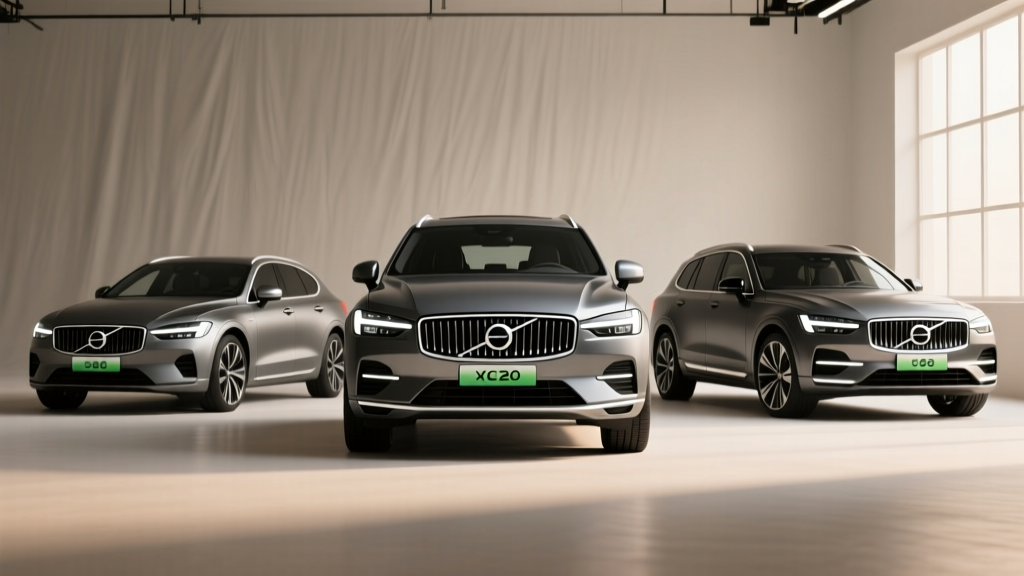
Volvo has committed fully to plug-in hybrid technology as a bridge between conventional gas engines and pure battery-electric vehicles. For 2026, the brand's "Recharge" badge marks every plug-in hybrid electric vehicle (PHEV) in its lineup — spanning the three-row XC90, the midsize XC60 SUV, the S60 sedan, and the V60 wagon. These aren't mild hybrids that simply recapture braking energy; they're serious PHEVs with 18.8 kWh battery packs, 35 to 41 miles of electric-only driving, and combined outputs reaching 455 horsepower.
If you've been searching for a Volvo hybrid plug in option, the Recharge models represent some of the most capable luxury PHEVs on the market. But understanding which one fits your commute, whether you'll actually plug in regularly, and how federal tax incentives apply requires digging into the specs. This guide breaks down every current Volvo PHEV with exact numbers — no marketing fluff.
HEV vs PHEV: What Volvo Actually Sells
Before we get into specific models, let's clarify a common source of confusion. Volvo's current US lineup includes two types of electrified powertrains:
Conventional Hybrid (HEV) — Volvo's "B" Models
Models like the XC90 B6 and XC60 B5 use a 48-volt mild-hybrid system. A small integrated starter generator assists the gas engine during acceleration and enables start-stop functionality. You never plug these in. They recover energy through regenerative braking and improve fuel economy by roughly 1–2 MPG over a non-hybrid equivalent. Battery capacity is under 1 kWh — these are efficiency assists, not electric-drive systems.
Plug-In Hybrid (PHEV) — Volvo's "Recharge" Models
Recharge models carry a much larger 18.8 kWh lithium-ion battery pack and a dedicated rear-axle electric motor producing 143 hp. You plug these in to a Level 1 (120V) or Level 2 (240V) charger. They can drive 35–41 miles on electricity alone before the 2.0L turbocharged gas engine engages. Total system output reaches 455 hp in the T8 AWD powertrain. These are the vehicles we're covering in depth here.
The distinction matters enormously for your daily driving. A mild hybrid (HEV) will save you a small amount at the pump. A PHEV, charged nightly, can eliminate gasoline entirely for commutes under 40 miles round-trip — while retaining a gas engine for road trips with no range anxiety.
2026 Volvo Recharge PHEV Specs: Side-by-Side
| Specification | XC90 Recharge | XC60 Recharge | S60 Recharge | V60 Recharge |
|---|---|---|---|---|
| Powertrain | 2.0L Turbo + Rear E-Motor (T8 AWD) | 2.0L Turbo + Rear E-Motor (T8 AWD) | 2.0L Turbo + Rear E-Motor (T8 AWD) | 2.0L Turbo + Rear E-Motor (T8 AWD) |
| Combined Horsepower | 455 hp | 455 hp | 455 hp | 455 hp |
| Combined Torque | 523 lb-ft | 523 lb-ft | 523 lb-ft | 523 lb-ft |
| Battery (Usable) | 18.8 kWh (NMC) | 18.8 kWh (NMC) | 18.8 kWh (NMC) | 18.8 kWh (NMC) |
| EPA Electric Range | 35 miles | 35 miles | 41 miles | 38 miles |
| Total Combined Range | ~470 miles | ~480 miles | ~520 miles | ~500 miles |
| 0–60 mph | 5.0 sec | 4.5 sec | 4.3 sec | 4.4 sec |
| Level 2 Charge Time (0–100%) | ~5 hours (3.7 kW) | ~5 hours (3.7 kW) | ~5 hours (3.7 kW) | ~5 hours (3.7 kW) |
| DC Fast Charge | No | No | No | No |
| Drivetrain | eAWD | eAWD | eAWD | eAWD |
| Starting MSRP (2026) | $78,150 | $60,350 | $52,350 | $55,350 |
Source: Volvo Cars USA official specifications. Pricing excludes destination charge. Verify current MSRP with your dealer as trim packages update throughout the model year.
Fuel Economy: EPA MPG and Real-World Expectations
Volvo's PHEV fuel economy numbers require careful interpretation because they depend heavily on how often you charge. The EPA reports two separate figures: MPGe (miles per gallon equivalent) when running primarily on electricity, and MPG when the gas engine is active.
| Model | EPA Combined MPGe (Charge-Depleting) | EPA Combined MPG (Gas Only) | EPA City / Hwy MPG (Gas) |
|---|---|---|---|
| XC90 Recharge | 58 MPGe | 27 MPG | 26 city / 28 hwy |
| XC60 Recharge | 63 MPGe | 28 MPG | 27 city / 29 hwy |
| S60 Recharge | 69 MPGe | 30 MPG | 30 city / 31 hwy |
| V60 Recharge | 66 MPGe | 29 MPG | 28 city / 30 hwy |
Fuel economy data via fueleconomy.gov (EPA). Verify exact figures for your trim, as wheel size and options affect ratings.
Real-World MPG: What to Actually Expect
If you charge nightly and commute under 35 miles: You'll burn almost zero gasoline on weekdays. Weekend road trips use the gas engine at 27–30 MPG combined. Annual fuel cost drops dramatically — potentially under $400/year for a 12,000-mile driver who charges at home.
If you never plug in: You're carrying 500+ lbs of battery and electric motor dead weight. Expect gas-only MPG to land at or slightly below EPA estimates — roughly 25–27 MPG combined in the XC90, 26–28 in the XC60. At that point, a mild-hybrid B5 or B6 model makes more financial sense.
Cold weather note: Electric-only range drops 15–25% in freezing temperatures due to cabin heating demands and reduced battery efficiency. A 35-mile EPA electric range may shrink to 26–30 miles in sub-30°F conditions. The gas engine will engage sooner to provide heat.
Charging: Level 1, Level 2, and the DC Fast-Charge Limitation
Every Volvo Recharge PHEV uses a J1772 connector for AC charging. Here's what charging looks like in practice:
| Charging Level | Power (kW) | Time to Full (18.8 kWh) | Practical Use Case |
|---|---|---|---|
| Level 1 (120V household outlet) | ~1.4 kW | ~13–14 hours | Overnight top-up if no Level 2 available |
| Level 2 (240V, 16A) | ~3.7 kW | ~5 hours | Standard home charging — full overnight |
| Level 2 (240V, 32A) | ~3.7 kW (vehicle-limited) | ~5 hours | Faster Level 2 EVSE won't charge faster — onboard charger caps at 3.7 kW |
| DC Fast Charge | N/A | N/A | Not supported on any Volvo PHEV |
The 3.7 kW onboard charger is the key bottleneck. Even if you plug into a 48A Level 2 station capable of delivering 11.5 kW, the Volvo's onboard charger will only accept 3.7 kW. This means a full charge always takes about five hours regardless of your Level 2 equipment. For most owners this isn't a problem — you plug in when you get home and wake up to a full battery. But it does mean you can't "top up" quickly at a public charger during a lunch break.
The absence of DC fast charging is standard across nearly all PHEVs in this class. BMW's X5 xDrive50e and the Toyota RAV4 Prime also lack DCFC. It's a tradeoff for the smaller battery — the engineering cost and weight of DC fast-charge hardware isn't justified on an 18.8 kWh pack.
Battery Warranty, Longevity, and Replacement Costs
Volvo PHEV Battery Warranty
Coverage: 8 years / 100,000 miles (whichever comes first)
Capacity retention guarantee: Volvo warrants the high-voltage battery against defects and excessive capacity loss. The industry-standard threshold is 70% of original capacity during the warranty period. If your battery degrades below this level within 8 years/100k miles, Volvo will repair or replace it at no cost.
Out-of-warranty replacement cost: Based on current dealer pricing and third-party hybrid specialists, a full high-voltage battery replacement for a Volvo T8 Recharge PHEV runs between $9,000 and $14,000 including parts and labor. However, module-level repair (replacing individual degraded cells rather than the full pack) can reduce this to $3,000–$6,000 at a qualified hybrid shop.
In practice, Volvo's PHEV batteries have shown strong longevity. The 18.8 kWh pack uses NMC (nickel manganese cobalt) chemistry with active liquid thermal management — the same cooling system that protects the battery during hot-weather driving and charging. Real-world data from high-mileage T8 owners suggests 8–12% degradation over the first 5 years of regular use, which is within normal expectations for a well-managed NMC pack.
The conventional hybrid components (12V battery, starter generator on B-models) carry separate warranty coverage. The 12V battery is a standard automotive battery with a typical 3–4 year lifespan and $200–$350 replacement cost — identical to any other vehicle.
Tax Credits and Incentives for Volvo PHEVs
Federal tax credit eligibility for plug-in hybrids has become significantly more complex under current IRS §30D rules. Here's where Volvo's Recharge models stand for 2026:
- Battery capacity requirement: ✓ All Recharge PHEVs exceed the 7 kWh minimum (18.8 kWh usable)
- MSRP cap: SUVs (XC90, XC60) must be under $80,000; sedans/wagons (S60, V60) under $55,000. Most XC90 Recharge trims exceed the $80,000 cap. The XC60 Recharge, S60 Recharge, and base V60 Recharge trims fall within limits — but higher trims may exceed them.
- Buyer income cap: Modified AGI must not exceed $150,000 (single), $225,000 (head of household), or $300,000 (joint filing)
- Battery component sourcing: A percentage of battery components must be manufactured or assembled in North America, and critical minerals must meet sourcing thresholds. These percentages increase annually. Check the IRS clean vehicle credit page for current-year sourcing requirements.
- Point-of-sale transfer: Eligible buyers can transfer the credit to the dealer at purchase, reducing the sale price directly rather than waiting for a tax refund.
The practical upshot: the XC60 Recharge and S60 Recharge are the most likely to qualify for a partial or full federal credit, depending on your income and the specific trim's MSRP. The XC90 Recharge's base price of $78,150 leaves narrow room under the $80,000 SUV cap, but adding packages can push it over. Always verify your specific VIN's eligibility on fueleconomy.gov before purchasing.
Many states offer additional PHEV incentives — California's CVRP, Colorado's state credit, and various utility company rebates can stack on top of federal credits. Check your state energy office and local utility for current programs.
Who Should Buy a Volvo PHEV — And Who Shouldn't
Pros
- 35–41 miles of zero-emission electric commuting covers most daily driving
- 455 hp provides genuine performance — the XC60 Recharge hits 60 mph in 4.5 seconds
- No range anxiety on road trips — gas engine provides 400+ miles of total range
- eAWD system with electric rear axle provides confident all-weather traction
- Premium Scandinavian interior, Google built-in infotainment, Pilot Assist ADAS
- Lower running costs than gas-only equivalents when charged regularly
Cons
- No DC fast charging — 5-hour Level 2 charge time is fixed
- $52,000–$78,000+ pricing puts these firmly in luxury territory
- XC90 Recharge trims often exceed the $80,000 federal tax credit MSRP cap
- 3.7 kW onboard charger is slow compared to some competitors (RAV4 Prime accepts 6.6 kW)
- Electric range drops 15–25% in freezing weather
- If you don't plug in regularly, you're carrying dead battery weight and getting mediocre MPG
Choose a Volvo Recharge PHEV If:
- Your daily round-trip commute is under 35–40 miles and you can charge at home nightly
- You take regular road trips and don't want to plan around charging infrastructure
- You want luxury features and performance without committing to a full EV
- You live in a cold climate where EV range loss is a genuine concern
- You want AWD capability with electric torque to the rear wheels
Choose a Full EV (Like the Volvo EX90 or EX40) Instead If:
- You have reliable home charging and your daily driving is under 250 miles
- You want the lowest possible operating cost (no oil changes, fewer moving parts)
- You want DC fast charging for road trips (150–250 kW capability)
- You want to maximize federal and state EV incentives
Choose a Conventional Hybrid (Volvo B5/B6) Instead If:
- You cannot charge at home or at work (apartment, street parking)
- Your budget is below $50,000
- You want a simpler ownership experience with no plug-in routine
Volvo PHEV Reliability: What Owners Report
Volvo's T8 powertrain has been in production since 2015, giving it one of the longest track records among luxury PHEVs. The twin-engine layout — gas engine driving the front wheels, electric motor driving the rear — is mechanically straightforward compared to some competitors' complex transmission-integrated hybrid systems.
Common reliability considerations based on owner forums and repair data:
- High-voltage battery: Few reported failures. Liquid-cooled thermal management contributes to longevity. Most degradation complaints involve 8–10% range loss over 4–5 years — within warranty tolerance.
- Onboard charger: The 3.7 kW charger is a proven, low-stress component. Failures are rare.
- Turbocharged 2.0L engine: Volvo's Drive-E four-cylinder has been in use across the lineup since 2014. It's well-understood by technicians. Standard maintenance (oil changes every 10,000 miles, timing chain inspection at high mileage) applies.
- Electronics/software: Google built-in infotainment (introduced 2022+) has drawn some complaints about responsiveness. Over-the-air updates continue to address bugs.
For reliability ratings, check IIHS crash-test scores (Volvo consistently earns Top Safety Pick+ designations) and consult owner surveys from Consumer Reports and J.D. Power for model-year-specific data.
Frequently Asked Questions
How many MPG does a Volvo plug-in hybrid get?
On gasoline alone (after the battery is depleted), Volvo Recharge PHEVs achieve 27–30 MPG combined depending on the model — the S60 Recharge leads at 30 MPG combined, while the three-row XC90 Recharge returns 27 MPG. When factoring in electric driving, the EPA rates them at 58–69 MPGe. Your real-world number depends entirely on how often you charge. Charge nightly with a short commute, and you may use 10–15 gallons of gas per month. Never charge, and you'll see 25–28 MPG.
How far can a Volvo Recharge go on electric only?
The EPA electric-only range varies by model: the S60 Recharge leads at 41 miles, the V60 Recharge achieves 38 miles, and both the XC60 and XC90 Recharge deliver 35 miles. In real-world driving at highway speeds or in cold weather, expect 15–25% less — roughly 26–35 miles depending on conditions. The electric motor drives the rear axle exclusively in Pure (EV) mode, providing smooth, silent acceleration up to about 78 mph before the gas engine assists.
Does the Volvo plug-in hybrid qualify for a tax credit?
Potentially, but it depends on the model, trim, your income, and current battery-sourcing rules. The S60 Recharge and XC60 Recharge are most likely to qualify because their MSRPs fall under the IRS §30D caps ($55,000 for sedans, $80,000 for SUVs). The XC90 Recharge often exceeds the SUV cap once options are added. All buyers must also meet income limits ($150K single / $300K joint). Check IRS.gov and fueleconomy.gov for your specific VIN's eligibility before purchase. Consult a tax professional for personalized guidance.
Is the Volvo PHEV battery reliable, and what does replacement cost?
Volvo's 18.8 kWh battery is covered by an 8-year/100,000-mile warranty against defects and excessive degradation (typically defined as dropping below 70% capacity). Real-world data shows 8–12% degradation over 5 years of regular use — well within warranty limits. Out-of-warranty full replacement costs $9,000–$14,000, but module-level repair at a hybrid specialist can reduce this to $3,000–$6,000. With proper thermal management and regular use, these batteries typically outlast the vehicle's first ownership cycle.
Can I charge a Volvo PHEV at a public DC fast charger?
No. Volvo Recharge PHEVs do not support DC fast charging. The vehicle is equipped with a J1772 AC charging port only, with a 3.7 kW onboard charger. You can charge at any public Level 2 station (240V), but a full charge will still take approximately 5 hours. For quick top-ups during the day, this isn't practical — the system is designed for overnight home charging.
What's the difference between Volvo's B5/B6 hybrid and the T8 Recharge?
The B5 and B6 are mild hybrids (HEVs) with a 48-volt system that assists the gas engine but cannot drive the car on electricity alone. You never plug them in. The T8 Recharge is a plug-in hybrid (PHEV) with a large 18.8 kWh battery, a dedicated 143-hp rear electric motor, and 35–41 miles of electric-only range. The T8 produces 455 combined horsepower versus 247–295 hp in the B5/B6. The T8 costs significantly more but eliminates gas use on short commutes when charged regularly.