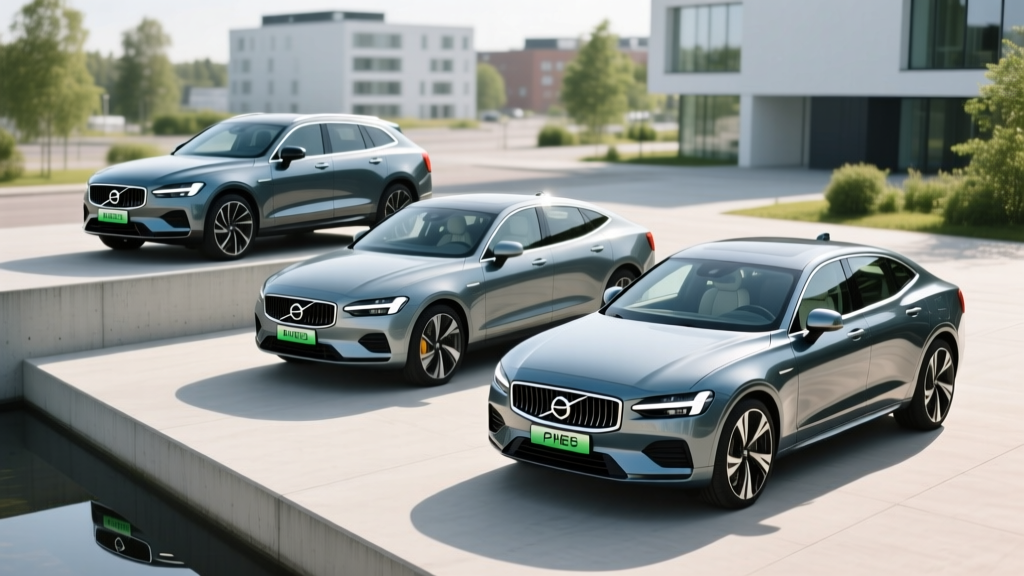
Volvo's 2026 lineup has fully committed to its "Recharge" plug-in hybrid strategy, offering PHEV variants across its entire core range. Unlike many legacy automakers still selling conventional hybrids alongside PHEVs, Volvo exclusively offers plug-in hybrids in the U.S. market — meaning every Volvo hybrid you can buy today has a charge port and meaningful electric-only range. If you're researching Volvo hybrid models to find the right balance of electric commuting and gas-powered road-trip flexibility, this guide breaks down every current option with exact EPA figures, real-world expectations, and ownership economics.
Volvo's PHEV Strategy: Why Every Volvo Hybrid Is a Plug-In
Volvo does not sell conventional hybrids (HEVs) in the United States for the 2026 model year. Every electrified Volvo uses a plug-in hybrid (PHEV) architecture branded as "Recharge" (formerly "T8" or "Twin Engine"). This matters because the distinction changes everything about daily ownership:
Conventional Hybrid (HEV)
- No charge port — battery charges via regenerative braking and engine
- Small battery (~1-2 kWh), electric assist only at low speeds
- No electric-only driving range of consequence
- No federal tax credit eligibility
- Example: Toyota RAV4 Hybrid
Plug-In Hybrid (PHEV) — Volvo Recharge
- Charge port — plug into Level 1 (120V) or Level 2 (240V) power
- Larger battery (~18.8 kWh usable), enabling 35-41 miles electric-only
- Full electric driving at highway speeds before engine engages
- May qualify for up to $7,500 federal tax credit (subject to §30D rules)
- Example: Volvo XC60 Recharge
Volvo's PHEV powertrain pairs a 2.0-liter turbocharged (and in some trims, supercharged) four-cylinder engine with an electric motor integrated into the rear axle, delivering all-wheel drive. The combined system output ranges from 455 to 462 horsepower depending on the model — making these some of the most powerful PHEVs in their respective segments.
2026 Volvo Hybrid Models: Full Lineup at a Glance
| Model | Body Style | Combined HP | Battery (kWh usable) | EPA Electric Range | EPA MPGe | 0-60 mph | Base MSRP |
|---|---|---|---|---|---|---|---|
| XC60 Recharge | Compact SUV | 455 hp | 18.8 kWh | 35 mi | 63 MPGe | 4.5 sec | $58,950 |
| XC90 Recharge | Midsize 3-Row SUV | 455 hp | 18.8 kWh | 33 mi | 58 MPGe | 4.9 sec | $73,350 |
| S60 Recharge | Compact Sedan | 455 hp | 18.8 kWh | 41 mi | 69 MPGe | 4.3 sec | $54,050 |
| S90 Recharge | Full-Size Sedan | 455 hp | 18.8 kWh | 38 mi | 66 MPGe | 4.4 sec | $69,850 |
| V60 Recharge | Compact Wagon | 455 hp | 18.8 kWh | 35 mi | 64 MPGe | 4.3 sec | $56,400 |
All five models share Volvo's SPA (Scalable Product Architecture) platform and the same 18.8 kWh usable lithium-ion battery pack. The variation in electric range comes down to vehicle weight, aerodynamics, and tire rolling resistance. The lighter, sleeker S60 sedan extracts the most electric miles; the heavier three-row XC90 the fewest.
Electric-Only Range and Fuel Economy Breakdown
The headline number for any PHEV is how far it travels on electricity alone before the gas engine starts. According to fueleconomy.gov, Volvo's 2026 Recharge models deliver between 33 and 41 miles of EPA-rated electric range. For context, the average American commute is roughly 16 miles each way, meaning most Recharge owners can complete their daily driving entirely on battery power.
| Model | Electric Range (EPA) | Combined MPGe (Electric + Gas) | Gas-Only MPG (City/Hwy/Combined) | Total Range (Est.) |
|---|---|---|---|---|
| XC60 Recharge | 35 mi | 63 MPGe | 27 / 28 / 27 | ~520 mi |
| XC90 Recharge | 33 mi | 58 MPGe | 25 / 27 / 26 | ~510 mi |
| S60 Recharge | 41 mi | 69 MPGe | 30 / 33 / 31 | ~550 mi |
| S90 Recharge | 38 mi | 66 MPGe | 28 / 30 / 29 | ~540 mi |
| V60 Recharge | 35 mi | 64 MPGe | 28 / 29 / 28 | ~520 mi |
Real-World Electric Range vs. EPA Sticker
EPA electric-range estimates for Volvo Recharge models are generally achievable in mild weather (55-75°F) with moderate driving. Expect 10-20% range reduction in cold weather (below 32°F) due to battery chemistry limitations and cabin heating demands. Highway-speed electric driving (70+ mph) will also reduce range below the EPA figure, as the test cycle includes significant city and low-speed segments. In our experience, a 35-mile EPA rating typically yields 28-32 real-world electric miles in winter and 33-37 miles in ideal conditions.
Charging the Volvo Recharge Battery: What You Need to Know
Every 2026 Volvo Recharge model uses the same 18.8 kWh usable battery pack, but charging behavior varies by equipment. Here's the critical detail many buyers miss: Volvo Recharge PHEVs do not support DC fast charging. The maximum charge rate is limited to Level 2 AC charging.
| Charging Level | Power Source | Max kW Rate | Full Charge Time (0-100%) | Practical Notes |
|---|---|---|---|---|
| Level 1 | 120V household outlet | ~1.4 kW | ~13-14 hours | Emergency use; adds ~5 mi/hr of charging |
| Level 2 | 240V home charger / public AC | ~3.7 kW | ~5 hours | Standard daily charging; overnight replenishes fully |
| DC Fast Charge | Not supported | N/A | N/A | No CCS/NACS DC port on any Volvo PHEV |
The 3.7 kW Level 2 onboard charger means you'll want a home Level 2 charging setup. A 240V outlet or dedicated wallbox will fully replenish the battery in about five hours — easily accomplished overnight. Because the battery is relatively small (compared to a full EV's 60-100+ kWh pack), even Level 1 charging can work if your daily electric driving stays under 15-20 miles and you plug in for 10+ hours each night. However, Level 2 is strongly recommended for consistent daily use.
Powertrain Deep Dive: 455 HP From a Four-Cylinder PHEV
Volvo's Recharge powertrain is one of the most potent PHEV systems on the market. The architecture combines:
- Front axle: 2.0-liter turbocharged four-cylinder engine producing approximately 312 hp and 295 lb-ft of torque
- Rear axle: Electric motor producing approximately 143 hp and 228 lb-ft of torque
- Combined system output: 455 hp and 523 lb-ft of torque
- Transmission: 8-speed automatic (Geartronic)
- Drive configuration: All-wheel drive (eAWD) — engine drives front wheels, motor drives rear
This split-axle design means the XC60 Recharge can operate as a rear-wheel-drive EV in Pure mode, a front-wheel-drive gas car when the battery is depleted, or a full AWD performance vehicle in Power mode. The 4.3-to-4.9-second 0-60 mph times across the lineup place these PHEVs firmly in performance territory — a Volvo XC60 Recharge will out-accelerate most gas-powered competitors in its class.
Volvo offers several drive modes that alter the powertrain behavior: Pure (electric-only up to ~78 mph), Hybrid (default, blends both power sources), Power (maximum combined output), and Off-Road (low-speed AWD lock for traction). The system defaults to Hybrid mode, which intelligently manages when to engage the engine based on speed, throttle input, and battery state of charge.
Pricing, Trims, and Federal Tax Credit Eligibility
Volvo Recharge models carry a price premium over their mild-hybrid (B5/B6) counterparts, typically $10,000-$13,000 more for the PHEV powertrain. Here's where each model starts for the 2026 model year:
- S60 Recharge: $54,050 (Core trim) — most affordable entry point
- V60 Recharge: $56,400 (Cross Country Core)
- XC60 Recharge: $58,950 (Core trim)
- S90 Recharge: $69,850 (Ultimate trim only)
- XC90 Recharge: $73,350 (Core trim)
§30D Federal Tax Credit Eligibility for Volvo Recharge PHEVs
Under current IRS rules, Volvo Recharge PHEVs may qualify for the federal plug-in vehicle tax credit, but eligibility depends on multiple factors that change regularly. Key requirements include:
- MSRP cap: SUVs (XC60, XC90) must be under $80,000; sedans/wagons (S60, S90, V60) must be under $55,000. Higher trims may exceed the cap.
- Buyer income cap: Modified AGI must not exceed $150,000 (single), $225,000 (head of household), or $300,000 (joint filers).
- Battery sourcing: Critical minerals and battery components must meet phased-in domestic/free-trade sourcing requirements. Volvo's supply chain has been adjusting to these rules — verify current eligibility at the point of sale.
- Point-of-sale transfer: As of 2024+, eligible buyers can transfer the credit to the dealer at purchase, reducing the upfront price rather than waiting for a tax refund.
Always confirm current eligibility with your dealer and a tax professional. Check the latest rules at IRS.gov and the DOE's fueleconomy.gov tax credit page.
For the S60 Recharge starting at $54,050, the sedan sits just under the $55,000 MSRP cap for non-SUVs — but adding options or choosing higher trims will push it above the threshold. The XC60 and XC90, classified as SUVs, benefit from the higher $80,000 cap, making most trim levels eligible on price alone. The S90 Recharge at $69,850 exceeds the $55,000 sedan cap and will not qualify for the federal credit.
Battery Warranty, Reliability, and Long-Term Ownership
Volvo covers its PHEV battery packs with an 8-year/100,000-mile warranty (whichever comes first), which is standard for the industry and meets the minimum requirement under EPA/CARB guidelines for advanced-technology components. The warranty guarantees that the battery will retain a minimum percentage of its original capacity — typically 70% — over the warranty period.
Volvo Recharge PHEV Battery Warranty
- Coverage: 8 years / 100,000 miles
- Capacity retention guarantee: ~70% of original capacity
- Replacement cost (out of warranty): Estimated $8,000-$12,000 for the battery pack, plus labor
- Powertrain warranty: 4 years / 50,000 miles (engine, transmission, motor)
- Basic vehicle warranty: 4 years / 50,000 miles
The 18.8 kWh battery is significantly smaller than a full EV pack, meaning lower replacement cost if needed. PHEV batteries also experience less extreme cycling than EV batteries since the gas engine serves as a backup — reducing degradation stress.
Volvo's reliability ratings have been mixed in recent years. The brand typically scores average to slightly below average in Consumer Reports reliability surveys, with infotainment software issues and minor electrical gremlins being the most common complaints rather than powertrain failures. The PHEV system itself — the battery, motor, and power electronics — has proven robust across Volvo's Recharge lineup since the architecture launched for the 2023 model year.
For long-term ownership beyond the warranty period, the smaller PHEV battery is an advantage: replacement cost is a fraction of what a full EV battery would require, and the gas engine ensures you're never stranded even if battery capacity degrades significantly after 10-15 years.
Who Should Choose a Volvo Recharge PHEV?
Choose a Volvo Recharge PHEV if:
- You can install a Level 2 home charger and want 30-40 miles of daily electric commuting
- You regularly take road trips exceeding 200+ miles where charging infrastructure is uncertain
- You want luxury-brand refinement and Scandinavian design with electrified efficiency
- You need AWD capability (all Recharge models are eAWD)
- You want strong performance (455 hp) alongside efficiency
Choose a full EV instead if:
- You want zero gasoline purchases and minimal maintenance (no oil changes, no engine)
- Your daily driving is under 250 miles and you have reliable home + destination charging
- You want DC fast charging for road trips (Volvo PHEVs don't support it)
- You want maximum federal/state incentives (full EVs have broader credit eligibility)
Choose a conventional hybrid (non-plug-in) instead if:
- You cannot install any home charging (apartment, street parking, no garage)
- You want hybrid efficiency without ever thinking about plugging in
- Your budget is tighter — conventional hybrids start $10,000+ lower
The Volvo Recharge PHEV is ideal for the homeowner with a garage or dedicated parking spot who wants the electric-commute experience Monday through Friday but demands the freedom to drive from Denver to Aspen without planning charging stops. It's also well-suited to buyers in colder climates where EV range loss is a genuine concern — the gas engine provides a safety net that pure EVs cannot match in sub-zero temperatures.
Pros
- 35-41 miles of real electric range covers most commutes
- 455 hp makes these genuinely quick vehicles
- Standard eAWD across the lineup
- Premium Scandinavian interior with Google-based infotainment
- No range anxiety — gas engine extends total range past 500 miles
- Potential federal tax credit up to $7,500 (model/trim dependent)
Cons
- No DC fast charging — limited to 3.7 kW Level 2
- Premium pricing — $54K-$73K starting MSRP
- Higher trims exceed §30D MSRP caps, eliminating tax credit
- Reliability ratings trail Japanese competitors
- Small cargo area reduction vs. gas-only versions (battery placement)
- Maintenance complexity of two full powertrains
Frequently Asked Questions About Volvo Hybrid Models
How many MPG does a Volvo hybrid get?
When the battery is depleted and the car runs on gasoline alone, Volvo Recharge PHEVs achieve 26-31 MPG combined depending on the model. The S60 Recharge sedan leads at 31 MPG combined (30 city/33 highway), while the three-row XC90 Recharge returns 26 MPG combined (25 city/27 highway). When factoring in electric driving, the combined MPGe ratings range from 58 MPGe (XC90) to 69 MPGe (S60).
How far can a Volvo PHEV go on electric only?
EPA-rated electric-only range spans 33 miles (XC90 Recharge) to 41 miles (S60 Recharge). Real-world electric range depends on temperature, driving style, and speed — expect 28-37 miles in typical conditions. In cold weather below freezing, plan for roughly 25-32 miles from a full charge.
Does the Volvo Recharge qualify for a tax credit?
It depends on the specific model, trim level, and your income. SUV-classified models (XC60, XC90) have an $80,000 MSRP cap; sedans and wagons (S60, S90, V60) have a $55,000 cap. The S90 Recharge at $69,850 exceeds the sedan cap and does not qualify. Other models may qualify for up to $7,500 depending on battery sourcing requirements and buyer income limits. Always verify current eligibility at IRS.gov before purchasing.
Is the Volvo PHEV battery reliable and what does replacement cost?
Volvo covers the PHEV battery for 8 years/100,000 miles with a ~70% capacity retention guarantee. Out-of-warranty replacement is estimated at $8,000-$12,000 — significantly less than a full EV battery due to the smaller 18.8 kWh pack. The PHEV battery undergoes less stress than a full EV battery since the gas engine reduces deep-cycling frequency. Most owners report minimal degradation in the first 3-5 years of ownership.
Can I charge a Volvo Recharge at a Tesla Supercharger or public DC fast charger?
No. Volvo Recharge PHEVs do not have DC fast-charging capability. They can only charge via Level 1 (120V) or Level 2 (240V) AC charging. You cannot use Tesla Superchargers, Electrify America DC stalls, or any other DC fast-charging network. Public Level 2 chargers (ChargePoint, EVgo Level 2, etc.) are compatible using the standard J1772 connector.
Do I have to plug in a Volvo Recharge, or does it charge itself?
You must plug it in to access the electric range. While regenerative braking does recover small amounts of energy during driving, it will not meaningfully recharge the 18.8 kWh battery. Without plugging in, you're essentially driving a heavy conventional hybrid and forfeiting the primary advantage of PHEV ownership. If you cannot charge at home or work, a conventional hybrid (non-plug-in) is a better choice.