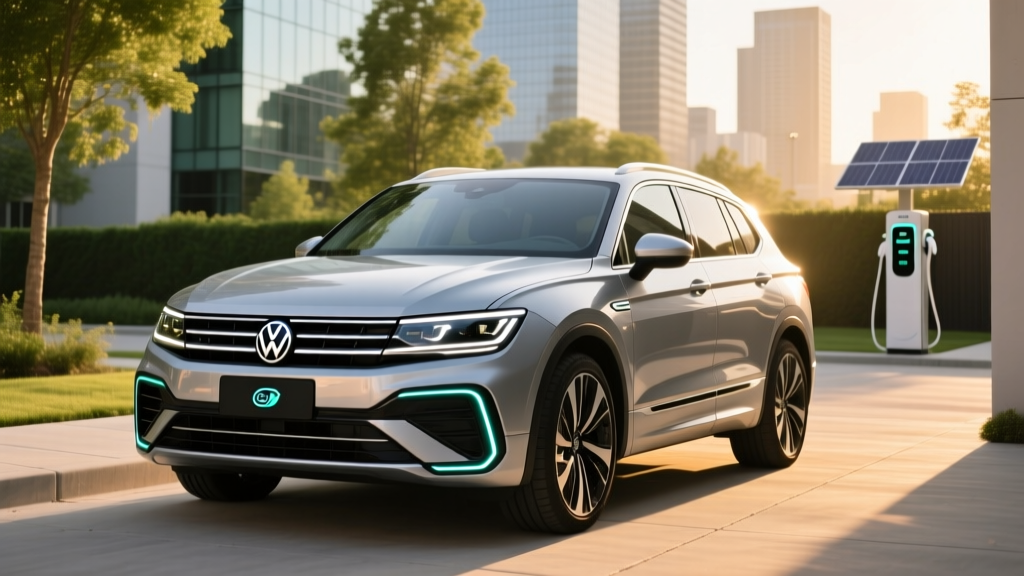
Volkswagen's approach to electrification in the United States has been almost entirely battery-electric, with the ID.4 crossover leading the charge. But for buyers who want electrified efficiency without committing to a plug-only lifestyle, the 2026 Volkswagen Tiguan eHybrid represents the brand's most compelling plug-in hybrid SUV option. Built on the third-generation Tiguan platform that debuted globally for the 2025 model year, the eHybrid variant pairs a turbocharged four-cylinder with an electric motor and a battery large enough to handle most daily commutes on electricity alone.
Here's everything you need to know about the Tiguan eHybrid — from its real-world electric range and fuel economy to pricing, tax-credit eligibility, and how it stacks up against going fully electric or sticking with a conventional hybrid.
HEV vs PHEV: Understanding What the Tiguan eHybrid Actually Is
Before diving into specs, it's critical to distinguish between the two hybrid flavors Volkswagen offers globally:
Conventional Hybrid (HEV) — e.g., mild-hybrid Tiguan eTSI (Europe only)
- How it works: A small electric motor assists the gas engine during acceleration and enables stop-start coasting. The battery recharges solely from regenerative braking and the engine — no plug, no cord.
- Electric-only driving: None (or negligible, at very low speeds for short distances).
- Fuel economy benefit: Modest — typically 2–5 MPG improvement over a gas-only equivalent.
Plug-in Hybrid (PHEV) — Tiguan eHybrid
- How it works: A larger battery (19.7 kWh usable) powers a dedicated electric motor for extended zero-emission driving. You plug it in to recharge — via a standard Level 1 outlet or a 240V Level 2 home charger — and the gas engine kicks in seamlessly when the battery depletes or you demand hard acceleration.
- Electric-only driving: EPA-rated at approximately 35 miles — enough for most commutes, school runs, and errands.
- Fuel economy benefit: Major — 34 MPG combined when operating as a hybrid after the battery is depleted, plus zero fuel use on short electric-only trips.
The Tiguan eHybrid sold in the U.S. is the PHEV variant. Volkswagen does not currently sell a conventional HEV Tiguan in the American market — if you see references to a "Tiguan hybrid" without the plug, that's likely the European mild-hybrid eTSI, which is not available stateside.
Powertrain, Performance, and Driving Dynamics
| Specification | 2026 Tiguan eHybrid |
|---|---|
| Engine | 1.5L turbocharged inline-4 (EA211 evo2) |
| Engine Output | 174 hp / 184 lb-ft |
| Electric Motor | Integrated into DSG transmission |
| Motor Output | 114 hp / 258 lb-ft |
| Combined System Output | 242 hp / 295 lb-ft |
| Transmission | 6-speed DSG automatic (dedicated hybrid variant) |
| Drivetrain | Front-wheel drive (FWD standard); 4MOTION AWD available on select trims |
| 0–60 mph | ~7.2 seconds (estimated) |
| Battery (Usable) | 19.7 kWh (lithium-ion NMC) |
| EPA Electric-Only Range | ~35 miles |
| Total Combined Range | ~440 miles (gas + electric) |
The 1.5L EA211 evo2 engine is Volkswagen's latest-generation Miller-cycle turbo four, designed specifically for hybrid duty. It operates at high thermal efficiency by closing the intake valves early, reducing pumping losses. Combined with the electric motor integrated into the DSG gearbox housing, the system delivers 242 horsepower — a meaningful step up from the gas-only Tiguan's 184 hp and enough to make highway merging and passing feel confident.
On the road, the eHybrid defaults to electric mode when the battery has charge. The transition from electric to gas is well-managed — you'll feel a faint vibration through the pedal when the engine fires, but it's far less intrusive than older PHEV systems. Regenerative braking is adjustable via steering-wheel paddles or the B-mode shifter position, though it doesn't quite achieve true one-pedal driving at a full stop the way a dedicated BEV like the ID.4 can.
Fuel Economy and Real-World Efficiency
| Driving Mode | City | Highway | Combined |
|---|---|---|---|
| Charge-Sustaining (Hybrid Mode, battery depleted) | 36 MPG | 32 MPG | 34 MPG |
| Electric-Only | ~110 MPGe (estimated) | ||
Those EPA figures apply when the battery is fully depleted and the Tiguan operates as a conventional hybrid. In practice, most owners who plug in nightly will burn far less fuel than those numbers suggest. If your daily round-trip commute is under 35 miles and you charge at home, you might go weeks without the engine running at all — aside from the occasional maintenance mode the car triggers to keep the engine lubricated.
Charging: What You Need to Plug In
The Tiguan eHybrid uses a J1772 connector for AC charging (the standard for all non-Tesla plug-in vehicles in North America). Here's what charging looks like in practice:
| Charging Level | Power (kW) | 0–100% Time | Setup |
|---|---|---|---|
| Level 1 (120V household outlet) | ~1.4 kW | ~14 hours | Included portable cord; any standard outlet |
| Level 2 (240V home or public charger) | ~3.6 kW (onboard charger limit) | ~5.5 hours | Requires 240V outlet or hardwired Level 2 station |
| DC Fast Charging | Not supported — no CCS DC inlet on PHEV models | ||
A critical point: the Tiguan eHybrid does not support DC fast charging. The onboard AC charger is capped at approximately 3.6 kW, which is typical for PHEVs with sub-20 kWh batteries. This means public fast-charging networks like Electrify America or Tesla Superchargers are irrelevant to this vehicle — you'll charge exclusively at home or at slower public Level 2 destinations (workplaces, shopping centers, hotels).
For most PHEV owners, a dedicated Level 2 home charger is the sweet spot. A full overnight charge in 5.5 hours means you can plug in when you get home at 6 PM and wake up to a full battery by midnight. If you're only topping up from 50%, you're looking at under 3 hours.
Level 2 home charger installation typically costs $500–$1,500 for the equipment and electrician labor, assuming your electrical panel has spare capacity. If you need a panel upgrade from 100A to 200A, add $1,500–$3,000. Always get a quote from a licensed electrician before committing.
Pricing, Trims, and Tax Credit Eligibility
| Trim | MSRP (estimated) | Key Features |
|---|---|---|
| SE R-Line Black eHybrid | ~$42,990 | 19" wheels, panoramic roof, IQ.DRIVE assist, leatherette |
| SEL R-Line eHybrid | ~$46,500 | 20" wheels, Nappa leather, Harman Kardon audio, HUD |
Volkswagen positions the Tiguan eHybrid as a premium compact SUV option, pricing it roughly $5,000–$7,000 above the gas-only Tiguan equivalent trims. That premium buys you the larger battery, electric motor, and the efficiency gains that come with them.
Federal Tax Credit: Does It Qualify?
Under IRS §30D rules for the 2026 tax year, the Tiguan eHybrid may qualify for up to $3,750 in federal tax credits — not the full $7,500. Here's why and what you need to check:
- Battery capacity: At 19.7 kWh, the Tiguan eHybrid exceeds the 7 kWh minimum for PHEVs ✓
- Vehicle weight: Under 14,000 lbs GVWR ✓
- MSRP cap: SUVs must be priced under $80,000 ✓
- Buyer income cap: AGI must not exceed $150,000 (single) / $300,000 (joint) ✓ (check your situation)
- Critical minerals requirement: Must source ≥80% of battery critical minerals from the U.S. or FTA partners — this is where the Tiguan eHybrid likely falls short of the full $7,500, qualifying for only the $3,750 battery-component half of the credit
- Final assembly: Must be assembled in North America — verify the specific VIN on the EPA/DOE tax credit lookup tool
- Point-of-sale transfer: As of 2024, eligible buyers can transfer the credit to the dealer at purchase, reducing the purchase price directly rather than waiting for a tax refund
Caveat: Tax credit eligibility changes based on battery sourcing rules and manufacturer qualification. Always verify current status at IRS.gov and consult a tax professional before relying on credit amounts in your purchase decision.
Battery Longevity, Warranty, and Replacement Costs
Volkswagen PHEV Battery Warranty
- Coverage: 8 years / 100,000 miles (whichever comes first)
- Capacity threshold: VW warrants that the high-voltage battery will retain at least 70% of its original usable capacity during the warranty period
- What's covered: Defects, excessive degradation below the 70% threshold, and cell/module failures
- What's not covered: Damage from accidents, improper charging, or modifications
PHEV batteries experience less stress than full-EV batteries because they operate in a narrower state-of-charge window — the car's software typically buffers the top and bottom 10–15% to prevent deep cycling. This means a 19.7 kWh PHEV battery often outlasts its warranty period with minimal degradation.
Industry data from PHEVs like the Toyota RAV4 Prime and Hyundai Tucson PHEV suggest that high-voltage batteries in plug-in hybrids routinely last 12–15 years before needing replacement. When replacement is eventually needed, expect a cost in the range of $4,000–$7,000 for the battery pack, plus labor. This is significantly less than a full-EV battery replacement ($10,000–$20,000) because the PHEV pack is much smaller.
The Tiguan eHybrid's 12V auxiliary battery (the standard car battery that runs lights and electronics) is a separate component and follows typical replacement intervals of 4–6 years at $200–$350.
Who Should Buy the Tiguan eHybrid vs. a Full EV or Gas SUV?
Choose the Tiguan eHybrid if:
- You can charge at home (garage, driveway, or dedicated outlet) and your daily driving is under 35 miles round-trip
- You want to drive on electricity most days but need the flexibility of a gas engine for road trips, towing, or rural travel
- You live in an area with sparse DC fast-charging infrastructure and aren't ready to rely on public charging
- You want a compact SUV with Volkswagen's interior quality, IQ.DRIVE driver-assist features, and available AWD
Choose a full EV (like the VW ID.4) if:
- You have reliable home Level 2 charging and rarely drive more than 200 miles without stopping overnight
- You want zero tailpipe emissions, minimal maintenance (no oil changes, no spark plugs), and the lowest per-mile energy cost
- You qualify for the full $7,500 federal credit, which can make EVs cheaper to own over 5 years
Stick with a gas-only Tiguan if:
- You cannot charge at home or at work — a PHEV you never plug in is just a heavier, less efficient gas car
- Your budget is under $38,000 and the PHEV premium doesn't pencil out against your fuel savings
- You drive mostly long highway miles where the electric range provides minimal benefit
Pros and Cons at a Glance
Pros
- 35 miles of electric range covers most daily commutes without using gas
- 242 hp combined output makes it the quickest Tiguan in the lineup
- No range anxiety — gas engine provides 440+ total miles of range
- J1772 charging works at home and at virtually all public Level 2 stations
- 8-year / 100,000-mile battery warranty provides long-term peace of mind
- Premium interior with IQ.DRIVE safety technology
Cons
- No DC fast-charging capability — road-trip charging is slow (Level 2 only)
- 3.6 kW onboard charger means a full Level 2 charge takes ~5.5 hours
- Estimated $42,990 starting MSRP is a significant premium over gas Tiguan
- Likely qualifies for only $3,750 federal credit, not the full $7,500
- AWD availability may be limited to higher trims, increasing cost
- FWD-only base configuration limits appeal in snow-belt states
Frequently Asked Questions
How many MPG does the Volkswagen Tiguan eHybrid get?
When operating as a conventional hybrid with a depleted battery, the Tiguan eHybrid achieves an EPA-estimated 36 MPG city / 32 MPG highway / 34 MPG combined. In real-world city driving with frequent regenerative braking, owners typically see 37–40 MPG. Highway cruising at 75+ mph yields roughly 30–31 MPG.
How far can the Tiguan eHybrid go on electric power alone?
The EPA rates the Tiguan eHybrid at approximately 35 miles of electric-only range on a full charge. In real-world conditions — with air conditioning, passengers, and moderate acceleration — expect 30–33 miles. In cold weather below 30°F, range drops to roughly 28–31 miles due to battery chemistry limitations and cabin heating demands.
Do I have to plug in the Tiguan eHybrid?
You don't have to, but you absolutely should. If you never plug in, the Tiguan eHybrid operates as a conventional hybrid and gets about 34 MPG — which is good, but you're carrying 300+ pounds of battery and motor you're not using to their potential. The real value comes from plugging in nightly and driving on electricity for your daily commute, reducing fuel consumption by 60–80% compared to a gas-only SUV.
Is the Tiguan eHybrid reliable? What does battery replacement cost?
Volkswagen's EA211 engine family and DSG transmissions have matured significantly over the past decade, and the hybrid-specific components (electric motor, power electronics) are shared with other VW Group PHEVs that have proven durable in European markets. The high-voltage battery is warranted for 8 years / 100,000 miles at 70% capacity retention. Out-of-warranty battery replacement is estimated at $4,000–$7,000, though most PHEV batteries last well beyond their warranty period.
Does the 2026 Tiguan eHybrid qualify for a federal tax credit?
Based on current IRS §30D rules, the Tiguan eHybrid likely qualifies for up to $3,750 (the battery-component half of the credit), not the full $7,500. Eligibility depends on your income (under $150K single / $300K joint), the vehicle's MSRP (under $80K for SUVs), and North American final assembly. The credit can be transferred to the dealer at point of sale to reduce your purchase price directly. Always verify your specific eligibility at IRS.gov and with a tax professional.
How does the Tiguan eHybrid compare to the Toyota RAV4 Prime?
The RAV4 Prime remains the PHEV compact SUV benchmark with 42 miles of electric range, 302 hp, standard AWD, and a starting price around $44,000. The Tiguan eHybrid offers a more premium interior and VW's driving dynamics but trails on electric range (35 vs. 42 miles) and likely on federal tax credit eligibility. The RAV4 Prime qualifies for the full $7,500 credit (subject to income/MSRP caps), making it significantly cheaper after incentives. If maximizing electric range and tax savings is your priority, the RAV4 Prime wins. If interior refinement and highway composure matter more, the Tiguan eHybrid is compelling.
The 2026 Volkswagen Tiguan eHybrid occupies a practical middle ground: more electric than a conventional hybrid, more flexible than a full EV. For buyers with home charging access and commutes under 35 miles, it can function as an EV five days a week and a gas SUV on weekends — without the infrastructure anxiety that still accompanies battery-electric ownership in many parts of the country. Check the latest EPA fuel economy data and your state's additional incentive programs to see if the math works in your favor.