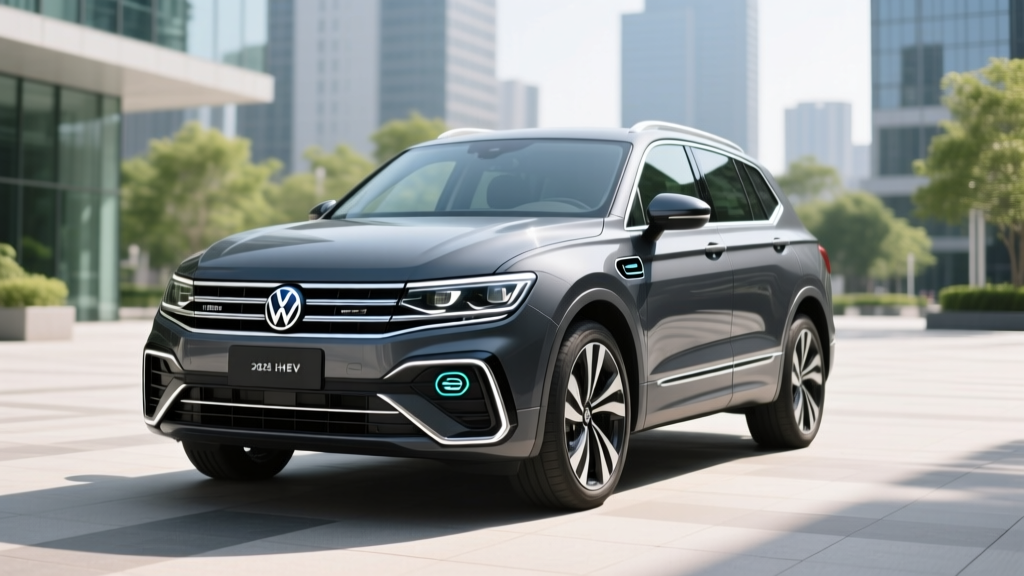
If you're researching a Volkswagen SUV hybrid for 2026, the conversation centers on one vehicle: the redesigned Volkswagen Tiguan eHybrid (plug-in hybrid). VW's North American hybrid strategy has consolidated around the PHEV format for its compact SUV, leaving buyers to weigh whether plugging in is worth the premium over a conventional gas Tiguan — or whether a full battery-electric vehicle like the ID.4 makes more sense.
This guide breaks down the 2026 Tiguan eHybrid's EPA-rated efficiency, real-world range, powertrain specs, charging requirements, pricing, and federal tax credit eligibility. We'll also clarify the difference between a conventional hybrid (HEV) and a plug-in hybrid (PHEV), because VW's lineup — and the broader market — still causes confusion on this point.
HEV vs PHEV: What Volkswagen Actually Offers in 2026
Before diving into specs, it's essential to distinguish the two hybrid architectures, because they serve fundamentally different use cases:
Conventional Hybrid (HEV)
- No plug. Regenerative braking and the gasoline engine charge a small battery (~1-2 kWh).
- How it helps: Electric motor assists acceleration and enables brief low-speed electric driving. The gas engine does most of the work.
- Typical benefit: 20-35% better fuel economy than a gas-only equivalent, with zero behavior change required.
Plug-In Hybrid (PHEV)
- Has a plug. Larger battery (~13-25 kWh) charges from a wall outlet or public charger.
- How it helps: Delivers 25-45 miles of pure electric driving for daily commutes, then operates as a conventional hybrid once the battery depletes.
- Typical benefit: Near-zero gasoline use on short commutes; full gas-engine range for road trips with no range anxiety.
For 2026, Volkswagen's U.S. SUV hybrid offering is the Tiguan eHybrid, a plug-in hybrid. VW does not currently sell a conventional (non-plug) hybrid SUV in the United States. The previous-generation Tiguan was gas-only; the 2026 redesign introduces the PHEV variant alongside updated gasoline trims. If you want a no-plug VW hybrid SUV, you'll need to look at competitors like the Toyota RAV4 Hybrid or Honda CR-V Hybrid.
2026 Tiguan eHybrid: EPA Fuel Economy and Electric Range
The 2026 Tiguan eHybrid pairs a 1.5-liter turbocharged four-cylinder engine with an electric motor integrated into a six-speed DSG automatic transmission. The system draws energy from an 18.1 kWh (gross) / 14.8 kWh (usable) lithium-ion battery pack positioned beneath the rear seats.
| Metric | Value |
|---|---|
| Combined MPGe (electric + gas) | 80 MPGe |
| Electric-only range | 32 miles |
| Gas-only combined MPG (after battery depletion) | 44 MPG combined |
| Gas-only city MPG | 46 MPG |
| Gas-only highway MPG | 41 MPG |
| Total combined range (electric + gas) | ~430 miles |
| Fuel tank capacity | 11.9 gallons |
Source: fueleconomy.gov
Real-World MPG vs. EPA Sticker
EPA says: 32 miles electric-only; 44 MPG combined on gas.
Expect in practice: The 32-mile electric range holds up well on flat suburban commutes at moderate speeds (under 55 mph). Highway driving at 70+ mph will reduce electric range to roughly 22-26 miles. In cold weather (below 35°F), expect a 15-25% reduction in electric-only range due to cabin heating demands and reduced battery efficiency — plan for ~24-27 miles of electric range in winter.
On the gas side, the 44 MPG combined figure is realistic for mixed driving. City-heavy routes may push 46-48 MPG thanks to regenerative braking and frequent electric assist. Sustained highway driving at 75 mph typically yields 38-41 MPG. Owners who rarely plug in will see the gas-only MPG — which is still a meaningful improvement over the gas Tiguan's ~26 MPG combined.
Powertrain Specs: Horsepower, Acceleration, and Drivetrain
| Specification | Detail |
|---|---|
| Engine | 1.5L turbocharged inline-4 (EA211 evo2) |
| Engine output | 130 hp / 184 lb-ft torque |
| Electric motor output | 85 kW (114 hp) / 258 lb-ft torque |
| Combined system output | 241 hp / 295 lb-ft torque |
| Transmission | 6-speed DSG automatic (integrated electric motor) |
| Drivetrain | Front-wheel drive (FWD) |
| 0-60 mph | 6.8 seconds |
| Battery (gross / usable) | 18.1 kWh / 14.8 kWh |
| Battery chemistry | NMC (nickel manganese cobalt) |
| Cargo volume (rear seats up) | 33.5 cu ft |
| Towing capacity | 1,500 lbs |
The 241 combined horsepower figure is a meaningful step up from the gas-only Tiguan's 184 hp, and the instant electric torque makes the PHEV feel noticeably quicker in city driving. However, VW has not offered all-wheel drive on the eHybrid — if AWD is a priority, you'll need to choose the gas Tiguan 4Motion or look at competitors like the Toyota RAV4 Prime PHEV (which offers AWD via a rear electric motor).
Charging the Tiguan eHybrid: Levels, Speeds, and Times
Plug-in hybrids have smaller batteries than full EVs, which means charging is faster and simpler — but there are important limitations to understand.
| Charging Level | Power (kW) | Connector | 0-100% Time | Availability |
|---|---|---|---|---|
| Level 1 (120V household outlet) | ~1.4 kW | J1772 | ~11 hours | Any standard outlet |
| Level 2 (240V home/public) | ~3.6 kW (onboard charger limit) | J1772 | ~4 hours 15 min | Home wallbox, public L2 stations |
| DC Fast Charging | Not supported | N/A | N/A | N/A |
Key detail: The Tiguan eHybrid's onboard AC charger is rated at 3.6 kW. Even if you plug into a 7.2 kW or 11.5 kW Level 2 station, the car will only accept 3.6 kW. This is typical for PHEVs — the smaller battery doesn't justify the cost and weight of a higher-capacity onboard charger.
No DC fast charging. This is standard for nearly all PHEVs on the market (the RAV4 Prime being a rare exception at up to 6.6 kW AC but still no DC). For an 18 kWh battery, Level 2 overnight charging is more than sufficient — you'll wake up to a full battery every morning.
Home charging setup: Most PHEV owners find a standard 120V outlet (Level 1) adequate if the car parks for 10+ hours overnight, yielding roughly 11 hours for a full charge. However, a 240V Level 2 outlet (such as a NEMA 14-50 receptacle, typically $300-$600 to install via a licensed electrician) cuts that to just over 4 hours, ensuring a full charge even if you plug in late.
Pricing, Trims, and Federal Tax Credit Eligibility
| Trim | MSRP | Est. After Federal Credit* |
|---|---|---|
| SE eHybrid | $39,490 | $31,990 |
| SEL eHybrid | $43,290 | $35,790 |
*Federal credit amount shown is the maximum $7,500 under IRS §30D, available as a point-of-sale transfer. Eligibility depends on multiple requirements — see checklist below.
Federal PHEV Tax Credit (§30D) — 2026 Eligibility Checklist
The Tiguan eHybrid may qualify for up to $7,500 in federal tax credit, but eligibility depends on all of the following:
- Battery capacity: Must be ≥ 7 kWh. The Tiguan eHybrid's 18.1 kWh pack qualifies. ✓
- MSRP cap: SUVs must be under $80,000. Both Tiguan eHybrid trims qualify. ✓
- Buyer income cap: Adjusted gross income must not exceed $150,000 (single) / $225,000 (head of household) / $300,000 (joint). Verify via your tax return.
- Critical minerals requirement ($3,750): A percentage of battery minerals must be sourced from the U.S. or free-trade-agreement countries. VW's supply chain compliance varies by production batch — confirm with your dealer at purchase.
- Battery components requirement ($3,750): Battery components must be manufactured or assembled in North America, with increasing percentages required each year. This is the requirement most likely to disqualify the Tiguan eHybrid for the full $7,500.
- Foreign entity of concern (FEOC) restriction: Battery components and minerals cannot be sourced from prohibited entities (primarily Chinese-owned supply chains after specified phase-in dates).
- Point-of-sale transfer: As of 2024, buyers can transfer the credit to the dealer for an immediate price reduction at purchase, rather than waiting to claim it on their tax return.
Bottom line: Confirm the exact credit amount with your VW dealer and a tax professional referencing current IRS guidance. The Tiguan eHybrid's eligibility for the full $7,500 vs. a partial $3,750 depends on battery sourcing details that can change with production runs.
Battery Warranty, Reliability, and Replacement Cost
VW PHEV Battery Warranty
Coverage: 8 years / 100,000 miles (whichever comes first)
Capacity retention threshold: VW warrants the high-voltage battery against defects and excessive capacity loss, defined as dropping below 70% of original capacity during the warranty period.
What's covered: Manufacturing defects, cell failures, and capacity degradation beyond the 70% threshold under normal use.
What's not covered: Damage from accidents, modifications, improper charging equipment, or operating outside specified temperature ranges.
Reliability context: Volkswagen's PHEV powertrains are newer to the U.S. market than Toyota's or Hyundai's hybrid systems, so long-term reliability data specific to the 2026 Tiguan eHybrid is not yet available. However, the EA211 engine family and DSG transmission are well-established in VW's global lineup. The high-voltage battery uses proven NMC cell chemistry from a major Tier 1 supplier.
Battery replacement cost: If the high-voltage battery requires replacement out of warranty (after 8 years/100,000 miles), expect a cost in the range of $8,000 to $12,000 for parts and labor, based on current PHEV battery pricing in this capacity class. Individual cell module replacement (if only a portion of the pack degrades) may reduce this to $3,000-$6,000. These costs are expected to decline as battery manufacturing scales and the PHEV aftermarket matures.
Conventional hybrid components: The 12V auxiliary battery, brake pads (which last significantly longer due to regenerative braking), and standard maintenance items follow typical VW service intervals. PHEVs generally require less brake maintenance than gas vehicles but the same engine maintenance (oil changes, spark plugs) as their gas counterparts when the engine is in regular use.
Tiguan eHybrid vs. Gas Tiguan vs. Full EV (ID.4): Which Fits You?
Choosing between VW's hybrid SUV, its gas sibling, and the brand's electric offering depends on your driving patterns, charging access, and budget:
Choose the Tiguan eHybrid (PHEV) if:
- Your daily commute is under 35 miles round-trip and you can charge at home overnight.
- You want electric commuting but regularly take road trips exceeding 250 miles and don't want to plan around DC fast chargers.
- You live in an area with sparse public charging infrastructure but want to reduce gasoline consumption.
- You want lower running costs than a gas SUV without committing to full electrification.
Choose the gas Tiguan if:
- You cannot charge at home (apartment, street parking, no garage).
- Your driving is primarily long-distance highway, where the PHEV's electric range advantage is minimal.
- You need AWD (4Motion) — not available on the eHybrid.
- Upfront cost is your primary concern, and you drive fewer than 10,000 miles/year.
Choose the VW ID.4 (full EV) if:
- You can install a Level 2 home charger and your daily driving is under 200 miles.
- You want zero tailpipe emissions and the lowest per-mile energy cost.
- You want to eliminate oil changes, spark plugs, and engine maintenance entirely.
- You drive enough miles annually that the EV's fuel savings offset its higher purchase price within 3-5 years.
| Attribute | Tiguan eHybrid | Tiguan (Gas) | ID.4 (AWD Pro) |
|---|---|---|---|
| Powertrain | PHEV (1.5L + electric motor) | 2.0L turbo I-4 | Battery electric (dual motor) |
| Combined output | 241 hp | 184 hp | 295 hp |
| Electric-only range | 32 miles | 0 miles | 275 miles (EPA) |
| Combined efficiency | 80 MPGe / 44 MPG gas | 26 MPG combined | 104 MPGe |
| Total range | ~430 miles | ~410 miles | 275 miles |
| Home charging required? | Recommended, not mandatory | No | Essential |
| Starting MSRP | $39,490 | $30,490 | $41,290 |
| Federal tax credit (max) | Up to $7,500* | $0 | Up to $7,500* |
| AWD available? | No | Yes (4Motion) | Yes |
*Tax credit eligibility varies by buyer income, battery sourcing, and MSRP. See IRS §30D guidelines and confirm with your dealer.
Pros and Cons: The Honest Assessment
Pros
- 32-mile electric range covers most daily commutes entirely on electricity
- 44 MPG on gas is excellent for a compact SUV — beats the gas Tiguan by ~69%
- 241 hp combined output makes it the quickest Tiguan variant
- No range anxiety — 430+ mile total range with gas engine backup
- Regenerative braking extends brake pad life significantly
- Eligible for up to $7,500 federal tax credit (verify sourcing eligibility)
- Level 1 (120V) overnight charging is sufficient for many owners — no expensive home install required
Cons
- FWD only — no AWD option on the eHybrid
- 3.6 kW onboard charger is slow compared to full EVs (limits public L2 utility)
- No DC fast charging capability
- ~$9,000 premium over base gas Tiguan (offset partially by tax credit and fuel savings)
- 1,500-lb towing capacity is below the gas Tiguan's rating
- VW's PHEV reliability track record in the U.S. is shorter than Toyota/Hyundai
- Cargo space slightly reduced vs. gas Tiguan due to battery packaging
Frequently Asked Questions
How many MPG does the Volkswagen Tiguan hybrid get?
The 2026 Tiguan eHybrid achieves an EPA-rated 80 MPGe when operating in combined electric and gas mode. Once the battery is depleted, it operates as a conventional hybrid delivering 44 MPG combined (46 city / 41 highway). In real-world driving, city-heavy routes can push gas-only efficiency to 46-48 MPG, while sustained highway driving at 75+ mph yields closer to 38-41 MPG.
How far can the Tiguan eHybrid go on electric only?
The EPA rates the 2026 Tiguan eHybrid at 32 miles of electric-only range. In real-world conditions, expect 22-26 miles at sustained highway speeds and 24-27 miles in cold weather (below 35°F). For suburban commutes under 55 mph in moderate temperatures, the full 32 miles is achievable.
Does the Volkswagen Tiguan hybrid qualify for a tax credit?
The 2026 Tiguan eHybrid may qualify for up to $7,500 in federal tax credit under IRS §30D. The vehicle meets the battery capacity (≥7 kWh) and MSRP (under $80,000 for SUVs) requirements. However, the full credit depends on battery component sourcing and critical minerals requirements, which vary by production batch. Buyer income caps also apply: $150K single / $300K joint. The credit can be transferred to the dealer as a point-of-sale discount. Confirm exact eligibility with your dealer and reference IRS clean vehicle credit guidance.
Is the Tiguan eHybrid reliable, and what does a battery replacement cost?
Long-term reliability data for the 2026 redesign is not yet available, but VW's EA211 engine and DSG transmission are proven globally. The high-voltage battery is warranted for 8 years / 100,000 miles against defects and capacity loss below 70%. Out-of-warranty battery replacement is estimated at $8,000-$12,000 for a full pack, or $3,000-$6,000 for partial module replacement. PHEV batteries in this class have demonstrated strong longevity in European-market VW models, with most retaining 85-90%+ capacity at the 5-year mark.
Do I need to plug in the Tiguan eHybrid, or does it charge itself?
The Tiguan eHybrid is a plug-in hybrid (PHEV), meaning you should plug it in to access its 32-mile electric range. The regenerative braking system and gas engine will maintain some charge, but they cannot fully recharge the 18.1 kWh battery — you need external power (a 120V or 240V outlet) for a full charge. If you never plug it in, the car will still function as a conventional hybrid at ~44 MPG, but you'll forfeit the electric-only driving benefit and the associated fuel cost savings.
How does the Tiguan eHybrid compare to the Toyota RAV4 Prime?
The RAV4 Prime offers 42 miles of electric range (vs. 32 for the Tiguan), 302 combined hp, standard AWD, and a 6.6 kW onboard charger. The Tiguan eHybrid counters with a more premium interior, slightly lower starting MSRP, and competitive gas-only MPG. If AWD and maximum electric range are priorities, the RAV4 Prime leads. If interior refinement and value (especially after tax credit) matter more, the Tiguan eHybrid is compelling.