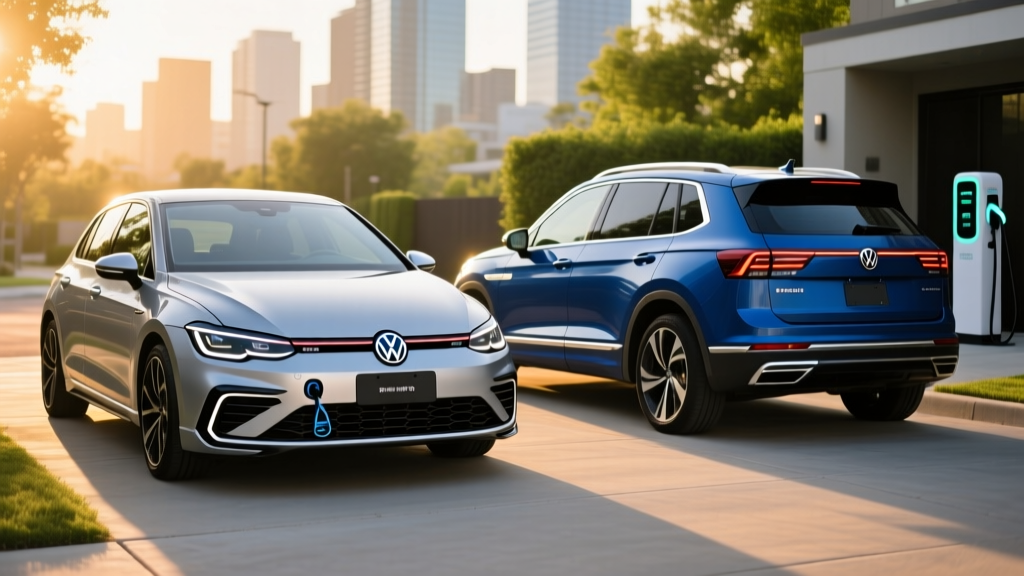
If you're researching a Volkswagen PHEV in 2026, you're likely weighing plug-in hybrid practicality against the simplicity of a conventional hybrid or the full commitment of a battery-electric vehicle. Volkswagen currently offers two plug-in hybrid models in the U.S. market: the Golf GTE (a hot-hatch performance PHEV) and the Tiguan eHybrid (a compact SUV family hauler). Both pair a turbocharged gasoline engine with an electric motor and a lithium-ion battery you can charge at home or at public stations.
This guide breaks down exactly what each 2026 Volkswagen PHEV delivers in electric-only range, real-world MPG, battery capacity, charging speed, pricing, and federal tax credit eligibility — plus how they compare to the HEV, full EV, and gas-only alternatives.
HEV vs PHEV vs EV: Where Does a Volkswagen PHEV Fit?
Before diving into specs, it's worth clarifying the three electrified powertrain types, because Volkswagen sells vehicles in multiple categories depending on market.
| Powertrain | How It Works | Plug In? | Electric-Only Range |
|---|---|---|---|
| HEV (Conventional Hybrid) | Small battery charges via regenerative braking and engine; assists acceleration | No | 0–1 mi (low speed only) |
| PHEV (Plug-In Hybrid) | Larger battery charges via plug + regen + engine; drives on electricity alone for short trips | Yes | 25–55 mi typical |
| BEV (Battery Electric) | Large battery, electric motor only; no gasoline engine | Yes | 200–400+ mi |
A Volkswagen PHEV is the middle ground: you get 30–50 miles of electric-only commuting for daily errands, then a gasoline engine kicks in for road trips without range anxiety. If you can charge at home and your commute is under 40 miles round-trip, you'll rarely visit a gas station on weekdays.
2026 Volkswagen Golf GTE: Performance-Oriented PHEV Hatch
The Golf GTE returns to the U.S. market for the 2026 model year after a hiatus, riding on the updated Mk8.5 Golf platform. It targets drivers who want GTI-like handling with electric-commute capability.
| Spec | 2026 VW Golf GTE |
|---|---|
| Powertrain | 1.5L turbo I4 + electric motor (6-speed DSG) |
| Combined Horsepower | 245 hp / 295 lb-ft torque |
| Battery (usable) | 19.7 kWh (NMC lithium-ion) |
| EPA Electric-Only Range | ~38 miles |
| EPA Combined MPGe (electric) | ~110 MPGe |
| EPA MPG (gas, charge-depleted) | 34 city / 37 highway / 35 combined |
| Total Combined Range | ~440 miles |
| 0–60 mph | 6.5 seconds |
| Level 2 Charging (AC) | 3.6 kW onboard charger; 0–100% in ~5 hours |
| DC Fast Charging | Not available |
| Base MSRP | $36,990 |
| Battery Warranty | 8 years / 100,000 miles |
The Golf GTE's 19.7 kWh battery is substantially larger than the previous generation's 13 kWh pack, giving it a meaningful real-world electric range bump. On a Level 2 home charger at 3.6 kW (the onboard charger's maximum), expect a full charge overnight. The GTE does not support DC fast charging — a limitation shared with most compact PHEVs due to cost and packaging constraints.
2026 Volkswagen Tiguan eHybrid: Family SUV With Electric Commute
The Tiguan eHybrid is VW's plug-in hybrid compact SUV, redesigned for the 2025 model year and carried forward into 2026 with minor software and battery-management updates. It's aimed at families who want school-run electric efficiency with weekend-road-trip flexibility.
| Spec | 2026 VW Tiguan eHybrid |
|---|---|
| Powertrain | 1.5L turbo I4 + electric motor (6-speed DSG) |
| Combined Horsepower | 218 hp / 258 lb-ft torque |
| Battery (usable) | 19.7 kWh (NMC lithium-ion) |
| EPA Electric-Only Range | ~33 miles |
| EPA Combined MPGe (electric) | ~95 MPGe |
| EPA MPG (gas, charge-depleted) | 32 city / 35 highway / 33 combined |
| Total Combined Range | ~410 miles |
| 0–60 mph | 7.5 seconds |
| Level 2 Charging (AC) | 3.6 kW onboard charger; 0–100% in ~5 hours |
| DC Fast Charging | Not available |
| Base MSRP | $41,490 |
| Battery Warranty | 8 years / 100,000 miles |
The Tiguan eHybrid shares the same 19.7 kWh battery and 3.6 kW onboard charger as the Golf GTE but delivers slightly less electric range due to its heavier curb weight and less aerodynamic SUV profile. Real-world electric range with HVAC use typically lands around 27–30 miles in moderate weather, dropping to 22–25 miles in winter.
For a compact PHEV SUV, 33 EPA electric miles is competitive — it matches the segment average set by rivals like the Toyota RAV4 Prime (42 mi) and Hyundai Tucson PHEV (33 mi). The Tiguan eHybrid prioritizes interior space and ride comfort over maximum electric efficiency.
Charging a Volkswagen PHEV: What You Need to Know
One of the most common questions from PHEV shoppers: how do you actually charge these vehicles, and how long does it take?
| Charging Level | Power (kW) | Time (0–100%) | Where |
|---|---|---|---|
| Level 1 (120V household outlet) | ~1.4 kW | ~14 hours | Any standard outlet |
| Level 2 (240V home/public) | 3.6 kW (max onboard) | ~5 hours | Home wallbox, public Level 2 |
| DC Fast Charging | N/A | N/A | Not supported |
kW vs kWh — the critical distinction: kW (kilowatts) measures the rate of charging — how fast energy flows into the battery. kWh (kilowatt-hours) measures the battery's total energy capacity. The Golf GTE and Tiguan eHybrid each have a 19.7 kWh battery and accept a maximum charge rate of 3.6 kW. That means even at a public 7.2 kW or 11 kW Level 2 station, the car will only draw 3.6 kW — the onboard charger is the bottleneck.
For most PHEV owners, a standard 120V outlet (Level 1) is actually sufficient. If you plug in when you get home at 6 PM and unplug at 7 AM, that's 13 hours × 1.4 kW = ~18 kWh delivered, nearly refilling the 19.7 kWh battery. A Level 2 home charger is faster and more convenient but not strictly necessary for a PHEV the way it is for a full EV.
Fuel Economy: Real-World MPG vs EPA Sticker
Hybrid and PHEV fuel economy depends heavily on your driving pattern. Here's what the EPA says and what owners typically see:
| Model | EPA City | EPA Highway | EPA Combined | Real-World Owner Avg |
|---|---|---|---|---|
| Golf GTE (charge-depleted, gas only) | 34 MPG | 37 MPG | 35 MPG | 33–38 MPG |
| Tiguan eHybrid (charge-depleted, gas only) | 32 MPG | 35 MPG | 33 MPG | 30–36 MPG |
Key insight: PHEVs often exceed their EPA city MPG in real-world driving when the battery is charged, because city driving at low speeds heavily favors the electric motor. On the highway at 75+ mph, the gasoline engine does most of the work, and real-world MPG may fall 1–3 MPG below the sticker.
If you charge nightly and commute under 35 miles, your effective "MPG" is essentially infinite on weekdays — you're burning zero gasoline. The EPA combined MPG figures above apply only when the battery is fully depleted and the car runs as a conventional hybrid.
Data from fueleconomy.gov and owner forums consistently show that PHEV owners who charge regularly use 60–80% less gasoline than they would in a comparable gas-only vehicle.
Pricing, Trims & Federal Tax Credit Eligibility
| Model & Trim | MSRP | Federal §30D Credit | Effective Price |
|---|---|---|---|
| Golf GTE S | $36,990 | Up to $3,750* | ~$33,240 |
| Golf GTE SE | $39,490 | Up to $3,750* | ~$35,740 |
| Tiguan eHybrid SE | $41,490 | Up to $3,750* | ~$37,740 |
| Tiguan eHybrid SEL | $44,990 | Up to $3,750* | ~$41,240 |
*Federal tax credit details: Under current IRS §30D rules, new PHEVs qualify for a credit of up to $3,750 (half of the maximum $7,500) if they meet critical-mineral sourcing requirements but not the full battery-component requirement. The credit is subject to:
- MSRP cap: Vans, SUVs, and pickup trucks — $80,000; other vehicles (sedans, hatchbacks) — $55,000. Both VW PHEVs fall well under these caps.
- Buyer income cap: Modified AGI must not exceed $150,000 (single), $225,000 (head of household), or $300,000 (joint filers).
- Battery sourcing: The $3,750 half-credit requires a percentage of critical minerals sourced from the U.S. or free-trade-agreement partners. VW's battery supply chain currently qualifies for this half-credit; the other $3,750 half requires battery components manufactured or assembled in North America, which these models do not currently meet.
- Point-of-sale transfer: You can elect to transfer the credit to the dealer at purchase, reducing your out-of-pocket cost immediately rather than waiting for a tax refund.
Tax credit rules are subject to change. Consult a tax professional or check the IRS website for the most current eligibility requirements before purchasing.
Battery Longevity, Warranty & Replacement Cost
PHEV batteries are smaller than full EV batteries (19.7 kWh vs 60–100+ kWh), so replacement costs are proportionally lower. Based on current VW parts pricing and dealer labor rates:
- Battery pack replacement (out of warranty): $5,500–$8,000 including labor
- Expected battery lifespan: 12–15 years / 150,000–200,000 miles before significant degradation, based on NMC chemistry cycle-life data
- Typical degradation at 8 years: 10–15% capacity loss, meaning a 38-mile electric range might drop to 32–34 miles
Because PHEV batteries are cycled less aggressively than full EV batteries (you're only using 19.7 kWh, not 80+), and because the gasoline engine serves as a backup, battery replacement is rarely a cost-of-ownership concern within the first decade. Most PHEV batteries outlast the vehicle itself.
For reliability data, NHTSA and owner surveys from Consumer Reports generally rate Volkswagen's hybrid systems as average to above-average, with the DSG transmission and turbocharged engines carrying well-established track records from the non-hybrid Golf and Tiguan lineups.
Who Should Buy a Volkswagen PHEV — and Who Shouldn't?
Choose a VW PHEV if:
- Your daily commute is under 35 miles round-trip and you can charge at home
- You want electric commuting but also take regular road trips where charging infrastructure is sparse
- You want a Volkswagen's driving dynamics and interior quality without going full EV
- You live in an apartment or area where reliable public DC fast charging is limited
Choose a full EV (like the VW ID.4) instead if:
- You can install a Level 2 charger at home and your daily driving is under 200 miles
- You want zero gasoline costs and zero tailpipe emissions
- You want access to the full $7,500 federal tax credit (many BEVs qualify for both halves)
Choose a conventional HEV or gas car if:
- You cannot charge at home or at work — a PHEV's electric range is wasted without regular plug-in charging
- Your budget is tight and you want the lowest upfront purchase price
- You drive predominantly long highway routes where the electric motor provides minimal benefit
Volkswagen PHEV Pros
- 30–38 miles electric-only covers most commutes gas-free
- No range anxiety — gas engine for road trips
- Level 1 (120V) charging is sufficient for daily use
- Refined driving dynamics typical of VW
- Eligible for up to $3,750 federal tax credit
Volkswagen PHEV Cons
- No DC fast charging capability
- 3.6 kW onboard charger is slow for public Level 2
- Only half of the $7,500 federal credit (sourcing rules)
- Higher MSRP than gas-only Golf/Tiguan equivalents
- Cargo space slightly reduced vs non-hybrid models
Frequently Asked Questions
How many MPG does the Volkswagen PHEV get?
When the battery is depleted and the car runs on gasoline alone, the 2026 Golf GTE gets an EPA-estimated 35 MPG combined (34 city / 37 highway), and the Tiguan eHybrid gets 33 MPG combined (32 city / 35 highway). When you factor in regular electric-only driving with nightly charging, effective fuel consumption drops dramatically — many owners report using gasoline only for weekend road trips.
How far can a Volkswagen PHEV go on electric only?
The 2026 Golf GTE delivers an EPA-estimated 38 miles of electric-only range, while the Tiguan eHybrid provides about 33 miles. Real-world results vary: expect 5–10% less in moderate weather with climate control on, and 25–35% less in cold weather below freezing. Total combined range (electric + gasoline) is roughly 440 miles for the Golf GTE and 410 miles for the Tiguan eHybrid.
Does the Volkswagen PHEV qualify for a federal tax credit?
Yes, partially. Under current IRS §30D rules, both the Golf GTE and Tiguan eHybrid qualify for up to $3,750 in federal tax credits (the critical-minerals half). They do not currently qualify for the other $3,750 battery-component half because their battery cells are not manufactured in North America. Eligibility also depends on your income (MSRP caps are not a concern — both models are well under the limits). Always verify current rules before purchasing.
Is the Volkswagen PHEV reliable, and what does battery replacement cost?
VW's hybrid powertrain uses well-proven components — the 1.5L turbo engine and DSG transmission have years of service history in non-hybrid VW models. The high-voltage battery is covered by an 8-year / 100,000-mile warranty against defects and excessive capacity loss (below 70%). Out-of-warranty battery replacement runs approximately $5,500–$8,000. In practice, PHEV batteries typically last 12–15 years with only 10–15% degradation, making replacement a rare expense.
Do I need to install a Level 2 home charger for a VW PHEV?
No. A standard 120V household outlet (Level 1) can fully recharge the 19.7 kWh battery in about 14 hours, which is sufficient for overnight charging if you plug in when you get home. A Level 2 (240V) charger reduces that to about 5 hours and is more convenient, but the investment ($500–$1,500 for equipment and installation) is optional for PHEV owners — unlike full EV owners, who practically need Level 2 for daily usability.
Can a Volkswagen PHEV use DC fast chargers?
No. Neither the Golf GTE nor the Tiguan eHybrid supports DC fast charging. The maximum charge rate is 3.6 kW via AC (Level 1 or Level 2). This is typical for compact PHEVs — the battery is small enough that fast charging infrastructure isn't necessary for daily use. You'll charge at home or at destination Level 2 chargers, not at highway DC fast-charging stations.
Hybrid vs PHEV vs EV — which is right for me?
If you can charge at home and commute under 35 miles daily, a PHEV like the Golf GTE or Tiguan eHybrid gives you electric commuting without road-trip range anxiety. If you can charge at home and your daily driving is under 200 miles, a full EV (like the VW ID.4) offers lower running costs and a larger tax credit. If you cannot charge at home at all, a conventional hybrid (HEV) is simpler and doesn't waste the electric-range capability you'd never use.