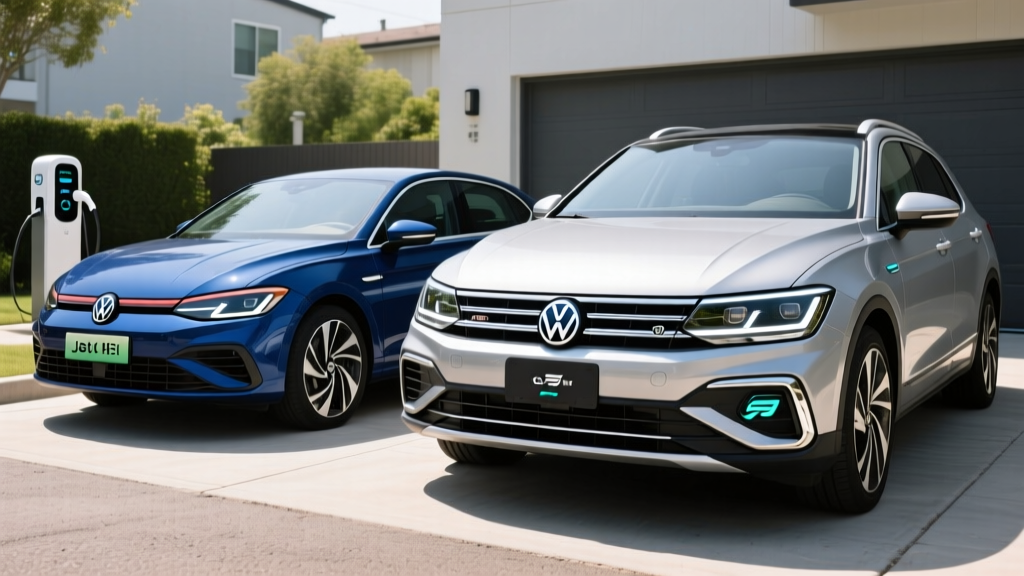
If you're researching Volkswagen hybrids in 2025, the German automaker's electrified lineup has shifted significantly. The Golf GTE is no longer sold in the United States, and Volkswagen has pivoted its hybrid strategy toward plug-in hybrid (PHEV) variants of its core models. For the 2025 model year, the two most relevant VW plug-in hybrids for US and European buyers considering imports are the updated Tiguan eHybrid (with the new-generation PHEV powertrain arriving in the redesigned Tiguan) and the Golf/GTI eHybrid variants sold abroad. In the US market specifically, VW's hybrid presence remains limited compared to Toyota and Hyundai, but the 2025 Tiguan redesign brings a PHEV option that deserves a close look.
This guide breaks down every Volkswagen hybrid available or announced for the 2025 model year, with exact EPA or WLTP figures, battery specs, pricing, and ownership considerations. We'll also clarify the critical difference between conventional hybrids (HEVs) and plug-in hybrids (PHEVs) — because VW's current lineup is exclusively the latter.
HEV vs PHEV: What Volkswagen Actually Offers in 2025
Before diving into specs, it's essential to understand the distinction, because confusion here leads to wrong purchase decisions:
Conventional Hybrid (HEV)
A small battery (typically 1–2 kWh) recharged entirely by regenerative braking and the gas engine. No plug. No external charging. You simply fill up with gas and the system optimizes efficiency. Think Toyota Prius, Honda CR-V Hybrid.
Plug-In Hybrid (PHEV)
A larger battery (13–26 kWh) that you plug in to charge, giving 25–50 miles of electric-only driving before the gas engine kicks in. After the battery depletes, it operates like a conventional hybrid. Think Toyota RAV4 Prime, Hyundai Tucson PHEV.
Volkswagen's 2025 US lineup includes zero conventional hybrids. Every VW hybrid is a PHEV. If you want a VW that never needs plugging in, you're looking at their standard TSI gasoline models — which are not hybrids. This is a deliberate strategy: VW has invested heavily in its MEB (electric) and updated MQB-evo (PHEV) platforms rather than traditional HEV powertrains.
2025 Volkswagen Tiguan eHybrid: The Main Contender
The redesigned third-generation Tiguan is the centerpiece of VW's 2025 hybrid strategy. Built on the updated MQB-evo platform, the Tiguan eHybrid pairs a 1.5-liter turbocharged four-cylinder engine with a more powerful electric motor and a significantly larger battery than the outgoing model.
| Specification | 2025 Tiguan eHybrid |
|---|---|
| Powertrain | 1.5L turbo I4 + electric motor |
| Combined Horsepower | ~245 hp (system output) |
| Battery (usable) | 19.7 kWh (NMC lithium-ion) |
| Electric-Only Range (WLTP) | Up to 62 miles (~43 mi EPA est.) |
| Total Combined Range | ~430–500 miles (est.) |
| DC Fast Charging | Yes, up to ~50 kW (CCS2 in Europe; CCS1 in US if offered) |
| Level 2 AC Charging | 3.6 kW onboard charger (~5.5 hours 0–100%) |
| 0–60 mph | ~7.5 seconds (est.) |
| Fuel Economy (charge-depleted) | ~35–38 MPG combined (EPA est.) |
| Starting MSRP (est.) | $42,000–$45,000 |
Electric-Only Range: The Real-World Picture
The outgoing Tiguan PHEV (sold in Europe as the eHybrid) managed roughly 30 miles on electric power. The 2025 generation's larger 19.7 kWh battery pushes the WLTP-rated range to over 60 miles. However, WLTP figures are typically 15–25% more optimistic than EPA estimates. Expect an EPA sticker in the 40–45 mile range once US-certified, with real-world highway or cold-weather driving reducing that to 30–38 miles.
This is competitive with the Toyota RAV4 Prime (42 miles EPA) and significantly better than most compact SUV PHEVs. For a daily commute under 35 miles round-trip, the Tiguan eHybrid can function almost entirely as an EV on weekdays, with the gas engine reserved for longer weekend trips.
Charging: Yes, It Can DC Fast Charge
One advantage VW has carried forward is DC fast-charging capability on its PHEVs. The Tiguan eHybrid supports approximately 50 kW DC charging via CCS, which can take the battery from 10% to 80% in roughly 35–40 minutes. This is uncommon among PHEVs — most competitors (including the RAV4 Prime) are limited to Level 2 AC charging only.
On a standard Level 2 home charger (240V, 32A), expect a full charge in about 5–6 hours using the 3.6 kW onboard charger. A standard 120V household outlet (Level 1) would require 14+ hours — feasible for overnight top-ups but slow for daily use.
2025 Volkswagen Golf eHybrid / GTE (Europe Only — US Context)
For completeness, VW's Golf eHybrid and Golf GTE remain available in European markets for 2025. These models share the MQB-evo PHEV architecture with the Tiguan:
| Specification | Golf eHybrid | Golf GTE |
|---|---|---|
| Combined HP | 204 hp | 245 hp |
| Battery (usable) | 19.7 kWh | 19.7 kWh |
| Electric-Only (WLTP) | ~87 miles | ~82 miles |
| 0–62 mph | 7.6 sec | 6.5 sec |
| US Availability | Not offered | Not offered |
The Golf lineup was discontinued in the US after the 2021 model year (GTI and Golf R excepted as gasoline models). While the Golf GTE's ~82-mile WLTP electric range is impressive — roughly 60–65 miles EPA-equivalent — it's irrelevant to American buyers unless VW reverses course. We include it here because some buyers cross-shop imported vehicles or track VW's global strategy.
Fuel Economy Breakdown: EPA MPG and MPGe
For PHEVs, fuel economy is expressed two ways: MPGe (miles per gallon equivalent, measuring efficiency when running on electricity) and MPG (traditional miles per gallon when the battery is depleted and the gas engine does all the work).
| Model | MPGe (Electric + Gas) | MPG (Gas Only, Charge-Depleted) | City / Highway / Combined |
|---|---|---|---|
| 2025 Tiguan eHybrid (est.) | ~80–90 MPGe | ~35–38 MPG | 38 city / 35 hwy / 37 combined (est.) |
| Toyota RAV4 Prime (comparison) | 94 MPGe | 38 MPG | 40 city / 36 hwy / 38 combined |
| Hyundai Tucson PHEV (comparison) | 80 MPGe | 35 MPG | 37 city / 34 hwy / 35 combined |
Real-world MPG note: PHEVs reward drivers who charge regularly. If you plug in nightly and drive fewer than 40 miles per day, your actual gasoline consumption may approach zero for weeks at a time, yielding effective "MPG" numbers in the triple digits. Conversely, if you never charge and drive 500-mile road trips, you'll see the charge-depleted MPG figure (mid-30s) — which is still better than a non-hybrid Tiguan's ~26 MPG combined but not transformative.
Pricing, Tax Credits, and Total Cost
The 2025 Tiguan eHybrid is expected to start in the $42,000–$45,000 range, representing a $5,000–$8,000 premium over the base gasoline Tiguan. This premium buys the PHEV powertrain, larger battery, and DC charging capability.
Federal Tax Credit Eligibility (§30D)
Under current IRS §30D rules, PHEVs can qualify for up to $7,500 in federal tax credits — but only if they meet strict requirements:
- Battery capacity: Minimum 7 kWh (the Tiguan eHybrid's 19.7 kWh battery clears this easily)
- MSRP cap: SUVs/vans/pickups must be under $80,000; sedans under $55,000
- Buyer income cap: AGI ≤ $150,000 (single), $225,000 (head of household), $300,000 (joint)
- Battery sourcing & critical minerals: Must meet escalating percentages of North American content — this is where many foreign-built PHEVs fail
- Final assembly: Must occur in North America
Critical caveat: If the 2025 Tiguan eHybound is assembled in Europe (VW's Wolfsburg or Emden plants), it will not qualify for the federal §30D credit regardless of other factors. VW's US-built models (like the Atlas and ID.4 from Chattanooga, TN) meet the assembly requirement, but the Tiguan has historically been imported. Verify final assembly location on the EPA's fueleconomy.gov listing or the vehicle's window sticker before purchasing. Point-of-sale credit transfer is available for qualifying vehicles, reducing your out-of-pocket cost at the dealer.
Some states offer additional PHEV incentives (California's CVRP, Colorado's state credit, etc.), but these vary by jurisdiction — check your state's energy office or DMV for current amounts.
Reliability and Battery Longevity
Volkswagen's PHEV systems have been in production since the 2015 Golf GTE, giving them a decade of real-world data. The high-voltage battery uses NMC (nickel manganese cobalt) chemistry, which offers good energy density but slightly faster degradation than LFP (lithium iron phosphate) cells used in some competitors.
Expected degradation: Based on owner reports from European Golf GTE and Passat GTE fleets, expect approximately 8–12% capacity loss over 5 years / 60,000 miles under normal use. This means a 40-mile electric range when new might drop to 35–37 miles after five years — noticeable but not debilitating.
Battery replacement cost: If the high-voltage battery fails outside warranty, replacement costs for VW PHEV batteries typically range from $6,000 to $9,000 including labor. This is comparable to Toyota and Hyundai PHEV battery replacement costs. However, outright failure within the 8-year/100,000-mile warranty window would be covered provided the battery drops below 70% of original capacity.
Volkswagen PHEV battery: 8 years / 100,000 miles (70% capacity retention threshold)
Powertrain warranty: 4 years / 50,000 miles
Note: California and states adopting CARB standards may require extended emissions-related warranty coverage — verify with your dealer.
VW's overall brand reliability has improved in recent IIHS safety testing, with the Tiguan earning top marks in crashworthiness. Long-term powertrain reliability for the new 1.5L TSI evo2 engine paired with the electric motor is still accumulating data, as this specific combination debuted with the 2024–2025 generation.
Who Should Buy a Volkswagen PHEV — And Who Shouldn't
Choose the VW Tiguan eHybrid if:
- You have home charging access (Level 2 recommended) and a daily commute under 40 miles
- You want a compact SUV that can run on electricity for weekday errands but take gas-fueled road trips without planning charging stops
- You prefer European driving dynamics, interior materials, and design language over Asian competitors
- DC fast-charging capability on a PHEV matters to you (rare in this segment)
Choose a full BEV (like the VW ID.4 or Tesla Model Y) if:
- You drive under 250 miles daily and have reliable home + public charging access
- You want zero gasoline expenses and minimal maintenance (no oil changes, no engine)
- You qualify for the full $7,500 federal credit on a US-assembled BEV
Choose a conventional hybrid (like the Toyota RAV4 Hybrid) if:
- You cannot charge at home or work (apartment, street parking, no outlet access)
- You want hybrid efficiency without ever thinking about plugging in
- Your budget is under $35,000 and you need maximum value
Skip the VW hybrid entirely if:
- You need a third row (look at the VW Atlas or Kia Sorento PHEV)
- You want a conventional HEV from VW — they don't make one
- The federal tax credit is critical to your budget and the Tiguan eHybrid doesn't qualify due to assembly location
Pros
- ~40+ mile EPA-estimated electric range covers most commutes
- DC fast charging (50 kW) is rare and valuable for PHEVs
- 245 hp system output provides confident highway merging
- Premium interior quality vs. RAV4 Prime or Tucson PHEV
- 8-year/100,000-mile battery warranty
Cons
- Estimated $42K+ starting price is steep for the segment
- Federal tax credit eligibility uncertain (assembly location dependent)
- 3.6 kW onboard charger is slow for Level 2 — 5+ hours for full charge
- No conventional HEV option for buyers without charging access
- VW's US PHEV lineup is limited — no sedan or hatchback option
Frequently Asked Questions
How many MPG does the 2025 Volkswagen Tiguan eHybrid get?
When the battery is depleted and the vehicle runs on gasoline only, expect approximately 35–38 MPG combined (estimated 38 city / 35 highway). When factoring in electric-only driving with regular charging, the MPGe rating is estimated at 80–90 MPGe. Your actual fuel consumption depends heavily on how often you plug in — nightly chargers may use almost no gasoline for daily driving.
How far can the 2025 Tiguan eHybrid go on electric only?
The WLTP-rated electric range is approximately 62 miles, but the EPA estimate is expected to land around 40–45 miles. Real-world highway driving or cold weather (below 40°F) can reduce this to 30–38 miles. This is competitive with the RAV4 Prime (42 miles EPA) and significantly better than most compact SUV PHEVs.
Does the Volkswagen Tiguan eHybrid qualify for the $7,500 federal tax credit?
It depends on final assembly location. Under current IRS §30D rules, the vehicle must be assembled in North America to qualify. The Tiguan has historically been built in Europe, which would disqualify it. Check the VIN decoder on fueleconomy.gov or the window sticker to confirm assembly location. Income caps ($150K single / $300K joint) and the $80K SUV MSRP cap also apply.
Is the Volkswagen PHEV battery reliable, and what does replacement cost?
VW's PHEV battery systems have been in production since 2015 with generally positive longevity data. Expect 8–12% capacity degradation over 5 years. The battery is covered under an 8-year / 100,000-mile warranty (70% capacity threshold). Out-of-warranty replacement costs approximately $6,000–$9,000 — comparable to other brands. Catastrophic battery failure is rare; gradual capacity loss is the typical wear pattern.
Hybrid vs PHEV vs EV — which Volkswagen should I buy?
VW doesn't sell conventional hybrids in the US — your choice is between a PHEV (Tiguan eHybrid) or a full BEV (ID.4). Choose the PHEV if you want electric commuting with gas-engine flexibility for road trips. Choose the ID.4 if you have reliable charging access, drive under 250 miles daily, and want zero gasoline costs. If you cannot charge at home at all, a VW PHEV loses much of its advantage — consider a Toyota or Honda conventional hybrid instead.
Can I charge the Tiguan eHybrid at a DC fast charger?
Yes. The 2025 Tiguan eHybrid supports DC fast charging at up to approximately 50 kW via CCS, enabling a 10–80% charge in roughly 35–40 minutes. This is a significant advantage over most competing PHEVs, which are limited to slower Level 2 AC charging only. Note that 50 kW is modest compared to full EVs (which charge at 150–350 kW), but it's ample for a 19.7 kWh PHEV battery.