Quick Verdict: Tucson Hybrid vs Tucson PHEV at a Glance
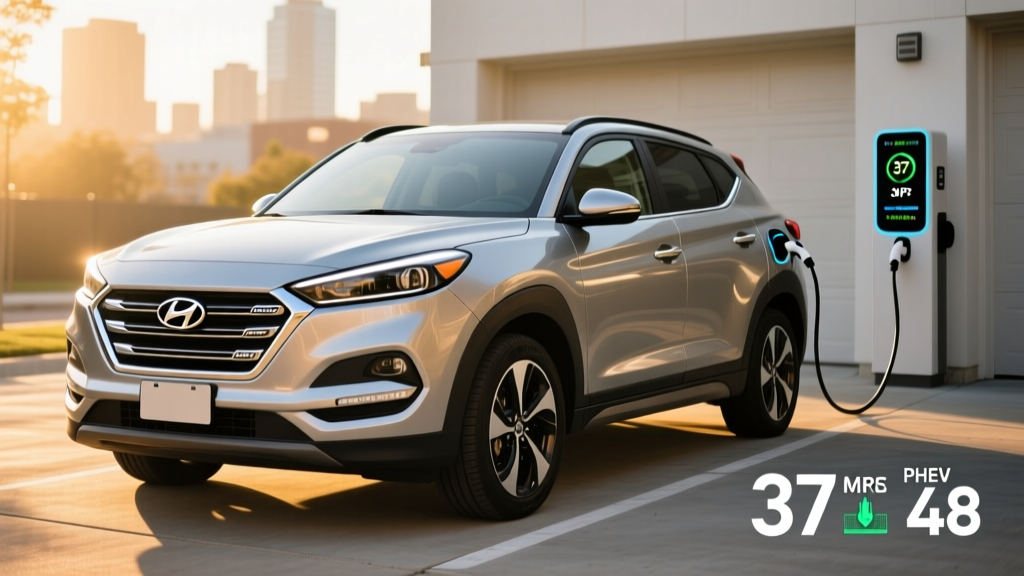
If you're researching Tucson Hybrid MPG, you're likely weighing two very different powertrains that share a badge: the conventional Hyundai Tucson Hybrid (HEV) and the Hyundai Tucson Plug-in Hybrid (PHEV). Both pair a 1.6-liter turbocharged four-cylinder with electric motor assist, but they serve distinctly different drivers. The HEV delivers strong fuel economy with zero plug-in hassle, while the PHEV offers roughly 33 miles of electric-only commuting before the gas engine kicks in. Below, we break down the exact EPA numbers, real-world expectations, battery specs, and ownership costs you need to decide which Tucson electrified model fits your garage.
HEV vs PHEV — What's the Difference?
Tucson Hybrid (HEV): Charges itself via regenerative braking and the gas engine. You never plug it in. The small battery (~1.5 kWh) provides electric motor assist for better acceleration and fuel economy.
Tucson Plug-in Hybrid (PHEV): Has a much larger battery (~13.8 kWh) that you charge via a wall outlet or Level 2 charger. It can drive on electricity alone for ~33 miles before switching to hybrid mode.
Hyundai Tucson Hybrid MPG: EPA Ratings and Real-World Results
The headline number for most shoppers: the 2026 Hyundai Tucson Hybrid returns an EPA-estimated 38 MPG combined with front-wheel drive and 37 MPG combined with all-wheel drive. That's a meaningful improvement over the gas-only Tucson, which rates around 28 MPG combined.
| Model | City MPG | Highway MPG | Combined MPG |
|---|---|---|---|
| Tucson Hybrid FWD | 38 | 38 | 38 |
| Tucson Hybrid AWD | 37 | 37 | 37 |
| Tucson PHEV AWD (hybrid mode) | 35 | 35 | 35 |
| Gas Tucson AWD (baseline) | 24 | 31 | 27 |
Source: EPA Fuel Economy
Real-World MPG vs EPA Sticker
Hybrids routinely exceed their EPA city rating in stop-and-go traffic because regenerative braking recaptures energy that gas cars waste as heat. In real-world city driving, Tucson Hybrid owners frequently report 39–42 MPG. Highway driving is a different story: at sustained 75+ MPH speeds, expect 33–35 MPG with AWD, since the electric motor contributes less at constant high speed and aerodynamic drag dominates. In cold weather (below 30°F), plan for a 5–10% fuel economy drop as the engine runs more often for cabin heat and the battery operates less efficiently.
Tucson PHEV Electric-Only Range and Total Range
The 2026 Hyundai Tucson Plug-in Hybrid carries a 13.8 kWh lithium-ion polymer battery that delivers an EPA-estimated 33 miles of electric-only range. That's enough to cover most daily commutes without burning a drop of gasoline — the average American drives roughly 37 miles per day, according to FHWA data.
| Spec | Tucson Hybrid (HEV) | Tucson PHEV |
|---|---|---|
| Battery Capacity | ~1.5 kWh | 13.8 kWh |
| Electric-Only Range | N/A (motor assist only) | 33 miles (EPA) |
| Total Range (gas + electric) | ~480 miles | ~420 miles |
| Combined System HP | 231 hp | 268 hp |
| Engine | 1.6L Turbo I-4 + electric motor | 1.6L Turbo I-4 + electric motor |
| Transmission | 6-speed automatic | 6-speed automatic |
| Drivetrain | FWD or AWD | AWD standard |
| 0-60 MPH (est.) | ~7.3 sec | ~6.8 sec |
Charging the Tucson PHEV
The Tucson PHEV supports Level 1 (120V) and Level 2 (240V) AC charging. It does not support DC fast charging — this is typical for PHEVs, whose smaller batteries don't warrant the added cost and weight of DC hardware.
| Charging Level | Power | 0–100% Time |
|---|---|---|
| Level 1 (120V household outlet) | ~1.4 kW | ~11 hours |
| Level 2 (240V home/public charger) | ~7.2 kW | ~2 hours |
For most PHEV owners, overnight Level 1 charging from a standard outlet is sufficient to replenish 33 miles of range. A Level 2 home charger is faster but not strictly necessary unless you need mid-day top-ups or plan to charge multiple vehicles.
Pricing and Federal Tax Credit Eligibility
The 2026 Hyundai Tucson Hybrid starts at approximately $33,450 MSRP (Blue trim, FWD), climbing to around $40,000 for a loaded Limited AWD. The Tucson PHEV begins at roughly $39,750 MSRP (SEL trim) and tops out near $47,000 for the Limited.
Does the Tucson Hybrid or PHEV Qualify for a Federal Tax Credit?
Tucson Hybrid (HEV): No. Conventional hybrids do not qualify for the IRS §30D Clean Vehicle Credit. That credit is reserved for plug-in vehicles with battery capacity ≥7 kWh.
Tucson PHEV: Eligibility for up to $3,750 under §30D depends on meeting critical-mineral and battery-component sourcing requirements, buyer income caps ($150K single / $300K joint MAGI), and the $80,000 SUV MSRP cap (which the Tucson PHEV clears easily). As of 2026, many Hyundai PHEVs qualify for the $3,750 partial credit because some battery components are sourced outside the U.S. or FTA-partner countries, disqualifying them from the full $7,500. The point-of-sale transfer option allows you to apply the credit as a down-payment reduction at the dealer. Always verify current eligibility on IRS.gov before purchasing — sourcing rules shift periodically.
Some states offer additional PHEV rebates (California's CVRP, Colorado's state credit, etc.). Check your state energy office or the AFDC state incentives database for current local programs.
Battery Warranty, Reliability, and Replacement Cost
Hybrid battery longevity is consistently the top concern for first-time hybrid buyers. Hyundai addresses this with one of the strongest warranty packages in the industry.
Hyundai Hybrid/PHEV Battery Warranty
- Hybrid/EV Battery: 10 years / 100,000 miles (whichever comes first)
- Powertrain Warranty: 10 years / 100,000 miles
- New Vehicle Limited Warranty: 5 years / 60,000 miles
- Capacity Retention Threshold: Hyundai typically warrants against the battery falling below ~70% of original capacity during the warranty period
Real-world reliability: Hyundai's 1.6L turbo hybrid powertrain has been in service across the Tucson, Sonata, and Elantra lineups since 2022 with generally positive durability data. The lithium-ion polymer battery chemistry is proven and conservative in its state-of-charge management — Hyundai buffers the top and bottom of the pack to minimize degradation stress.
Battery replacement cost: If you need a hybrid battery replacement out of warranty, expect $2,500–$4,500 for the HEV pack (smaller, simpler) and $5,000–$8,000 for the PHEV pack (larger capacity). However, modern hybrid batteries rarely require full replacement within 150,000+ miles. Individual cell module repairs can cost significantly less.
Hybrid vs PHEV vs Full EV: Which Tucson Fits Your Life?
Decision Framework
Choose the Tucson Hybrid (HEV) if:
- You can't charge at home (apartment, street parking, no garage outlet)
- You want maximum fuel economy with zero behavior change
- Your budget is tighter — the HEV starts ~$6,300 less than the PHEV
- You drive mostly highway miles where PHEV electric range adds little value
Choose the Tucson PHEV if:
- You have home charging access (even a standard 120V outlet works overnight)
- Your daily commute is under 33 miles round-trip — you could drive months without visiting a gas station
- You want the performance bump (268 hp vs 231 hp) and standard AWD
- You can capture the $3,750 federal credit plus any state PHEV rebates
Choose a full EV (e.g., Hyundai Ioniq 5) if:
- You have reliable Level 2 home charging and your trips rarely exceed 250 miles
- You want to eliminate oil changes, spark plugs, and exhaust-system maintenance entirely
- You qualify for the full $7,500 federal credit on a BEV
- You want the lowest per-mile energy cost (~$0.04/mi on home electricity vs ~$0.12/mi on gas for the hybrid)
Pros and Cons at a Glance
Pros
- 38 MPG combined (HEV) easily beats the 27 MPG gas Tucson
- PHEV offers 33 mi electric-only — genuine gas-free commuting
- 10-year/100,000-mile battery warranty among the best in the industry
- Strong combined HP (231 HEV / 268 PHEV) — no sluggish hybrid feel
- Practical cargo space retained vs gas model (~38.7 cu ft behind rear seats)
- PHEV eligible for up to $3,750 federal credit + state incentives
Cons
- HEV does not qualify for any federal tax credit
- PHEV has no DC fast charging — limits road-trip electric top-ups
- PHEV cargo slightly reduced due to larger battery (~33.5 cu ft)
- Highway MPG advantage shrinks at 75+ MPH speeds
- PHEV premium (~$6,300 over HEV) takes years to recoup on fuel savings alone
- Cold weather reduces both MPG (HEV) and electric range (PHEV) by 5–15%
5-Year Ownership Cost Snapshot
| Cost Factor | Tucson Hybrid AWD | Tucson PHEV AWD | Gas Tucson AWD |
|---|---|---|---|
| Base MSRP (approx.) | $35,500 | $39,750 | $31,500 |
| Federal Tax Credit | $0 | Up to $3,750 | $0 |
| Fuel Cost (5 yr, 15K mi/yr, $3.40/gal) | ~$6,710 | ~$4,250* | ~$9,445 |
| Est. Maintenance (5 yr) | ~$2,800 | ~$2,600 | ~$3,200 |
*PHEV fuel cost assumes 70% of daily miles driven on electricity at $0.14/kWh and 30% on gasoline. Actual costs vary by electricity rate and driving pattern.
Frequently Asked Questions
How many MPG does the Hyundai Tucson Hybrid actually get?
The EPA rates the 2026 Tucson Hybrid at 38 MPG combined (FWD) or 37 MPG combined (AWD). In real-world city driving with frequent stops, owners often see 39–42 MPG thanks to regenerative braking. Highway cruising at 75 MPH typically yields 33–35 MPG with AWD. Cold weather reduces these figures by roughly 5–10%.
How far can the Tucson PHEV go on electric power alone?
The EPA rates the Tucson PHEV at 33 miles of electric-only range. In mild weather at city speeds, you may see 35–37 miles. In cold weather or at highway speeds, expect 25–28 miles before the gas engine activates. Once the battery is depleted, the PHEV operates as a conventional hybrid at roughly 35 MPG combined.
Do I need to plug in the Tucson Hybrid (HEV)?
No. The conventional Tucson Hybrid charges its small battery entirely through regenerative braking and the gasoline engine. There is no plug and no charging cord. You simply drive it like a normal car and refuel at gas stations. Only the Tucson PHEV requires (or benefits from) plugging in.
Is the Tucson Hybrid reliable, and what does battery replacement cost?
Hyundai's hybrid powertrain has shown strong reliability since its 2022 introduction across multiple models. The hybrid battery is covered by a 10-year/100,000-mile warranty. Out-of-warranty replacement costs run approximately $2,500–$4,500 for the HEV battery and $5,000–$8,000 for the PHEV battery, though full replacements are rare within 150,000+ miles based on current industry data.
Does the Tucson Hybrid or PHEV qualify for a federal tax credit?
The Tucson Hybrid (HEV) does not qualify for any federal tax credit — §30D requires plug-in capability and ≥7 kWh battery capacity. The Tucson PHEV may qualify for up to $3,750 under current 2026 IRS rules, subject to battery-sourcing requirements, buyer income caps, and the $80,000 MSRP cap. The credit can be transferred to the dealer at point of sale as a price reduction. Always confirm current eligibility at IRS.gov before purchasing.
Should I get the Tucson Hybrid, the PHEV, or just go full electric?
If you lack home charging access, the HEV is the clear winner — it requires no infrastructure changes and delivers a 10-MPG improvement over the gas model. If you can charge at home and commute under 33 miles daily, the PHEV lets you drive most days on electricity while keeping a gas engine for road trips. If you have Level 2 home charging, rarely drive over 250 miles between stops, and want the lowest operating cost, a full EV like the Hyundai Ioniq 5 may serve you better long-term.