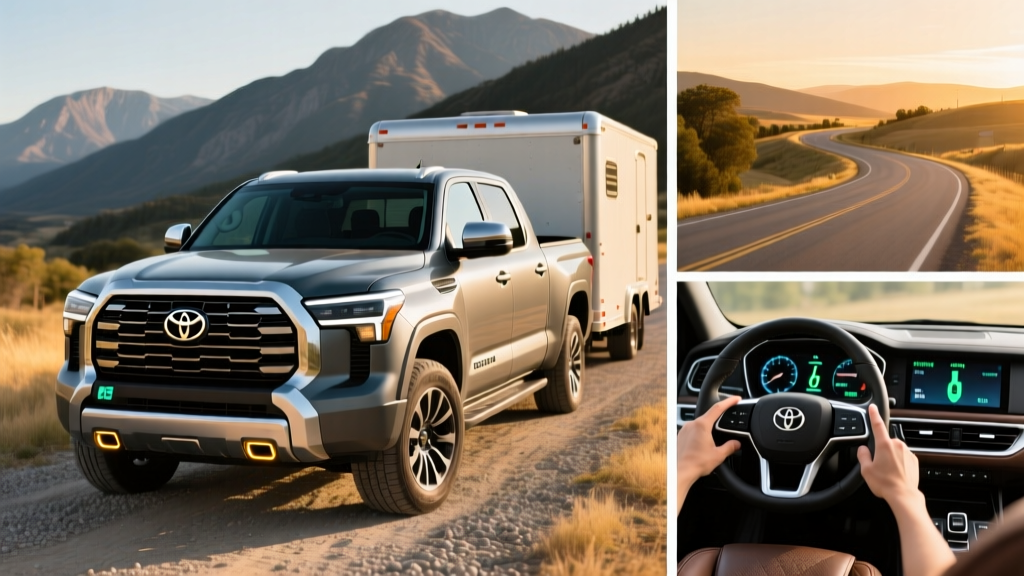
The Toyota Tundra i-FORCE MAX hybrid occupies a specific niche in the full-size truck market: it delivers meaningful fuel-economy gains over the standard twin-turbo V6 without sacrificing towing or payload capacity. Unlike Ford's F-150 PowerBoost, which uses a traditional hybrid architecture, or the F-150 Lightning, which is fully electric, the i-FORCE MAX is a conventional hybrid (HEV) — no plug, no electric-only range, no range anxiety. It simply makes the Tundra more efficient while adding torque.
For 2026, Toyota continues to offer the i-FORCE MAX across multiple Tundra trims, positioning it as the powertrain upgrade for buyers who tow, haul, and want to spend less time at the pump. Here's exactly what you get, what it costs, and how the numbers shake out in real-world driving.
HEV vs. PHEV vs. EV: Where the i-FORCE MAX Fits
Before diving into specs, it's critical to understand what the i-FORCE MAX is — and what it isn't. The Tundra's hybrid system is a conventional hybrid (HEV), meaning it charges its small battery through regenerative braking and the gasoline engine. You never plug it in.
HEV vs. PHEV vs. EV — Quick Distinction
| Feature | HEV (i-FORCE MAX) | PHEV (e.g., F-150 PHEV concept) | BEV (e.g., F-150 Lightning) |
|---|---|---|---|
| Plug-in charging | No | Yes | Yes |
| Electric-only range | 0 miles | 20–40 miles typical | 200–350+ miles |
| Fuel required | Gasoline always | Gasoline for long trips | None |
| Federal tax credit (§30D) | Not eligible | Up to $7,500 if eligible | Up to $7,500 if eligible |
| Home charging needed | No | Recommended | Essential |
The i-FORCE MAX trades electric-only capability for simplicity — no charging infrastructure required, no range planning.
Toyota Tundra i-FORCE MAX: Full Powertrain Specs
| Specification | Value |
|---|---|
| Engine | 3.5L twin-turbo V6 (V35A-FTS) |
| Electric motor | 49 HP / 184 lb-ft (sandwiched between engine and transmission) |
| Combined system output | 437 HP @ 5,200 RPM / 583 lb-ft @ 2,400 RPM |
| Transmission | 10-speed automatic (Direct Shift-10AT) |
| Hybrid battery | 1.87 kWh nickel-metal hydride (NiMH), sealed |
| Drivetrain | RWD or 4WD (part-time, with available multi-terrain select) |
| 0–60 mph | ~5.7 seconds (4WD CrewMax) |
| Max towing capacity | Up to 11,175 lbs (varies by configuration) |
| Max payload | Up to 1,735 lbs |
The i-FORCE MAX's architecture is worth noting: Toyota places the electric motor between the engine and the bell housing rather than using an e-CVT like the Prius. This means you get a traditional 10-speed automatic with fixed gear ratios — important for towing feel and engine braking on grades. The motor provides low-end torque fill while the turbos spool, eliminating the lag that plagues non-hybrid turbo engines at low RPM.
Fuel Economy: EPA Ratings and Real-World MPG
The headline reason to choose the i-FORCE MAX over the standard i-FORCE (non-hybrid) V6 is fuel economy. According to fueleconomy.gov, here's how the 2026 Tundra hybrid rates:
| Configuration | City MPG | Highway MPG | Combined MPG |
|---|---|---|---|
| i-FORCE MAX 4x2 CrewMax | 20 | 24 | 22 |
| i-FORCE MAX 4x4 CrewMax | 19 | 22 | 20 |
| Standard i-FORCE (non-hybrid) 4x4 for comparison | 17 | 22 | 19 |
Real-World MPG vs. EPA Sticker
Hybrids typically outperform their EPA city ratings in stop-and-go traffic because regenerative braking recovers energy that a gas-only truck wastes as heat. Expect the 4x4 i-FORCE MAX to deliver 21–23 MPG in city driving under moderate conditions — slightly above the 19 MPG EPA city figure. However, highway MPG tends to run closer to or slightly below the sticker: 20–22 MPG at 70–75 mph is typical, especially with a bed load or crosswinds.
When towing, expect fuel economy to drop to 10–13 MPG depending on trailer weight and terrain — a significant improvement over the non-hybrid's 8–11 MPG under similar loads, but still firmly in "plan your fuel stops" territory.
Over 15,000 miles per year, the 4x4 i-FORCE MAX at 20 MPG combined versus the non-hybrid at 19 MPG saves roughly 40 gallons of fuel annually at $3.50/gallon — about $140 per year. The hybrid premium is typically $2,500–$3,500 depending on trim, meaning payback from fuel savings alone takes many years. The real value is the torque and responsiveness, not just the fuel economy.
Pricing by Trim and Tax Credit Eligibility
The i-FORCE MAX is available on Tundra trims from Limited upward, plus as an option on select SR5 configurations. Here's the approximate 2026 MSRP structure:
| Trim | Starting MSRP (4x2) | Starting MSRP (4x4) |
|---|---|---|
| SR5 (i-FORCE MAX option) | ~$52,500 | ~$55,500 |
| Limited | ~$58,200 | ~$61,200 |
| Platinum | ~$65,800 | ~$68,800 |
| 1794 Edition | ~$66,500 | ~$69,500 |
| TRD Pro | N/A | ~$74,000 |
| Capstone | ~$75,500 | ~$78,500 |
Federal Tax Credit: Not Eligible
The i-FORCE MAX is a conventional hybrid (HEV), not a plug-in hybrid or battery-electric vehicle. Under current IRS §30D rules, only PHEVs and BEVs with sufficient battery capacity qualify for the federal clean vehicle credit. The Tundra hybrid does not qualify for the up-to-$7,500 federal tax credit, nor does it qualify for the up-to-$4,000 used-EV credit.
Some states offer their own hybrid incentives — check your state's energy office or DMV for local programs. These vary widely and change frequently.
Battery Warranty, Reliability, and Replacement Cost
Hybrid Battery Warranty
Toyota covers the i-FORCE MAX hybrid battery and hybrid system components under its Hybrid Battery Warranty: 10 years or 150,000 miles (whichever comes first), transferable to subsequent owners. This is one of the strongest hybrid warranties in the truck segment and reflects Toyota's extensive experience with hybrid powertrains dating back to the 1997 Prius.
The hybrid battery itself is a compact 1.87 kWh NiMH pack — far smaller and less expensive to replace than a BEV's 80–130 kWh lithium-ion pack. If replacement is needed out of warranty, expect $2,000–$4,000 for the hybrid battery assembly at a Toyota dealer, a fraction of the $10,000–$20,000+ cost of a full EV battery replacement.
Toyota's hybrid reliability track record is among the best in the industry. The i-FORCE MAX uses a proven engine block (the V35A-FTS, shared with the Lexus LX 600) and a well-tested hybrid motor/generator assembly. The most common maintenance items remain conventional: oil changes, brake fluid, coolant, and transmission fluid. Regenerative braking actually extends brake pad life — many hybrid owners report 60,000–80,000+ miles on original pads.
One note for cold-climate buyers: the NiMH battery's performance is largely unaffected by cold temperatures compared to lithium-ion packs in EVs. You won't see the 20–30% range loss that EV drivers experience in sub-freezing weather because the gasoline engine is always the primary power source.
Who Should Choose the i-FORCE MAX vs. an EV or Gas Truck
Choose the i-FORCE MAX If:
- You tow regularly (5,000–11,000 lbs) and need a proven truck platform
- You don't have access to home Level 2 charging or public DC fast chargers
- You want hybrid efficiency without changing your fueling habits
- You value low-RPM torque for off-road crawling or heavy loads
- You plan to keep the truck 8–10+ years (warranty coverage period)
- You drive in extreme cold where EV range loss is a concern
Consider an EV or PHEV Instead If:
- You commute daily under 40 miles round-trip and can charge at home (a BEV eliminates fuel costs entirely)
- You qualify for the full $7,500 federal tax credit and your state offers additional EV incentives
- You want zero tailpipe emissions for local air quality
- You rarely tow more than 5,000 lbs (the F-150 Lightning handles light towing with 200+ miles of range)
- You want one-pedal driving and instant, silent acceleration
- Total cost of ownership over 5 years matters more than upfront price
The i-FORCE MAX is best understood as a powertrain refinement rather than a fuel-economy revolution. The 1–3 MPG gain over the non-hybrid is real but modest. The 583 lb-ft of torque available at just 2,400 RPM, however, transforms how the truck feels when loaded — and that's where the hybrid premium pays dividends.
Pros and Cons at a Glance
✅ Pros
- 583 lb-ft torque at low RPM — excellent for towing
- 10-year/150,000-mile hybrid battery warranty
- No charging infrastructure required
- 1–3 MPG improvement over non-hybrid, more under tow
- Proven Toyota hybrid reliability
- Strong resale value (Toyota trucks historically retain value well)
- Regenerative braking extends brake pad life
❌ Cons
- No federal tax credit eligibility (HEV, not PHEV/BEV)
- Hybrid premium adds $2,500–$3,500 to purchase price
- Fuel savings alone don't quickly offset the premium
- Not available on base SR trim
- Still requires gasoline — no electric-only mode
- Towing MPG (10–13) still demands frequent fuel stops
- Heavier than non-hybrid by ~200 lbs, slightly reducing payload
Frequently Asked Questions
How many MPG does the Toyota Tundra i-FORCE MAX hybrid get?
The 2026 Tundra i-FORCE MAX 4x4 rates at 19 city / 22 highway / 20 combined MPG per the EPA. The 4x2 version rates slightly higher at 20/24/22 MPG. Real-world city driving often yields 21–23 MPG thanks to regenerative braking, while highway driving at 75 mph typically returns 20–22 MPG.
Can I plug in the Tundra i-FORCE MAX to charge?
No. The i-FORCE MAX is a conventional hybrid (HEV), not a plug-in hybrid. Its 1.87 kWh battery charges entirely through regenerative braking and the gasoline engine. There is no charging port and no electric-only driving mode.
Does the Tundra hybrid qualify for a federal tax credit?
No. Under IRS §30D, only plug-in hybrid (PHEV) and battery-electric (BEV) vehicles with minimum battery capacities qualify for the federal clean vehicle credit. Conventional hybrids like the i-FORCE MAX are not eligible. Check your state for any local hybrid incentives.
How long will the i-FORCE MAX hybrid battery last?
Toyota warranties the hybrid battery for 10 years or 150,000 miles. Based on Toyota's track record with Prius and Camry Hybrid batteries, many NiMH hybrid packs last 150,000–200,000+ miles before significant degradation. If replacement is needed, expect $2,000–$4,000 — far less than an EV battery replacement.
Is the i-FORCE MAX worth the extra cost over the standard V6?
If you tow frequently, the answer is generally yes — the 583 lb-ft of low-RPM torque makes a noticeable difference when pulling a trailer up grades or accelerating from a stop with a load. If your primary goal is fuel savings on a light-duty commute, the fuel-economy gain (1–3 MPG) won't offset the $2,500–$3,500 hybrid premium quickly. In that case, a BEV like the F-150 Lightning or a smaller hybrid SUV may be a better financial choice.
How does the i-FORCE MAX compare to the Ford F-150 PowerBoost hybrid?
The F-150 PowerBoost uses a 3.5L twin-turbo V6 with a 47-HP electric motor integrated into the transmission, producing 430 HP and 570 lb-ft. It rates at 23–25 MPG combined (4x2) — slightly better than the Tundra's 20–22 MPG — and offers an onboard generator (Pro Power Onboard) that the Tundra lacks. However, the Tundra's 10-year/150,000-mile hybrid battery warranty beats Ford's 8-year/100,000-mile hybrid component coverage. Both are strong choices; the decision often comes down to brand loyalty, dealer access, and specific trim/feature preferences.