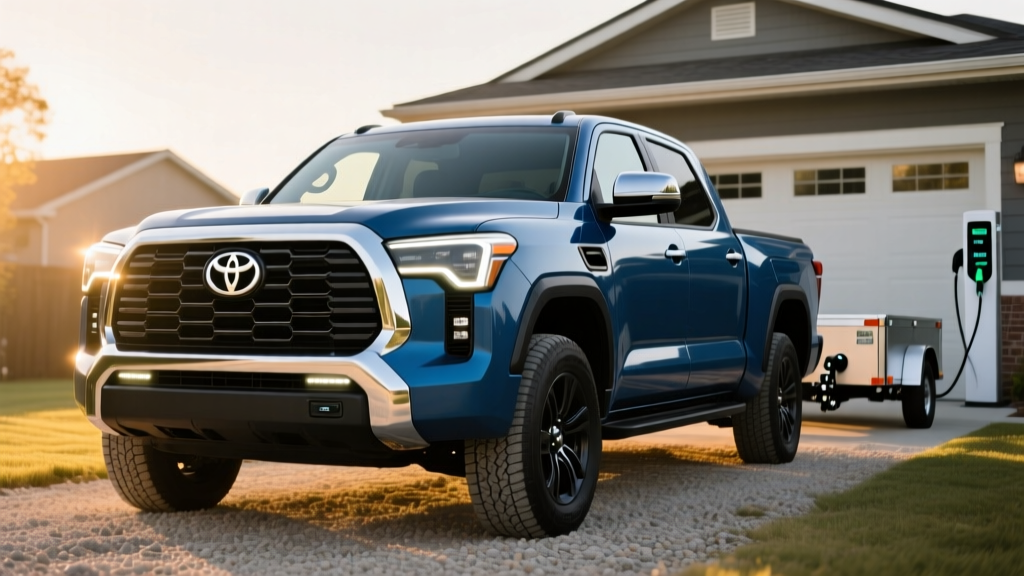
The 2026 Toyota Tundra i-FORCE MAX hybrid truck represents Toyota's strategy for buyers who need full-size pickup capability without the fuel penalties of traditional V8 engines. Unlike the Ford F-150 PowerBoost or the upcoming Ram 1500 REV range-extended models, the Tundra hybrid is a conventional hybrid (HEV) — it charges its own battery through regenerative braking and engine operation, requiring no plug-in charging. This makes it appealing to truck buyers who lack home charging infrastructure but still want meaningful fuel savings.
HEV vs PHEV: Understanding the Tundra Hybrid
Conventional Hybrid (HEV) - Tundra i-FORCE MAX
- No plug required: Charges via regenerative braking and engine
- Self-sufficient: Never needs external charging
- Simpler ownership: No home charger installation, no range anxiety
- Lower upfront cost: ~$3,700 hybrid premium over gas-only Tundra
Plug-in Hybrid (PHEV) - Not Available for Tundra
- Requires plug-in charging for electric-only driving
- Offers 20-40 miles electric range (when available in trucks)
- Higher upfront cost, requires charging infrastructure
- Qualifies for federal tax credits (when meeting §30D requirements)
The Tundra hybrid is strictly an HEV. Toyota has not announced a Tundra PHEV variant for 2026. If you need electric-only driving for short commutes, you'd need to look at the Ford F-150 Lightning (full EV) or wait for upcoming range-extended pickups.
Fuel Economy: EPA Ratings vs Real-World MPG
| Configuration | City MPG | Highway MPG | Combined MPG |
|---|---|---|---|
| Tundra i-FORCE MAX 4x2 | 20 | 24 | 22 |
| Tundra i-FORCE MAX 4x4 | 19 | 22 | 20 |
| Tundra Gas-Only V6 4x4 (baseline) | 17 | 22 | 19 |
Source: EPA Fuel Economy
Real-World MPG Expectations
The Tundra hybrid's EPA ratings are conservative for city driving but optimistic for highway use:
- City driving: Expect 21-23 MPG (hybrids excel in stop-and-go traffic where regenerative braking recovers energy)
- Highway driving: Expect 18-20 MPG (aerodynamic drag dominates at 70+ mph; hybrid advantage diminishes)
- Mixed driving: Expect 19-21 MPG combined in real-world conditions
- Towing: Expect 12-14 MPG when towing 7,000+ lb loads
- Cold weather: Expect 10-15% reduction in winter months (engine runs more to heat cabin and warm up)
The hybrid system's biggest advantage appears in city driving, where it can improve fuel economy by 2-4 MPG over the gas-only Tundra. Highway efficiency gains are minimal — just 1-2 MPG better than the non-hybrid V6. If your driving is 80% highway, the hybrid premium takes longer to pay back.
Powertrain Specs: i-FORCE MAX Hybrid System
| Specification | Value |
|---|---|
| Engine | 3.5L Twin-Turbo V6 |
| Electric Motor | 48-hp motor integrated in bell housing |
| Combined System Output | 437 hp @ 5,200 rpm |
| Combined Torque | 583 lb-ft @ 2,400 rpm |
| Transmission | 10-speed automatic |
| Hybrid Battery | 1.87 kWh nickel-metal hydride (NiMH) |
| 0-60 mph | 5.7 seconds |
| Max Towing Capacity | 12,000 lb (properly equipped) |
| Max Payload | 1,940 lb |
The i-FORCE MAX uses a parallel hybrid architecture where the electric motor sits between the engine and transmission. The motor provides instant torque fill at low RPMs, eliminating the turbo lag typical of twin-turbo engines. The 1.87 kWh battery is small by EV standards but sufficient for hybrid assist — it's not designed for electric-only driving.
Notably, the hybrid battery uses nickel-metal hydride (NiMH) chemistry rather than lithium-ion. Toyota has stuck with NiMH for its conventional hybrids due to proven longevity and lower cost, though it sacrifices some energy density. The battery is air-cooled and mounted under the rear seat.
Reliability and Battery Warranty
Toyota Hybrid Battery Warranty
- Hybrid Battery Coverage: 10 years / 150,000 miles (whichever comes first)
- Hybrid System Components: 8 years / 100,000 miles
- Powertrain Warranty: 5 years / 60,000 miles
- Capacity Retention Threshold: Battery must retain sufficient capacity for hybrid operation (Toyota does not specify exact percentage)
Source: Toyota Warranty Information
Toyota's hybrid systems have an exceptional reliability track record. The Prius, with over 25 years of real-world data, shows hybrid battery failure rates below 5% at 150,000 miles. The Tundra's i-FORCE MAX system is newer (introduced 2022), so long-term data is limited, but the fundamental architecture is proven across Toyota's hybrid lineup.
Hybrid Battery Replacement Cost
If the hybrid battery fails outside warranty:
- OEM replacement: $3,000-$4,000 (battery + labor)
- Refurbished/remanufactured: $2,000-$2,800
- Individual cell replacement: $1,500-$2,200 (specialist shops can replace failed cells rather than full pack)
For context, the Tundra's hybrid battery is much smaller and cheaper to replace than a full EV battery. A Ford F-150 Lightning battery replacement runs $20,000-$30,000. The Tundra's 1.87 kWh pack is closer in size and cost to a laptop battery than an EV pack.
Pricing and Tax Credit Eligibility
| Trim Level | MSRP (4x4) | Hybrid Premium |
|---|---|---|
| Limited i-FORCE MAX | $62,505 | +$3,720 vs gas Limited |
| Platinum i-FORCE MAX | $68,905 | +$3,720 vs gas Platinum |
| 1794 Edition i-FORCE MAX | $69,430 | +$3,720 vs gas 1794 |
| TRD Pro i-FORCE MAX | $76,130 | Standard (hybrid-only trim) |
| Capstone i-FORCE MAX | $82,530 | Standard (hybrid-only trim) |
Source: Toyota Tundra Specifications
Federal Tax Credit Eligibility
The 2026 Toyota Tundra i-FORCE MAX does NOT qualify for the federal §30D clean vehicle tax credit.
Under current IRS rules, only plug-in electric vehicles (BEVs and PHEVs) with battery capacity ≥7 kWh qualify. The Tundra hybrid's 1.87 kWh battery falls well below this threshold. The truck is classified as a conventional hybrid, not a plug-in vehicle.
State incentives: Some states offer hybrid incentives, but these are increasingly rare as programs shift focus to full EVs. Check your state's energy office for current programs.
Source: IRS Clean Vehicle Credits
Total Cost of Ownership: Hybrid vs Gas Tundra
Assuming 15,000 miles/year, $3.50/gallon fuel, 5-year ownership:
| Cost Factor | Gas Tundra 4x4 | Hybrid Tundra 4x4 | Difference |
|---|---|---|---|
| Fuel Cost (5 years) | $13,816 | $13,125 | -$691 (hybrid saves) |
| Hybrid Premium | $0 | +$3,720 | +$3,720 (hybrid costs) |
| Net 5-Year Cost | $13,816 | $16,845 | +$3,029 (hybrid costs more) |
The hybrid premium is not recovered through fuel savings alone over 5 years at current gas prices. The breakeven point is approximately 8-10 years or 120,000-150,000 miles. However, the hybrid offers performance benefits (more torque, quicker acceleration) that may justify the cost beyond pure economics.
Who Should Choose the Tundra Hybrid?
Choose the Tundra Hybrid If:
- You do significant city/suburban driving (hybrid advantage is greatest in stop-and-go traffic)
- You want instant torque for towing without turbo lag
- You lack home charging access (no plug required)
- You want better fuel economy than a gas V8 but aren't ready for a full EV
- You value Toyota's hybrid reliability track record
- You plan to keep the truck 8+ years (to recoup hybrid premium)
Choose Gas-Only Tundra If:
- Your driving is 80%+ highway (hybrid advantage is minimal)
- You're on a tight budget and can't absorb the $3,720 hybrid premium
- You prioritize lowest upfront cost over long-term efficiency
- You want the widest trim/option availability (hybrid not offered on base trims)
Choose Full EV (F-150 Lightning) If:
- You have home Level 2 charging access
- You want the lowest fuel cost per mile (electricity vs gas)
- You qualify for the $7,500 federal tax credit (with income/sourcing requirements)
- You want instant torque and one-pedal driving
- Your daily driving is under 250 miles (within EV range)
Frequently Asked Questions
How many MPG does the Toyota Tundra hybrid truck get?
The 2026 Tundra i-FORCE MAX hybrid gets 20 MPG combined (19 city / 22 highway) for 4x4 models, and 22 MPG combined (20 city / 24 highway) for 4x2 models. Real-world city driving often exceeds EPA ratings by 1-3 MPG due to regenerative braking, while highway driving typically falls 2-4 MPG below EPA estimates.
Does the Tundra hybrid need to be plugged in?
No. The Tundra i-FORCE MAX is a conventional hybrid (HEV), not a plug-in hybrid (PHEV). It charges its small 1.87 kWh battery through regenerative braking and engine operation. You never need to plug it in — just fuel it with gasoline like a conventional truck.
Is the Toyota Tundra hybrid reliable?
Toyota's hybrid systems have exceptional reliability records, with failure rates below 5% at 150,000 miles based on Prius data spanning 25+ years. The Tundra's i-FORCE MAX system is newer but uses proven hybrid architecture. The hybrid battery is covered by a 10-year/150,000-mile warranty.
What does it cost to replace the Tundra hybrid battery?
Outside warranty, a Tundra hybrid battery replacement costs $3,000-$4,000 for an OEM pack, or $2,000-$2,800 for a refurbished unit. Individual cell replacement (specialist service) runs $1,500-$2,200. This is far less expensive than full EV battery replacement ($20,000+).
Does the Tundra hybrid qualify for any tax credits?
No. The Tundra i-FORCE MAX does not qualify for the federal §30D clean vehicle tax credit because it's a conventional hybrid, not a plug-in vehicle. The credit requires ≥7 kWh battery capacity and plug-in capability. The Tundra's 1.87 kWh battery doesn't meet these requirements. Some states may offer hybrid incentives, but these are increasingly rare.
How much can the Tundra hybrid tow?
The Tundra i-FORCE MAX hybrid can tow up to 12,000 pounds when properly equipped (4x2 models). The 4x4 hybrid models have slightly lower ratings, typically 11,000-11,400 pounds depending on configuration. Towing fuel economy drops to 12-14 MPG under heavy loads.
Is the hybrid faster than the gas Tundra?
Yes. The i-FORCE MAX hybrid produces 437 hp and 583 lb-ft of torque, reaching 0-60 mph in 5.7 seconds. The gas-only twin-turbo V6 makes 389 hp and 479 lb-ft, with 0-60 times around 6.5-6.8 seconds. The hybrid's electric motor provides instant torque fill, eliminating turbo lag and improving throttle response.
The Bottom Line
The 2026 Toyota Tundra i-FORCE MAX hybrid truck delivers modest fuel economy gains (1-4 MPG depending on driving conditions) with meaningful performance improvements. It's best suited for buyers who do significant city driving, value Toyota's hybrid reliability, and plan long-term ownership. The $3,720 hybrid premium takes 8-10 years to recoup through fuel savings alone, making the performance and drivability benefits the primary justification. For buyers with home charging access and shorter commutes, the Ford F-150 Lightning offers lower operating costs and federal tax credit eligibility, though with range and charging infrastructure considerations.