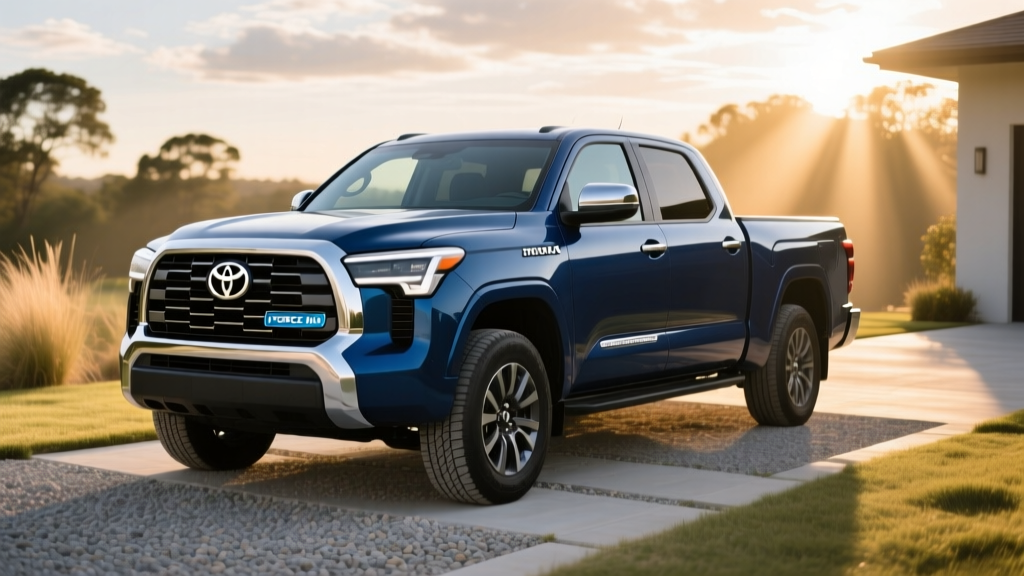
Quick Verdict: The Tundra Hybrid Is a Conventional HEV, Not a Plug-In
If you've been searching for the Toyota Tundra hybrid, here's the most important thing to understand upfront: the Tundra's i-FORCE MAX powertrain is a conventional hybrid electric vehicle (HEV). It does not plug in. It has no electric-only driving range. You fuel it like any other truck at a gas station, and the hybrid system recovers energy from braking and deceleration to supplement the twin-turbo V6.
That distinction matters because Toyota currently offers no plug-in hybrid (PHEV) Tundra, and none has been announced for the 2026 model year. If you were hoping to drive 30 miles on electricity before the gas engine kicks in — the way a RAV4 Prime or a Ford F-150 PowerBoost can operate in limited EV mode — the Tundra hybrid won't do that. What it will do is deliver 437 horsepower, up to 12,000 pounds of towing capacity, and an EPA-rated 22 MPG combined in a full-size truck that traditionally guzzles fuel.
HEV vs. PHEV — Where Does the Tundra Fit?
| Feature | Tundra i-FORCE MAX (HEV) | Plug-In Hybrid (PHEV) |
|---|---|---|
| Plugs in to charge? | No | Yes (Level 1/2 AC) |
| Electric-only range | 0 miles | Typically 20–45 miles |
| Battery size | ~1.87 kWh (small buffer) | 12–25+ kWh |
| Federal tax credit (§30D) | Not eligible | Up to $7,500 if eligible |
| Fueling | Gas station only | Gas + plug-in charging |
i-FORCE MAX Powertrain: Twin-Turbo V6 Meets Electric Motor
The Tundra's hybrid system pairs a 3.4-liter twin-turbocharged V6 engine with a 36-kW (48-hp) electric motor integrated between the engine and the 10-speed automatic transmission. The combined system output is 437 horsepower and 583 lb-ft of torque. That torque figure is particularly important for truck buyers — it's available low in the rev range thanks to the electric motor's instant response, which translates to confident acceleration from a stop and strong low-speed pulling power when towing.
The electric motor is sandwiched in the bell housing, not driving a separate axle. This means all power — engine and electric — routes through the same 10-speed automatic and available four-wheel-drive system. The hybrid battery pack is a compact nickel-metal hydride (NiMH) unit with roughly 1.87 kWh of total capacity (usable capacity is far less, as the system manages a narrow state-of-charge window to preserve longevity). This is not an energy-dense lithium-ion pack designed for sustained electric driving; it's a power-assist buffer that smooths torque delivery, enables engine stop-start, and captures regenerative braking energy.
| Spec | Value |
|---|---|
| Engine | 3.4L twin-turbo V6 + 36-kW electric motor |
| Combined output | 437 hp / 583 lb-ft torque |
| Transmission | 10-speed automatic |
| Drivetrain | RWD or 4WD (part-time or full-time) |
| Hybrid battery | ~1.87 kWh NiMH |
| Max towing capacity | Up to 12,000 lbs (properly equipped) |
| Payload capacity | Up to ~1,760 lbs |
| 0-60 mph | ~5.7 seconds (4WD CrewMax) |
| Fuel tank | 32.2 gallons |
| Base MSRP (SR5 i-FORCE MAX) | ~$59,960 (2026 est.) |
Fuel Economy: EPA Ratings and Real-World MPG
The i-FORCE MAX hybrid is available across most of the Tundra lineup — from the SR5 up through the Platinum and 1794 Edition trims. EPA ratings vary slightly by cab configuration and drivetrain.
| Configuration | City | Highway | Combined |
|---|---|---|---|
| 4x2 CrewMax (SR5) | 20 MPG | 24 MPG | 22 MPG |
| 4x4 CrewMax (SR5) | 19 MPG | 22 MPG | 20 MPG |
| 4x4 CrewMax (TRD Pro) | 18 MPG | 20 MPG | 19 MPG |
Source: fueleconomy.gov — EPA estimates. Your mileage will vary.
Real-World MPG: What Owners Actually Report
Conventional hybrids tend to perform closer to — or even above — their EPA city estimates because stop-and-go driving maximizes regenerative braking and electric motor assist. Highway driving is where the Tundra hybrid's efficiency drops, since aerodynamic drag dominates at 70+ mph and the hybrid system contributes less at sustained speed.
Based on owner-reported data and independent testing, here's what to expect:
- City / suburban driving: 20–23 MPG (4x4) — the hybrid system shines here, with frequent stops allowing regen to recharge the small battery.
- Highway cruising (70 mph): 18–20 MPG (4x4) — the twin-turbo V6 does most of the work; the electric motor's contribution is minimal at steady speed.
- Towing: 10–14 MPG depending on trailer weight and terrain. The hybrid assist helps with low-speed pulling, but towing a 8,000-lb trailer up a grade will spike fuel consumption regardless of hybridization.
- Cold weather: Expect a 1–2 MPG drop in winter. The engine runs more often to maintain cabin heat and operating temperature, reducing the hybrid system's stop-start benefit.
Compared to the non-hybrid Tundra with the standard i-FORCE 3.4L V6 (rated around 17–18 MPG combined for 4x4 models), the hybrid delivers a meaningful 2–3 MPG improvement in mixed driving. Over 15,000 miles per year at $3.50/gallon, that translates to roughly $250–$400 in annual fuel savings for the hybrid over the gas-only version.
Hybrid Battery Warranty, Reliability, and Replacement Cost
Toyota Hybrid Battery Warranty
Coverage: 10 years / 150,000 miles (whichever comes first) on the hybrid battery and hybrid system components.
What's covered: The hybrid battery pack, inverter, electric motor, and associated control modules. Toyota will repair or replace components that fail due to defects or fall below performance thresholds during the warranty period.
Transferable: Yes — the hybrid warranty transfers to subsequent owners, which supports resale value.
Source: Toyota Warranty Guide
How Long Will the Tundra Hybrid Battery Last?
Toyota has been refining its hybrid battery technology since the original Prius in 1997. The Tundra's NiMH pack is deliberately kept in a narrow state-of-charge window — typically between 40% and 80% — which dramatically reduces stress on the cells. This is why Toyota's hybrid batteries routinely last 150,000–200,000+ miles in real-world service, often outlasting the vehicle itself.
The Tundra's hybrid system is also simpler than a PHEV or BEV battery. There's no liquid cooling system for the small NiMH pack, no high-voltage DC fast-charging circuitry, and no large battery pack that degrades measurably over time. The electric motor assists the engine; it doesn't replace it.
Hybrid Battery Replacement Cost
If the hybrid battery does eventually need replacement outside warranty, expect the following:
- OEM replacement battery: $2,500–$4,000 (parts) + $500–$1,000 (labor) = roughly $3,000–$5,000 total
- Refurbished / aftermarket pack: $1,500–$2,500 installed
- Individual cell module replacement: Some independent hybrid specialists can replace failed modules within the pack for $800–$1,500, extending the pack's life at lower cost
For context, this is a fraction of what a BEV battery replacement costs ($10,000–$20,000+), and the failure rate on Toyota's modern hybrid packs is low. The 10-year/150,000-mile warranty provides substantial coverage.
Trims, Pricing, and Tax Credit Eligibility
The i-FORCE MAX hybrid powertrain is available on the following 2026 Tundra trims (4x4 CrewMax pricing shown; 4x2 and Double Cab configurations are less expensive):
| Trim | Approx. MSRP (4x4 CrewMax) | Hybrid Standard? |
|---|---|---|
| SR5 | ~$59,960 | Optional (add ~$2,500) |
| Limited | ~$64,500 | Standard |
| Platinum | ~$70,200 | Standard |
| 1794 Edition | ~$70,800 | Standard |
| TRD Pro | ~$75,500 | Standard |
| Capstone | ~$82,000 | Standard |
Federal Tax Credit: Does the Tundra Hybrid Qualify?
No. The Toyota Tundra i-FORCE MAX is a conventional hybrid (HEV), not a plug-in hybrid or battery electric vehicle. Under IRS §30D rules, the federal clean vehicle credit applies only to plug-in electric vehicles (BEVs and PHEVs) with battery packs of at least 7 kWh that meet sourcing, MSRP, and buyer income requirements.
The Tundra hybrid's ~1.87 kWh NiMH pack falls far short of the 7 kWh minimum. There is currently no federal tax credit, point-of-sale rebate, or §30D eligibility for conventional hybrids.
State incentives: A small number of states offer rebates or HOV-lane access for conventional hybrids, but these programs are increasingly rare as incentive budgets shift toward plug-in vehicles. Check your state's energy or environmental agency for current programs.
Towing, Payload, and Performance with the Hybrid
One of the strongest arguments for choosing the Tundra hybrid over the gas-only version is towing performance. The electric motor's instant 583 lb-ft of combined torque means the truck pulls confidently from low RPM without waiting for turbo spool-up. In real-world towing, this translates to:
- Smoother launches from stoplights and highway on-ramps with a trailer attached
- Less transmission hunting on moderate grades — the electric motor fills torque gaps between shifts
- Regenerative braking assistance on downhill grades, reducing brake wear when towing
Maximum towing capacity for the i-FORCE MAX is 12,000 pounds (properly equipped with the tow package, 4x2 CrewMax). Four-wheel-drive models and heavier trims see slight reductions — typically 11,000–11,600 lbs. The TRD Pro, with its off-road suspension and equipment, is rated around 11,175 lbs.
Payload ranges from approximately 1,500 to 1,760 lbs depending on configuration. The hybrid system adds roughly 200 lbs of weight over the gas-only powertrain, which slightly reduces payload but doesn't materially affect the truck's utility.
Who Should Buy the Tundra Hybrid — and Who Shouldn't?
✓ Reasons to Choose It
- You want a full-size truck with better fuel economy than the V8-era competition
- You tow regularly and want the low-RPM torque assist the electric motor provides
- You prefer not to deal with plug-in charging infrastructure
- You value Toyota's hybrid reliability track record and 10-year battery warranty
- You drive a mix of city and highway miles where the hybrid system's city MPG advantage pays off
✗ Reasons to Look Elsewhere
- You want electric-only driving capability (you need a PHEV like the F-150 PowerBoost or a BEV like the F-150 Lightning)
- You're counting on a $7,500 federal tax credit to offset the purchase price
- You primarily drive long highway miles where the hybrid advantage shrinks to 1–2 MPG
- You need a manual transmission or a diesel option (neither is available)
- You want the absolute lowest purchase price — the hybrid premium adds ~$2,500 on lower trims
Hybrid vs. PHEV vs. Full EV Truck — Which Fits You?
| Buyer Profile | Best Fit | Example |
|---|---|---|
| No home charging, tow frequently, want simplicity | HEV (Tundra Hybrid) | Toyota Tundra i-FORCE MAX |
| Home charging available, short daily commute + weekend towing | PHEV | Ford F-150 PowerBoost (limited EV mode) / upcoming Silverado PHEV |
| Home charging, under 300-mile trips, want lowest running cost | BEV | Ford F-150 Lightning / Chevy Silverado EV |
Frequently Asked Questions
How many MPG does the Toyota Tundra hybrid get?
The 2026 Tundra i-FORCE MAX is EPA-rated at 20 MPG city, 24 MPG highway, and 22 MPG combined in its most efficient 4x2 CrewMax configuration. Four-wheel-drive models drop to 19/22/20 MPG. Real-world results vary: city driving tends to match or slightly exceed EPA estimates thanks to regenerative braking, while sustained highway speeds above 70 mph and towing reduce fuel economy to 14–18 MPG.
Does the Toyota Tundra hybrid plug in?
No. The Tundra i-FORCE MAX is a conventional hybrid (HEV). It charges its small battery pack exclusively through regenerative braking and engine power. There is no plug, no charging port, and no electric-only driving range. You refuel it at a gas station like any other truck.
Is the Tundra hybrid reliable? What about the battery?
Toyota's hybrid systems have an extensive reliability track record spanning over 25 years. The Tundra's hybrid battery is covered by a 10-year / 150,000-mile warranty, and Toyota's NiMH packs routinely last 150,000–200,000+ miles in service. The hybrid system has fewer moving parts than a traditional powertrain — no starter motor, no alternator, and regenerative braking reduces wear on the friction brakes. If the battery does need replacement outside warranty, expect $3,000–$5,000 installed for an OEM pack.
Does the Toyota Tundra hybrid qualify for any tax credit?
The Tundra hybrid does not qualify for the federal §30D clean vehicle tax credit, which requires a plug-in vehicle with at least 7 kWh of battery capacity. The Tundra's ~1.87 kWh pack doesn't meet this threshold. Some states may offer minor incentives for hybrids, but these are uncommon and vary by jurisdiction — check your state's energy office for current programs.
How much does the hybrid add to the Tundra's price?
On trims where the i-FORCE MAX is optional (such as the SR5), the hybrid powertrain typically adds approximately $2,500 to the MSRP. On Limited, Platinum, 1794 Edition, TRD Pro, and Capstone trims, the hybrid is standard equipment and included in the base price.
Can the Tundra hybrid tow as much as the gas version?
Yes — the i-FORCE MAX actually has a higher maximum tow rating than the standard i-FORCE gas engine in most configurations. The hybrid's peak rating is 12,000 lbs (4x2 CrewMax with tow package), compared to approximately 8,300–10,200 lbs for the non-hybrid V6, depending on configuration. The electric motor's instant torque gives the hybrid an advantage in low-speed pulling and grade-climbing with a trailer.
Is there a plug-in hybrid Tundra coming?
As of 2026, Toyota has not announced a PHEV version of the Tundra. Toyota's plug-in hybrid efforts in the truck/SUV space currently focus on the RAV4 Prime, Prius Prime, and the bZ-series BEVs. If a Tundra PHEV arrives, it would likely feature a larger lithium-ion battery (15–20 kWh) and 25–35 miles of electric-only range — but this remains speculative.