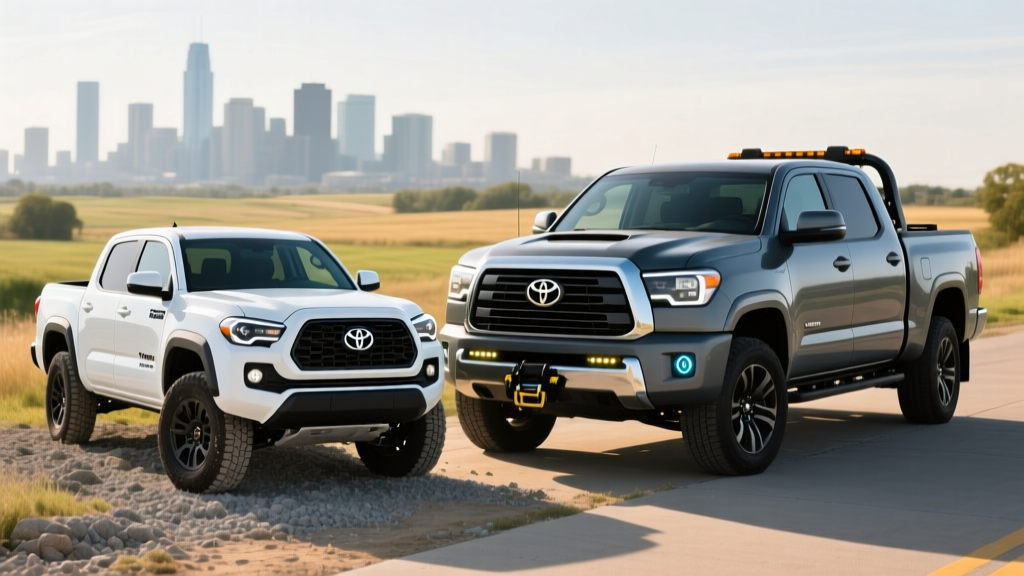
Toyota's truck lineup has gone hybrid — but not in the way you might expect. Neither the Tacoma nor the Tundra hybrid is designed for silent electric-only commuting. Instead, Toyota's i-FORCE MAX powertrain uses a turbocharged engine paired with an electric motor to deliver more torque and better fuel economy than the non-hybrid versions. If you're researching hybrid Toyota trucks, you're looking at two very different vehicles that share a philosophy: use electrification for capability first, efficiency second.
This guide breaks down the 2026 Tacoma Hybrid and 2026 Tundra Hybrid side by side — EPA MPG, real-world fuel economy, towing capacity, powertrain specs, pricing, tax credit eligibility, and long-term battery reliability. We'll also clarify a common point of confusion: these are conventional hybrids (HEVs), not plug-in hybrids (PHEVs), and that distinction matters for how you'll own and operate them.
HEV vs PHEV: What Toyota's Hybrid Trucks Actually Are
Before diving into specs, it's essential to understand what you're buying. Both the Tacoma i-FORCE MAX and Tundra i-FORCE MAX are conventional hybrids (HEVs). They do not plug in. They do not have a meaningful electric-only driving range. The battery recharges through regenerative braking and the gasoline engine.
HEV vs PHEV — Quick Distinction
| Feature | HEV (Tacoma/Tundra i-FORCE MAX) | PHEV (e.g., Toyota RAV4 Prime) |
|---|---|---|
| Plugs in? | No | Yes |
| Electric-only range | ~1 mile at low speed | 25–42 miles typical |
| Battery size | 1.87 kWh (small buffer) | 13–18 kWh usable |
| Federal tax credit | No | Up to $7,500 (if eligible) |
| Primary benefit | More torque + better MPG | Electric commuting + gas backup |
Toyota does not currently offer a plug-in hybrid truck. If you need electric-only commuting in a Toyota, the RAV4 Prime (42 miles EV range) remains the closest PHEV option, but it's an SUV — not a body-on-frame truck. For truck buyers who want electrification without plugging in, the i-FORCE MAX HEV system is the answer.
2026 Toyota Tacoma i-FORCE MAX Hybrid: MPG, Specs & Pricing
The Tacoma Hybrid pairs a 2.4-liter turbocharged inline-4 with a 48-hp electric motor integrated into the 8-speed automatic transmission. Combined output: 326 horsepower and 465 lb-ft of torque. That's 59 more lb-ft than the non-hybrid turbo-4, and the electric motor fills in the torque curve at low RPM where turbos lag.
| 2026 Toyota Tacoma i-FORCE MAX — Key Specs | |
|---|---|
| Engine | 2.4L turbo I-4 + 48-hp electric motor |
| Combined output | 326 hp / 465 lb-ft |
| Transmission | 8-speed automatic |
| Battery | 1.87 kWh lithium-ion (NiMH on some trims) |
| Drivetrain | 4WD (i-FORCE MAX requires 4WD) |
| Max towing | 6,000 lbs |
| Payload | ~1,500 lbs (varies by trim) |
| 0–60 mph | ~6.5 seconds |
| Starting MSRP | ~$42,900 (TRD Off-Road Hybrid) |
EPA Fuel Economy: Tacoma Hybrid
| Trim / Config | City | Highway | Combined |
|---|---|---|---|
| i-FORCE MAX 4WD (Double Cab) | 23 | 27 | 24 |
| Non-hybrid turbo-4 4WD (comparison) | 20 | 26 | 22 |
Source: EPA Fuel Economy
2026 Toyota Tundra i-FORCE MAX Hybrid: MPG, Specs & Pricing
The Tundra Hybrid uses a larger 3.5-liter twin-turbo V6 paired with a 49-hp electric motor sandwiched into the 10-speed automatic. Combined output: 437 horsepower and 583 lb-ft of torque. This is the powertrain you want if you're towing heavy or want effortless highway passing without downshifting.
| 2026 Toyota Tundra i-FORCE MAX — Key Specs | |
|---|---|
| Engine | 3.5L twin-turbo V6 + 49-hp electric motor |
| Combined output | 437 hp / 583 lb-ft |
| Transmission | 10-speed automatic |
| Battery | 1.87 kWh lithium-ion (sealed NiMH available) |
| Drivetrain | RWD or 4WD |
| Max towing | 10,890 lbs (properly equipped) |
| Payload | ~1,600 lbs (varies by trim) |
| 0–60 mph | ~5.7 seconds |
| Starting MSRP | ~$57,600 (Limited Hybrid) |
EPA Fuel Economy: Tundra Hybrid
| Trim / Config | City | Highway | Combined |
|---|---|---|---|
| i-FORCE MAX RWD | 20 | 24 | 22 |
| i-FORCE MAX 4WD | 19 | 22 | 20 |
| Non-hybrid V6 4WD (comparison) | 17 | 22 | 19 |
Source: EPA Fuel Economy
Side-by-Side: Tacoma Hybrid vs Tundra Hybrid
| Attribute | Tacoma i-FORCE MAX | Tundra i-FORCE MAX |
|---|---|---|
| Combined HP / TQ | 326 hp / 465 lb-ft | 437 hp / 583 lb-ft |
| EPA Combined MPG | 24 | 20–22 |
| Max Towing | 6,000 lbs | 10,890 lbs |
| 0–60 mph | ~6.5 sec | ~5.7 sec |
| Battery | 1.87 kWh | 1.87 kWh |
| Plugs In? | No (HEV) | No (HEV) |
| Starting MSRP | ~$42,900 | ~$57,600 |
| Federal Tax Credit | None | None |
Battery Reliability, Warranty & Replacement Cost
Hybrid battery longevity is the number-one concern for first-time hybrid truck buyers. Here's what Toyota's track record actually shows:
Toyota Hybrid Battery Warranty
Hybrid battery: 10 years / 150,000 miles (whichever comes first)
Hybrid system components (inverter, motor, control module): 8 years / 100,000 miles
Powertrain: 5 years / 60,000 miles
Toyota's hybrid battery warranty is among the strongest in the industry. In California and states adopting CARB emissions rules, the hybrid battery warranty extends to 10 years / 150,000 miles under emissions warranty provisions.
How Long Do Toyota Hybrid Batteries Actually Last?
Toyota's hybrid battery packs are designed for a 15–20 year service life under normal use. The 1.87 kWh pack in the i-FORCE MAX system is small and operates in a narrow state-of-charge window (roughly 40–80%), which dramatically reduces stress on the cells. Real-world data from the Prius — Toyota's longest-running hybrid — shows battery packs routinely exceeding 200,000 miles before significant degradation. The Tacoma and Tundra hybrid systems use similar management strategies.
Battery Replacement Cost
If the hybrid battery does fail outside warranty, replacement costs for Toyota truck hybrid batteries currently range from $2,500 to $4,500 for the battery pack itself, plus $500–$1,000 in labor. Third-party remanufactured packs are available for $1,800–$2,800. This is significantly cheaper than a full EV battery replacement ($8,000–$20,000+) because the pack is small — you're replacing 1.87 kWh, not 80 kWh.
For context, a conventional truck's transmission replacement or turbo failure can cost $3,000–$6,000. The hybrid system's additional complexity is offset by the fact that regenerative braking extends brake pad life (often 80,000+ miles) and the electric motor reduces load on the engine and transmission.
Tax Credits & Incentives: What Hybrid Truck Buyers Qualify For
Here's the straightforward answer: neither the Tacoma Hybrid nor the Tundra Hybrid qualifies for the federal §30D Clean Vehicle Credit. The IRS restricts the $7,500 credit to plug-in electric vehicles (BEVs and PHEVs) with minimum battery capacity of 7 kWh. Toyota's i-FORCE MAX trucks carry a 1.87 kWh pack and cannot be plugged in — they don't meet the threshold.
Current Hybrid Incentive Landscape (2026)
- Federal §30D credit: Not applicable to HEVs. Requires plug-in capability and ≥7 kWh battery. See IRS guidelines.
- State incentives: A handful of states offer rebates for hybrids, but most have shifted focus to BEVs and PHEVs. Check your state's energy office or DMV for current programs.
- Manufacturer incentives: Toyota periodically offers lease cash or financing deals on hybrid trims. Check Toyota's current offers page for your zip code.
- Fuel savings as the real incentive: At $3.50/gallon and 15,000 miles/year, the Tacoma Hybrid saves roughly $340/year vs. the non-hybrid turbo-4. The Tundra Hybrid saves $450–$600/year vs. the non-hybrid V6.
Who Should Buy a Hybrid Toyota Truck (And Who Shouldn't)
Choose the Tacoma Hybrid If:
- You want a midsize truck with the best fuel economy in its class (24 MPG combined)
- You do a lot of city/suburban driving where the electric motor maximizes efficiency
- You want 465 lb-ft of torque for trail crawling and moderate towing (up to 6,000 lbs)
- You don't have access to home charging and don't want to rely on public infrastructure
- You value Toyota's long-term reliability reputation and 10-year hybrid battery warranty
Choose the Tundra Hybrid If:
- You need full-size truck capability: 10,890-lb towing, 437 hp, spacious CrewMax cab
- You tow frequently and want the hybrid system's low-RPM torque to reduce strain
- You drive 20,000+ miles/year and want every MPG advantage you can get in a full-size truck
- You want a daily driver that can handle heavy workloads without a diesel
- You prefer not to deal with DEF fluid, diesel maintenance, or diesel fuel pricing
Hybrid Truck vs Full EV vs Gas — Decision Framework
Choose the hybrid Toyota truck if: You need a body-on-frame truck for towing/hauling, you don't have reliable home charging, or you regularly drive in areas with sparse EV charging infrastructure. The hybrid gives you MPG gains without changing your refueling behavior.
Choose a full EV (e.g., Ford F-150 Lightning, Rivian R1T) if: You have Level 2 home charging, your daily driving is under 250 miles, you rarely tow over 5,000 lbs, and you want to eliminate fuel costs entirely. EV trucks offer 70+ MPGe equivalent and instant torque, but towing range drops 40–50%.
Stick with gas if: You drive under 10,000 miles/year (the hybrid premium won't pay back), you need maximum towing in a midsize truck (the non-hybrid Tacoma has slightly higher payload on some trims), or you're buying used and want the lowest upfront cost.
5-Year Ownership Cost Snapshot
| Cost Factor | Tacoma Hybrid | Tundra Hybrid | Tacoma Gas (non-hybrid) |
|---|---|---|---|
| Purchase price (base) | ~$42,900 | ~$57,600 | ~$37,500 |
| Federal tax credit | $0 | $0 | $0 |
| Fuel (5 yr, 15k mi/yr @ $3.50/gal) | ~$10,940 | ~$13,125 | ~$11,930 |
| Estimated maintenance (5 yr) | ~$2,800 | ~$3,200 | ~$3,400 |
| Insurance (avg 5 yr) | ~$8,500 | ~$9,800 | ~$8,200 |
| Total 5-yr cost | ~$65,140 | ~$83,725 | ~$61,030 |
Estimates based on national averages. Insurance varies significantly by state, age, and driving record. Maintenance includes tires, fluids, and brake service. Hybrid brake savings factored in.
Frequently Asked Questions
How many MPG does the Toyota Tacoma Hybrid get?
The 2026 Toyota Tacoma i-FORCE MAX Hybrid is EPA-rated at 23 city / 27 highway / 24 combined MPG with 4WD. In real-world city-heavy driving, owners often achieve 25–27 MPG thanks to the electric motor handling low-speed acceleration. Highway driving at 75+ mph returns closer to 22–24 MPG. Towing reduces economy to 13–16 MPG depending on trailer weight.
How many MPG does the Toyota Tundra Hybrid get?
The 2026 Tundra i-FORCE MAX is EPA-rated at 20 city / 24 highway / 22 combined (RWD) or 19 city / 22 highway / 20 combined (4WD). Real-world city driving often yields 20–22 MPG. Highway cruising returns 18–22 MPG. The hybrid's biggest advantage over the gas Tundra is in stop-and-go traffic, where the electric motor does the heavy lifting.
Can Toyota hybrid trucks drive on electric power alone?
Only minimally. The i-FORCE MAX system can propel the truck on electric power alone for roughly 1 mile at very low speeds (under 15 mph) — useful for creeping through a drive-through or silently leaving a neighborhood at dawn. This is not a PHEV; there is no meaningful electric-only commute capability. The battery recharges through regenerative braking and the engine, so you never plug in.
Is the Toyota hybrid truck system reliable?
Toyota has built over 25 million hybrid vehicles since the 1997 Prius. The i-FORCE MAX system uses a proven architecture: a small lithium-ion (or NiMH) battery pack operating in a narrow charge window to minimize degradation, a sealed electric motor with no brushes to wear, and a transmission-integrated design with fewer moving parts than a conventional setup. The hybrid battery carries a 10-year / 150,000-mile warranty. Third-party reliability data from Consumer Reports consistently ranks Toyota hybrids among the most reliable powertrains on the market.
What does a Toyota hybrid truck battery replacement cost?
Outside warranty, a replacement hybrid battery pack for the Tacoma or Tundra i-FORCE MAX costs approximately $2,500–$4,500 for the part and $500–$1,000 for labor. Remanufactured packs are available for $1,800–$2,800. Because the pack is only 1.87 kWh (vs. 75–130 kWh in a full EV), replacement is far less expensive than an EV battery swap. Under normal use, the battery should last the life of the truck.
Do Toyota hybrid trucks qualify for any tax credits?
No. The federal §30D Clean Vehicle Credit requires plug-in capability and a minimum 7 kWh battery. Toyota's i-FORCE MAX trucks are conventional hybrids with a 1.87 kWh pack and no plug — they do not qualify for the $7,500 federal credit or the point-of-sale transfer. Some states may offer minor incentives for hybrids, but most state programs now prioritize BEVs and PHEVs. Check your state's energy office for current programs. Consult a tax professional for eligibility specifics.
Hybrid vs PHEV vs EV truck — which should I buy?
If you need a body-on-frame truck for towing and off-road work, have no home charging, and want better fuel economy without changing your habits — the hybrid Toyota truck (Tacoma or Tundra) is the right fit. If you have Level 2 home charging, commute under 250 miles daily, and want to eliminate fuel costs — consider a full EV truck like the Ford F-150 Lightning or Rivian R1T. Toyota does not currently make a PHEV truck; the closest PHEV in Toyota's lineup is the RAV4 Prime SUV. A plug-in hybrid truck (like the upcoming Ram Ramcharger EREV) may be worth watching if you want electric commuting with gas-truck range.
Does the hybrid system reduce towing capacity?
On the Tacoma, the i-FORCE MAX hybrid actually requires 4WD and is rated for 6,000 lbs — comparable to the non-hybrid 4WD turbo-4. On the Tundra, the i-FORCE MAX hybrid is rated up to 10,890 lbs when properly equipped, which is slightly less than the maximum non-hybrid Tundra rating (12,000 lbs on specific trims). The hybrid's added battery weight slightly reduces payload on both trucks, but the extra 583 lb-ft (Tundra) or 465 lb-ft (Tacoma) of low-RPM torque makes the actual towing experience smoother and less strained.