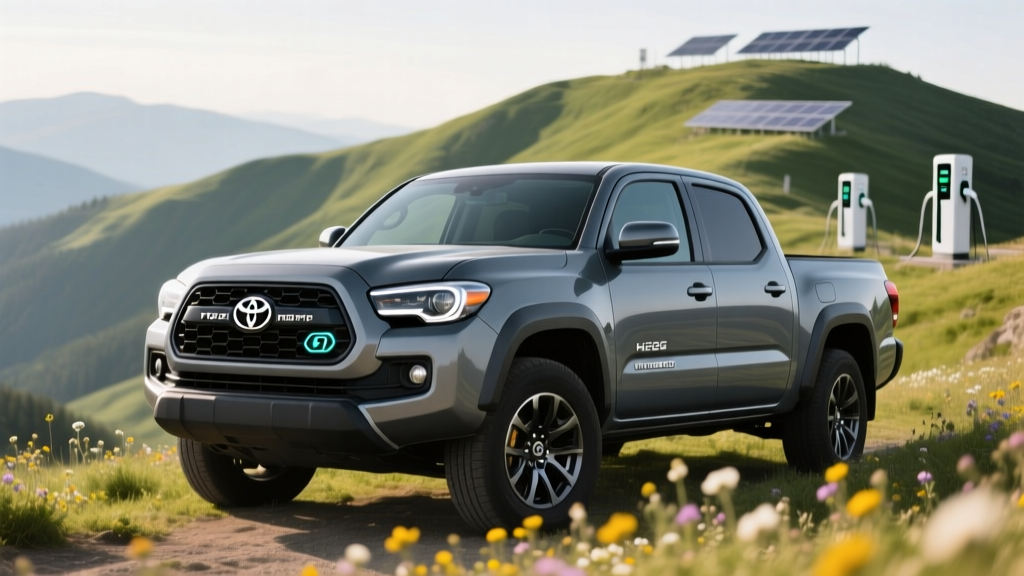
The midsize truck segment has gone turbo, but Toyota took a different route with the current-generation Tacoma. Instead of chasing peak horsepower with a conventional turbo-four, Toyota paired a turbocharged 2.4-liter engine with an electric motor to create the i-FORCE MAX — a hybrid powertrain that delivers V6-rivaling torque while squeezing more miles from every gallon. For 2026, the Toyota Tacoma hybrid powertrain remains the only electrified option in the midsize pickup class, making it a critical choice for buyers who need truck capability without the fuel bill of a full-size rig.
This guide breaks down every number that matters: EPA fuel economy, real-world MPG, the hybrid system's architecture, battery warranty coverage, and whether the Tacoma hybrid qualifies for any federal tax credits.
HEV vs PHEV: Where the Tacoma Hybrid Fits
Before diving into specs, it's essential to clarify what the Tacoma hybrid is — and isn't. The i-FORCE MAX is a conventional hybrid (HEV), not a plug-in hybrid (PHEV). That distinction matters for ownership expectations:
| Feature | HEV (Tacoma i-FORCE MAX) | PHEV (e.g., RAV4 Prime) |
|---|---|---|
| Plug-in charging required? | No — charges via regen & engine | Yes — plug in for EV range |
| Electric-only driving range | None (motor assists engine) | Typically 25–42 miles |
| Battery size | ~1.87 kWh (NiMH) | 18–22 kWh (lithium-ion) |
| Federal tax credit eligible? | No | Up to $7,500 (if requirements met) |
| Primary benefit | More torque + better MPG | EV commuting + gas backup |
The Tacoma's hybrid system uses a small battery pack that charges exclusively through regenerative braking and the gasoline engine. You never plug it in. There's no electric-only mode for commuting — the electric motor exists to supplement torque and improve efficiency, not to replace the engine.
i-FORCE MAX Powertrain: Engine, Motor, and Output
The i-FORCE MAX powertrain combines a turbocharged 2.4-liter inline-four with a 48-horsepower electric motor sandwiched between the engine and an 8-speed automatic transmission. Here's the complete output breakdown:
| Specification | Value |
|---|---|
| Engine | 2.4L turbocharged inline-4 |
| Electric motor output | 48 hp / 184 lb-ft |
| Combined system horsepower | 326 hp |
| Combined system torque | 463 lb-ft |
| Transmission | 8-speed automatic |
| Drivetrain | RWD or 4WD (part-time, depending on trim) |
| Battery type | Nickel-metal hydride (NiMH), ~1.87 kWh |
| Towing capacity (max) | 6,000 lbs |
| Payload capacity (max) | 1,709 lbs |
The headline number is 463 lb-ft of torque, available at just 1,700 RPM. That's more low-end grunt than the previous-generation Tacoma's 4.0L V6 and competitive with the twin-turbo V6 in the Ford F-150. The electric motor fills the torque gap before the turbo spools, eliminating the lag that plagues some turbo-four trucks. In practice, this means confident merging, strong low-speed crawling in 4WD, and no drama when towing near the 6,000-pound limit.
Fuel Economy: EPA Ratings and Real-World MPG
Efficiency is where the Tacoma hybrid separates itself from non-hybrid midsize trucks. According to fueleconomy.gov, here are the official EPA ratings for the 2025–2026 i-FORCE MAX:
| Drivetrain | City MPG | Highway MPG | Combined MPG |
|---|---|---|---|
| 4WD (most trims) | 23 | 27 | 24 |
| RWD (if available) | 24 | 27 | 25 |
For context, the non-hybrid turbo-four Tacoma (i-FORCE) rates at 20–21 city / 26 highway / 22–23 combined depending on configuration. The hybrid's advantage is most pronounced in city driving, where regenerative braking and electric-motor assist reduce the engine's workload.
Real-World MPG: What to Actually Expect
Hybrids frequently exceed their EPA city ratings in stop-and-go traffic, where the electric motor does the most work. However, trucks face variables that sedans don't:
- Highway cruising (70–80 mph): Expect 24–26 MPG. The turbo-four is efficient at steady speed, and the hybrid system provides less benefit here than in the city.
- City driving with light loads: 24–27 MPG is achievable. The hybrid system shines here, and some owners report slightly beating the EPA city estimate.
- Towing or heavy payloads: Drop to 15–18 MPG. No midsize truck is efficient under load, but the hybrid's torque advantage means fewer downshifts on grades.
- Off-road / low-range 4WD: MPG becomes irrelevant; expect single-digit figures in technical terrain.
- Cold weather (below 30°F): Subtract 1–2 MPG. The engine runs richer during warm-up, and battery efficiency drops slightly.
On a mixed 400-mile road trip with highway and suburban driving, expect roughly 24–25 MPG from a 4WD model — closely matching the EPA combined figure. That translates to approximately 480–500 miles per 20-gallon tank under normal conditions.
Pricing, Trims, and Tax Credit Eligibility
The i-FORCE MAX hybrid powertrain is available across several Tacoma trims for 2026. Pricing has climbed modestly year-over-year, reflecting Toyota's positioning of the hybrid as a premium option:
| Trim Level | Approx. 2026 MSRP (4WD) | i-FORCE MAX Standard? |
|---|---|---|
| TRD Off-Road | ~$42,500 | Optional |
| Limited | ~$48,000 | Standard |
| TRD Pro | ~$56,500 | Standard |
| Trailhunter | ~$53,000 | Standard |
Does the Tacoma Hybrid Qualify for a Federal Tax Credit?
No. Under current IRS §30D rules, the federal clean vehicle credit applies only to plug-in electric vehicles (BEVs and PHEVs) that meet battery-sourcing, critical-mineral, MSRP, and buyer-income requirements. Because the Tacoma i-FORCE MAX is a conventional hybrid with no plug and a battery under 4 kWh, it does not qualify for the federal credit.
Some states offer rebates for conventional hybrids, but these vary widely by jurisdiction. Check your state's energy office or department of environmental quality for current programs. No state currently offers a credit comparable to the $7,500 federal EV incentive for non-plug-in hybrids.
Battery Warranty, Lifespan, and Replacement Cost
Toyota Hybrid Battery Warranty: 10 years / 150,000 miles (whichever comes first) on the hybrid battery and all hybrid-system components, including the electric motor, inverter, and control modules. This applies nationwide for 2020 and newer models.
Toyota's hybrid battery warranty is among the strongest in the industry and reflects decades of hybrid powertrain experience dating back to the 1997 Prius. The NiMH battery in the Tacoma i-FORCE MAX is relatively small (~1.87 kWh) and operates within a narrow state-of-charge window — typically between 40% and 80% — which significantly reduces degradation stress compared to a full EV battery that cycles through a wider range.
How Long Will the Hybrid Battery Last?
Based on data from Toyota's broader hybrid fleet (Prius, RAV4 Hybrid, Highlander Hybrid), NiMH hybrid batteries routinely last 150,000–200,000+ miles with minimal capacity loss. The Tacoma's battery is less stressed than those in earlier Toyota hybrids because the i-FORCE MAX uses a more conservative charge/discharge strategy, relying on the turbo engine for primary propulsion.
Battery Replacement Cost (Out of Warranty)
If the hybrid battery fails outside the warranty period, replacement costs typically fall between $2,000 and $4,000 for a new OEM unit, including labor. Third-party rebuilt or refurbished NiMH packs are available for $1,000–$2,000. This is far less expensive than replacing a full EV traction battery ($10,000–$20,000+) because the Tacoma's pack is small and uses mature, well-understood NiMH chemistry.
Individual hybrid battery modules can sometimes be replaced rather than the entire pack, reducing costs further if only one or two cells degrade.
Who Should Choose the Tacoma Hybrid Over a Full EV or Gas Truck?
Choose the Tacoma i-FORCE MAX hybrid if:
- You need a midsize truck for towing, hauling, or off-road use and want the best fuel economy in the segment.
- You don't have reliable access to home or workplace charging (making a PHEV or EV impractical).
- You want V6-class torque without V6 fuel consumption.
- You plan to keep the truck 8–10+ years and value Toyota's long-term reliability track record.
- You frequently drive in city or suburban conditions where hybrid efficiency gains are largest.
Stick with the non-hybrid i-FORCE (turbo-four gas) if:
- Your budget is tight and you won't recoup the ~$2,000–$3,500 hybrid premium through fuel savings.
- You drive predominantly highway miles at steady speeds, where the hybrid advantage shrinks.
- You want the lightest possible curb weight for maximum payload (the hybrid adds roughly 150–200 lbs).
Consider a full EV (Rivian R1T, Ford F-150 Lightning) if:
- You have Level 2 home charging and your daily driving is under 250 miles.
- You want the lowest per-mile energy cost (electricity is typically 3–5¢/mile vs. 15–20¢/mile for gas in a midsize truck).
- You qualify for the $7,500 federal tax credit and your state offers additional EV incentives.
- You don't regularly tow heavy loads (EV range drops 30–50% when towing).
Reliability and Long-Term Ownership
Toyota's hybrid systems are among the most proven in the automotive industry. The i-FORCE MAX uses Toyota's fourth-generation hybrid architecture, which has been refined across millions of vehicles. Key reliability factors:
- No plug, no charging stress: The NiMH battery never sees the deep discharge cycles that wear down EV batteries. It operates in a narrow, protected SoC window.
- Proven components: The electric motor, inverter, and planetary gearset share DNA with systems Toyota has shipped in over 20 million hybrid vehicles globally.
- Turbo engine maturity: The 2.4L turbo-four (T24A-FTS) has been in production since 2022 and is used in the Grand Highlander and Lexus TX, providing a growing reliability data set.
- 8-speed automatic: A conventional torque-converter transmission — no CVT, which some truck buyers distrust for towing.
The primary reliability unknown for 2026 models is long-term turbo durability under heavy-load, high-temperature conditions (towing in desert heat, for example). Early data from the 2024–2025 model years shows no systemic issues, but 100,000+ mile data is still accumulating.
Pros
- 463 lb-ft of torque from 1,700 RPM — strongest in midsize truck class
- 24 MPG combined (4WD) — best fuel economy in the segment
- No plug-in required; no charging infrastructure needed
- 10-year / 150,000-mile hybrid battery warranty
- 6,000-lb towing capacity with less strain on the powertrain
- Toyota's hybrid reliability track record
Cons
- Not eligible for federal clean vehicle tax credit
- ~$2,000–$3,500 premium over non-hybrid i-FORCE
- Hybrid system adds ~150–200 lbs of curb weight
- No electric-only driving mode
- Highway MPG advantage over non-hybrid is modest (1–2 MPG)
- NiMH battery chemistry is older (though proven)
Frequently Asked Questions
How many MPG does the Toyota Tacoma hybrid get?
The i-FORCE MAX hybrid with 4WD earns an EPA-estimated 23 city / 27 highway / 24 combined MPG. Real-world results typically match or slightly exceed the city figure in stop-and-go driving, while highway driving at 70–80 mph yields 24–26 MPG. Towing drops efficiency to 15–18 MPG.
Can I plug in the Tacoma hybrid to charge it?
No. The Tacoma i-FORCE MAX is a conventional hybrid (HEV), not a plug-in hybrid (PHEV). The battery charges through regenerative braking and the gasoline engine. There is no charging port and no electric-only driving range.
Is the Tacoma hybrid powertrain reliable?
Toyota's hybrid systems are among the most proven in the industry, with over 20 million hybrid vehicles sold globally. The i-FORCE MAX uses Toyota's fourth-generation hybrid architecture with a 10-year / 150,000-mile warranty on all hybrid components. Long-term turbo engine data is still accumulating for the 2.4L, but early indications from 2024–2025 models show no systemic issues.
What does it cost to replace the Tacoma hybrid battery?
Out of warranty, a new OEM hybrid battery replacement costs approximately $2,000–$4,000 including labor. Refurbished or rebuilt NiMH packs are available for $1,000–$2,000. The battery is covered under Toyota's 10-year / 150,000-mile hybrid warranty, and real-world data from Toyota's hybrid fleet suggests these batteries commonly last 150,000–200,000+ miles.
Does the Tacoma hybrid qualify for any tax credit?
The Tacoma i-FORCE MAX does not qualify for the federal §30D clean vehicle credit because it is a conventional hybrid without plug-in capability. Some states may offer small rebates for hybrid vehicles, but these vary by jurisdiction and are typically far less than EV incentives. Check your state's energy office for current programs.
How does the Tacoma hybrid compare to the Ford Maverick hybrid?
The Ford Maverick hybrid achieves an EPA-estimated 42 MPG combined (FWD) — far more efficient than the Tacoma's 24 MPG. However, the Maverick is a smaller unibody truck with a 2,000-lb towing capacity and no 4WD option. The Tacoma i-FORCE MAX trades fuel economy for 6,000-lb towing, available 4WD, and off-road capability. They serve fundamentally different use cases.
Is the hybrid worth the extra cost over the gas-only Tacoma?
At current fuel prices (~$3.30/gallon national average), the hybrid's 2 MPG combined advantage saves roughly $150–$200 per year for a driver covering 15,000 miles annually. The payback period on a ~$2,500 hybrid premium is 12–16 years purely on fuel savings. However, the hybrid's real value is the 463 lb-ft of torque — significantly more than the gas-only i-FORCE's 243 lb-ft — which improves towing, off-road crawling, and everyday drivability. If you value torque and refinement, the hybrid is worth the premium regardless of fuel savings.