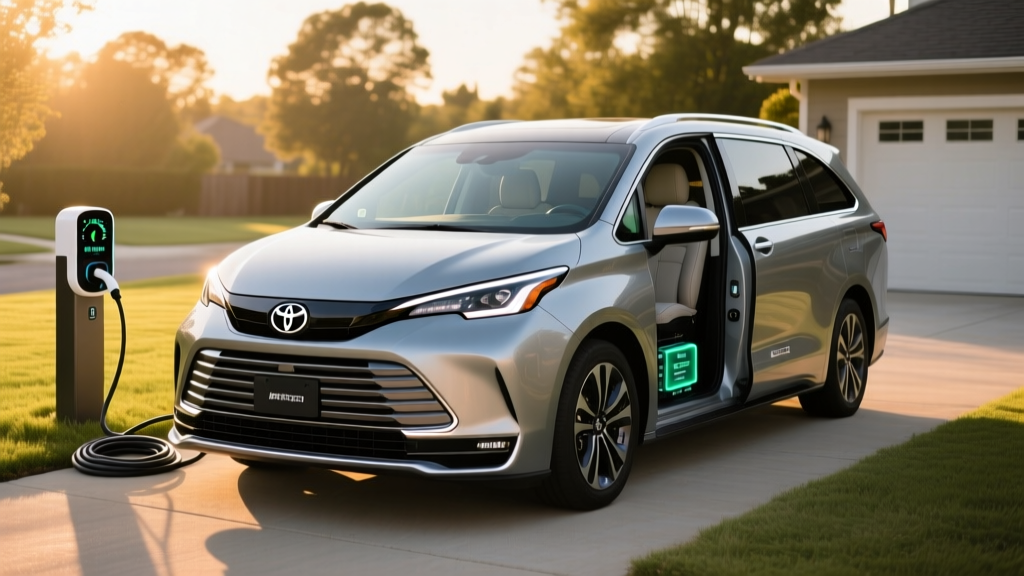
If you've been searching for a Toyota hybrid van, the answer in 2026 is straightforward: the Toyota Sienna. Since the 2021 model year, Toyota made the bold decision to offer the Sienna exclusively as a hybrid — no gas-only variant exists. That means every Sienna rolling off the line pairs a 2.5-liter four-cylinder engine with Toyota's fourth-generation hybrid system, delivering minivan practicality with fuel economy that embarrasses many compact sedans.
But the Sienna is a conventional hybrid (HEV), not a plug-in hybrid (PHEV). That distinction matters enormously for your daily routine, your budget, and your expectations at the pump. This guide breaks down exactly what the 2026 Sienna delivers — EPA numbers, real-world fuel economy, powertrain specs, battery longevity, and whether it's the right electrified choice for your family versus a PHEV or full EV alternative.
HEV vs PHEV: What the Sienna Actually Is
Before examining specs, let's eliminate the most common confusion. The Toyota Sienna is a conventional hybrid electric vehicle (HEV). It does not plug in. It does not have a charge port. You fuel it at a gas station like any other vehicle, and the hybrid system manages energy recovery and electric-motor assist automatically.
HEV vs PHEV vs EV — Quick Distinction
| Feature | HEV (Sienna) | PHEV (e.g., Chrysler Pacifica Hybrid) | BEV (e.g., VW ID. Buzz) |
|---|---|---|---|
| Plugs in? | No | Yes (Level 1/2) | Yes (Level 1/2/DC) |
| Electric-only range | ~1 mi at low speed | 20–40 mi typical | 200–300+ mi |
| Fuel needed? | Yes, always | Yes, for longer trips | No |
| Home charging required? | No | Recommended | Essential |
| Federal tax credit (§30D)? | No | Up to $7,500* | Up to $7,500* |
*§30D credit eligibility depends on MSRP caps, buyer income limits, and battery critical-mineral sourcing requirements per current IRS rules. Consult a tax professional.
Toyota does not currently offer a Sienna PHEV or Sienna EV in the U.S. market. If you need plug-in electric driving from a Toyota van, you'll have to wait or look at competitors. The Sienna's value proposition is simplicity: exceptional fuel economy with zero lifestyle change.
2026 Toyota Sienna Hybrid: Full Spec Sheet
| Specification | 2026 Toyota Sienna (FWD) | 2026 Toyota Sienna (AWD) |
|---|---|---|
| Powertrain | 2.5L I4 + 2 electric motors | 2.5L I4 + 3 electric motors |
| Combined HP | 245 hp | 245 hp |
| Transmission | eCVT | eCVT |
| EPA MPG (City/Hwy/Combined) | 36 / 36 / 36 | 35 / 36 / 35 |
| Fuel Tank | 14.5 gal | 14.5 gal |
| Total Range | ~522 mi | ~508 mi |
| 0–60 mph | ~7.1 sec | ~7.0 sec |
| Hybrid Battery | 1.6 kWh NiMH (sealed) | 1.6 kWh NiMH (sealed) |
| Towing Capacity | 3,500 lbs | 3,500 lbs |
| Cargo (behind 3rd row) | 33.5 cu ft | 33.5 cu ft |
| Seating | 7 or 8 passengers | 7 or 8 passengers |
| Base MSRP (LE trim) | ~$39,485 | ~$40,285 (AWD add) |
Source: EPA / fueleconomy.gov and Toyota Motor Corporation specifications. MSRP excludes destination charge. Verify current pricing with your dealer.
Fuel Economy: EPA Numbers vs Real-World MPG
The 2026 Sienna's EPA ratings are remarkably consistent across driving conditions — a hallmark of Toyota's hybrid synergy drive. The FWD model earns 36 MPG city / 36 highway / 36 combined, while AWD drops just 1 MPG in the city to 35 / 36 / 35. Per fueleconomy.gov, these figures place the Sienna among the most efficient vehicles in its class by a wide margin.
EPA Fuel Economy Breakdown
| Drivetrain | City | Highway | Combined | Annual Fuel Cost* |
|---|---|---|---|---|
| FWD | 36 MPG | 36 MPG | 36 MPG | ~$1,750 |
| AWD | 35 MPG | 36 MPG | 35 MPG | ~$1,800 |
*Based on 15,000 mi/yr at $3.50/gal regular unleaded. Your costs will vary with local fuel prices and driving habits.
Real-World MPG: What Owners Actually See
Here's where the Sienna hybrid shines in a way that surprises many first-time hybrid buyers: real-world fuel economy often meets or exceeds the EPA sticker, particularly in city and suburban driving. Toyota's hybrid system recovers energy during braking and low-speed operation, conditions where conventional gas engines are least efficient.
In mixed suburban driving with moderate traffic, owners commonly report 36–40 MPG. In stop-and-go city traffic — school runs, grocery trips, urban commutes — the electric motor does substantial work at low speeds, and 38–42 MPG is achievable without hypermiling. Highway-only driving at 75+ mph tends to pull figures down to 30–33 MPG, as aerodynamic drag overwhelms the hybrid system's advantages at sustained high speed.
Cold weather impacts are modest compared to a full EV. Expect a 5–10% reduction in winter (roughly 32–34 MPG combined in freezing temperatures) because the engine must run more frequently for cabin heat and battery warming. This is far less severe than the 20–40% range loss a BEV experiences in the same conditions.
Powertrain Deep Dive: How Toyota's Hybrid System Works in the Sienna
The 2026 Sienna uses Toyota's fourth-generation Hybrid Synergy Drive, pairing a 2.5-liter Atkinson-cycle four-cylinder engine (producing approximately 189 hp on its own) with one or two front-mounted electric motors. FWD models use two motor-generators (MG1 for starting/generating, MG2 for propulsion), while AWD models add a third, independent rear electric motor that provides on-demand all-wheel drive without a mechanical driveshaft.
Combined system output is 245 horsepower — adequate for a minivan, though not quick by performance standards. The 0–60 mph time of approximately 7.0–7.1 seconds is respectable for a 4,600-pound vehicle and comparable to turbocharged four-cylinder competitors. The eCVT (electronically controlled continuously variable transmission) uses a planetary gearset rather than a belt-and-pulley design, which eliminates the "rubber-band" feel of older CVTs and delivers smooth, direct acceleration.
The AWD system deserves specific attention: the rear motor engages only when slip is detected or during hard acceleration from a stop. It can send up to 50% of torque to the rear wheels. This is not a full-time AWD system like Subaru's, but it handles rain, light snow, and gravel roads competently — and the penalty is just 1 MPG combined versus FWD.
Battery, Warranty, and Long-Term Reliability
Hybrid Battery Warranty
Coverage: 10 years / 150,000 miles (whichever comes first)
What's covered: Hybrid battery pack, hybrid control module, and related hybrid-system components against defects and excessive capacity loss.
Threshold: Toyota warrants the hybrid battery to retain sufficient capacity for normal hybrid operation. There is no published specific percentage-retention guarantee as with BEVs, but Toyota's hybrid batteries have demonstrated exceptional longevity in real-world use.
Verify current warranty terms with Toyota's official warranty guide or your dealer, as terms may vary by model year.
Hybrid Battery Replacement Cost
The Sienna's 1.6 kWh nickel-metal hydride (NiMH) hybrid battery is small, proven, and inexpensive to replace compared to a full EV traction battery. If replacement is needed outside of warranty — typically at 150,000–250,000+ miles based on data from earlier Toyota hybrid generations — expect to pay approximately $2,000–$3,500 for a new OEM battery pack including labor at a dealership. Independent hybrid specialists may offer refurbished packs for $1,000–$2,000.
For context, Toyota's hybrid battery track record is among the best in the industry. Prius taxis routinely exceed 300,000 miles on original hybrid batteries. The Sienna's battery is less stressed than a PHEV or BEV battery because it operates within a narrow state-of-charge window (roughly 40–80% SoC), which dramatically reduces degradation. The system never fully charges or fully depletes the pack, preserving cell health over decades of use.
Overall Reliability
The Sienna's hybrid powertrain eliminates several failure-prone components found in conventional vehicles: there is no traditional starter motor, no alternator, no accessory drive belt, and the eCVT has no clutch packs or torque converter to wear out. Regenerative braking significantly reduces brake pad wear — many owners report 60,000–80,000+ miles on original brake pads. Toyota's hybrid system has been refined over 25+ years of production, and the Sienna benefits from that maturity.
Pricing, Trims, and Tax Credit Eligibility
The 2026 Toyota Sienna is offered in six trims, all hybrid-only:
| Trim | Approx. MSRP (FWD) | Key Features |
|---|---|---|
| LE | $39,485 | 8-passenger, Toyota Safety Sense 3.0, 9" touchscreen |
| XLE | $43,385 | SofTex seats, power liftgate, wireless CarPlay/Android Auto |
| XSE | $44,885 | Sport-tuned suspension, 20" wheels, 7-passenger |
| Limited | $49,135 | Leather, JBL audio, dual sunroofs, HUD |
| Platinum | $53,235 | 360° camera, rear entertainment, heated/ventilated 2nd row |
| Woodland Edition | $48,485 | AWD standard, roof rails, all-terrain tires |
Add approximately $800 for AWD on trims where optional. Destination charge (~$1,395) not included. Verify pricing with Toyota.com.
Does the Sienna Qualify for a Federal Tax Credit?
No. The Toyota Sienna is a conventional hybrid (HEV), and the federal §30D Clean Vehicle Credit applies only to plug-in electric vehicles — battery electric vehicles (BEVs) and plug-in hybrids (PHEVs) with a minimum battery capacity of 7 kWh. The Sienna's 1.6 kWh NiMH battery does not qualify.
Some states offer modest incentives for conventional hybrids, but these are increasingly rare as incentive programs shift toward plug-in vehicles. Check your state's energy office or AFDC incentive database for current local programs. A few states have offered $500–$1,000 rebates for HEVs, but availability varies and programs change frequently.
Sienna vs the Competition: Hybrid Van Alternatives
The Sienna occupies a unique position as the only exclusively hybrid minivan on the market. Here's how it compares to the key alternatives:
Sienna Advantages
- Best-in-class fuel economy (35–36 MPG combined)
- No plug-in required — zero lifestyle change
- Proven hybrid reliability over 25+ years of Toyota systems
- Available AWD with minimal MPG penalty
- 10-year/150,000-mile hybrid battery warranty
- 500+ mile total range per tank
Sienna Limitations
- No electric-only driving capability
- No federal tax credit eligibility
- 245 hp feels modest when fully loaded (passengers + cargo)
- Higher starting price than base Honda Odyssey (~$38,000)
- Third-row seat does not fold into the floor (unlike Odyssey/Pacifica)
- No plug-in hybrid variant available
Chrysler Pacifica Hybrid (PHEV): The Pacifica Hybrid offers 32 miles of electric-only range and qualifies for up to $7,500 in federal tax credits (subject to §30D sourcing and income requirements). Combined MPG on gas after battery depletion is approximately 30 MPG — less than the Sienna. It's the better choice if you have home charging and a short commute, but the Sienna wins on simplicity and long-trip efficiency.
Honda Odyssey (gas-only): The Odyssey earns 22 MPG combined — 13 MPG less than the Sienna. Over 15,000 miles per year, that's roughly $800–$1,000 more in annual fuel costs. The Odyssey's advantages are its Magic Slide second-row seats and fold-flat third row for maximum cargo flexibility.
VW ID. Buzz (BEV): The all-electric ID. Buzz offers 231 miles of EPA range, three rows, and zero tailpipe emissions. However, it costs significantly more (~$60,000+), requires home charging infrastructure, and delivers less total range for road trips. It's ideal for families with reliable home charging and mostly local driving.
Who Should Choose the Sienna Hybrid?
The Sienna Hybrid Is Right for You If:
- You want maximum fuel savings with zero behavior change. No plugs, no apps, no range planning — just fill up and drive.
- You lack home charging access. Apartment dwellers, street parkers, and those without garage access get full hybrid benefits without installing a charger.
- You take frequent long road trips. 500+ mile range with 5-minute refueling beats any EV or PHEV on cross-country travel.
- You prioritize long-term reliability. Toyota's hybrid system has the longest real-world track record in the industry.
- You live in a cold climate. Minimal winter MPG loss compared to the 20–40% range reduction EVs experience in freezing weather.
Look Elsewhere If:
- You want electric-only daily driving. Consider the Pacifica Hybrid (PHEV) or ID. Buzz (BEV).
- You want federal tax credits. The §30D credit requires a plug-in vehicle with ≥7 kWh battery.
- You need maximum cargo flexibility. The Odyssey's fold-flat third row and the Pacifica's Stow 'n Go seating beat the Sienna's fixed third row.
Frequently Asked Questions
How many MPG does the Toyota Sienna hybrid get?
The 2026 Toyota Sienna FWD earns an EPA-rated 36 MPG city / 36 highway / 36 combined. The AWD version rates 35 city / 36 highway / 35 combined. Real-world city driving often yields 38–42 MPG thanks to the hybrid system's regenerative braking, while sustained highway driving at 75+ mph may return 30–33 MPG.
Does the Toyota Sienna plug in?
No. The Sienna is a conventional hybrid (HEV) and does not have a charge port. It is fueled exclusively at a gas station. The hybrid system charges its small battery through regenerative braking and the gasoline engine. If you want a Toyota van that plugs in, one does not currently exist in the U.S. market.
How long will the Sienna hybrid battery last, and what does replacement cost?
Toyota warrants the hybrid battery for 10 years or 150,000 miles. Based on data from millions of Toyota hybrids on the road, these batteries commonly last 150,000–250,000+ miles. Replacement cost outside of warranty is approximately $2,000–$3,500 for an OEM pack at a dealer, or $1,000–$2,000 for a refurbished unit from an independent hybrid specialist.
Is the Sienna hybrid underpowered for a minivan?
With 245 combined horsepower, the Sienna delivers a 0–60 mph time of approximately 7.0 seconds. That's adequate for merging, passing, and daily driving, though it's noticeably less punchy than the Honda Odyssey's 280-hp V6 or the Chrysler Pacifica's 287-hp V6. When fully loaded with seven passengers and cargo, the Sienna feels deliberate rather than quick — but the electric motor's instant torque at low speeds keeps it responsive around town.
Hybrid vs PHEV vs EV — which minivan should I buy?
Choose the Sienna (HEV) if you want the simplest, most fuel-efficient option with no plug-in requirement and maximum road-trip range. Choose the Pacifica Hybrid (PHEV) if you have home charging, a short commute (under 32 miles), and want to drive on electricity most days while retaining gas capability for longer trips. Choose the ID. Buzz (BEV) if you have reliable home charging, mostly drive locally, want zero tailpipe emissions, and can accept 231 miles of range with longer charging stops on road trips.
Does the Toyota Sienna qualify for any tax credit?
The Sienna does not qualify for the federal §30D Clean Vehicle Credit because it is a conventional hybrid, not a plug-in vehicle. Some states may offer small incentives for hybrids, but these are uncommon and vary by jurisdiction. Check the Alternative Fuels Data Center for state-specific programs.
Can I get AWD with the Sienna hybrid?
Yes. Electronic On-Demand AWD is available on most Sienna trims for approximately $800 additional and comes standard on the Woodland Edition. The system uses an independent rear electric motor — no mechanical driveshaft — and imposes only a 1 MPG penalty versus FWD.