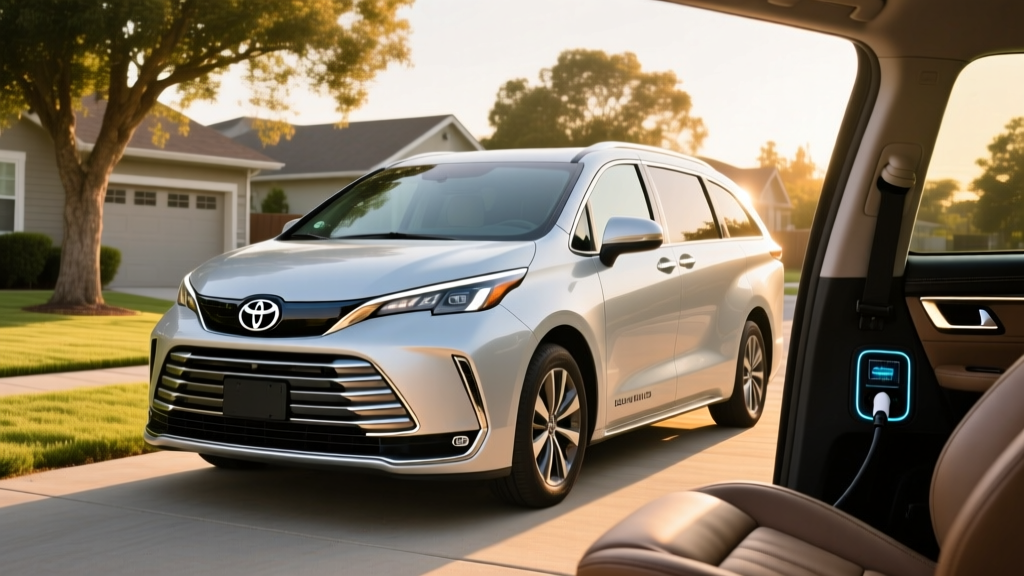
The Toyota Sienna has been an exclusively hybrid minivan since its fourth-generation redesign, and the 2026 model continues that commitment with a proven 2.5-liter four-cylinder hybrid powertrain delivering 36 MPG combined. For families searching for a Toyota van hybrid, the Sienna remains the only electrified minivan in its class — no gas-only variant exists, which means every buyer gets hybrid efficiency whether they sought it out or not.
This review covers the 2026 Sienna's real-world fuel economy, powertrain specs, hybrid battery longevity, pricing, and whether it makes sense versus a full EV or a conventional gas minivan like the Honda Odyssey.
2026 Toyota Sienna Hybrid Powertrain and Performance
Every 2026 Sienna uses Toyota's fourth-generation hybrid system pairing a 2.5-liter inline-four Atkinson-cycle engine with three electric motors (two front, one rear on AWD trims). Combined output is 245 horsepower. The powertrain routes through an electronically controlled CVT — no traditional geared transmission.
| Specification | Value |
|---|---|
| Engine | 2.5L inline-4 Atkinson cycle |
| Electric Motors | 2 front (generator + drive), 1 rear (AWD only) |
| Combined Horsepower | 245 HP |
| Transmission | eCVT (electronically controlled) |
| Drivetrain Options | FWD or electronic AWD |
| 0–60 mph | ~7.1 seconds (FWD) |
| Towing Capacity | 3,500 lbs (with tow prep package) |
| Hybrid Battery | ~1.9 kWh nickel-metal hydride (NiMH) |
The Sienna's hybrid battery is small — roughly 1.9 kWh usable — because this is a conventional hybrid (HEV), not a plug-in. The battery assists during acceleration, captures energy during braking, and enables short low-speed electric-only movement, but it cannot be plugged in and does not provide meaningful electric-only range at highway speeds. If you're looking for plug-in capability, the Sienna does not offer a PHEV variant as of 2026.
Fuel Economy: EPA Ratings and Real-World MPG
The Sienna's headline number is efficiency. The front-wheel-drive model earns an EPA-estimated 36 MPG combined, while the all-wheel-drive version drops slightly to 35 MPG combined. These figures are exceptional for a three-row, 4,600-pound minivan.
| Drivetrain | City MPG | Highway MPG | Combined MPG |
|---|---|---|---|
| FWD | 36 | 36 | 36 |
| AWD | 35 | 36 | 35 |
Real-World MPG vs. EPA Sticker
Toyota's hybrid system excels in stop-and-go city driving where regenerative braking and electric-motor assist do the most work. In real-world testing, owners frequently report 37–40 MPG in suburban and city driving, occasionally exceeding the EPA city estimate. Highway driving at 75+ mph tends to return 32–34 MPG, slightly below the EPA highway number, because aerodynamic drag on a large minivan body overwhelms the hybrid system's advantages at sustained high speed.
In cold weather (below 30°F), expect a 5–10% efficiency drop as the engine runs more frequently to provide cabin heat and maintain battery temperature. This is a smaller penalty than full EVs experience (which can lose 20–30% range in extreme cold) because the Sienna's engine waste heat warms the cabin without a major efficiency hit.
HEV vs. PHEV vs. Full EV: Which Fits Your Family?
The Sienna is a conventional hybrid — it never needs to be plugged in, and it recovers its own electricity through regenerative braking and engine power. This is the right choice for families who lack home charging access, who take frequent long road trips, or who simply don't want to think about charging logistics. But it's worth understanding how it compares to the other electrified options.
Conventional Hybrid (HEV)
Example: Toyota Sienna
Plug in? No
Electric-only range: Less than 1 mile at low speed
Best for: No home charger, road trips, simplicity
Fuel cost: ~$0.10/mile at $3.50/gal, 36 MPG
Plug-In Hybrid (PHEV)
Example: Chrysler Pacifica Hybrid
Plug in? Yes (optional)
Electric-only range: ~32 miles
Best for: Short commutes on electric, road trips on gas
Fuel cost: ~$0.04/mile electric, ~$0.13/mile gas
Full EV (BEV)
Example: Kia EV9
Plug in? Yes (required)
Electric-only range: 230–304 miles
Best for: Home charging, lower operating cost, zero tailpipe emissions
Fuel cost: ~$0.04–0.06/mile at $0.15/kWh
The Chrysler Pacifica Hybrid is the Sienna's only direct competitor with a plug. It offers 32 miles of electric-only range on a 16 kWh battery and can DC fast charge — but it commands a significant price premium and has historically trailed the Sienna in reliability ratings. The Kia EV9 three-row electric SUV offers zero tailpipe emissions and lower per-mile energy cost, but its higher starting price and charging logistics on long trips present trade-offs.
Pricing, Trims, and Tax Credit Eligibility
The 2026 Toyota Sienna starts at approximately $39,000 MSRP for the LE FWD trim and climbs to around $54,000 for the Platinum AWD trim. Here's the trim breakdown:
| Trim | Drivetrain | Starting MSRP |
|---|---|---|
| LE | FWD | $39,000 |
| LE | AWD | $40,000 |
| XLE | FWD / AWD | $43,000 / $44,000 |
| XSE | FWD / AWD | $45,500 / $46,500 |
| Limited | FWD / AWD | $49,000 / $50,000 |
| Platinum | FWD / AWD | $53,000 / $54,000 |
Does the Sienna Qualify for a Federal Tax Credit?
No. The federal §30D clean vehicle credit applies only to plug-in electric vehicles (BEVs and PHEVs) with a battery capacity of at least 7 kWh, per IRS guidelines. The Sienna's conventional hybrid system with its ~1.9 kWh NiMH battery does not meet this threshold. There is no federal tax credit for conventional hybrids as of 2026.
Some states offer their own incentives for hybrid vehicles, though these are uncommon and vary significantly by jurisdiction. Check your state's energy or environmental agency website for current programs. A tax professional can confirm any applicable local credits.
Hybrid Battery Warranty, Reliability, and Replacement Cost
Hybrid battery longevity is the single most common concern among first-time hybrid buyers. Toyota's track record here is among the strongest in the industry, dating back to the original Prius in 2001.
• 10 years or 150,000 miles (whichever comes first) for the hybrid battery and hybrid system components
• Covers battery capacity loss below a defined threshold and all hybrid-system electronics
• Transferable to subsequent owners
Toyota's fourth-generation hybrid system in the Sienna uses a nickel-metal hydride (NiMH) battery pack rather than the lithium-ion chemistry found in full EVs. NiMH is a mature, well-understood technology with excellent cycle-life characteristics. Real-world data from Toyota's hybrid fleet (Prius, Camry Hybrid, RAV4 Hybrid) shows that hybrid batteries routinely last 150,000–200,000+ miles before significant degradation, and many outlast the vehicle itself.
Battery Replacement Cost
If a hybrid battery does fail outside warranty, a replacement NiMH pack for the Sienna costs approximately $3,000–$4,500 installed at a Toyota dealership. Independent hybrid specialists may offer refurbished packs for $2,000–$3,000. This is a fraction of full EV battery replacement costs, which can exceed $10,000–$20,000, because the Sienna's battery is much smaller.
Overall Reliability
Toyota consistently ranks at or near the top in long-term reliability studies from J.D. Power and Consumer Reports. The Sienna's hybrid powertrain has fewer wear-prone components than a conventional gas minivan: no traditional starter motor, no alternator, no accessory belt, and regenerative braking extends brake pad life significantly (many owners report 80,000+ miles on original pads). The eCVT has no physical gears or clutches to wear out.
According to NHTSA, check current safety ratings and any open recalls before purchasing. The Sienna comes standard with Toyota Safety Sense 3.0, which includes pre-collision braking, lane departure alert, dynamic radar cruise control, and lane tracing assist — all SAE Level 1–2 driver-assistance features requiring full driver engagement.
Who Should Choose the Sienna Hybrid?
✓ Choose the Sienna If
- You want three rows and maximum cargo space with no charging hassle
- Your daily driving is mostly city/suburban (where hybrids shine)
- You take regular road trips and don't want to plan around chargers
- You lack access to home or workplace charging
- You value long-term reliability and low maintenance costs
- You want ~644 miles of range without stopping
✗ Look Elsewhere If
- You want electric-only commuting (consider Pacifica Hybrid or an EV)
- You want to qualify for the $7,500 federal tax credit
- You prioritize acceleration — 245 HP in a 4,600-lb van is adequate, not quick
- You want the lowest per-mile energy cost (home-charged EVs win here)
- You want one-pedal driving or a fully electric experience
5-Year Ownership Cost Snapshot
The Sienna's hybrid efficiency translates directly to fuel savings versus the gas-only Honda Odyssey, which earns 22 MPG combined. Over five years and 75,000 miles, the difference is meaningful:
| Vehicle | Combined MPG | Gallons Used | 5-Year Fuel Cost |
|---|---|---|---|
| Toyota Sienna Hybrid | 36 | 2,083 | $7,291 |
| Honda Odyssey (gas) | 22 | 3,409 | $11,932 |
| Fuel savings with Sienna | $4,641 | ||
That ~$4,600 fuel savings over five years partially offsets the Sienna's higher starting price versus some gas-only competitors. Factor in reduced brake wear and the absence of a traditional transmission to service, and the Sienna's total cost of ownership is competitive with — or lower than — gas minivans despite the lack of a tax credit.
Frequently Asked Questions
How many MPG does the Toyota Sienna hybrid get?
The 2026 Sienna FWD earns 36 MPG city / 36 highway / 36 combined. The AWD model earns 35/36/35. Real-world city driving often yields 37–40 MPG, while sustained highway driving at 75+ mph typically returns 32–34 MPG.
Does the Toyota Sienna need to be plugged in?
No. The Sienna is a conventional hybrid (HEV), not a plug-in hybrid. It charges its own small battery through regenerative braking and the gasoline engine. You simply fill it with gas like any other vehicle.
Can the Sienna drive on electric power alone?
Only at very low speeds (under ~25 mph) for brief distances — typically less than a mile. The electric motors assist the engine during acceleration and enable silent, electric-only creeping in parking lots and stop-and-go traffic, but the Sienna cannot sustain highway speeds on electric power alone. If you want meaningful electric-only range, look at the Chrysler Pacifica Hybrid (32 miles EV range) or a full EV.
How long will the Sienna hybrid battery last?
Toyota warranties the hybrid battery for 10 years or 150,000 miles. Based on decades of Toyota hybrid data, these batteries routinely last 150,000–200,000+ miles. Replacement cost, if needed out of warranty, is approximately $3,000–$4,500 — far less than a full EV battery.
Does the 2026 Sienna qualify for any tax credit?
No federal tax credit applies to conventional hybrids under current IRS §30D rules. Only plug-in vehicles (BEVs and PHEVs) with at least 7 kWh of battery capacity qualify. Check your state's incentive programs for any local hybrid rebates, though these are rare.
Is the Sienna hybrid good for road trips?
Excellent. With roughly 644 miles of range and no need to plan charging stops, the Sienna is one of the most practical road-trip vehicles available. You'll stop for fuel every 8–10 hours of driving — the same rhythm as any gas car, just less frequently.
Sienna hybrid vs. Pacifica Hybrid: which is better?
The Sienna wins on reliability, fuel efficiency as a hybrid (36 vs. 30 MPG combined when the Pacifica's battery is depleted), and pricing. The Pacifica Hybrid wins on electric-only commuting (32 miles) and potential federal tax credit eligibility. If you can charge at home and your commute is under 30 miles, the Pacifica Hybrid can run mostly on electricity. If you want a no-compromise hybrid with maximum simplicity, the Sienna is the stronger pick.