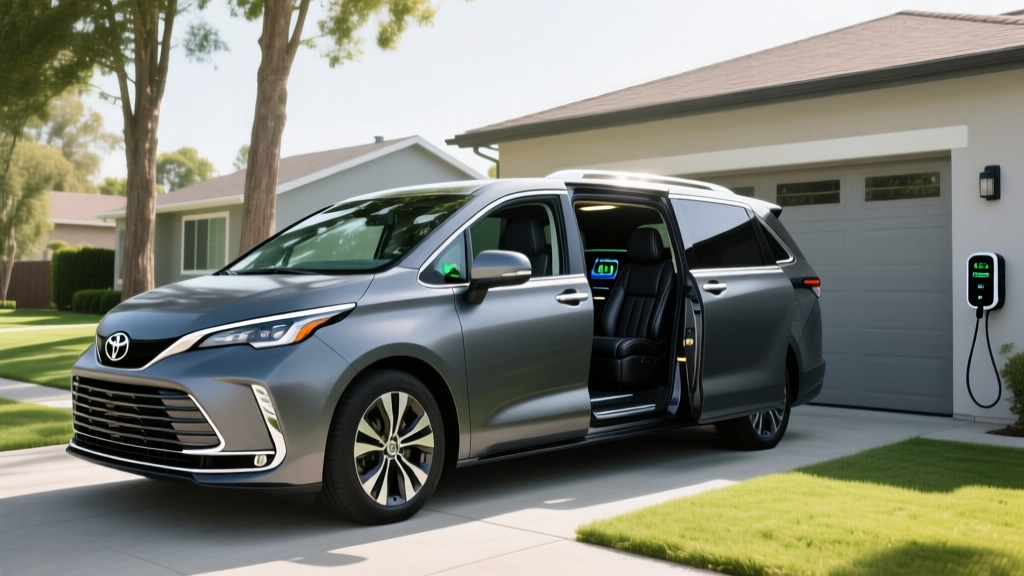
The Toyota Sienna has been a hybrid-only minivan since the 2021 model year, and the 2026 Toyota Sienna hybrid minivan continues that formula with a fourth-generation 2.5-liter four-cylinder hybrid powertrain delivering 245 combined horsepower and an EPA-estimated 36 MPG combined. For families weighing a three-row vehicle against full-electric SUVs or conventional gas minivans, the Sienna occupies a pragmatic middle ground: no plug required, no range anxiety, and fuel costs that undercut every non-hybrid competitor in the segment.
This review covers the 2026 Sienna's real-world efficiency, powertrain details, battery longevity, pricing across all trims, and how it stacks up against plug-in hybrid and full EV alternatives for family hauling.
2026 Toyota Sienna Hybrid Powertrain and Performance
The 2026 Sienna uses Toyota's fourth-generation hybrid system, pairing a 2.5-liter inline-four Atkinson-cycle gasoline engine with two electric motor-generators (three on AWD trims) routed through an electronically controlled continuously variable transmission (eCVT).
| Specification | FWD | AWD (Electronic) |
|---|---|---|
| Engine | 2.5L 4-cylinder Atkinson-cycle | |
| Gas Engine Output | 189 hp / 176 lb-ft torque | |
| Front Electric Motor | 134 hp / 199 lb-ft | |
| Rear Electric Motor (AWD only) | N/A | 54 hp / 89 lb-ft |
| Combined System Horsepower | 245 hp | |
| Transmission | eCVT | |
| Drivetrain | Front-Wheel Drive | Electronic On-Demand AWD |
| 0–60 mph (est.) | ~7.1 sec | ~7.0 sec |
| Towing Capacity | 3,500 lbs | |
The eCVT is a power-split device, not a belt-driven CVT, so it avoids the rubber-band feel associated with traditional continuously variable transmissions. Acceleration is adequate for merging and passing, though the Sienna prioritizes smoothness and efficiency over urgency. The electronic AWD system engages the rear motor only when slip is detected or during hard acceleration — it's a traction aid, not an off-road system.
Fuel Economy: EPA Estimates vs. Real-World MPG
The Sienna's headline number is its efficiency. Here's the full EPA breakdown per fueleconomy.gov:
| Drivetrain | City MPG | Highway MPG | Combined MPG |
|---|---|---|---|
| FWD | 36 | 36 | 36 |
| AWD | 35 | 36 | 35 |
The near-identical city and highway figures reflect how Toyota's hybrid system recovers energy during stop-and-go driving via regenerative braking, then supplements the gas engine on the highway. Most conventional minivans split 19 city / 28 highway — the Sienna effectively doubles city efficiency.
Real-World MPG Expectations
Owner-reported data on Fuelly and long-term fleet testing consistently show the Sienna averaging 33–38 MPG combined in mixed driving. City-heavy commutes often push the number to 38–40 MPG because the electric motors handle low-speed propulsion. Sustained 80-mph highway cruising drops efficiency to roughly 30–32 MPG due to the minivan's boxy aerodynamic profile.
In cold weather (below 30°F), expect a 5–10% reduction. The engine runs more frequently to generate cabin heat and warm the catalytic converter, reducing electric-only low-speed operation. A block heater isn't available, but Toyota's thermal management system is proven across millions of Prius and Camry Hybrid units.
HEV vs. PHEV vs. EV: Where Does the Sienna Fit?
The 2026 Sienna is a conventional hybrid (HEV) — it has a small 1.6 kWh nickel-metal hydride (NiMH) traction battery that recharges through regenerative braking and the gas engine. You never plug it in.
- HEV (Sienna): No plug, 36 MPG combined, ~530-mile total range on a 14.5-gallon tank. Ideal if you lack home charging access.
- PHEV (e.g., Chrysler Pacifica Hybrid): Plugs in for ~32 miles electric-only, then operates as a hybrid. Requires home Level 2 charging to realize fuel savings. Battery: 16 kWh.
- BEV (e.g., Kia EV9): Fully electric, 230–300 mile range, requires reliable home or public charging infrastructure. Lowest operating cost but highest upfront price.
Sienna Hybrid Battery: Chemistry, Warranty, and Replacement Cost
Toyota equips the Sienna with a 1.6 kWh (gross) NiMH hybrid battery pack. This is a small buffer — it stores enough energy for brief electric-only assists at low speeds (roughly 0.5–1 mile at under 25 mph), not sustained electric driving. The small capacity is intentional: it reduces weight, cost, and thermal management complexity.
Hybrid Battery Warranty Coverage
- Duration: 10 years / 150,000 miles (whichever comes first)
- Coverage: Defects and capacity loss below a defined threshold
- Transferability: Fully transferable to subsequent owners
- Hybrid System Components: Inverter, motor-generators, and control electronics covered under the same 10yr/150k term
Battery Lifespan and Replacement Cost
Toyota's NiMH hybrid batteries have an exceptional longevity record. Data from Prius fleets and high-mileage Camry Hybrids show these packs commonly lasting 200,000–300,000 miles before significant degradation. NiMH chemistry is less energy-dense than modern lithium-ion but more tolerant of the shallow charge-discharge cycles that hybrid systems use.
If replacement is needed out of warranty, a new OEM Sienna hybrid battery costs approximately $3,000–$4,000 installed at a dealership. Reconditioned aftermarket packs are available for $1,500–$2,500. Given the 10-year/150,000-mile warranty and NiMH's proven durability, battery replacement is a low-probability event for most owners.
Pricing, Trims, and Tax Credit Eligibility
The 2026 Sienna is offered across six trims. All trims come standard with the hybrid powertrain — there is no gas-only option.
| Trim | FWD MSRP | AWD MSRP |
|---|---|---|
| LE | $39,485 | $40,285 |
| XLE | $43,995 | $44,795 |
| XSE | $45,235 | $46,035 |
| Woodland Edition | — | $47,945 |
| Limited | $50,835 | $51,635 |
| Platinum | $54,995 | $55,795 |
Destination charge: ~$1,395 additional. Prices reflect 2026 model-year MSRP as published by Toyota.
Federal Tax Credit Status
The 2026 Toyota Sienna does not qualify for the federal §30D Clean Vehicle Credit ($7,500 for new EVs/PHEVs). Under current IRS rules, the §30D credit applies only to plug-in electric vehicles (BEVs and PHEVs) with battery capacities of at least 7 kWh. The Sienna's 1.6 kWh NiMH pack and conventional HEV architecture place it outside eligibility.
However, some states offer hybrid-specific incentives. Check your state's energy office or DOE Alternative Fuels Data Center for local rebates. Additionally, Toyota Financial Services occasionally offers lease cash or low-APR promotions that can offset the lack of a federal credit.
Sienna vs. Pacifica Hybrid vs. EV Three-Row: Which Should You Choose?
The Sienna's main competitors are the Chrysler Pacifica Hybrid (PHEV) and full-electric three-row options like the Kia EV9. Here's how they compare on the metrics that matter to family-vehicle buyers:
| Metric | 2026 Sienna (HEV) | Pacifica Hybrid (PHEV) | Kia EV9 (BEV) |
|---|---|---|---|
| Powertrain | 2.5L HEV | 3.6L V6 PHEV | Dual-motor BEV |
| Combined MPG / MPGe | 36 MPG | 30 MPG (gas) / 82 MPGe (elec) | 88 MPGe |
| Electric-Only Range | N/A | 32 miles | 270 miles (LR AWD) |
| Total Range | ~530 miles | ~460 miles | 270 miles |
| Plug Required? | No | Yes (for EV range) | Yes (always) |
| Starting MSRP | ~$39,485 | ~$44,595 | ~$54,900 |
| Federal Tax Credit | None | Up to $7,500* | Up to $7,500* |
| Seating | 7–8 | 7 | 6–7 |
| Cargo (behind 3rd row) | 33.5 cu ft | 32.3 cu ft | 20.2 cu ft |
*Pacifica Hybrid and EV9 credit eligibility depends on buyer income, MSRP caps, and battery-sourcing requirements per IRS §30D. Verify at irs.gov before purchasing.
Choose the Sienna Hybrid If:
- You don't have access to home charging (apartment, street parking, no 240V outlet)
- You regularly drive 400+ miles between stops and can't risk charging delays
- You want the lowest starting price among three-row electrified vehicles
- You prioritize cargo volume and sliding-door convenience over electric driving
Choose a PHEV (Pacifica Hybrid) If:
- You can install a Level 2 home charger and most daily trips are under 30 miles
- You want electric-only school-run commuting with gas-engine road-trip flexibility
- You qualify for the $7,500 federal credit, narrowing the price gap
Choose a Full EV (Kia EV9) If:
- You have reliable home Level 2 charging and your daily driving is under 200 miles
- You want the lowest per-mile fuel cost and zero tailpipe emissions
- You value instant torque, quiet operation, and minimal drivetrain maintenance
Pros and Cons of the 2026 Sienna Hybrid Minivan
Pros
- 36 MPG combined — best-in-class minivan efficiency by a wide margin
- No plug-in charging required; works with any gas station
- Standard hybrid powertrain on every trim — no premium to unlock efficiency
- 10-year/150,000-mile hybrid battery warranty
- Available AWD for snow-belt families
- 33.5 cu ft cargo behind third row; 101 cu ft with both rows folded
- 3,500-lb towing capacity covers small trailers and boats
- Sliding doors, low step-in height — ideal for car seats and kids
Cons
- No federal tax credit eligibility (HEV, not PHEV/BEV)
- 245 hp feels merely adequate when fully loaded with passengers and cargo
- eCVT drones under hard acceleration (common to all Toyota hybrids)
- Infotainment system lags behind competitors in responsiveness and UI design
- No plug-in hybrid variant available — Toyota has not offered a Sienna PHEV
- Third-row seat doesn't fold into the floor (unlike Pacifica's Stow 'n Go)
- AWD trims sacrifice ~1 MPG vs. FWD
Ownership Costs: Fuel, Insurance, and Maintenance
At 36 MPG combined and a national average gas price of $3.15/gallon (early 2026), the Sienna costs approximately $1,575 per year to fuel for 18,000 miles of driving. A comparable gas-only minivan at 22 MPG combined would cost roughly $2,577 — a $1,000 annual savings with the Sienna.
Insurance premiums for the Sienna average $1,600–$2,100 annually depending on trim, location, and driver profile. Hybrid components don't typically increase insurance costs because collision coverage focuses on body and structural repair, where the Sienna is conventional.
Maintenance is minimal: no transmission fluid changes (the eCVT is sealed), no spark plug replacement until 120,000 miles, and regenerative braking extends pad life to 80,000+ miles in typical driving. Toyota recommends synthetic 0W-16 oil changes every 10,000 miles.
Frequently Asked Questions
How many MPG does the Toyota Sienna hybrid get?
The 2026 Sienna hybrid achieves an EPA-estimated 36 MPG city / 36 MPG highway / 36 MPG combined with front-wheel drive, and 35/36/35 with all-wheel drive. Real-world owners typically report 33–38 MPG combined, with city-heavy driving pushing efficiency higher and sustained high-speed highway driving lowering it to around 30–32 MPG.
Does the Toyota Sienna need to be plugged in?
No. The Sienna is a conventional hybrid (HEV), not a plug-in hybrid (PHEV). Its 1.6 kWh battery recharges exclusively through regenerative braking and the gasoline engine. You fuel it at any gas station and never need a charging cable or outlet.
Is the Sienna hybrid reliable? What about the battery?
Toyota's hybrid system has over 25 years of proven reliability across millions of vehicles. The Sienna's hybrid battery is covered by a 10-year/150,000-mile warranty, and NiMH packs in Toyota hybrids commonly last 200,000–300,000 miles. Out-of-warranty replacement costs $3,000–$4,000 at a dealer, though reconditioned options are cheaper. Overall, the Sienna is among the most reliable three-row vehicles available.
Does the Sienna hybrid qualify for any tax credit?
The Sienna does not qualify for the federal §30D Clean Vehicle Credit because it is a conventional hybrid, not a plug-in vehicle. The §30D credit requires a minimum 7 kWh battery and plug-in capability. Some states may offer hybrid-specific rebates — check your state energy office or the DOE Alternative Fuels Data Center for local programs.
Can the Sienna hybrid run on electric power alone?
Only at very low speeds (under ~25 mph) for roughly half a mile to a mile, such as creeping through a parking lot or in heavy stop-and-go traffic. The 1.6 kWh battery is too small for sustained electric-only driving. For meaningful electric-only range, you'd need a PHEV like the Chrysler Pacifica Hybrid (32 miles electric) or a full EV.
How does the Sienna hybrid compare to the Chrysler Pacifica Hybrid?
The Pacifica Hybrid is a plug-in hybrid offering 32 miles of electric-only range before switching to hybrid mode at 30 MPG combined. It costs roughly $5,000 more upfront but may qualify for the $7,500 federal tax credit if you meet income, MSRP, and battery-sourcing requirements. If you can charge at home and drive under 32 miles daily, the Pacifica PHEV uses less gas. If you lack home charging or regularly exceed 30 miles, the Sienna's consistent 36 MPG without plugging in is simpler and often more economical.
Is AWD worth it on the Sienna hybrid?
If you live in a region with regular snow, ice, or heavy rain, the electronic AWD system is worth the $800 premium and 1 MPG penalty. It adds a rear electric motor that engages automatically when front-wheel slip is detected. It's not designed for off-roading, but it provides meaningful traction improvement in winter conditions. For sun-belt buyers, FWD is sufficient and slightly more efficient.