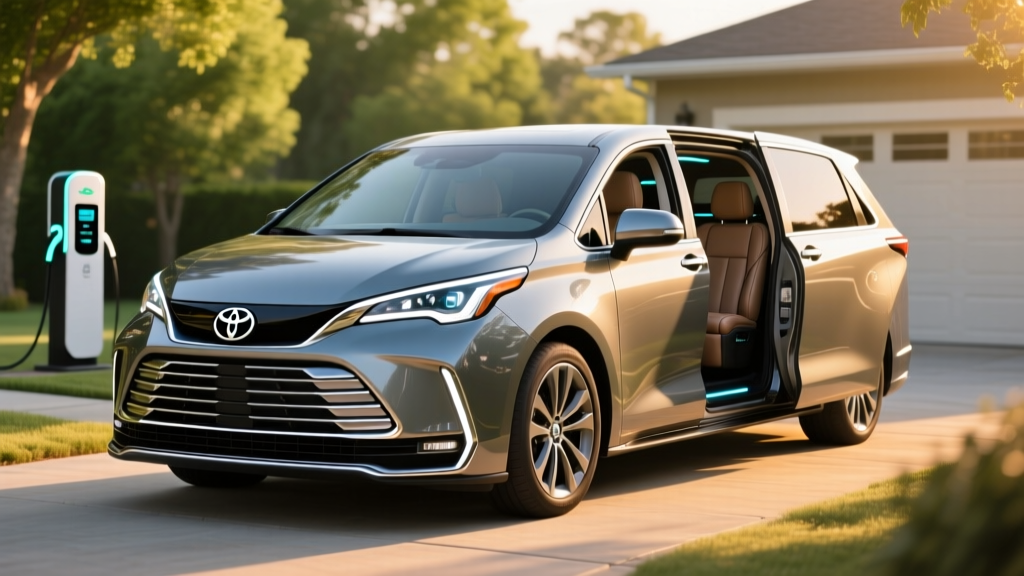
The Toyota Sienna has been a hybrid-only minivan since the 2021 model year, and the available Electronic On-Demand AWD system makes it one of the few all-wheel-drive minivans that doesn't sacrifice fuel economy for traction. For 2026, the Sienna Hybrid AWD continues with Toyota's fourth-generation hybrid system, delivering 245 combined horsepower and an EPA-estimated 35 MPG combined — figures that remain exceptional for a three-row, eight-passenger vehicle.
This guide covers the Sienna Hybrid AWD's real-world efficiency, powertrain details, ownership costs, and where it fits against plug-in hybrid and fully electric alternatives. Whether you're cross-shopping the Chrysler Pacifica PHEV, the Kia Carnival, or considering an EV like the upcoming electric minivans, here are the exact numbers you need.
HEV vs. PHEV: Where the Sienna Fits
The Toyota Sienna is a conventional hybrid (HEV), not a plug-in hybrid (PHEV). This distinction matters for your daily routine and expectations:
| Feature | Toyota Sienna (HEV) | Plug-In Hybrid (e.g., Pacifica PHEV) | Battery Electric (BEV) |
|---|---|---|---|
| Plug in to charge? | No — self-charging via regenerative braking and engine | Yes — plug in for electric-only miles | Yes — plug in always |
| Electric-only range | ~1 mile at low speed | 32 miles (Pacifica PHEV) | 250–350+ miles typical |
| Home charging needed? | No | Recommended (Level 2, ~2 hrs) | Essential |
| Total range | ~630 miles | ~430 miles (electric + gas) | 250–350 miles |
| §30D Federal Tax Credit | Not eligible | Up to $7,500 (eligibility varies) | Up to $7,500 (eligibility varies) |
The Sienna's hybrid system uses a small 1.9 kWh nickel-metal hydride (NiMH) battery that charges automatically through regenerative braking and the gasoline engine. You never plug it in. This is a major advantage for buyers without garage or driveway charging access — you simply fuel up at any gas station and drive.
Fuel Economy: EPA Ratings and Real-World MPG
For the 2026 Toyota Sienna Hybrid AWD, the EPA publishes the following fuel economy estimates via fueleconomy.gov:
| Drivetrain | City MPG | Highway MPG | Combined MPG |
|---|---|---|---|
| Sienna Hybrid FWD | 36 | 36 | 36 |
| Sienna Hybrid AWD | 35 | 36 | 35 |
The AWD system costs you just 1 MPG combined versus front-wheel drive — a remarkably small penalty for all-weather traction. The AWD model uses a separate rear electric motor that engages automatically when slippage is detected, rather than a mechanical driveshaft, which preserves efficiency.
Real-World MPG: What Owners Actually See
Toyota's hybrid system excels in stop-and-go city driving, where the electric motor handles low-speed propulsion and the engine shuts off at stops. Many Sienna owners report exceeding the EPA city estimate in suburban driving with frequent stops — 37–40 MPG is common in mild weather on flat terrain.
Highway driving tells a different story. At sustained 70–80 mph speeds, the engine runs continuously, and the aerodynamic drag of a minivan body reduces efficiency. Expect 30–33 MPG on the highway at interstate speeds. Cold weather (below 30°F) typically reduces combined economy by 3–5 MPG due to increased engine run time for cabin heat and battery conditioning.
Total Range: With a 17.9-gallon fuel tank and 35 MPG combined, the Sienna Hybrid AWD delivers approximately 626 miles of total range between fill-ups. In favorable city conditions, that number can exceed 660 miles.
Powertrain and Performance Specs
| Specification | 2026 Toyota Sienna Hybrid AWD |
|---|---|
| Engine | 2.5L 4-cylinder Atkinson cycle |
| Engine Output | 189 HP / 176 lb-ft torque |
| Front Electric Motor | 134 HP |
| Rear Electric Motor (AWD) | 54 HP |
| Combined System Horsepower | 245 HP |
| Hybrid Battery | 1.9 kWh NiMH (sealed, self-charging) |
| Transmission | eCVT (planetary gearset, no traditional belts) |
| 0–60 MPH | ~7.1 seconds (FWD); ~7.4 seconds (AWD) |
| Towing Capacity | 3,500 lbs (when properly equipped) |
| Seating | 7 or 8 passengers (trim dependent) |
| Cargo Volume (behind 3rd row) | 33.5 cu ft |
| Cargo Volume (max, seats folded) | 101.0 cu ft |
The Sienna's eCVT is not a belt-driven continuously variable transmission like those found in some competitors. Toyota uses a planetary gearset that seamlessly blends power from the engine and electric motors without the rubber-band effect or drone associated with older CVT designs. Acceleration is linear and adequate for merging and passing, though the Sienna prioritizes efficiency over sportiness.
The AWD system's rear motor provides up to 54 HP to the rear axle when needed. It engages automatically during acceleration from a stop, on wet or snowy roads, and during hard cornering. There is no driver-selectable AWD mode — the system manages torque distribution transparently.
Pricing and Trim Breakdown
The 2026 Toyota Sienna Hybrid AWD is available across multiple trims. AWD is a $760 option on most trims (standard on Woodland Edition). Pricing below reflects MSRP before destination charges:
| Trim | AWD MSRP (approx.) | Key Features |
|---|---|---|
| LE | $39,485 | Toyota Safety Sense 3.0, 8-inch touchscreen, tri-zone climate |
| XLE | $44,285 | SofTex seats, power liftgate, 2nd-row sunshades |
| XSE | $45,835 | Sport-tuned suspension, 20-inch wheels, black accents |
| Woodland Edition | $48,735 | Standard AWD, raised ride height, roof rails, all-terrain tires |
| Limited | $50,185 | Leather, 12.3-inch screen, JBL audio, heated/ventilated front seats |
| Platinum | $54,435 | Panoramic roof, rear entertainment, 360-degree camera, head-up display |
Tax Credit Eligibility
The Toyota Sienna Hybrid (HEV) does not qualify for the federal §30D Clean Vehicle Credit. That credit applies only to plug-in electric vehicles (BEVs and PHEVs) meeting battery sourcing, MSRP cap, and buyer income requirements under current IRS rules.
Some states and utilities offer rebates for conventional hybrids, though these are increasingly rare as incentive programs shift toward plug-in vehicles. Check your state's energy office or utility provider for any local hybrid incentives. Toyota also occasionally offers manufacturer cash-back or low-APR financing on the Sienna — check Toyota's current offers page for seasonal promotions.
Battery Warranty, Lifespan, and Replacement Cost
Hybrid battery longevity is a top concern for minivan buyers planning long-term ownership. Here's what you need to know about the Sienna's hybrid battery:
Hybrid Battery Warranty: 10 years / 150,000 miles (whichever comes first), covering defects and capacity loss below a defined threshold. This applies in all 50 states for 2020 and newer Toyota hybrids.
Hybrid System Components Warranty: 8 years / 100,000 miles for the inverter, electric motors, and associated control electronics.
How Long Do Toyota Hybrid Batteries Last?
Toyota's NiMH hybrid batteries have a strong track record. Data from Prius fleets and high-mileage owner reports show these batteries commonly last 150,000–200,000+ miles before significant degradation. The Sienna's relatively small 1.9 kWh battery operates in a narrow state-of-charge window (roughly 40–80%), which reduces stress and extends cell life compared to larger batteries cycled to full capacity.
Toyota's eCVT transmission also has an excellent reliability record, with very few reported failures. The planetary gearset design eliminates the wear-prone belts and pulleys found in conventional CVTs.
Battery Replacement Cost
If the hybrid battery fails outside of warranty, replacement costs typically range from $2,500 to $4,000 for a new OEM battery pack installed at a Toyota dealer. Refurbished or aftermarket battery packs are available for $1,500–$2,500. Individual cell module replacement (if only a few cells degrade) can cost $500–$1,200 at a hybrid-specialist shop.
For context, the hybrid system adds roughly $1,500–$2,000 to the Sienna's MSRP versus a comparable gas-only minivan (if one existed). Over 150,000 miles at 35 MPG versus 22 MPG for a typical gas minivan, the fuel savings total approximately $7,000–$9,000 (at $3.50/gallon), easily offsetting both the upfront premium and a potential out-of-warranty battery replacement.
Sienna Hybrid AWD vs. Alternatives: Which Is Right for You?
Sienna Hybrid AWD Pros
- 35 MPG combined — best-in-class for AWD minivans
- No plug-in charging required
- 630+ mile total range
- Standard Toyota Safety Sense 3.0 (L2 ADAS)
- Strong reliability history and 10-year hybrid battery warranty
- 3,500-lb towing capacity
Sienna Hybrid AWD Cons
- No electric-only driving range (unlike PHEVs)
- No federal tax credit eligibility
- eCVT can drone under hard acceleration
- AWD adds slight weight and reduces MPG by 1 vs. FWD
- No DC fast charging (not applicable to HEVs)
- Infotainment system trails competitors in responsiveness
Decision Framework: Hybrid vs. PHEV vs. EV
Choose the Sienna Hybrid AWD if:
- You lack home or workplace charging access
- You want maximum range without range anxiety (630+ miles)
- You drive in all weather and need AWD traction
- You prioritize low operating costs without lifestyle changes
- You plan to own the vehicle 10+ years
Choose a PHEV (e.g., Chrysler Pacifica Hybrid) if:
- You have home Level 2 charging and a short commute (<30 miles)
- You want electric-only daily driving with gas backup for road trips
- You may qualify for the §30D federal tax credit (up to $7,500, subject to income and sourcing rules)
Choose a full EV (e.g., upcoming electric minivans) if:
- You have reliable home charging and drive <250 miles/day
- You want zero tailpipe emissions and minimal maintenance
- You qualify for federal/state EV incentives that offset the higher purchase price
Reliability and Safety Ratings
Toyota's hybrid powertrain is among the most proven in the industry, with over 25 years of continuous production since the original Prius. The Sienna's 2.5L Atkinson-cycle engine is naturally aspirated and conservatively tuned, which favors long-term durability.
The IIHS has rated the Sienna as a Top Safety Pick+ in recent model years, with top marks in crashworthiness tests. Toyota Safety Sense 3.0 comes standard on every trim and includes:
- Pre-Collision System with Pedestrian Detection
- Full-Speed Range Dynamic Radar Cruise Control
- Lane Departure Alert with Steering Assist
- Lane Tracing Assist (SAE Level 2 — driver must remain engaged)
- Automatic High Beams
- Road Sign Assist
Note: Toyota Safety Sense is a Level 2 driver-assistance system. It supports steering, braking, and acceleration on highways but requires the driver to remain attentive and keep hands on the wheel at all times. It is not a self-driving system.
Frequently Asked Questions
How many MPG does the Toyota Sienna Hybrid AWD get?
The EPA rates the Sienna Hybrid AWD at 35 MPG city, 36 MPG highway, and 35 MPG combined. Real-world results vary: city driving often yields 37–40 MPG in mild weather, while sustained highway speeds above 70 mph typically return 30–33 MPG. Cold weather reduces efficiency by 3–5 MPG.
Does the Sienna Hybrid need to be plugged in?
No. The Sienna is a conventional hybrid (HEV), not a plug-in. Its 1.9 kWh battery charges automatically through regenerative braking and the gasoline engine. You only need to fill up at a gas station, just like a traditional vehicle.
How far can the Sienna Hybrid go on a full tank?
With a 17.9-gallon fuel tank and 35 MPG combined, the Sienna Hybrid AWD can travel approximately 626 miles between fill-ups. In favorable city driving conditions, owners have reported exceeding 660 miles on a single tank.
Does the Toyota Sienna Hybrid qualify for any tax credit?
No. The federal §30D Clean Vehicle Credit applies only to plug-in vehicles (BEVs and PHEVs). The Sienna Hybrid is a conventional HEV and does not qualify. Some states or utilities may offer small hybrid incentives — check your local programs. Consult a tax professional for personalized eligibility guidance.
Is the Sienna Hybrid battery reliable, and what does replacement cost?
Toyota's NiMH hybrid batteries have an excellent longevity record, commonly lasting 150,000–200,000+ miles. The battery is covered by a 10-year/150,000-mile warranty. Out-of-warranty replacement costs $2,500–$4,000 for a new OEM pack, or $1,500–$2,500 for a refurbished unit.
How does the Sienna AWD system work?
The Sienna AWD uses a separate rear-mounted electric motor (54 HP) rather than a mechanical driveshaft. It engages automatically during acceleration, on slippery surfaces, and during cornering. There is no driver-selectable mode. This electronic system adds minimal weight and preserves the Sienna's fuel efficiency — the AWD penalty is only 1 MPG combined versus FWD.
Sienna Hybrid vs. Pacifica PHEV: which is better?
It depends on your charging situation. The Chrysler Pacifica PHEV offers 32 miles of electric-only range and may qualify for a federal tax credit, but requires home charging to realize those benefits. The Sienna Hybrid requires no plug-in infrastructure, delivers 35 MPG combined (vs. 30 MPG combined for the Pacifica PHEV when the battery is depleted), and offers greater total range. If you can charge at home and commute under 30 miles, the Pacifica PHEV can eliminate most gas use on weekdays. If you lack charging access or take frequent long trips, the Sienna Hybrid is the simpler, more flexible choice.
Can the Sienna Hybrid tow?
Yes. The Sienna Hybrid is rated to tow up to 3,500 pounds when properly equipped with the available towing package. This is sufficient for small boat trailers, light campers, and utility trailers, though it falls short of body-on-frame SUVs rated for 5,000+ pounds.
For the latest EPA data, visit fueleconomy.gov. For current IRS incentive rules, consult the IRS Clean Vehicle Credits page and a qualified tax professional. Toyota's official specifications are available at toyota.com/sienna.