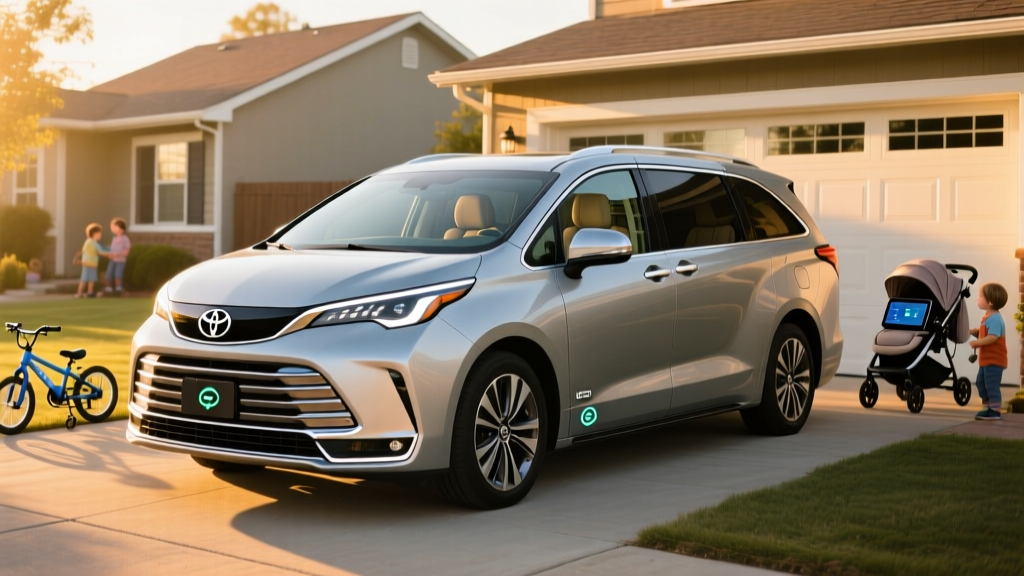
The Toyota Sienna has been a hybrid-only minivan since the 2021 model year, and the 2025 Toyota Sienna hybrid continues that strategy with a proven fourth-generation hybrid powertrain, standard all-wheel drive availability, and segment-leading fuel economy. If you're researching the 2025 Sienna as a family hauler, this guide covers every number that matters — EPA MPG, real-world efficiency, powertrain specs, pricing by trim, battery warranty, and whether this hybrid minivan makes more financial sense than a full EV or a conventional gas rival.
2025 Toyota Sienna Hybrid: Quick Verdict
The 2025 Sienna is a conventional hybrid (HEV), not a plug-in hybrid. It never needs to be plugged in. The gasoline engine and regenerative braking recharge a small nickel-metal hydride (NiMH) battery pack, which assists the 2.5-liter four-cylinder engine through two electric motors. The result is an EPA-estimated 36 MPG combined — a figure that beats every non-hybrid minivan on the market by a wide margin and even outperforms many compact sedans.
| Spec | Value |
|---|---|
| Powertrain | 2.5L 4-cyl + 2 electric motors (FWD) / 3 motors (AWD) |
| Combined Horsepower | 245 hp |
| Drivetrain | FWD standard; electronic AWD available |
| Battery Type | NiMH (sealed, hybrid-assist) |
| EPA MPG (FWD) | 36 city / 36 hwy / 36 combined |
| EPA MPG (AWD) | 35 city / 36 hwy / 35 combined |
| Fuel Tank | 14.5 gallons |
| Total Range (FWD) | ~522 miles |
| 0–60 mph | ~7.1 seconds (est.) |
| Seating | 7 or 8 passengers |
| Cargo (behind 3rd row) | 33.5 cu ft |
| Max Cargo | 101.0 cu ft |
| Towing Capacity | 3,500 lbs |
| Base MSRP (LE FWD) | $39,185 |
| Hybrid Battery Warranty | 10 years / 150,000 miles |
How Many MPG Does the 2025 Toyota Sienna Hybrid Get?
The EPA rates the front-wheel-drive 2025 Sienna at 36 MPG city, 36 MPG highway, and 36 MPG combined. The available electronic all-wheel-drive (AWD) model drops slightly to 35/36/35 MPG. These figures come from Toyota's fourth-generation hybrid system, which uses a 2.5-liter Atkinson-cycle four-cylinder engine paired with electric motors and an electronically controlled continuously variable transmission (eCVT).
| Drivetrain | City MPG | Highway MPG | Combined MPG |
|---|---|---|---|
| FWD | 36 | 36 | 36 |
| AWD | 35 | 36 | 35 |
Source: fueleconomy.gov
Real-World MPG vs. EPA Estimates
Toyota hybrids have a well-documented tendency to exceed their EPA city estimates in stop-and-go driving, where regenerative braking recovers energy that gas-only vehicles waste as heat. In real-world suburban and urban driving, owners frequently report 37–40 MPG on the FWD Sienna. Highway driving at sustained 75–80 mph speeds tends to return closer to 32–34 MPG, as the engine carries more of the load without regenerative opportunities.
Cold weather impacts are modest compared to full EVs. Expect roughly a 2–4 MPG drop in winter conditions (short trips, cold starts, cabin heating), but the Sienna's hybrid system doesn't suffer the 20–30% range loss that battery-electric vehicles experience in freezing temperatures. With a 14.5-gallon tank, real-world total range typically falls between 470 and 540 miles depending on driving style and conditions.
Hybrid Powertrain: Engine, Motors, and Performance
The 2025 Sienna uses Toyota's hybrid synergy drive system. Here's how the components break down:
- Gasoline engine: 2.5-liter DOHC 4-cylinder, Atkinson cycle, 189 hp / 176 lb-ft torque
- Front electric motor: 134 hp / 199 lb-ft (MG2 — primary drive motor)
- Second front motor: Starter/generator (MG1 — recharges battery, smooths transitions)
- Rear electric motor (AWD only): 54 hp / 89 lb-ft — powers rear axle when extra traction is needed
- Combined system output: 245 hp
- Transmission: eCVT (planetary gearset, no belt or traditional gears)
The electric motors deliver instant torque from a stop, which gives the Sienna surprisingly responsive off-the-line acceleration despite its 4,600+ lb curb weight. The 0–60 mph time of approximately 7.1 seconds is competitive with turbocharged V6 minivans. The eCVT operates without the shift shock of a traditional automatic, though it can drone under hard acceleration — a common hybrid trait.
The AWD system is fully electronic: there's no mechanical driveshaft to the rear wheels. The rear electric motor engages automatically during acceleration from a stop, in low-traction conditions, or when the stability control system detects slip. It disengages at higher cruising speeds to preserve fuel economy. This setup adds roughly 100 lbs and costs 1 MPG combined versus FWD — a minimal tradeoff for buyers in snow-belt states.
HEV vs. PHEV vs. EV: Which Minivan Fits Your Family?
The Sienna is a conventional hybrid (HEV). It cannot be plugged in and has no electric-only driving range beyond very low-speed, short-distance creep in EV mode. If you're comparing minivan powertrains, here's how the three electrification levels stack up for family use:
| Factor | HEV (Sienna) | PHEV (e.g., Chrysler Pacifica Hybrid) | Full EV (e.g., Kia EV9) |
|---|---|---|---|
| Plug-in required? | No | Yes (for max savings) | Yes (mandatory) |
| Electric-only range | None (EV mode ~1 mi) | ~32 miles | 230–310 miles |
| Total range | ~520 miles | ~520 miles (gas + electric) | 230–310 miles |
| Combined efficiency | 36 MPG | 30 MPG (gas) / 82 MPGe (electric) | 85–97 MPGe |
| Home charging needed? | No | Recommended (Level 2) | Required (Level 2) |
| Federal tax credit | Not eligible | Up to $7,500 (see IRS rules) | Up to $7,500 (see IRS rules) |
| Base MSRP range | $39,185–$53,000+ | $51,095–$60,000+ | $54,900–$70,000+ |
| Best for | No home charging; road trips | Short commutes + long trips | Home charging; daily driving |
The Chrysler Pacifica Hybrid remains the only plug-in hybrid minivan, offering about 32 miles of electric-only range on a full charge. That's useful for school runs and grocery trips, but it requires a Level 2 home charger to realize its value and carries a significantly higher base price. The Kia EV9 three-row electric SUV competes on space but has less total range and a higher entry cost.
Choose the Sienna HEV if: you don't have reliable home charging access, you take frequent long road trips, you want the lowest purchase price, or you simply don't want to think about plugging in.
Choose a PHEV minivan if: you have a garage with a 240V outlet, your daily driving is under 30 miles, and you want electric commuting with gas-engine flexibility for road trips.
Choose a full EV if: you have home Level 2 charging, your daily mileage is predictable, you want to eliminate gas entirely, and you're comfortable planning around charging stops on longer trips.
2025 Sienna Pricing by Trim and Tax Credit Eligibility
The 2025 Toyota Sienna is available in six trims. Pricing includes the mandatory destination charge:
| Trim | FWD MSRP | AWD MSRP |
|---|---|---|
| LE | $39,185 | $40,785 |
| XLE | $43,785 | $45,385 |
| XSE | $46,285 | $47,885 |
| Woodland Edition | — | $49,485 |
| Limited | $50,585 | $52,185 |
| Platinum | $54,785 | $56,385 |
Federal Tax Credit Status
The 2025 Toyota Sienna hybrid does not qualify for the federal §30D clean vehicle tax credit. That credit applies only to plug-in electric vehicles (BEVs and PHEVs) with sufficient battery capacity and compliant battery sourcing. As a conventional hybrid with a small NiMH battery that cannot be plugged in, the Sienna is ineligible regardless of buyer income or MSRP.
Some states offer their own incentives for hybrid vehicles, but these vary widely and change frequently. Check your state's energy office or department of environmental quality for current programs. A tax professional can confirm whether any local credits apply to your situation. For federal EV/PHEV credit rules, see the IRS clean vehicle credit page.
Hybrid Battery Warranty, Lifespan, and Replacement Cost
Hybrid battery longevity is the single most common concern among first-time hybrid buyers. Toyota addresses this with one of the strongest hybrid battery warranties in the industry:
2025 Sienna Hybrid Battery Warranty
- Coverage: 10 years or 150,000 miles (whichever comes first)
- Applies to: Hybrid battery pack, hybrid control module, and hybrid system components
- Transferable: Yes — transfers to subsequent owners automatically
- Capacity threshold: Toyota replaces the battery if it fails to hold sufficient charge to operate the hybrid system (no specific percentage stated, unlike EV warranties)
How Long Do Toyota Hybrid Batteries Actually Last?
Real-world data from Toyota's hybrid fleet (Prius, Camry Hybrid, Highlander Hybrid, Sienna) shows that NiMH hybrid batteries routinely last 150,000–200,000+ miles before requiring replacement. Unlike the large lithium-ion packs in full EVs, the Sienna's hybrid battery is small (approximately 1.6 kWh equivalent), never fully charges or fully depletes, and operates within a narrow state-of-charge window managed by the hybrid control system. This shallow cycling dramatically extends cell life.
Failures before 100,000 miles are uncommon. When they do occur, they're covered under warranty. Out-of-warranty replacement costs for a Sienna hybrid battery typically range from $2,500 to $4,000 including labor at a Toyota dealer, though refurbished and aftermarket options exist for $1,500–$2,500. For context, this is far less than EV battery replacement, which can exceed $10,000–$20,000.
Toyota's hybrid system also has fewer wear components than a conventional gas minivan. There's no traditional alternator, no starter motor, and no conventional transmission — the eCVT planetary gearset has no clutches or bands to wear. Regenerative braking reduces brake pad wear significantly; many Sienna owners report original brake pads lasting 80,000+ miles.
Who Should Buy the 2025 Toyota Sienna Hybrid?
Pros
- Best-in-class minivan fuel economy (36 MPG combined)
- No plug-in required — works like a normal gas car
- Standard Toyota Safety Sense 2.5+ (adaptive cruise, lane keep, auto emergency braking)
- AWD available across most trims for snow/rain traction
- Low cost of ownership: no charging install, minimal brake wear, proven reliability
- 522-mile total range eliminates road-trip range anxiety
- 10-year / 150,000-mile hybrid battery warranty
Cons
- No electric-only driving range (EV mode limited to ~1 mile at low speed)
- Engine drone under hard acceleration (eCVT characteristic)
- No federal tax credit eligibility
- Third-row seats don't fold into the floor (unlike Chrysler Pacifica Stow 'n Go)
- AWD models lose 1 MPG combined vs. FWD
- Higher trims (Platinum) approach $57,000 — competitive with luxury crossovers
2025 Toyota Sienna Hybrid — Frequently Asked Questions
How many MPG does the 2025 Toyota Sienna hybrid get in real-world driving?
The EPA rates the FWD Sienna at 36 MPG combined. In real-world city and suburban driving, many owners report 37–40 MPG thanks to regenerative braking. Highway driving at 75+ mph typically returns 32–34 MPG. Cold weather reduces efficiency by roughly 2–4 MPG on short trips.
Does the 2025 Sienna need to be plugged in?
No. The Sienna is a conventional hybrid (HEV). Its small battery is recharged by the gasoline engine and regenerative braking. You fuel it like any other car — there is no plug, no charging cable, and no home charger requirement.
Is the Toyota Sienna hybrid reliable?
Toyota's hybrid system has been in production since 1997 (Prius) and is among the most thoroughly proven powertrains in the industry. The Sienna's fourth-generation hybrid system has been in use since 2021 with strong reliability records. Toyota's 10-year/150,000-mile hybrid battery warranty provides long-term protection. The Sienna consistently earns top reliability scores from owner surveys and industry trackers.
What does it cost to replace the Sienna hybrid battery?
Out-of-warranty hybrid battery replacement typically costs $2,500–$4,000 at a Toyota dealer, including parts and labor. Refurbished batteries are available for $1,500–$2,500. Most Toyota hybrid batteries last 150,000–200,000+ miles, so many original owners will never face this expense.
Does the 2025 Toyota Sienna hybrid qualify for a tax credit?
No. The federal §30D clean vehicle tax credit applies only to plug-in vehicles (BEVs and PHEVs) that meet battery sourcing, MSRP, and buyer income requirements. The Sienna, as a conventional hybrid, does not qualify. Some states may offer hybrid-specific incentives — check your state energy office for current programs.
How does the Sienna hybrid compare to the Chrysler Pacifica Hybrid?
The Pacifica Hybrid is a PHEV with ~32 miles of electric-only range and 30 MPG combined on gas. It qualifies for up to $7,500 in federal tax credits (subject to current IRS sourcing and income rules), which can narrow the price gap. However, the Pacifica Hybrid starts at ~$51,095, requires plug-in charging to maximize savings, and has a smaller total electric-plus-gas range. The Sienna wins on simplicity, lower base price, and better gas-only MPG; the Pacifica Hybrid wins if you want electric-only commuting and can charge at home.
Can the 2025 Sienna hybrid tow?
Yes. All 2025 Sienna trims are rated for 3,500 lbs of towing capacity when properly equipped with the factory towing package. That's sufficient for a small camping trailer, a pair of jet skis, or a light utility trailer — though it trails the 4,500-lb rating of some V6 minivans.
Final Take: The Sensible Family Hauler
The 2025 Toyota Sienna hybrid doesn't try to be revolutionary — it tries to be the most efficient, lowest-hassle minivan you can buy, and it succeeds. At 36 MPG combined with no plug, no range anxiety, no charging infrastructure dependency, and a 10-year hybrid warranty, it occupies a specific lane: the family vehicle that just works. If you don't need electric-only commuting and want to minimize fuel costs without changing your habits, the Sienna hybrid is the default choice in the minivan segment.