Sequoia Hybrid MPG: The Numbers That Matter for 2026
If you're researching Sequoia hybrid MPG, you're likely weighing whether Toyota's full-size, body-on-frame SUV can genuinely save fuel compared to its gas-only rivals — or whether the hybrid premium pays for itself at the pump. The short answer: the Sequoia's i-FORCE MAX twin-turbo V6 hybrid delivers an EPA-estimated 22 MPG combined (21 city / 24 highway for 4x2), which is exceptional for an 8-passenger SUV capable of towing 9,520 pounds. But real-world results vary significantly depending on driving style, payload, and climate.
Before we get into the data, an important clarification: the Toyota Sequoia is a conventional hybrid electric vehicle (HEV). It is not a plug-in hybrid (PHEV) and does not need to be plugged in. The battery recharges through regenerative braking and the gasoline engine. If you're looking for electric-only driving, you'll want to look at PHEV alternatives — which we'll cover below.
| Drivetrain | City MPG | Highway MPG | Combined MPG |
|---|---|---|---|
| 4x2 (Rear-Wheel Drive) | 21 | 24 | 22 |
| 4x4 (Four-Wheel Drive) | 19 | 22 | 20 |
| TRD Pro 4x4 | 19 | 21 | 20 |
| Capstone 4x4 | 19 | 22 | 20 |
Source: fueleconomy.gov (EPA estimates). Your actual mileage will vary based on conditions, driving habits, and vehicle configuration.
i-FORCE MAX Powertrain: How the Sequoia Hybrid Works
The Sequoia's hybrid system isn't a Prius-style efficiency-first setup. Toyota's i-FORCE MAX pairs a 3.4-liter twin-turbo V6 with an electric motor-generator sandwiched between the engine and a 10-speed automatic transmission. The result is 437 combined horsepower and 583 lb-ft of torque — figures that demolish the outgoing V8 Sequoia's 381 hp while returning roughly 50% better fuel economy.
| Specification | Detail |
|---|---|
| Engine | 3.4L twin-turbo V6 (V35A-FTS) |
| Electric Motor | Motor-generator integrated in bell housing |
| Combined Output | 437 hp / 583 lb-ft torque |
| Transmission | 10-speed automatic |
| Hybrid Battery | ~1.87 kWh, nickel-metal hydride (NiMH) |
| Drivetrain Options | 4x2 or 4x4 with multi-terrain select |
| Max Towing Capacity | 9,520 lbs (4x2 SR5) |
| 0–60 mph | ~5.6 seconds (est.) |
| EPA Combined MPG | 22 (4x2) / 20 (4x4) |
The hybrid battery is small — roughly 1.87 kWh — because this is a performance-assist hybrid, not an electric-range hybrid. The battery's job is to fill torque gaps during acceleration, enable engine stop-start at idle, and recapture energy during braking. You won't drive more than a mile or two on electric power alone at low speeds. That's by design.
Real-World MPG vs. EPA: What Owners Actually Report
EPA estimates are a starting point, not a guarantee. Based on owner-reported data and third-party testing, here's what real-world Sequoia hybrid MPG looks like across driving scenarios:
- City driving (stop-and-go): 20–23 MPG — Hybrids shine here. The electric motor handles low-speed launches, and regenerative braking recaptures energy. Many owners report meeting or slightly exceeding the 21 MPG EPA city figure in moderate urban traffic.
- Highway cruising (70–75 mph): 19–22 MPG — Aerodynamic drag dominates at highway speeds. The Sequoia's boxy, truck-based profile works against it. Expect figures closer to 19–20 MPG at sustained interstate speeds, slightly below the 24 MPG EPA highway estimate.
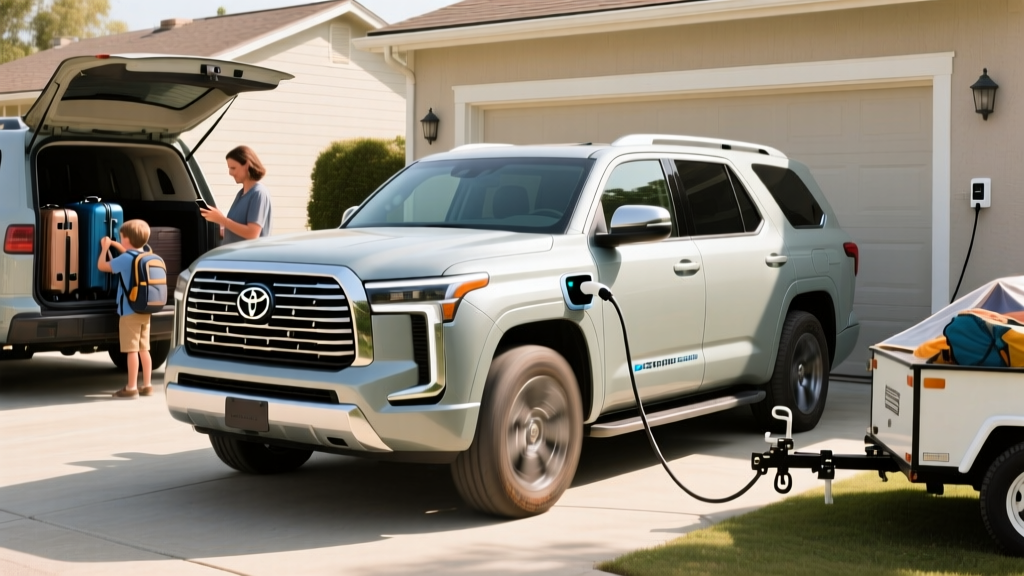
- Towing (loaded trailer): 12–15 MPG — Towing a 5,000–7,000 lb trailer drops fuel economy significantly. The hybrid system still provides some assist, but physics demands more fuel when moving heavy loads. Plan fuel stops accordingly.
- Cold weather (below 30°F): 17–19 MPG combined — The engine runs more frequently to heat the cabin and maintain operating temperature. Expect a 10–15% fuel economy penalty in winter conditions.
- Mixed daily driving: 19–21 MPG combined — Most owners land slightly below the 22 MPG EPA combined figure in real mixed use.
The Sequoia's real-world efficiency is strongest in suburban and city driving where the hybrid system cycles between electric assist and engine-off coasting. Highway-heavy commuters will see less benefit — at which point the Sequoia's advantage over non-hybrid rivals narrows but doesn't disappear.
HEV vs. PHEV vs. Full EV: Which Powertrain Fits You?
The Sequoia is only available as a conventional HEV. Toyota does not currently offer a Sequoia plug-in hybrid variant. Here's how the three powertrain types compare for a full-size SUV buyer:
| Factor | HEV (Sequoia Hybrid) | PHEV (e.g., no direct rival) | Full EV (e.g., Rivian R1S) |
|---|---|---|---|
| Plug-in Required? | No — self-charging | Yes — for electric range | Yes — sole energy source |
| Electric-Only Range | ~1 mile at low speed | 25–45 miles typical | 250–400 miles |
| Combined MPG / MPGe | 20–22 MPG | 50+ MPGe (electric) / 20–25 MPG (gas) | 70–100+ MPGe |
| Towing Capability | 9,520 lbs | Varies, typically 3,500–7,500 lbs | 7,700 lbs (R1S) |
| Home Charging Needed? | No | Recommended (Level 2) | Required (Level 2) |
| Federal Tax Credit | Not eligible (§30D is BEV/PHEV only) | Up to $7,500 (if eligible) | Up to $7,500 (if eligible) |
| Best For | No charging access, heavy towing | Short electric commute + long trips | Home charging + daily driving |
Choose the Sequoia HEV if: You need maximum towing, three-row seating for eight, no charging infrastructure at home, and you want fuel savings without changing your refueling habits. It drives like a gas SUV — because functionally, it is one with hybrid assist.
Consider a PHEV if: You have a garage with a 240V outlet, your daily commute is under 35 miles, and you want electric-only weekday driving with gas-engine flexibility for road trips. The challenge: no full-size body-on-frame PHEV currently competes directly with the Sequoia. The closest alternatives are the Jeep Grand Cherokee 4xe (PHEV, 25 miles electric, 5,000-lb towing) or the Volvo XC90 Recharge (PHEV, 35 miles electric, unibody).
Consider a full EV if: You can install a Level 2 home charger, your daily driving is under 250 miles, and you want the lowest per-mile operating cost. The Rivian R1S and Tesla Model X offer three rows and 300+ miles of range, but neither matches the Sequoia's 9,500-lb towing capacity.
Pricing, Trims, and Tax Credit Eligibility
The 2026 Toyota Sequoia hybrid starts at approximately $63,275 for the SR5 4x2 trim (including destination) and climbs to roughly $82,000+ for the Capstone luxury trim. Here's the approximate trim-level breakdown:
- SR5: ~$63,275 (4x2) / ~$66,275 (4x4)
- Limited: ~$69,775
- Platinum: ~$74,275
- TRD Pro: ~$78,475
- Capstone: ~$82,275
Does the Sequoia Hybrid Qualify for a Federal Tax Credit?
No. Under current IRS §30D rules, the federal clean vehicle tax credit applies only to battery electric vehicles (BEVs) and plug-in hybrids (PHEVs) that meet specific battery-sourcing, critical-mineral, MSRP, and buyer-income requirements. The Sequoia is a conventional hybrid (HEV) — it does not have a plug and does not meet the §30D definition of a qualified plug-in electric drive vehicle.
Some states may offer their own incentives for hybrid vehicles, though these are increasingly rare as state programs shift toward BEVs and PHEVs. Check your state's energy office or department of environmental quality for current programs. For federal rules, see IRS.gov §30D guidelines.
Battery Reliability, Warranty, and Replacement Cost
Hybrid battery longevity is the single most common concern among first-time hybrid buyers. Here's what the data shows for the Sequoia's system:
Warranty coverage: Toyota covers the Sequoia's hybrid battery for 10 years or 150,000 miles (whichever comes first) under its Hybrid System Warranty. This applies to all 50 states. The broader hybrid system components — inverter, control module, motor-generator — are also covered under this warranty. Toyota's standard powertrain warranty covers 5 years / 60,000 miles, and the basic bumper-to-bumper warranty is 3 years / 36,000 miles.
Expected lifespan: Toyota's NiMH hybrid batteries have an excellent longevity track record. Data from the RAV4 Hybrid and Highlander Hybrid (which use similar systems) shows most hybrid batteries lasting 150,000–200,000+ miles with minimal capacity degradation. Unlike BEV batteries that degrade noticeably over time, HEV batteries operate in a narrow state-of-charge window (roughly 40–80%), which dramatically reduces wear. The Sequoia's small ~1.87 kWh battery cycles far less stress than an 80 kWh BEV pack.
Replacement cost: If the hybrid battery fails out of warranty, a replacement from Toyota typically runs $3,000–$5,000 including parts and labor for the i-FORCE MAX system. Independent hybrid shops may offer refurbished units for less. However, given the 10-year/150,000-mile warranty and Toyota's reliability history, most owners will sell or trade the vehicle before battery replacement becomes relevant.
Reliability track record: The i-FORCE MAX powertrain debuted in the 2022 Tundra and has been in the Sequoia since its 2023 redesign. Early reliability data from Consumer Reports and J.D. Power shows the Sequoia performing at or above average for full-size SUVs, with no systemic hybrid battery failures reported. The twin-turbo V6 is a newer engine design, and some early 2022–2023 Tundra examples had turbo-related service campaigns — but Toyota addressed these through warranty extensions and software updates.
Towing Efficiency: MPG When the Sequoia Is Working
The Sequoia's 9,520-pound max towing capacity is one of its core selling points — and one area where hybrid assist provides a measurable advantage over non-hybrid competitors. When towing a 6,000-pound travel trailer or boat:
- Flat terrain, moderate speeds (55–60 mph): Expect 14–16 MPG
- Rolling hills or 65–70 mph: Expect 12–14 MPG
- Mountain grades: Expect 9–12 MPG (downhill regen recaptures some energy)
Compare this to the Chevrolet Tahoe with the 5.3L V8 (EPA 17 combined, ~10–12 towing) or the Ford Expedition with the 3.5L EcoBoost (EPA 19 combined, ~11–13 towing). The Sequoia's hybrid system provides a 1–3 MPG advantage under load, which translates to roughly 20–40 fewer fuel stops per year for frequent towers.
The electric motor's instant torque also reduces transmission hunting on grades — the 10-speed automatic doesn't need to downshift as aggressively because the motor fills the torque gap. This makes the towing experience smoother and less stressful on the drivetrain.
Ownership Cost: Sequoia Hybrid vs. Gas-Only Rivals
Let's put the Sequoia's fuel economy in financial context. Assuming 15,000 miles per year, $3.50/gallon regular unleaded, and EPA combined MPG:
| Vehicle | EPA Combined | Annual Fuel Cost | 5-Year Fuel Cost |
|---|---|---|---|
| Toyota Sequoia Hybrid (4x4) | 20 MPG | $2,625 | $13,125 |
| Chevrolet Tahoe 5.3L V8 | 17 MPG | $3,088 | $15,441 |
| Ford Expedition 3.5L EcoBoost | 19 MPG | $2,763 | $13,816 |
| Jeep Wagoneer 3.0L Hurricane | 19 MPG | $2,763 | $13,816 |
The Sequoia hybrid saves roughly $300–$460 per year in fuel compared to its V8 rivals, or $1,500–$2,300 over five years. These savings partially offset the Sequoia's higher starting price. Factor in Toyota's strong resale value — the Sequoia historically retains 55–65% of its value after five years — and the total cost of ownership becomes competitive with or lower than the Tahoe and Expedition.
Insurance costs for the Sequoia hybrid run $1,800–$2,400 annually depending on your profile and state, which is in line with other full-size SUVs. Hybrid-specific insurance surcharges are rare — most insurers treat the Sequoia like any other SUV in its class.
Pros
- Best-in-class fuel economy for a body-on-frame 8-passenger SUV
- 437 hp / 583 lb-ft — no performance compromise for efficiency
- 9,520-lb towing capacity with hybrid torque assist
- 10-year / 150,000-mile hybrid battery warranty
- No charging infrastructure needed — refuel at any gas station
- Strong Toyota resale value
Cons
- Highway MPG falls short of EPA estimate at sustained 70+ mph
- No PHEV option for electric-only commuting
- No federal tax credit eligibility
- Starting price above $63,000; well-equipped trims exceed $80,000
- Third-row cargo space limited behind folded seats vs. some rivals
- Towing MPG drops to 12–15 — still better than rivals, but plan fuel stops
Frequently Asked Questions
How many MPG does the Toyota Sequoia hybrid get?
The 2026 Toyota Sequoia hybrid achieves an EPA-estimated 21 city / 24 highway / 22 combined MPG in 4x2 configuration, and 19 city / 22 highway / 20 combined in 4x4. Real-world mixed driving typically yields 19–21 MPG combined. City driving often meets or exceeds EPA estimates thanks to hybrid regenerative braking, while highway cruising at 70+ mph tends to fall 2–3 MPG below the sticker.
Is the Sequoia a plug-in hybrid? Do I need to charge it?
No. The Sequoia is a conventional hybrid (HEV), not a plug-in hybrid (PHEV). You never plug it in. The ~1.87 kWh hybrid battery recharges automatically through regenerative braking and the gasoline engine. You refuel at any gas station with regular unleaded fuel.
Does the Sequoia hybrid qualify for any tax credit?
The Sequoia hybrid does not qualify for the federal §30D clean vehicle tax credit, which is limited to plug-in electric vehicles (BEVs and PHEVs). Some states may offer hybrid-specific incentives, but these are uncommon. Check with your state energy office and consult a tax professional for your specific situation.
How long will the Sequoia hybrid battery last, and what does replacement cost?
Toyota covers the hybrid battery for 10 years or 150,000 miles. Based on Toyota's hybrid reliability history (RAV4 Hybrid, Highlander Hybrid, Camry Hybrid), most batteries last 150,000–200,000+ miles. If replacement is needed out of warranty, expect $3,000–$5,000 for a new OEM battery including labor. The Sequoia's HEV battery operates in a narrow charge window, which greatly extends its lifespan compared to full EV batteries.
Is the Sequoia hybrid reliable?
The i-FORCE MAX powertrain has been in production since 2022 (Tundra) and 2023 (Sequoia). Early reliability data from Consumer Reports and J.D. Power shows average to above-average ratings for the Sequoia. Toyota's hybrid systems have a 25+ year track record of durability dating back to the original Prius. The main powertrain concern has been isolated turbo-related issues in early 2022 Tundras, which Toyota addressed through service campaigns.
How does Sequoia hybrid MPG compare to a full EV like the Rivian R1S?
The Sequoia returns 20–22 MPG on gasoline, costing roughly $2,600/year in fuel. The Rivian R1S returns approximately 73 MPGe (combined) and costs roughly $800–$1,100/year in electricity (depending on local rates). However, the R1S starts above $79,000, requires home Level 2 charging, and maxes out at 7,700-lb towing. The Sequoia is the practical choice for heavy towing and no-charging-access buyers; the R1S wins on operating cost and daily driving refinement.
What's the Sequoia's MPG when towing?
Expect 12–16 MPG when towing a 5,000–7,000 lb trailer, depending on terrain, speed, and wind conditions. This is 1–3 MPG better than comparable non-hybrid V8 and EcoBoost rivals under similar loads. The hybrid motor's instant torque reduces transmission shifting on inclines, improving both drivability and efficiency while towing.
For the latest EPA fuel economy data, visit fueleconomy.gov. For Toyota's official specifications and warranty details, see Toyota.com/Sequoia. Federal tax credit rules are published at IRS.gov. All pricing reflects approximate 2026 model-year MSRP including destination; dealer prices may vary.