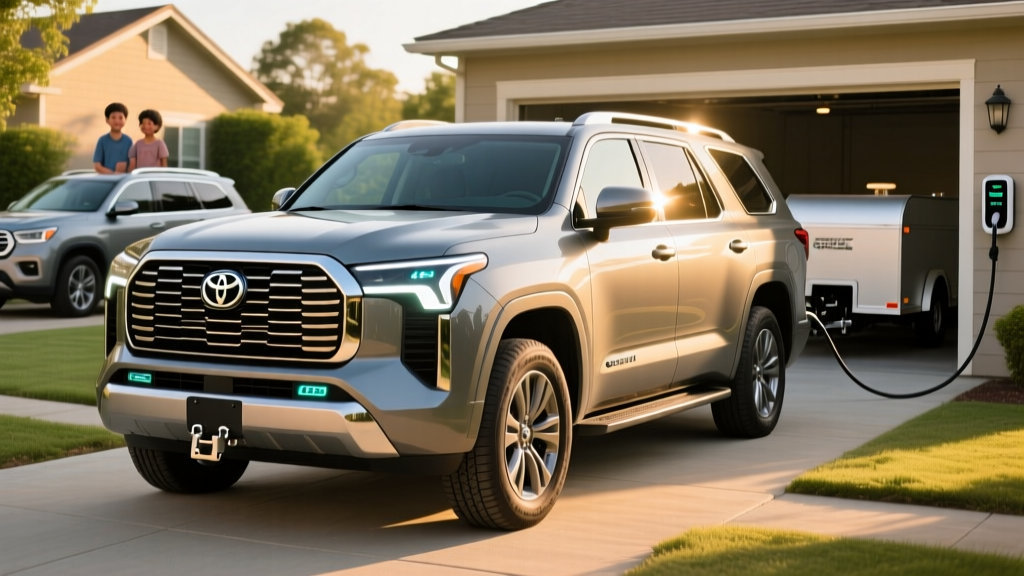
The third-generation Toyota Sequoia ditched its thirstier V8 past for the twin-turbo i-FORCE MAX hybrid powertrain, promising full-size SUV capability without the punishing fuel bill. But with a curb weight north of 6,000 pounds and a tow rating up to 9,520 lbs, buyers want to know one thing above all else: what does the Toyota Sequoia hybrid gas mileage actually look like in daily driving?
We've analyzed EPA figures, real-world owner reports, and highway-towing data to give you a complete picture of what this hybrid three-row SUV delivers at the pump — and whether it makes financial sense compared to a body-on-frame gas rival or a fully electric alternative.
2026 Toyota Sequoia Hybrid: Key Specifications at a Glance
| Specification | Value |
|---|---|
| Powertrain | 3.5L Twin-Turbo V6 + electric motor (i-FORCE MAX) |
| Combined Horsepower | 437 hp |
| Combined Torque | 583 lb-ft |
| Transmission | 10-speed automatic |
| EPA MPG (2WD) | 21 city / 24 highway / 22 combined |
| EPA MPG (4WD) | 19 city / 22 highway / 20 combined |
| Hybrid Battery | ~1.87 kWh NiMH (self-charging HEV) |
| Towing Capacity (max) | 9,520 lbs (2WD SR5) |
| 0-60 mph | ~5.6 seconds (estimated) |
| Starting MSRP | $62,175 (SR5 2WD) |
| Battery Warranty | 10 years / 150,000 miles |
Toyota Sequoia Hybrid Gas Mileage: EPA Ratings vs. Real-World Results
The EPA rates the 2026 Toyota Sequoia hybrid at 22 MPG combined for rear-wheel-drive models (21 city / 24 highway) and 20 MPG combined for 4WD variants (19 city / 22 highway). These numbers apply across most trims, though the TRD Pro and Capstone — with their more aggressive tires and standard 4WD — sit at the lower end.
EPA Fuel Economy Breakdown by Drivetrain
| Drivetrain | City | Highway | Combined |
|---|---|---|---|
| 2WD (SR5, Limited, Platinum, Capstone) | 21 MPG | 24 MPG | 22 MPG |
| 4WD (All trims) | 19 MPG | 22 MPG | 20 MPG |
Here's where real-world driving diverges from the sticker. Like most Toyota hybrids, the Sequoia's hybrid system recovers energy aggressively during stop-and-go driving. Owners frequently report exceeding the EPA city estimate by 1-2 MPG in suburban commuting with frequent stops. Highway driving at sustained 75-80 mph, however, tends to drop fuel economy to 18-20 MPG for 4WD models, since aerodynamic drag dominates and the electric motor provides less assistance at constant speed.
Towing is the great equalizer. When pulling a 5,000-7,000 lb trailer, expect fuel economy to fall to 10-13 MPG depending on terrain and wind. This is competitive with the segment — a Chevrolet Tahoe with the 5.3L V8 returns similar numbers under load — but it's important to budget for if you tow frequently.
i-FORCE MAX Powertrain: How the Hybrid System Actually Works
The Sequoia uses Toyota's i-FORCE MAX powertrain, which pairs a 3.5-liter twin-turbocharged V6 engine with an electric motor generator sandwiched between the engine and the 10-speed automatic transmission. The electric motor contributes additional low-end torque and enables brief electric-only driving at very low speeds (parking lots, stop-and-go creep), but this is not a plug-in hybrid.
The system produces a combined 437 horsepower and 583 lb-ft of torque — the torque figure especially matters for towing and off-the-line responsiveness. The electric motor's contribution fills in the torque curve below 2,000 RPM where the turbo V6 is still spooling, giving the Sequoia a responsiveness that feels more like a diesel than a traditional gasoline V8.
HEV vs. PHEV: What the Sequoia Is (and Isn't)
| Feature | Sequoia (HEV) | Typical PHEV SUV (e.g., RAV4 Prime) |
|---|---|---|
| Plug-in charging required? | No — charges via regenerative braking and engine | Yes — plug in for full EV range |
| Electric-only range | Less than 1 mile at low speed | 30-42 miles typical |
| Battery size | ~1.87 kWh (NiMH) | 18-22 kWh (Li-ion) |
| Federal tax credit eligible? | No | Up to $7,500 (varies by model/sourcing) |
| Primary benefit | Better MPG without behavior change | EV commuting + gas road trips |
The Sequoia's ~1.87 kWh nickel-metal hydride battery pack is small by electrified-vehicle standards — by design. It's sized for frequent shallow charge-discharge cycles (assist during acceleration, recover during braking), not for sustained electric driving. You never plug it in, and there is no EV mode worth speaking of. This is a conventional hybrid through and through.
Who Should Buy the Sequoia Hybrid — And Who Should Look Elsewhere
Choose the Sequoia Hybrid If:
- You need three rows and up to 9,520 lbs of towing capacity
- You want better fuel economy than a Tahoe/Expedition without plug-in infrastructure
- You value Toyota's long-term reliability reputation and 10-year hybrid warranty
- You drive a mix of city and highway and want effortless MPG gains in stop-and-go traffic
- You want 583 lb-ft of torque for trailer launches and mountain grades
Consider Alternatives If:
- You want electric-only commuting range (look at PHEV SUVs or BEVs)
- You don't need body-on-frame capability (unibody 3-row EVs like the Kia EV9 offer lower running costs)
- You want a federal tax credit (the Sequoia HEV does not qualify)
- You primarily drive highway miles with no towing — a more aerodynamic crossover will beat 22 MPG
Pricing, Trim Levels, and Tax Credit Reality
The 2026 Toyota Sequoia starts at $62,175 for the SR5 2WD and climbs to roughly $82,000+ for a fully loaded Capstone or TRD Pro. Here's the approximate trim-level breakdown:
- SR5: $62,175 (2WD) / $64,175 (4WD)
- Limited: ~$68,000
- Platinum: ~$73,500
- TRD Pro: ~$78,500 (4WD only)
- Capstone: ~$82,000
Tax credit status: Because the Sequoia is a conventional hybrid (HEV), not a plug-in hybrid or battery electric vehicle, it does not qualify for the federal §30D clean vehicle credit. That credit — up to $7,500 — is reserved for BEVs and PHEVs that meet battery-sourcing, MSRP cap, and buyer income requirements as defined by the IRS. No plug, no credit.
Some states offer their own incentives for hybrid vehicles, but these are increasingly rare as state programs shift focus to zero-emission vehicles. Check your state's energy office or DMV for current programs, but do not factor a hybrid incentive into your purchase math unless you've confirmed it in writing.
Hybrid Battery Longevity, Warranty, and Replacement Cost
Toyota Hybrid Battery Warranty
Coverage: 10 years or 150,000 miles (whichever comes first), transferable to subsequent owners.
What it covers: Defects and capacity loss below a defined threshold on the hybrid battery pack and related hybrid system components (inverter, motor generator, control module).
Real-world lifespan data: Toyota's NiMH hybrid batteries in the Prius, Camry Hybrid, and Highlander Hybrid have demonstrated 150,000–250,000+ mile lifespans in widespread fleet and owner data. The Sequoia's battery, being newer (introduced for the 2023 model year), lacks this depth of field history, but uses proven Toyota hybrid architecture.
The question every hybrid buyer asks: what does a replacement cost out of warranty? Based on current Toyota dealer pricing for comparable i-FORCE MAX hybrid battery packs, expect a replacement to run $3,000–$4,500 including parts and labor. This is significantly less than a full EV battery replacement ($8,000–$20,000+) because the pack is small (~1.87 kWh). Individual module replacement or reconditioning by independent hybrid specialists can bring the cost down further.
For context, the previous-generation Sequoia's 5.7L V8 had no hybrid battery to worry about — but it also returned 13-15 MPG combined. The fuel savings from the hybrid system (roughly 7 MPG improvement) pay for a potential battery replacement in approximately 50,000-60,000 miles of driving at current fuel prices.
Real-World Ownership: 5-Year Fuel Cost Comparison
To put the Sequoia's fuel economy in perspective, here's how it compares to key body-on-frame rivals over 5 years at 15,000 miles/year (75,000 total miles) using an average fuel price of $3.60/gallon:
| Vehicle | Combined MPG | Gallons Used (75k mi) | 5-Year Fuel Cost |
|---|---|---|---|
| Toyota Sequoia Hybrid (4WD) | 20 MPG | 3,750 | $13,500 |
| Chevrolet Tahoe 5.3L V8 (4WD) | 17 MPG | 4,412 | $15,883 |
| Ford Expedition 3.5L EcoBoost (4WD) | 18 MPG | 4,167 | $15,000 |
| Jeep Wagoneer 3.0L Hurricane (4WD) | 17 MPG | 4,412 | $15,883 |
The Sequoia saves roughly $1,500–$2,400 in fuel over five years compared to its V8 and turbo-gas competitors. That doesn't sound dramatic in isolation, but it compounds over a decade of ownership, and the hybrid system also reduces brake wear (regenerative braking extends pad life by 30-50% in typical driving).
Sequoia Hybrid vs. Full EV: Which Three-Row SUV Fits Your Life?
The Decision Framework
Choose the Sequoia Hybrid if: You tow regularly, take long road trips through areas with sparse charging infrastructure, want 300+ miles of total range without planning stops, and don't have reliable home charging access.
Choose a full EV (e.g., Rivian R1S, Kia EV9, Tesla Model X) if: You have Level 2 home charging, rarely tow more than 5,000 lbs, want the lowest per-mile energy cost ($0.04–$0.08/mile vs. $0.18/mile for the Sequoia), and qualify for the federal tax credit to offset the higher purchase price.
Choose a PHEV (limited 3-row options) if: You want electric-only commuting under 30 miles but gas flexibility for road trips. Currently, the only 3-row PHEV options are the Chrysler Pacifica Hybrid (minivan) and the Mazda CX-90 PHEV (mid-size). No body-on-frame PHEV SUV competes directly with the Sequoia.
Reliability Track Record and What to Watch For
Toyota's hybrid systems carry one of the strongest reliability reputations in the industry. The i-FORCE MAX powertrain, shared with the Tundra and Tacoma, has been in production since the 2022 model year. Early reports from Consumer Reports and owner forums indicate no systemic hybrid-battery failures, though some owners have noted turbo-related hesitation under heavy load in early-build 2023 models — addressed via software updates.
The Sequoia rides on the TNGA-F body-on-frame platform, shared with the Land Cruiser 300 and Lexus LX 600. Toyota's long-standing practice of over-engineering drivetrain components for this platform bodes well for 200,000+ mile longevity, provided routine maintenance (oil changes, transmission fluid, coolant) is followed.
One ownership note: the Sequoia's solid rear axle and body-on-frame construction mean a firmer ride than unibody crossovers. If your priority is passenger comfort over towing, test-drive it loaded with passengers before committing.
Frequently Asked Questions
How many MPG does the Toyota Sequoia hybrid get?
The EPA rates the Sequoia hybrid at 22 MPG combined (21 city / 24 highway) for 2WD models and 20 MPG combined (19 city / 22 highway) for 4WD models. Real-world city driving often exceeds the EPA city estimate by 1-2 MPG thanks to regenerative braking, while sustained highway driving at 75+ mph may drop to 18-20 MPG for 4WD variants.
Is the Toyota Sequoia a plug-in hybrid?
No. The Sequoia is a conventional hybrid (HEV). It charges its small battery pack through regenerative braking and the gasoline engine. You never plug it in. There is no meaningful electric-only driving range — the electric motor assists the gas engine but cannot power the vehicle alone for more than a few hundred yards at parking-lot speeds.
Does the Toyota Sequoia hybrid qualify for a federal tax credit?
No. The federal §30D clean vehicle credit applies only to plug-in electric vehicles (BEVs and PHEVs) that meet battery sourcing, MSRP, and buyer income requirements. The Sequoia, as a self-charging hybrid, does not qualify. Check your state's energy office for any local hybrid incentives, though these are increasingly uncommon.
How long will the Sequoia hybrid battery last, and what does replacement cost?
Toyota warranties the hybrid battery for 10 years or 150,000 miles. Based on Toyota's track record with NiMH hybrid packs in the Prius and Highlander Hybrid, real-world lifespans of 150,000–250,000+ miles are common. Out-of-warranty replacement costs approximately $3,000–$4,500 for the battery pack and labor at a Toyota dealer.
How does the Sequoia hybrid MPG compare to a gas-only full-size SUV?
The Sequoia hybrid returns 20-22 MPG combined, compared to 16-18 MPG for comparable gas-only rivals like the Chevrolet Tahoe 5.3L V8 (17 combined) and Ford Expedition EcoBoost (18 combined). That's a 15-30% fuel economy improvement, saving roughly $300-$500 per year in fuel at average mileage and current gas prices.
Can the Sequoia hybrid tow as much as a gas-only SUV?
Yes. The Sequoia hybrid tows up to 9,520 lbs (2WD SR5), which is competitive with or exceeds most gas-only full-size SUVs. The i-FORCE MAX's 583 lb-ft of torque — available low in the rev range thanks to electric motor assist — actually makes it one of the more responsive towing platforms in the segment. Expect fuel economy to drop to 10-13 MPG when towing a loaded trailer.
Should I buy the Sequoia hybrid or a fully electric 3-row SUV?
If you tow frequently, drive in rural areas with limited charging, or lack home charging access, the Sequoia hybrid is the practical choice. If you have Level 2 home charging, rarely tow, and want the lowest per-mile operating cost, a 3-row EV like the Kia EV9 or Rivian R1S will cost significantly less to fuel and maintain — and may qualify for up to $7,500 in federal tax credits that the Sequoia cannot access.