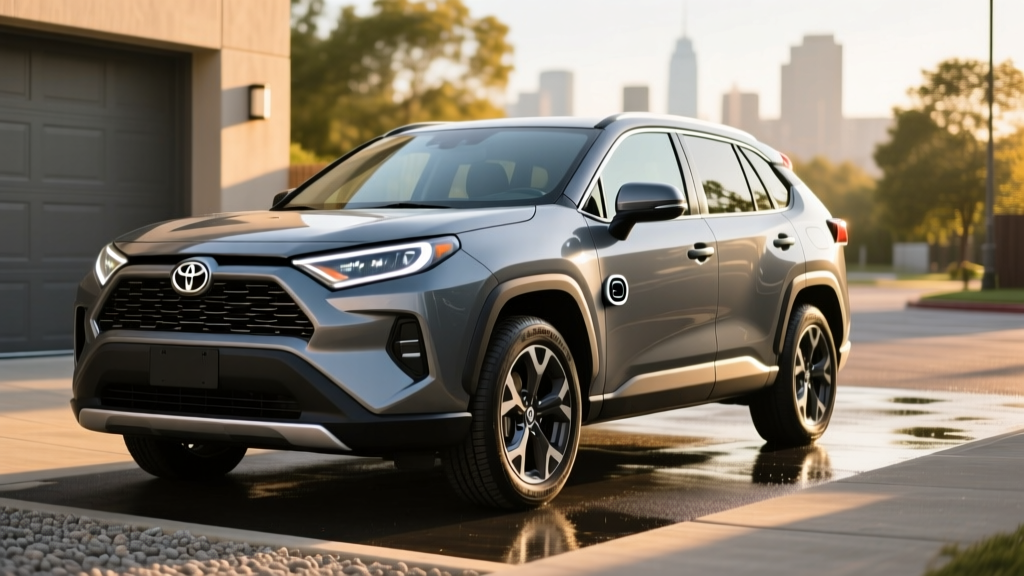
Quick Verdict: The RAV4 XLE Hybrid Still Sets the Compact SUV Bar
The Toyota RAV4 XLE Hybrid occupies a rare sweet spot in the 2026 compact SUV market: it delivers genuine fuel savings without requiring a plug, a panel upgrade, or a six-figure income to justify the purchase. With an EPA-estimated 41 MPG combined and a starting MSRP around $34,025, this conventional hybrid (HEV) remains one of the most practical electrified vehicles for buyers who lack home charging access or simply don't want to think about plugging in.
But how does it stack up against the plug-in RAV4 Prime, a full battery-electric vehicle, or even its own gas-only sibling? This review breaks down the exact numbers — fuel economy, powertrain output, battery warranty, real-world efficiency, and total ownership cost — so you can decide whether the XLE Hybrid trim is the right call for your next SUV.
HEV vs. PHEV: Which RAV4 Hybrid Are We Talking About?
Toyota sells two distinct electrified RAV4 variants, and confusing them is the most common buyer mistake:
| Feature | RAV4 Hybrid (HEV) | RAV4 Prime (PHEV) |
|---|---|---|
| Plug-in required? | No — self-charging via regenerative braking and engine | Yes — 18.1 kWh battery, plug to unlock EV mode |
| EPA combined MPG / MPGe | 41 MPG (combined) | 94 MPGe (EV mode) / 38 MPG (hybrid mode) |
| Electric-only range | None (EV mode limited to ~1 mi at low speed) | 42 miles EPA |
| Battery capacity | 1.6 kWh (NiMH, small buffer) | 18.1 kWh (lithium-ion) |
| Combined horsepower | 219 hp | 302 hp |
| DC fast charging | N/A | No — AC Level 2 only (up to 6.6 kW) |
| Federal tax credit (§30D) | Not eligible | Eligible up to $7,500 (subject to sourcing/income rules) |
| Starting MSRP (2026 est.) | ~$34,025 (XLE) | ~$44,500 (SE) |
The Toyota RAV4 XLE Hybrid discussed in this review is the conventional HEV. It never needs to be plugged in. The gasoline engine and regenerative braking keep the small 1.6 kWh nickel-metal hydride (NiMH) battery charged at all times. If you want plug-in capability with 42 miles of electric-only driving, you're looking at the RAV4 Prime — a different vehicle at a different price point, which we address in the decision framework below.
Fuel Economy: EPA Numbers and Real-World MPG
Fuel economy is the XLE Hybrid's headline advantage over the gas-only RAV4. Here is the full EPA breakdown according to fueleconomy.gov:
| Driving Cycle | RAV4 Hybrid AWD (EPA) | RAV4 Gas AWD (EPA) | Difference |
|---|---|---|---|
| City | 41 MPG | 27 MPG | +14 MPG |
| Highway | 38 MPG | 35 MPG | +3 MPG |
| Combined | 41 MPG | 30 MPG | +11 MPG |
Notice something counterintuitive: the hybrid gets better mileage in the city than on the highway. This is a hallmark of Toyota's Hybrid Synergy Drive system. In stop-and-go traffic, the electric motor handles low-speed propulsion and regenerative braking recaptures energy that a gas car would waste as heat. On the highway, the 2.5-liter four-cylinder does most of the work, and the hybrid advantage shrinks.
Real-World MPG: What Owners Actually Report
EPA estimates are standardized lab figures. In practice, the RAV4 XLE Hybrid's real-world fuel economy depends heavily on your driving mix:
- City-dominant commuting (70%+ city): Many owners report 42–44 MPG, occasionally exceeding the EPA city figure thanks to frequent regen opportunities.
- Highway-dominant road trips (75+ mph sustained): Expect 34–36 MPG. Aerodynamic drag and reduced regen benefit erode the hybrid advantage at high speed.
- Cold weather (below 32°F): The engine runs more often to provide cabin heat and warm the catalytic converter, dropping observed MPG to roughly 35–37 combined until the powertrain reaches operating temperature.
- Mixed driving (50/50 city/highway): Most owners land within 1–2 MPG of the 41 combined EPA figure, making it one of the more accurate EPA estimates in the hybrid segment.
For a driver covering 15,000 miles per year with a 60/40 city/highway split, the XLE Hybrid burns approximately 366 gallons annually at 41 MPG. A comparable gas AWD RAV4 at 30 MPG would consume 500 gallons — a difference of 134 gallons, or roughly $450–$550 per year depending on local fuel prices.
Powertrain and Performance Specs
| Specification | 2026 RAV4 XLE Hybrid (AWD) |
|---|---|
| Engine | 2.5L inline-4 Atkinson-cycle |
| Engine output | 176 hp / 163 lb-ft torque |
| Electric motors | Front motor (118 hp) + rear motor (54 hp) |
| Net combined horsepower | 219 hp |
| 0–60 mph | 7.4 seconds (est.) |
| Drivetrain | Electronic AWD (eAWD), no mechanical driveshaft |
| Transmission | Continuously variable (eCVT, planetary gearset) |
| Hybrid battery | 1.6 kWh NiMH, sealed |
| Towing capacity | 1,750 lbs |
| Cargo volume (behind rear seats) | 37.6 cu ft |
The 219 combined horsepower figure comes from Toyota's method of adding peak engine output and peak motor output at the points where they overlap — not a simple sum of maximums. The result is a compact SUV that feels genuinely quick off the line (electric motors deliver instant torque) while maintaining the efficiency of an Atkinson-cycle engine at cruise.
The electronic AWD system deserves a note: there is no physical driveshaft connecting the front and rear axles. Instead, a dedicated 54 hp rear motor engages when the system detects front-wheel slip, during hard acceleration, or in cornering scenarios. This means AWD traction without the parasitic drivetrain losses of a mechanical system — a key reason the hybrid AWD barely loses MPG versus a hypothetical FWD-only configuration.
Battery Warranty, Reliability, and Replacement Cost
Toyota Hybrid Battery Warranty (2026): 10 years / 150,000 miles (whichever comes first), transferable to subsequent owners. This covers the hybrid traction battery and all hybrid-system components including the inverter, DC-DC converter, and electric motors.
Toyota's hybrid battery track record is among the best in the industry. The NiMH chemistry used in the RAV4 Hybrid is mature technology — the same basic architecture that has powered millions of Prius units since 1997. Unlike high-energy-density NMC lithium-ion packs in full EVs, NiMH cells degrade slowly and predictably. Toyota's hybrid battery failure rate within the warranty period is historically low, and many first-generation Prius batteries lasted 200,000+ miles before needing service.
What Does a Hybrid Battery Replacement Cost?
If your RAV4 Hybrid battery fails outside the 10-year/150,000-mile window, here is the realistic cost landscape:
- New OEM battery from Toyota: $3,000–$4,000 (parts + labor at a dealership)
- Refurbished/remanufactured battery: $1,500–$2,500 (aftermarket suppliers, common for out-of-warranty vehicles)
- Individual module replacement: $500–$1,200 (a specialist can replace only the failed cells within the pack rather than the entire assembly)
For context, a conventional gas-engine RAV4 will likely need a transmission replacement or major engine repair in the $3,000–$5,000 range at similar mileage. The hybrid battery is not a financial time bomb — it's a maintenance item with a cost comparable to what any vehicle faces in its second decade.
Pricing, Trim Value, and Tax Credit Eligibility
The 2026 Toyota RAV4 XLE Hybrid carries an MSRP of approximately $34,025 (including destination). This positions it roughly $2,000–$2,500 above the equivalent gas-only RAV4 XLE AWD, a premium that fuel savings typically recover within 3–5 years depending on mileage and gas prices.
Does the RAV4 Hybrid Qualify for a Federal Tax Credit?
No. The conventional RAV4 Hybrid (HEV) does not qualify for the federal §30D Clean Vehicle Credit. Under current IRS rules, only plug-in electric vehicles with a battery capacity of at least 7 kWh are eligible — which excludes all conventional hybrids regardless of efficiency. The RAV4 Prime (PHEV), with its 18.1 kWh battery, may qualify for up to $7,500 depending on battery-component sourcing, critical-mineral requirements, buyer income caps ($150K single / $300K joint), and the $80,000 SUV MSRP cap. But the standard HEV receives no federal purchase incentive.
Some states and local utilities offer rebates for conventional hybrids, though these are increasingly rare as incentive programs shift toward plug-in vehicles. Check your state energy office or utility provider for current programs — these vary significantly by jurisdiction and change frequently.
Who Should Buy the RAV4 XLE Hybrid (and Who Shouldn't)
Choose the RAV4 XLE Hybrid If:
- You rent or live somewhere without access to a dedicated parking spot with an electrical outlet — no plug needed, ever
- Your commute is city-heavy with frequent stops where the hybrid system excels (41+ MPG real-world)
- You want AWD traction for snow or rain without the fuel-economy penalty of a mechanical AWD system
- You plan to own the vehicle 8+ years and value Toyota's long-term reliability reputation and 10-year hybrid warranty
- Your budget is $32,000–$38,000 and you want maximum efficiency per dollar without EV charging logistics
Look Elsewhere If:
- You have home Level 2 charging and a short commute — the RAV4 Prime PHEV delivers 42 miles of zero-gas driving daily, dramatically cutting fuel costs
- You want a fully electric driving experience with zero tailpipe emissions — consider a BEV like the Hyundai Ioniq 5 or Tesla Model Y
- You regularly tow more than 1,750 lbs — the hybrid's eCVT and battery thermal limits constrain towing capacity versus some gas or diesel alternatives
- You prioritize acceleration above all — at 7.4 seconds to 60 mph, the XLE Hybrid is adequate but not quick; the RAV4 Prime does it in 5.7 seconds
The Decision Framework: Hybrid vs. PHEV vs. Full EV
Choose the RAV4 XLE Hybrid (HEV) if: You lack reliable charging access, drive 12,000–18,000 miles/year in mixed conditions, and want a simple ownership experience with no plug-in routine. Total 5-year fuel cost: ~$5,500–$6,500.
Choose the RAV4 Prime (PHEV) if: You can install a Level 2 charger at home, your daily round-trip commute is under 40 miles (covering most days on electricity alone), and you want the option of gas-free driving without range anxiety on road trips. Total 5-year fuel cost: ~$2,500–$4,000 (highly dependent on electricity vs. gas ratio).
Choose a full BEV if: You have home charging, your daily driving is under 250 miles, you want minimal maintenance (no oil changes, no engine), and you qualify for the $7,500 federal tax credit that narrows the upfront price gap. Total 5-year fuel cost: ~$2,000–$3,500 depending on local electricity rates.
Ownership Costs: 5-Year Breakdown
Beyond the sticker price, the RAV4 XLE Hybrid's total cost of ownership reflects its fuel advantage, strong resale value, and Toyota's low maintenance costs. Here is an estimated 5-year/75,000-mile comparison:
| Cost Category | RAV4 XLE Hybrid | RAV4 XLE Gas AWD |
|---|---|---|
| Purchase price (MSRP) | $34,025 | $31,525 |
| Fuel (75K mi, $3.60/gal avg) | $6,585 (1,829 gal) | $9,000 (2,500 gal) |
| Maintenance (oil, filters, brakes) | $2,800 | $3,200 |
| Insurance (avg) | $7,500 | $7,200 |
| Estimated depreciation | $14,500 | $14,000 |
| 5-Year Total | ~$65,410 | ~$64,925 |
The hybrid's $2,500 premium is almost entirely offset by fuel savings within five years. Beyond year five, the hybrid pulls further ahead as fuel savings compound and the gas vehicle's maintenance costs (transmission fluid, more frequent brake pad replacements due to lack of regenerative braking) accumulate faster.
According to IIHS, the RAV4 continues to earn strong safety ratings, which helps keep insurance costs competitive. Resale values for Toyota hybrids remain among the highest in the compact SUV segment, further reducing effective depreciation.
Frequently Asked Questions
How many MPG does the Toyota RAV4 XLE Hybrid actually get?
The EPA rates it at 41 city / 38 highway / 41 combined. In real-world city-dominant driving, many owners see 42–44 MPG. Highway-only driving at 75+ mph drops to roughly 34–36 MPG. Cold weather reduces combined figures by 3–5 MPG on short trips where the engine runs continuously for cabin heat.
Do I need to plug in the RAV4 XLE Hybrid?
No. The RAV4 XLE Hybrid is a conventional hybrid (HEV), not a plug-in. It has no charging port. The 1.6 kWh battery is charged entirely by the gasoline engine and regenerative braking. You fuel it like any other car at a gas station.
How far can the RAV4 Hybrid drive on electric power alone?
Less than one mile, and only at very low speeds (under 25 mph). The EV mode button allows brief electric-only creeping in parking lots or drive-through lanes, but the small NiMH battery is not designed for meaningful electric-only driving. If you want 42 miles of EV range, you need the RAV4 Prime PHEV.
Is the RAV4 Hybrid battery reliable, and what does replacement cost?
Toyota's NiMH hybrid batteries are among the most proven in the automotive industry, with millions of units in service over 25+ years. The battery is covered by a 10-year/150,000-mile warranty. Out-of-warranty replacement costs $3,000–$4,000 for a new OEM pack, or $1,500–$2,500 for a refurbished unit. Module-level repair can cost as little as $500–$1,200.
Does the RAV4 XLE Hybrid qualify for any federal tax credit?
No. Under IRS §30D rules, only plug-in vehicles with at least 7 kWh of battery capacity are eligible for the federal Clean Vehicle Credit. The RAV4 Hybrid's 1.6 kWh battery does not meet this threshold. The RAV4 Prime PHEV may qualify for up to $7,500, subject to battery-sourcing requirements, buyer income limits, and MSRP caps. Consult a tax professional for your specific eligibility.
How does the RAV4 Hybrid compare to a full EV like the Tesla Model Y?
The Model Y offers lower per-mile energy costs (roughly $0.04–$0.06/mile on home electricity vs. $0.10–$0.12/mile for the RAV4 Hybrid on gas), near-zero routine maintenance, and access to the Supercharger network. However, the Model Y starts around $44,000 before incentives, requires home charging infrastructure ($500–$2,000 installation), and may not suit buyers in apartments or areas with limited public charging. The RAV4 Hybrid eliminates all charging logistics at a lower entry price.
Is the RAV4 Hybrid good in snow?
Yes. The electronic AWD system (eAWD) engages the rear motor automatically when front-wheel slip is detected, providing confident traction in snow and rain. Combined with Toyota Safety Sense (standard on all trims), the RAV4 Hybrid performs well in winter conditions. The hybrid battery's performance is minimally affected by cold — unlike full EVs, you don't lose significant range in freezing temperatures because the engine provides cabin heat without drawing from a large battery.