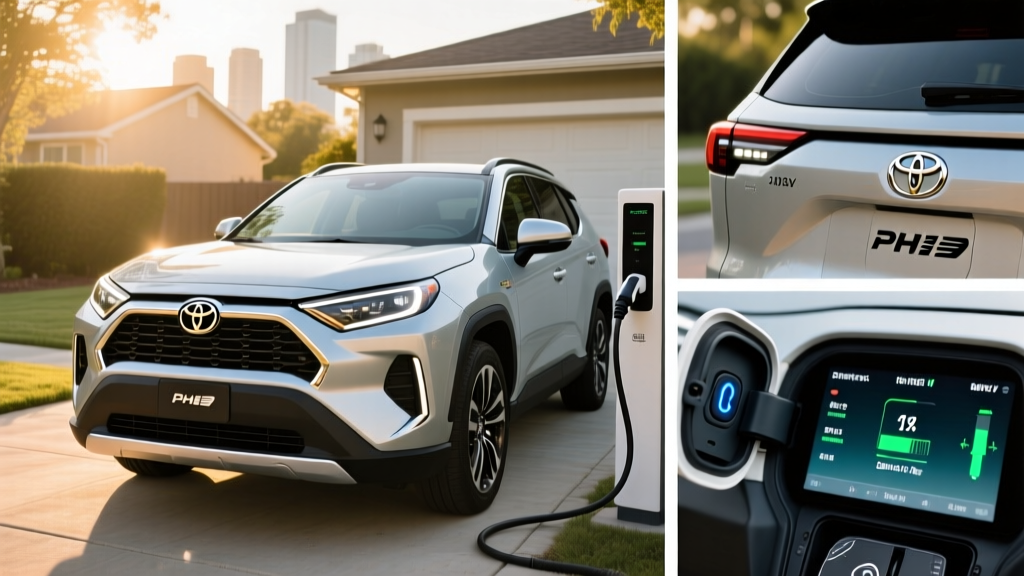
The Toyota RAV4 Prime — Toyota's plug-in hybrid variant of the best-selling RAV4 — occupies a narrow but valuable space in the electrified-vehicle market. It pairs a 2.5-liter four-cylinder engine with a pair of electric motors and an 18.1 kWh lithium-ion battery pack, yielding 302 combined horsepower and a substantial electric-only driving range. For buyers who want EV-like daily commuting without ever worrying about finding a charger on a road trip, the 2026 RAV4 PHEV makes a compelling case.
This guide breaks down everything you need to know: real-world fuel economy versus EPA estimates, electric-only range expectations, charging logistics, powertrain specs, warranty coverage, tax credit eligibility under current IRS §30D rules, and whether this PHEV fits your lifestyle better than a full EV or a conventional hybrid.
HEV vs PHEV: What's the Difference?
Toyota sells the RAV4 in three powertrain flavors, and confusing them is easy if you're new to electrified vehicles. Here's the breakdown:
| Feature | RAV4 Hybrid (HEV) | RAV4 Prime (PHEV) | bZ4X (Full EV) |
|---|---|---|---|
| Plug-in required? | No — self-charging via engine + regen | Yes — plug in for max EV range | Yes — plug in always |
| Electric-only range | ~0.5 mi at very low speeds | 42 mi (EPA) | 236-252 mi (EPA) |
| Combined fuel economy | 39 MPG | 38 MPG (charge-sustaining) / 94 MPGe (EV mode) | N/A (electric only) |
| Combined horsepower | 219 HP | 302 HP | 201-214 HP |
| Battery size | 1.6 kWh | 18.1 kWh | 71.4 kWh |
| Starting MSRP | ~$33,500 | ~$44,500 | ~$37,000 |
The key distinction: the conventional RAV4 Hybrid (HEV) never needs to be plugged in. It recovers energy through regenerative braking and the gasoline engine to keep its small battery charged. The RAV4 Prime (PHEV) has a much larger battery that you should plug in to unlock its 42-mile electric-only range — but if you forget or skip charging, it simply operates as a conventional hybrid with no range penalty.
Electric-Only Range: EPA vs Real-World
The EPA rates the 2026 RAV4 Prime at 42 miles of electric-only range. That figure assumes moderate temperatures, mixed driving, and a fully charged battery. In practice, your experience will vary based on several factors:
- Mild weather, city/suburban driving: 38-44 miles — PHEVs are most efficient at lower speeds with frequent regen opportunities
- Highway driving (70+ mph): 30-35 miles — higher aerodynamic drag and sustained speeds drain the battery faster
- Cold weather (below 32°F): 28-34 miles — battery chemistry loses efficiency, and cabin heating draws significant power (the RAV4 Prime uses a resistance heater in EV mode, not a heat pump)
- Hot weather with A/C: 36-40 miles — less impact than cold, but still noticeable
The 42-mile figure is generous enough to cover the average American's one-way commute. According to FHWA data, the average daily driving distance is roughly 37 miles, meaning many RAV4 Prime owners could complete most daily driving on electricity alone — effectively using it as an EV during the week and a hybrid on weekends.
Total combined range (electric + gasoline) exceeds 600 miles, eliminating any range anxiety on longer trips.
Fuel Economy: EPA Numbers and Real-World MPG
Once the battery depletes, the RAV4 Prime operates as a conventional hybrid. Here's the EPA-rated fuel economy breakdown:
| Mode | City | Highway | Combined |
|---|---|---|---|
| Charge-Depleted (Hybrid Mode) | 40 MPG | 36 MPG | 38 MPG |
| Charge-Sustaining (EV + Gas) | 94 MPGe (electricity + gasoline combined) | ||
Real-world MPG tends to exceed EPA city estimates. Toyota's hybrid system excels in stop-and-go traffic where regenerative braking recovers energy that would otherwise be lost. Many owners report 41-44 MPG in city and suburban driving. Highway MPG, however, often falls slightly short of the 36 MPG EPA figure, particularly at speeds above 75 mph or in headwinds, where the boxy crossover shape creates aerodynamic drag.
For comparison, the conventional RAV4 Hybrid achieves 39 MPG combined — nearly identical to the Prime in charge-sustaining mode. The real economy advantage of the Prime comes from those first 42 electric miles, which cost roughly $0.04-$0.06 per mile to "fuel" on average US electricity rates versus $0.14-$0.18 per mile on gasoline at $3.50/gallon.
Powertrain and Performance Specs
The RAV4 Prime is the quickest RAV4 in the lineup — and one of the quickest vehicles Toyota sells, period.
| Specification | 2026 Toyota RAV4 Prime |
|---|---|
| Engine | 2.5L Dynamic Force 4-cylinder (177 HP / 165 lb-ft) |
| Front Electric Motor | 134 kW (180 HP) |
| Rear Electric Motor | 40 kW (54 HP) — enables electronic AWD (eAWD) |
| Combined System Output | 302 HP |
| 0-60 mph | 5.7 seconds |
| Drivetrain | Electronic On-Demand AWD (rear motor activates as needed) |
| Transmission | eCVT (electronically controlled continuously variable) |
| Battery Capacity | 18.1 kWh (lithium-ion, NMC chemistry) |
| Battery Location | Under rear floor — no cargo space penalty vs. hybrid |
| Towing Capacity | 1,500 lbs |
| Cargo Volume (rear seats up) | 33.5 cu ft |
| Cargo Volume (rear seats folded) | 63.2 cu ft |
The eAWD system is worth noting: unlike mechanical AWD with a driveshaft, the rear axle is powered exclusively by the rear electric motor. It engages automatically during acceleration, slippery conditions, or when the system detects front-wheel slip. It's not designed for serious off-roading, but it handles rain, light snow, and gravel roads competently.
Charging: Speeds, Connectors, and Logistics
Charging the RAV4 Prime is straightforward but limited compared to a full EV. Here's what you need to know:
| Charging Level | Power | Connector | 0-100% Time | Miles of EV Range per Hour |
|---|---|---|---|---|
| Level 1 (120V household outlet) | ~1.4 kW | Standard J1772 | ~12-13 hours | ~3-4 mi/hr |
| Level 2 (240V, standard trim) | 3.3 kW | J1772 | ~5.5 hours | ~8 mi/hr |
| Level 2 (240V, XSE w/ Premium Pkg) | 6.6 kW | J1772 | ~2.5 hours | ~17 mi/hr |
| DC Fast Charging | N/A | N/A | Not supported | |
The RAV4 Prime cannot DC fast charge. This is a deliberate engineering choice: the 18.1 kWh battery is small enough that Level 2 charging fully replenishes it overnight (or during a workday), and adding DC fast-charge hardware would increase cost, weight, and complexity for minimal practical benefit.
Important trim distinction: The SE trim and base XSE come with a 3.3 kW onboard charger. Upgrading to the XSE with the Premium Package unlocks a 6.6 kW onboard charger, cutting Level 2 charge time in half. If you plan to install a Level 2 home charger (recommended), the 6.6 kW option means a full charge in roughly 2.5 hours — useful if you want to recharge midday for a second electric commute.
On a standard 120V household outlet (Level 1), a full overnight charge is technically possible but tight — you'll get roughly 20-25 miles of EV range from an 8-hour overnight plug, not the full 42 miles. A Level 2 home charger is strongly recommended for PHEV ownership.
Pricing, Trims, and Tax Credit Eligibility
The 2026 RAV4 Prime is offered in two main trims:
| Trim | MSRP (approx.) | Onboard Charger | Key Features |
|---|---|---|---|
| SE | $44,500 | 3.3 kW | SofTex seats, 8" touchscreen, 18" alloy wheels, heated front seats |
| XSE | $48,500 | 3.3 kW (6.6 kW w/ Premium Pkg) | Sport-tuned suspension, panoramic roof available, 19" wheels, ambient lighting |
| XSE w/ Premium Package | $53,000+ | 6.6 kW | JBL audio, 10.5" display, panoramic roof, head-up display, ventilated seats |
Federal Tax Credit (§30D) — Does the RAV4 Prime Qualify?
Under current IRS §30D rules, the RAV4 Prime's federal tax credit eligibility is complex and subject to change:
- MSRP cap: SUVs must be under $80,000 MSRP — the RAV4 Prime qualifies on this criterion
- Buyer income cap: AGI must not exceed $150,000 (single) / $300,000 (joint) / $225,000 (head of household)
- Battery component sourcing: A percentage of battery components must be manufactured or assembled in North America — Toyota's supply chain for the RAV4 Prime battery has historically not met the escalating thresholds
- Critical minerals sourcing: A percentage of critical minerals must be sourced from the US or free-trade-agreement countries
- FEOC restriction: No battery components from Foreign Entities of Concern (primarily targeting Chinese supply chains) beginning 2024, with critical minerals restrictions phasing in through 2027
As of the most recent IRS guidance, the RAV4 Prime's eligibility for the full $7,500 credit — or any partial credit — depends on the specific model year's battery sourcing compliance, which changes as supply chains shift. Always verify current eligibility on the fueleconomy.gov tax credit page before purchasing. The point-of-sale transfer option allows qualifying buyers to apply the credit as a down payment reduction at the dealership, but only if the vehicle is confirmed eligible.
Many states offer additional rebates or HOV lane access for PHEVs — check your state's energy office or DMV for current programs.
Reliability and Battery Warranty
The RAV4 Prime carries Toyota's hybrid battery warranty, which is among the strongest in the industry:
- Hybrid Battery: 10 years / 150,000 miles (whichever comes first) — covers defects and capacity loss below a specified threshold
- Hybrid System Components: 8 years / 100,000 miles (inverter, electric motors, control modules)
- Powertrain: 5 years / 60,00,000 miles
- Basic (bumper-to-bumper): 3 years / 36,000 miles
Battery replacement cost: If the hybrid battery requires replacement outside of warranty, expect a cost between $4,000 and $6,500 for parts and labor at a Toyota dealership. Third-party hybrid battery refurbishers may offer replacements for $2,500-$4,000. However, Toyota's hybrid batteries have demonstrated exceptional longevity — many first-generation Prius batteries (2001-2003) lasted well beyond 200,000 miles with gradual capacity loss rather than catastrophic failure.
The RAV4 Prime's battery is liquid-cooled, which significantly extends lifespan compared to air-cooled packs. Toyota also employs a conservative state-of-charge buffer — the battery never charges to a true 100% or discharges to 0% — reducing stress on the cells and slowing degradation over time.
Toyota consistently ranks at or near the top of J.D. Power's Vehicle Dependability Study, and the RAV4 line specifically has strong long-term reliability data across both conventional and hybrid variants.
Who Should Choose the RAV4 Prime vs a Full EV or Gas Car?
The RAV4 Prime isn't the right choice for everyone. Here's a decision framework:
Choose the RAV4 Prime (PHEV) if:
- Your daily commute is under 40 miles round-trip and you have access to Level 1 or Level 2 charging at home or work
- You take frequent road trips (200+ miles) and don't want to plan around charging stops
- You live in a cold climate where EV range loss is a concern — the gas engine provides heat and unlimited range
- You want AWD, 302 HP, and a spacious crossover without the $50,000+ price tag of most electric SUVs
- You're transitioning from a gas car and want to "test" electric driving before committing to a full EV
Choose a full EV (like the Toyota bZ4X or Tesla Model Y) if:
- You have reliable home Level 2 charging and your daily driving rarely exceeds 200 miles
- You want zero tailpipe emissions and minimal maintenance (no oil changes, no spark plugs, fewer moving parts)
- You want access to DC fast charging for road trips (250+ kW on some models = 15-20 min stops)
- Your state offers significant EV-only rebates or incentives that make a full EV cheaper than a PHEV
Choose the conventional RAV4 Hybrid (HEV) if:
- You cannot charge at home (apartment, street parking, no garage) — a PHEV's electric range is wasted without regular plug-in charging
- You want the lowest upfront price and don't care about electric-only driving
- Your daily driving is long and mostly highway, where the PHEV's electric range provides minimal benefit
Pros
- 42-mile EV range covers most daily commutes
- 302 HP — quickest RAV4 by a wide margin
- No range anxiety — 600+ mile total range
- eAWD standard with no mechanical complexity
- Strong resale value and reliability reputation
- 10-year/150,000-mile hybrid battery warranty
- No cargo space penalty vs. gas/hybrid RAV4
Cons
- No DC fast charging — Level 2 only
- 3.3 kW onboard charger on base trims is slow
- $44,500+ starting price — $11,000 more than RAV4 Hybrid
- Federal tax credit eligibility uncertain due to battery sourcing
- Only 1,500-lb towing capacity
- Infotainment system lags behind competitors in responsiveness
- High demand means dealer markups are common
Frequently Asked Questions
How many MPG does the Toyota RAV4 Prime get?
The EPA rates the RAV4 Prime at 40 MPG city / 36 MPG highway / 38 MPG combined when operating in hybrid mode (after the battery is depleted). In real-world city and suburban driving, many owners consistently achieve 41-44 MPG thanks to Toyota's efficient regenerative braking system. Highway MPG at sustained speeds above 70 mph often falls to 33-35 MPG.
How far can the RAV4 Prime go on electric only?
The EPA rates the RAV4 Prime at 42 miles of electric-only range. In real-world conditions, expect 38-44 miles in mild weather and city driving, 30-35 miles on the highway, and 28-34 miles in freezing temperatures. Once the battery is depleted, the gas engine seamlessly engages and the vehicle operates as a conventional hybrid.
Does the RAV4 Prime qualify for the $7,500 federal tax credit?
Eligibility depends on current IRS §30D rules regarding battery component sourcing, critical mineral requirements, buyer income caps, and MSRP limits. The RAV4 Prime's MSRP is under the $80,000 SUV cap, but battery sourcing compliance changes as supply chains evolve. Always verify on fueleconomy.gov or consult a tax professional before relying on the credit for your purchase decision.
Is the RAV4 Prime reliable, and what does battery replacement cost?
The RAV4 Prime carries Toyota's strong reliability reputation. The hybrid battery is covered by a 10-year/150,000-mile warranty. Out-of-warranty battery replacement costs approximately $4,000-$6,500 at a dealership, though Toyota's hybrid batteries historically last well beyond 200,000 miles with gradual rather than catastrophic degradation. The liquid-cooled battery pack and conservative charge buffers further extend lifespan.
Can I charge the RAV4 Prime at a DC fast charger?
No. The RAV4 Prime does not support DC fast charging. It uses a J1772 connector for Level 1 (120V) and Level 2 (240V) charging only. The XSE with Premium Package offers a 6.6 kW onboard charger for ~2.5-hour full charges on Level 2; base trims have a 3.3 kW charger requiring ~5.5 hours.
How does the RAV4 Prime compare to a full EV like the Tesla Model Y?
The Model Y offers 260-330 miles of range, DC fast charging at up to 250 kW, and lower running costs (no gasoline). However, it costs more upfront (depending on trim and credits), requires reliable home charging access, and involves planning for road-trip charging stops. The RAV4 Prime trades maximum electric efficiency for the flexibility of a gas engine — ideal if your driving patterns are unpredictable or you lack consistent charging access.
Do I have to plug in the RAV4 Prime?
You don't have to, but you should. If you never plug it in, the RAV4 Prime functions as a slightly heavier conventional hybrid with nearly identical MPG to the standard RAV4 Hybrid — and you've paid an $11,000 premium for a battery you're not using. The PHEV's value proposition only works if you charge regularly to capture those 42 electric miles.