The RAV4 Prime at a Glance: Toyota's Plug-In Hybrid SUV
The Toyota RAV4 Prime — Toyota's official name for the RAV4 plugin hybrid — occupies a compelling middle ground between a conventional hybrid and a full battery-electric vehicle. With 42 miles of electric-only driving, 302 combined horsepower, and the ability to run as a standard hybrid once the battery depletes, it addresses the two biggest barriers to EV adoption: range anxiety and charging access. For the 2025 model year, the RAV4 Prime remains one of the most practical plug-in hybrids on the market, though its popularity has created persistent inventory constraints and dealer markups.
This guide covers everything you need to evaluate whether the RAV4 Prime fits your driving pattern, including real-world efficiency data, charging logistics, federal tax credit eligibility under current IRS §30D rules, and how it stacks up against both the standard RAV4 Hybrid and full-electric alternatives.
| Spec | Value |
|---|---|
| EPA Electric-Only Range | 42 miles |
| EPA Combined Range (EV + Gas) | ~440 miles |
| MPGe (Electric Mode) | 94 MPGe combined |
| MPG (Hybrid Mode, Battery Depleted) | 38 city / 35 hwy / 36 combined |
| Battery Capacity | 18.1 kWh (lithium-ion) |
| Combined Horsepower | 302 hp |
| 0–60 mph | 5.7 seconds |
| Drivetrain | AWD (electronic on-demand) |
| Level 2 Charge Time (0–100%) | ~2.5 hours (6.6 kW onboard charger) |
| DC Fast Charging | Not available |
| Base MSRP (SE trim) | $43,690 |
| XSE trim MSRP | $47,660 |
| Hybrid Battery Warranty | 10 years / 150,000 miles |
HEV vs PHEV: What's the Difference and Why It Matters
Toyota sells two electrified RAV4 variants, and the distinction trips up many shoppers. Here's the breakdown:
| Feature | RAV4 Hybrid (HEV) | RAV4 Prime (PHEV) |
|---|---|---|
| Plug-in Charging | No — charges via regenerative braking and engine | Yes — plug in to access full electric range |
| Electric-Only Range | ~0.5–1 mile at low speed | 42 miles EPA |
| Battery Size | 1.6 kWh (small buffer) | 18.1 kWh |
| Combined Horsepower | 219 hp | 302 hp |
| Combined MPG (gas) | 41 combined | 36 combined (once battery is depleted) |
| Base MSRP | ~$33,425 | $43,690 |
| Federal Tax Credit Eligibility | Not eligible (§30D requires plug-in) | Eligibility varies — see tax credit section |
The conventional RAV4 Hybrid never needs to be plugged in. Its small battery charges through regenerative braking and the gasoline engine, delivering strong fuel economy with zero lifestyle change. The RAV4 Prime (PHEV) has a much larger battery that you plug in to charge, enabling 42 miles of pure electric driving for daily commutes. Once that electric range is used up, it operates exactly like a conventional hybrid — no range anxiety, no stranded scenarios.
The practical upshot: If your daily round-trip commute is under 40 miles and you can charge at home, the Prime lets you drive on electricity most days while retaining gas-engine flexibility for road trips. If you can't charge at home or your commute exceeds 42 miles regularly, the standard RAV4 Hybrid may deliver better overall value at a $10,000 lower price.
Electric Range, MPGe, and Real-World MPG
EPA Electric-Only Range: 42 miles
Real-World Expectation: 35–40 miles in moderate temperatures; 28–33 miles in freezing weather or sustained highway speeds above 70 mph.
The RAV4 Prime's 18.1 kWh battery delivers an EPA-rated 42 miles of electric-only range. In real-world driving, most owners report 35–40 miles on a full charge during temperate weather with mixed city/highway driving. Cold weather (below 32°F) reduces lithium-ion battery efficiency and increases cabin heating demand, which can drop usable electric range to 28–33 miles. Highway driving at 75+ mph also reduces range more aggressively than city driving due to aerodynamic drag.
When operating in electric mode, the RAV4 Prime achieves 94 MPGe combined (miles per gallon equivalent — a metric the EPA uses to compare electricity consumption to gasoline energy content). According to fueleconomy.gov, the energy consumption rate is 36 kWh per 100 miles in EV mode.
| Mode | City | Highway | Combined |
|---|---|---|---|
| Electric Mode (MPGe) | 105 MPGe | 84 MPGe | 94 MPGe |
| Hybrid Mode (MPG, battery depleted) | 38 MPG | 35 MPG | 36 MPG |
Real-world hybrid MPG: Once the battery is depleted, the RAV4 Prime operates as a conventional hybrid rated at 36 MPG combined. In practice, city driving often yields 38–42 MPG because regenerative braking recaptures energy in stop-and-go traffic. Highway cruising at 75 mph typically returns 32–34 MPG. This is slightly lower than the standard RAV4 Hybrid's 41 MPG combined, due to the Prime's 400+ pounds of additional battery weight.
Total combined range — electric plus gasoline — is approximately 440 miles on a full charge and full 14.5-gallon tank, meaning you'll stop for gas no more often than in any conventional SUV.
Powertrain and Performance
The RAV4 Prime pairs a 2.5-liter inline-4 Atkinson-cycle engine with two electric motors (one front, one rear) to deliver a combined 302 horsepower. That makes it the quickest RAV4 variant Toyota sells, hitting 0–60 mph in 5.7 seconds — a figure that surprises drivers expecting a fuel-economy-focused vehicle.
The electronic on-demand AWD system uses the rear electric motor to power the rear wheels when traction is needed, without a mechanical driveshaft. This means AWD engagement is instant and seamless, though the rear motor provides less torque than a traditional mechanical AWD system under hard acceleration.
In EV mode, the RAV4 Prime can reach speeds up to 84 mph on electric power alone, making it fully capable of highway merging and passing without engaging the gas engine. The transition from EV to hybrid mode is nearly imperceptible — the engine starts smoothly when the battery depletes or when you demand hard acceleration.
Charging: What You Need to Know Before You Buy
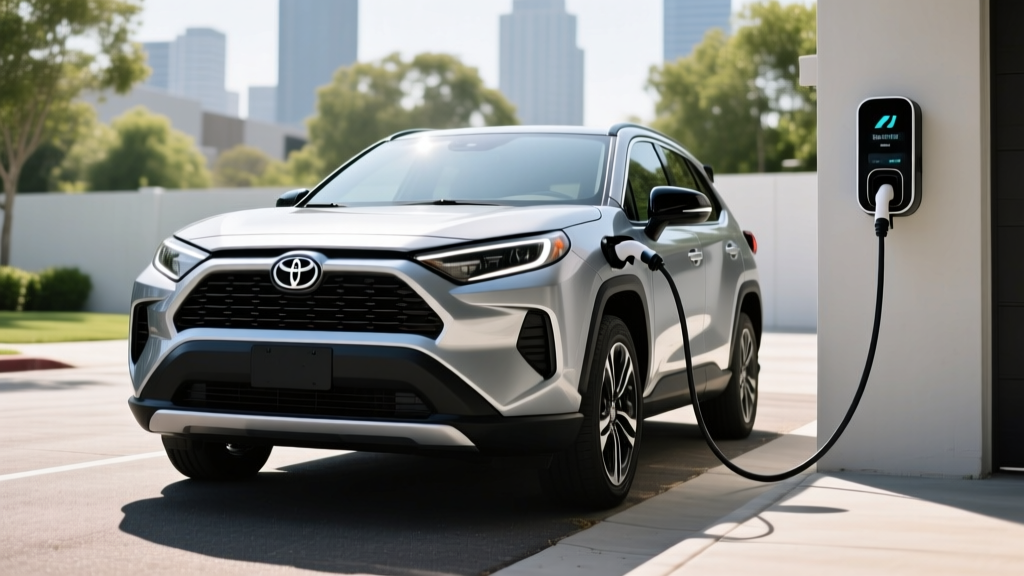
The RAV4 Prime charges via a standard J1772 connector (the universal Level 2 plug for non-Tesla EVs). Here are the critical charging details:
| Charging Level | Power | Time (0–100%) | Practical Notes |
|---|---|---|---|
| Level 1 (120V household outlet) | ~1.4 kW | ~12 hours | Works for overnight if daily use is low |
| Level 2 (240V, 16A) | 3.3 kW | ~5.5 hours | Minimum recommended for daily use |
| Level 2 (240V, 32A) | 6.6 kW | ~2.5 hours | Optimal — requires 6.6 kW onboard charger (standard on XSE, available on SE) |
| DC Fast Charging | N/A | N/A | Not supported — no CCS or CHAdeMO port |
No DC fast charging. The RAV4 Prime does not support DC fast charging. This is typical for PHEVs — the battery is small enough that Level 2 charging replenishes it fully in a few hours, and adding DC fast-charge hardware would increase cost and weight for minimal benefit.
Home charging setup: Most Prime owners install a 240V Level 2 home charger on a 40-amp circuit (delivering up to 32 amps / 7.7 kW to the vehicle, though the Prime caps at 6.6 kW). A quality Level 2 charger (ChargePoint Home Flex, Emporia V2, or similar) costs $350–$700 for the unit, with electrician installation typically running $500–$1,500 depending on panel proximity and local permit requirements. Total home charging setup: $850–$2,200.
Important trim note: The SE trim's standard onboard charger is 3.3 kW, which means a full charge takes ~5.5 hours even on a 240V circuit. To get the faster 6.6 kW charge rate (2.5 hours), you need the XSE trim or the optional 6.6 kW charger upgrade on the SE. Verify this spec at purchase — it significantly impacts daily charging convenience.
Pricing, Tax Credits, and Ownership Cost
The 2025 Toyota RAV4 Prime starts at $43,690 for the SE trim and $47,660 for the XSE trim, before destination charges. Fully loaded XSE models with Premium packages can exceed $52,000.
Federal Tax Credit (§30D) Eligibility for the RAV4 Prime:
- Credit amount: Up to $7,500, split into $3,750 for critical minerals sourcing and $3,750 for battery component sourcing — current 2025 rules under the Inflation Reduction Act.
- MSRP cap: SUVs must have an MSRP at or below $80,000 — the RAV4 Prime qualifies.
- Buyer income cap: Modified AGI must not exceed $150,000 (single), $225,000 (head of household), or $300,000 (joint filers).
- Battery sourcing requirements: Increasingly strict critical-minerals and battery-component sourcing thresholds apply. Toyota has faced challenges meeting these requirements for the Prime's battery supply chain. Check the latest fueleconomy.gov credit listings and IRS guidance before purchasing — eligibility can change with model year and production batch.
- Point-of-sale transfer: If eligible, the credit can be transferred to the dealer at purchase to reduce the upfront price, rather than waiting for a tax refund.
Critical caveat: Due to evolving battery-sourcing rules, the RAV4 Prime's eligibility for the full $7,500 credit has fluctuated. Some model years and production runs have qualified for only $3,750 or none at all. Always verify current eligibility with your dealer and a tax professional before relying on the credit in your purchase budget.
Total cost of ownership context: The RAV4 Prime's $10,000+ premium over the standard RAV4 Hybrid is partially offset by fuel savings (if you charge daily and drive under 42 miles) and potential tax credits. At $0.13/kWh (national average electricity rate) and $3.50/gallon gas, charging the Prime's 18.1 kWh battery costs roughly $2.35 for 42 miles of driving — equivalent to about $0.056/mile. The same 42 miles in the RAV4 Hybrid at 41 MPG costs about $3.59, or $0.085/mile. Annual fuel savings of $400–$800 are realistic for daily chargers with short commutes, meaning the price premium takes 8–15 years to recoup through fuel savings alone — the tax credit, if obtained, significantly shortens that payback period.
Reliability, Battery Warranty, and Replacement Cost
Hybrid Battery Warranty: 10 years / 150,000 miles (whichever comes first), covering defects and capacity loss below a specified threshold. This applies in all 50 states for 2025 models. The standard powertrain warranty is 5 years / 60,000 miles, and the basic comprehensive warranty is 3 years / 36,000 miles.
Toyota's hybrid systems have an exceptional reliability track record spanning two decades, dating back to the original Prius. The RAV4 Prime's lithium-ion traction battery is larger and more complex than the standard hybrid's nickel-metal hydride pack, but Toyota engineers it with conservative charge/discharge buffers — you never use the full 18.1 kWh, which reduces stress and extends longevity.
Battery degradation: Based on owner reports from 2021–2023 model-year Primes (the first generation), most vehicles retain 90–95% of original electric range after 50,000 miles. Significant degradation (below 80% capacity) within the warranty period is uncommon but covered.
Replacement cost: If the hybrid battery requires replacement outside warranty coverage, expect a cost of $4,000–$7,000 for the battery pack plus labor at a Toyota dealership. Third-party hybrid battery refurbishers offer remanufactured packs for $2,500–$4,000. However, given the 10-year/150,000-mile warranty and Toyota's track record, out-of-pocket battery replacement is rare within the typical ownership period.
According to IIHS, the RAV4 Prime earns top safety ratings, and Toyota Safety Sense 2.5+ (pre-collision, lane tracing, adaptive cruise, blind spot monitoring) is standard across all trims.
RAV4 Prime vs Full EV vs Standard Hybrid: Which Should You Choose?
Choose the RAV4 Prime (PHEV) if:
- Your daily commute is under 40 miles round-trip and you can charge at home
- You want electric daily driving but take road trips where charging infrastructure is uncertain
- You live in a region with extreme cold that significantly reduces EV range
- You want 302 hp performance without the cost of a luxury EV
Choose the standard RAV4 Hybrid (HEV) if:
- You cannot install a home charger (apartment, street parking, no garage)
- Your budget is closer to $35,000 and the $10K+ premium isn't justified
- Your daily driving exceeds 50+ miles, making the 42-mile EV range less impactful
- You want maximum fuel economy in hybrid mode (41 vs 36 MPG combined)
Choose a full EV (e.g., Tesla Model Y, Hyundai Ioniq 5, Ford Mustang Mach-E) if:
- You want zero gasoline use and zero tailpipe emissions
- You can charge at home and your typical trips fall within 250–300 miles
- You want lower maintenance costs (no oil changes, no gas engine upkeep)
- You qualify for the full $7,500 federal tax credit on a qualifying BEV
Pros
- 42-mile EV range covers most daily commutes gas-free
- 302 hp makes it the quickest RAV4 — genuinely fun to drive
- No range anxiety — gas engine provides 440+ mile total range
- Standard AWD with electric rear motor
- Strong reliability record and 10-year battery warranty
- Can use a standard 120V outlet in a pinch
Cons
- $10,000+ premium over the standard RAV4 Hybrid
- No DC fast charging capability
- Persistent dealer markups and limited inventory in many markets
- Federal tax credit eligibility is uncertain due to battery-sourcing rules
- 36 MPG hybrid mode is lower than the standard hybrid's 41 MPG
- Cargo space slightly reduced vs non-hybrid RAV4 due to battery placement
Frequently Asked Questions
How many MPG does the Toyota RAV4 Prime get?
In hybrid mode (battery depleted), the RAV4 Prime achieves 38 city / 35 highway / 36 combined MPG. In electric mode, it achieves 94 MPGe combined. Real-world city driving in hybrid mode often yields 38–42 MPG thanks to regenerative braking, while sustained highway driving at 75 mph typically returns 32–34 MPG.
How far can the RAV4 Prime go on electric only?
The EPA rates the RAV4 Prime at 42 miles of electric-only range. Real-world results vary: expect 35–40 miles in moderate temperatures with mixed driving, and 28–33 miles in freezing weather or at sustained highway speeds above 70 mph. The vehicle can reach up to 84 mph in EV mode before the gas engine engages.
Does the RAV4 Prime qualify for a federal tax credit?
The RAV4 Prime may qualify for up to $7,500 under the IRS §30D Clean Vehicle Credit, but eligibility depends on current battery-sourcing requirements, your income level (capped at $150K single / $300K joint), and the vehicle's MSRP (must be under $80K for SUVs — the Prime qualifies). Battery-sourcing rules have caused eligibility to fluctuate. Always verify current status at fueleconomy.gov and consult a tax professional before purchasing.
Is the RAV4 Prime reliable and what does battery replacement cost?
Toyota's hybrid powertrains have a 20+ year track record of reliability. The RAV4 Prime's lithium-ion battery is covered by a 10-year / 150,000-mile warranty. Based on early owner data, most Primes retain 90–95% of electric range after 50,000 miles. Out-of-warranty battery replacement costs $4,000–$7,000 at a dealership, or $2,500–$4,000 through third-party refurbishers — though this is rarely needed within normal ownership periods.
Do I need to plug in the RAV4 Prime?
You don't have to — if you never plug it in, the RAV4 Prime operates as a conventional hybrid at 36 MPG combined. However, you'll miss the entire benefit of the 42-mile electric range and the fuel savings that justify the price premium. To get the most value, plug in nightly at home using a Level 2 (240V) charger for a full charge in 2.5–5.5 hours depending on your onboard charger configuration.
Can the RAV4 Prime DC fast charge?
No. The RAV4 Prime only supports Level 1 (120V) and Level 2 (240V) AC charging via a J1772 connector. DC fast charging is not available on any current PHEV from Toyota. For the 18.1 kWh battery, Level 2 charging fully replenishes the pack in 2.5–5.5 hours, which is adequate for overnight or workplace charging.
Hybrid vs PHEV vs EV — which is right for me?
A conventional hybrid (HEV) like the RAV4 Hybrid is best if you can't charge at home and want maximum MPG with no lifestyle change. A PHEV like the RAV4 Prime is ideal if you can charge at home and want electric daily driving with gas-engine backup for long trips. A full EV (BEV) like the Tesla Model Y suits those who want zero gas use, have home charging access, and typically drive under 250–300 miles per trip. Each has trade-offs in upfront cost, fuel savings, maintenance, and infrastructure requirements.