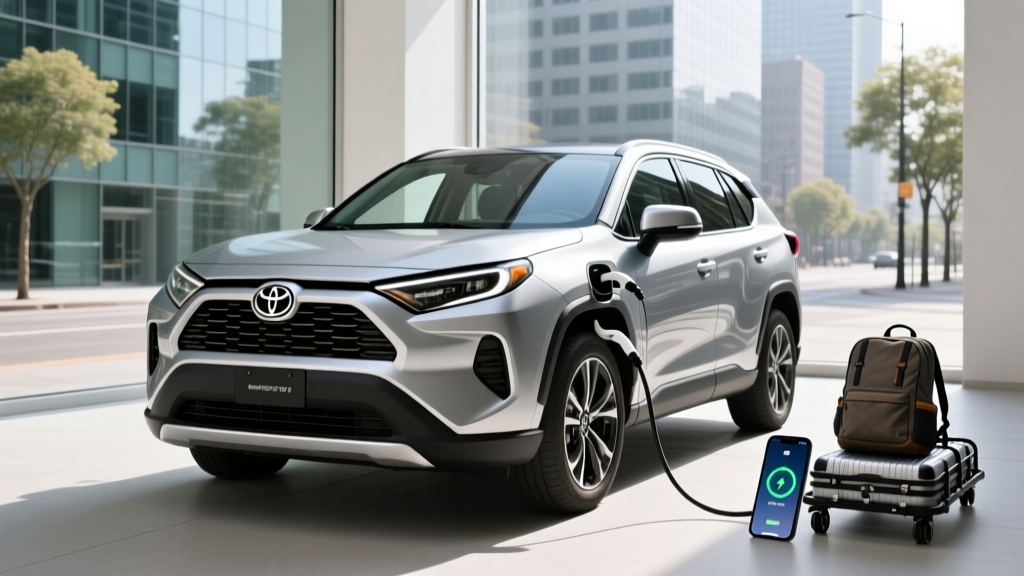
Quick Verdict: The RAV4 Limited Hybrid at a Glance
The Toyota RAV4 Limited Hybrid remains one of the most compelling compact SUVs for buyers who want electric-like efficiency without plugging in. For 2026, the Limited trim pairs a 2.5-liter four-cylinder with front and rear electric motors for standard electronic AWD, delivering 219 combined horsepower and an EPA-rated 41 city / 38 highway / 39 combined MPG. At roughly $40,000 MSRP before destination, it occupies a sweet spot: premium features, proven hybrid reliability, and no range anxiety whatsoever.
But the real question in 2026 is whether a conventional hybrid (HEV) like this one still makes sense — or if you should look at the plug-in RAV4 Prime or a full battery-electric vehicle instead. This guide breaks down every number that matters.
RAV4 Hybrid vs. RAV4 Prime (PHEV): Know the Difference
Toyota sells two electrified RAV4 variants, and confusing them is the most common buyer mistake. Here's what separates them:
| Feature | RAV4 Hybrid (HEV) | RAV4 Prime (PHEV) |
|---|---|---|
| Plugs in? | No — self-charging | Yes — 18.1 kWh battery |
| Electric-only range | N/A (motor assists engine) | 42 miles EPA |
| Combined horsepower | 219 hp | 302 hp |
| 0–60 mph | ~7.4 sec | ~5.7 sec |
| EPA combined MPG / MPGe | 39 MPG | 94 MPGe (elec) / 38 MPG (gas) |
| Total range | ~580 miles | ~600 miles (elec + gas) |
| Starting MSRP (2026) | ~$33,500 | ~$45,000 |
| Federal tax credit (§30D) | Not eligible | Up to $7,500* |
*RAV4 Prime §30D eligibility depends on battery-sourcing, buyer income, and MSRP cap rules. See IRS §30D guidelines. The conventional RAV4 Hybrid does not qualify for the federal new clean vehicle credit because it is not a plug-in vehicle.
Bottom line: If you want to drive on electricity alone for daily commutes and have access to home or workplace charging, the RAV4 Prime is the play. If you want zero lifestyle change — just fill up with gas and go — the RAV4 Hybrid is the simpler, more affordable choice. The Limited trim reviewed here is the HEV (conventional hybrid).
Fuel Economy: EPA Ratings and Real-World MPG
| Driving Condition | EPA Estimate | Real-World Expectation |
|---|---|---|
| City | 41 MPG | 40–44 MPG (hybrids excel in stop-and-go) |
| Highway | 38 MPG | 34–37 MPG (sustained 70+ mph reduces regen benefit) |
| Combined | 39 MPG | 37–41 MPG depending on driving mix |
According to fueleconomy.gov, the 2026 RAV4 Hybrid AWD achieves 41 city / 38 highway / 39 combined MPG. The city advantage is a hallmark of Toyota's Hybrid Synergy Drive: the electric motor handles low-speed propulsion and regenerative braking recovers energy that conventional vehicles waste as heat.
In real-world mixed driving, most owners report 37–41 MPG combined. City-heavy commuters routinely exceed the EPA city figure, while long highway road trips at 75+ mph with air conditioning can dip into the low-to-mid 30s. Cold weather (below 30°F) typically reduces MPG by 5–10% as the engine runs more frequently for cabin heat and the battery operates less efficiently.
Real-World Range: With a 14.5-gallon fuel tank and 39 MPG combined, the RAV4 Hybrid Limited delivers approximately 565 miles of total range on a fill-up. Expect closer to 500–520 miles on highway-heavy trips, and up to 600+ miles for city-dominant driving.
Powertrain Specs: 219 HP with Standard AWD
| Specification | 2026 RAV4 Limited Hybrid |
|---|---|
| Engine | 2.5L 4-cylinder Dynamic Force |
| Engine output | 176 hp / 163 lb-ft torque |
| Front electric motor | 118 hp / 149 lb-ft |
| Rear electric motor (AWD) | 54 hp / 89 lb-ft |
| Net combined horsepower | 219 hp |
| Transmission | eCVT (electronically controlled) |
| Drivetrain | Electronic On-Demand AWD (standard) |
| 0–60 mph | ~7.4 seconds |
| Towing capacity | 1,750 lbs |
| Hybrid battery | ~1.6 kWh (NiMH), sealed, self-charging |
The RAV4 Hybrid uses Toyota's fourth-generation hybrid system. The gasoline engine and electric motors don't simply add together — the power-control unit blends them for a net 219 hp. The rear motor activates automatically when the system detects front-wheel slip, providing AWD traction without a mechanical driveshaft. This keeps weight down and efficiency up.
The eCVT is not a traditional belt-driven CVT. It's a planetary gearset that seamlessly blends engine and motor output with no fixed gear ratios. The result is smooth, stepless acceleration — though the engine note under hard acceleration can drone at a fixed RPM, a trait common to all Toyota hybrids.
Pricing, Trims, and Tax-Credit Eligibility
The 2026 RAV4 Limited Hybrid starts at approximately $40,075 MSRP (including destination). This positions it as the top non-Prime trim, featuring:
- SofTex-trimmed heated and ventilated front seats
- 12.3-inch Toyota Audio Multimedia touchscreen
- Wireless Apple CarPlay and Android Auto
- JBL 11-speaker premium audio
- Panoramic glass moonroof
- Toyota Safety Sense 3.0 (ADAS suite)
- 19-inch alloy wheels
- Digital rearview mirror
Federal Tax Credit: Does the RAV4 Hybrid Qualify?
No. The conventional RAV4 Hybrid (HEV) does not qualify for the federal §30D Clean Vehicle Credit. Under current IRS rules, only plug-in electric vehicles (BEVs and PHEVs) with sufficient battery capacity are eligible. The RAV4 Hybrid's ~1.6 kWh battery is far below the 7 kWh minimum threshold, and the vehicle cannot be plugged in.
If the federal tax credit is a priority, consider the RAV4 Prime (PHEV), which may qualify for up to $7,500 depending on battery-component sourcing, critical-mineral requirements, buyer income caps ($150K single / $300K joint), and the $80,000 SUV MSRP cap. The point-of-sale transfer option allows dealers to apply the credit as a down-payment reduction at purchase.
- RAV4 Hybrid (HEV): Not eligible for §30D federal credit
- RAV4 Prime (PHEV): Potentially up to $7,500 — verify sourcing and income limits
- State/local incentives: Vary by jurisdiction — check AFDC state incentive database
- Used hybrid purchase: The §25E used clean vehicle credit also requires a plug-in vehicle
Hybrid Battery Warranty, Reliability, and Replacement Cost
Toyota Hybrid Battery Warranty: 10 years / 150,000 miles (whichever comes first) for all 50 states. This covers the hybrid traction battery against defects and capacity loss below a defined threshold. The standard new-vehicle warranty is 3 years / 36,000 miles, and the powertrain warranty is 5 years / 60,000 miles.
Toyota's hybrid system is among the most proven in the industry. The RAV4 Hybrid uses a nickel-metal hydride (NiMH) battery pack — less energy-dense than the lithium-ion packs in full EVs, but extremely durable and tolerant of the shallow charge-discharge cycles that hybrid operation demands. The battery never fully charges or fully depletes; the system keeps it in a narrow state-of-charge window (roughly 40–80%) that minimizes degradation.
How Long Will the Hybrid Battery Last?
Based on data from millions of Toyota hybrids on the road (Prius, Camry Hybrid, Highlander Hybrid), the hybrid battery typically lasts 150,000–200,000+ miles before significant capacity loss. Many first-generation Prius batteries exceeded 200,000 miles. The RAV4 Hybrid, introduced for the 2016 model year, has an excellent track record with very few reported battery failures under normal use.
Battery Replacement Cost
If replacement is needed outside warranty, a new OEM Toyota RAV4 Hybrid battery costs approximately $3,000–$4,500 including installation at a dealership. Refurbished or aftermarket options are available for $1,500–$2,500. Individual modules can sometimes be replaced for $300–$600 if only one cell group has degraded. For context, a full EV battery replacement runs $10,000–$20,000+ — the hybrid's small battery is dramatically cheaper to replace.
Who Should Buy the RAV4 Limited Hybrid?
Pros
- 39 MPG combined with zero plug-in requirement
- Standard AWD with no fuel-economy penalty vs. FWD
- 10-year/150,000-mile hybrid battery warranty
- Proven reliability and strong resale value
- ~565 miles total range per tank
- Premium Limited features at a reasonable price
Cons
- No federal tax credit eligibility (HEV)
- eCVT drone under hard acceleration
- 1,750-lb towing capacity limits utility
- No electric-only driving mode
- Rear cargo slightly reduced vs. gas RAV4 (~37.6 cu ft)
Choose the RAV4 Hybrid If:
- You want maximum MPG with zero behavior change — no plugging in, no route planning
- You lack access to home or workplace Level 2 charging
- You drive a mix of city and highway and want the city MPG advantage
- You plan to keep the vehicle 8–12 years and value long-term reliability
Choose the RAV4 Prime (PHEV) If:
- You can install a Level 2 home charger and want 42 miles of electric-only commuting
- You want the potential $7,500 federal tax credit to offset the higher MSRP
- You want 302 hp and a 5.7-second 0–60 time
Choose a Full EV (e.g., Tesla Model Y, Hyundai Ioniq 5) If:
- You have reliable home charging and want zero tailpipe emissions
- You want the lowest per-mile fuel cost (~$0.04–0.06/mi on home electricity vs. ~$0.12/mi in this hybrid)
- You qualify for the full $7,500 federal credit and want minimal maintenance
Real-World Ownership Costs: 5-Year Breakdown
| Cost Category | RAV4 Hybrid (39 MPG) | Gas RAV4 (30 MPG) | EV (e.g., Model Y, 3.5 mi/kWh) |
|---|---|---|---|
| Purchase price (est. after credits) | ~$40,075 | ~$35,000 | ~$42,000 (after $7,500 credit) |
| Fuel/energy (5 yrs, 75K mi) | ~$6,730 | ~$8,750 | ~$3,215 |
| Maintenance (5 yrs) | ~$2,500 | ~$3,500 | ~$1,500 |
| Insurance (5 yrs, avg) | ~$7,500 | ~$7,000 | ~$8,500 |
| Estimated 5-yr total cost | ~$56,805 | ~$54,250 | ~$55,215 |
Assumes $3.50/gal gas, $0.15/kWh electricity, 15,000 miles/year. Actual costs vary by region, driving habits, and insurance provider. Source: fueleconomy.gov comparison tool.
The RAV4 Hybrid saves approximately $2,000 in fuel over five years compared to the gas-only RAV4, partially offsetting its higher MSRP. It won't match an EV's fuel savings, but it eliminates charging-infrastructure concerns entirely.
Frequently Asked Questions
How many MPG does the Toyota RAV4 Limited Hybrid get?
The 2026 RAV4 Limited Hybrid AWD achieves an EPA-rated 41 city / 38 highway / 39 combined MPG. In real-world driving, most owners see 37–41 MPG combined, with city-dominant driving often exceeding the EPA estimate thanks to regenerative braking.
Does the RAV4 Hybrid need to be plugged in?
No. The RAV4 Hybrid is a conventional hybrid (HEV). It charges its own small battery through regenerative braking and the gasoline engine. You simply fill it with gas like any other vehicle. If you want plug-in capability, look at the RAV4 Prime (PHEV).
Is the RAV4 Hybrid reliable? What does a battery replacement cost?
Toyota's hybrid system has over 25 years of proven reliability across millions of vehicles. The hybrid battery is warrantied for 10 years / 150,000 miles and typically lasts 150,000–200,000+ miles. Out-of-warranty replacement costs $3,000–$4,500 for a new OEM battery — far less than a full EV battery replacement.
Does the RAV4 Hybrid qualify for a federal tax credit?
No. The conventional RAV4 Hybrid does not qualify for the §30D federal Clean Vehicle Credit because it is not a plug-in vehicle. Only the RAV4 Prime (PHEV) or a full BEV can qualify. Check IRS §30D rules for current eligibility requirements.
Hybrid vs. PHEV vs. full EV — which should I choose?
Choose the RAV4 Hybrid if you want better MPG with zero lifestyle change and no plug-in access. Choose the RAV4 Prime (PHEV) if you have home charging and want 42 miles of electric-only range plus the potential $7,500 tax credit. Choose a full EV if you want the lowest per-mile cost, zero tailpipe emissions, and have reliable charging access.
How does the RAV4 Hybrid perform in cold weather?
Expect a 5–10% MPG reduction in sustained below-freezing temperatures. The gasoline engine runs more frequently to provide cabin heat, and battery efficiency drops in cold conditions. Unlike a full EV (which can lose 20–30% range in extreme cold), the hybrid's impact is modest because the engine waste heat is repurposed for the cabin.