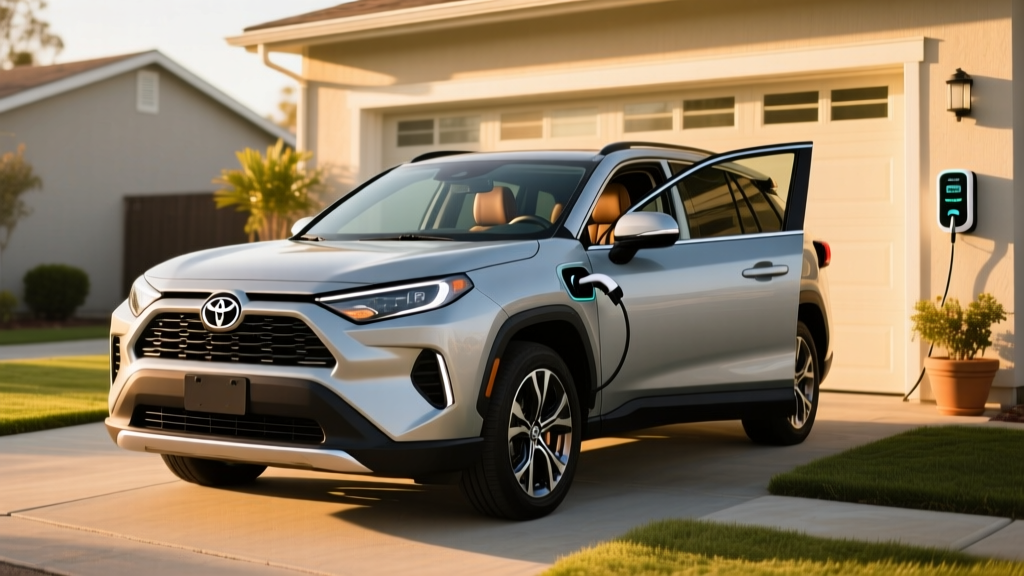
The Toyota RAV4 Hybrid XLE sits in a rare sweet spot: it's the volume-selling trim of America's best-selling non-truck, and it pairs a proven hybrid powertrain with enough tech and comfort to justify its ~$34,000 sticker. If you've been cross-shopping the Toyota RAV4 Hybrid XLE against the plug-in RAV4 Prime, a fully electric SUV, or the conventional gas RAV4, this guide gives you the exact numbers — EPA MPG, real-world fuel economy, battery warranty terms, and total ownership math — to make a confident decision.
Quick Verdict: Who the RAV4 Hybrid XLE Is For
The RAV4 Hybrid XLE is the right call if you want dramatically better fuel economy than a gas RAV4 without changing your fueling habits. There's no plug, no range anxiety, no charging logistics. You fill up at any gas station and go. It's ideal for apartment dwellers without home charging access, high-mileage commuters, and buyers who want Toyota's hybrid reliability track record without stepping into the higher-priced RAV4 Prime PHEV or a full battery-electric vehicle.
If you can charge at home and want 40+ miles of electric-only commuting, the RAV4 Prime (PHEV) makes more sense. If you're ready to go fully electric and have reliable charging access, a BEV like the Hyundai Ioniq 5 or Tesla Model Y eliminates gas entirely. But for plug-and-play efficiency with zero infrastructure requirements, the RAV4 Hybrid XLE is hard to beat.
HEV vs. PHEV: Understanding What the RAV4 Hybrid Actually Is
Before diving into specs, it's critical to distinguish the RAV4 Hybrid (HEV) from the RAV4 Prime (PHEV). Toyota sells both, and the naming trips up many shoppers.
Conventional Hybrid (HEV) — RAV4 Hybrid
- No plug required. The 1.6 kWh battery charges itself through regenerative braking and the gasoline engine.
- You fuel it like a normal car — gas station only.
- Electric motors assist the engine continuously but cannot propel the car for extended distances on electricity alone (typically under 1 mile at very low speeds).
- Federal EV tax credit: Not eligible. The IRS §30D credit applies only to plug-in vehicles with sufficient battery capacity.
Plug-In Hybrid (PHEV) — RAV4 Prime
- Requires plugging in to access its 42 miles of electric-only range (EPA estimate).
- Larger 18.1 kWh battery that charges via Level 1 (120V) or Level 2 (240V) charging. No DC fast charging.
- After the battery depletes, it operates as a conventional hybrid with ~38 MPG combined.
- May qualify for a federal tax credit depending on current-year IRS sourcing and income rules — but the RAV4 Prime's credit availability has been inconsistent due to battery-component sourcing requirements.
The RAV4 Hybrid XLE reviewed here is the conventional HEV. You will never plug it in.
Fuel Economy: EPA Ratings and Real-World MPG
The 2026 Toyota RAV4 Hybrid (all trims including XLE) carries the following EPA estimates, as published on fueleconomy.gov:
| Metric | EPA Estimate | Real-World Expectation |
|---|---|---|
| City | 41 MPG | 39–44 MPG |
| Highway | 38 MPG | 34–37 MPG |
| Combined | 39 MPG | 36–40 MPG |
| Fuel Tank | 14.5 gallons | ~520–580 miles range |
Why real-world MPG varies: Toyota's hybrid system excels in stop-and-go city driving where regenerative braking recovers energy constantly. Many owners report exceeding the 41 MPG city estimate in warm-weather urban commuting. Highway driving is less favorable — sustained 70+ MPH speeds reduce the hybrid advantage, and cold weather (below 40°F) can drop combined MPG by 3–5 points as the engine runs more frequently to heat the cabin and warm the catalytic converter.
Compared to the gas-only RAV4 LE AWD (30 MPG combined), the Hybrid XLE delivers roughly a 30% fuel-economy improvement. At $3.40/gallon and 15,000 miles/year, that's approximately $470 in annual fuel savings.
Powertrain and Performance Specs
| Specification | 2026 RAV4 Hybrid XLE |
|---|---|
| Engine | 2.5L 4-cylinder Dynamic Force |
| Electric Motors | Front + rear (AWD standard) |
| Combined Horsepower | 219 HP |
| 0–60 MPH | ~7.4 seconds |
| Drivetrain | Electronic AWD (eAWD) |
| Transmission | eCVT (planetary gearset) |
| Hybrid Battery | ~1.6 kWh, Lithium-ion |
| Towing Capacity | 1,750 lbs |
| Cargo Volume | 37.6 cu ft (rear seats up) / 69.8 cu ft (folded) |
The 219 HP combined output makes the RAV4 Hybrid noticeably quicker than the 203 HP gas RAV4, particularly in city merging scenarios where the electric motors deliver instant torque. The eAWD system uses a dedicated rear electric motor (no mechanical driveshaft) that activates under acceleration or low-traction conditions. It's not a rock-crawling system, but it handles rain, light snow, and gravel competently.
Pricing and Tax Credit Eligibility
The 2026 Toyota RAV4 Hybrid XLE carries a starting MSRP of approximately $34,050 (including destination charge). Popular options like the Convenience Package (power moonroof, Smart Key on all doors) and Technology Package (upgraded infotainment, digital rearview mirror) push well-equipped examples to $36,000–$38,000.
Federal tax credit: Not eligible. The RAV4 Hybrid is a conventional HEV, not a plug-in vehicle. The IRS §30D Clean Vehicle Credit applies exclusively to plug-in electric vehicles (BEVs and PHEVs) meeting battery-sourcing, MSRP, and buyer-income requirements. The RAV4 Prime PHEV may qualify depending on current-year sourcing rules — check the latest IRS guidance — but the standard RAV4 Hybrid does not.
Some states offer separate rebates or HOV-lane access for hybrids. California's Clean Vehicle Rebate Project (CVRP), for example, has historically focused on zero-emission vehicles (BEVs and fuel cells), not hybrids. Check your state energy office for current programs.
Battery Warranty, Lifespan, and Replacement Cost
Toyota Hybrid Battery Warranty
Coverage: 10 years / 150,000 miles (whichever comes first), transferable to subsequent owners.
What's covered: Hybrid battery pack, hybrid control module, and related hybrid system components.
Capacity threshold: Toyota warrants the battery against defects and abnormal capacity loss. There is no published minimum State of Health (SoH) percentage in the warranty document — claims are evaluated case-by-case based on diagnostic results.
How long does a RAV4 Hybrid battery actually last? Toyota's hybrid batteries are among the most durable in the industry. The Prius — which uses similar nickel-metal hydride and lithium-ion technology — routinely exceeds 200,000 miles on the original battery. The RAV4 Hybrid's battery is relatively small (~1.6 kWh) and operates within a conservative State of Charge window (roughly 40%–80%), which dramatically reduces stress and degradation compared to the deep cycling seen in full EVs.
Replacement cost if out of warranty: A new OEM hybrid battery pack for the RAV4 Hybrid typically costs $2,000–$3,500 installed at a dealership. Third-party refurbished packs are available for $1,000–$2,000. This is a fraction of the $10,000–$20,000 replacement cost for a full EV traction battery, and it's a repair most RAV4 Hybrid owners will never face.
RAV4 Hybrid XLE vs. RAV4 Prime vs. Full EV: Which Fits You?
| Factor | RAV4 Hybrid XLE (HEV) | RAV4 Prime (PHEV) | Full EV (e.g., Ioniq 5) |
|---|---|---|---|
| Starting Price | ~$34,050 | ~$44,500 | ~$42,000–$48,000 |
| Plug Required? | No | Yes (for EV range) | Yes |
| Electric-Only Range | ~0.5 mi (low speed) | 42 mi (EPA) | 250–310 mi (EPA) |
| Combined Efficiency | 39 MPG | 94 MPGe / 38 MPG (hybrid mode) | 110–132 MPGe |
| Federal Tax Credit | None | Varies (check IRS) | Up to $7,500 (if eligible) |
| Home Charging Needed? | No | Recommended | Essential |
| Annual Fuel Cost (15k mi) | ~$1,300 | ~$600–$1,100 (depends on charging) | ~$550–$700 (home charging) |
Decision Framework
Choose the RAV4 Hybrid XLE if: You rent or live somewhere without charging access, you want proven reliability with zero lifestyle change, and your budget is under $38,000.
Choose the RAV4 Prime if: You can install a Level 2 charger at home, your daily commute is under 40 miles round-trip, and you want to drive mostly on electricity while keeping a gas engine for road trips.
Choose a full EV if: You have reliable home charging, you want the lowest per-mile fuel cost, you're eligible for the federal tax credit, and you're comfortable planning around DC fast charging on road trips.
What the XLE Trim Gets You (and What It Doesn't)
The XLE is the mid-tier volume trim, and it strikes a strong value balance. Standard equipment on the 2026 RAV4 Hybrid XLE includes:
- 8-inch touchscreen with wireless Apple CarPlay and Android Auto
- Blind Spot Monitor with Rear Cross-Traffic Alert
- Toyota Safety Sense 2.5+ (adaptive cruise control, lane-keeping assist, automatic emergency braking, lane departure alert)
- Dual-zone automatic climate control
- Smart Key System with push-button start (driver's door)
- 18-inch alloy wheels
- LED headlights and taillights
What you don't get at XLE: leather-trimmed seats (SofTex is available on XLE Premium), a panoramic moonroof, a 360-degree camera, or the larger 10.5-inch navigation touchscreen. Those features require stepping up to the XLE Premium, Limited, or Woodland Edition trims.
Safety note: The RAV4 has earned top marks from both the NHTSA (5-Star Overall) and the IIHS (Top Safety Pick when equipped with specific headlights). Toyota Safety Sense is standard across all trims — you don't pay extra for automatic emergency braking or adaptive cruise.
Pros, Cons, and Ownership Reality
✓ Pros
- 39 MPG combined — among the best for any AWD SUV
- AWD standard on every RAV4 Hybrid trim
- 219 HP provides confident highway merging
- 10-year/150,000-mile hybrid battery warranty
- No charging infrastructure required
- Strong resale value (Toyota RAV4 historically retains 55%+ at 5 years)
- Standard Toyota Safety Sense 2.5+
✗ Cons
- No federal tax credit (HEV, not plug-in)
- eCVT drone under hard acceleration (common Toyota hybrid trait)
- 1,750-lb towing capacity is low for the class
- Infotainment feels dated vs. Hyundai/Kia competitors
- XLE lacks premium features (SofTex, moonroof) available only on higher trims
- Dealer markups remain common in some markets due to high demand
- Cabin noise at highway speeds is above average for the segment
Frequently Asked Questions
How many MPG does the Toyota RAV4 Hybrid XLE get?
The EPA rates the RAV4 Hybrid at 41 MPG city, 38 MPG highway, and 39 MPG combined. In real-world driving, many owners exceed the city estimate in warm-weather stop-and-go traffic (42–44 MPG) but fall slightly short on sustained highway driving (34–37 MPG at 70+ MPH). Cold weather reduces combined MPG by roughly 3–5 points.
Does the RAV4 Hybrid need to be plugged in?
No. The RAV4 Hybrid is a conventional hybrid (HEV). Its small lithium-ion battery recharges through regenerative braking and the gasoline engine. You fuel it exclusively at gas stations — there is no plug and no charging cable.
How far can the RAV4 Hybrid drive on electric power alone?
Essentially zero meaningful distance. The hybrid system can propel the RAV4 at very low speeds (under 25 MPH) for roughly half a mile on battery power in ideal conditions, but the engine engages almost immediately under normal driving. If you want extended electric-only range, the RAV4 Prime PHEV offers 42 miles of EV driving.
Is the RAV4 Hybrid reliable, and what does battery replacement cost?
Toyota's hybrid system is one of the most proven in the automotive industry, with decades of real-world data from the Prius, Camry Hybrid, and RAV4 Hybrid. The hybrid battery is warranted for 10 years/150,000 miles. Out-of-warranty replacement costs $2,000–$3,500 for a new OEM pack, though most owners never need this service. The IIHS and consumer reliability surveys consistently rank the RAV4 Hybrid above the compact SUV average.
Does the Toyota RAV4 Hybrid qualify for any tax credit?
The RAV4 Hybrid (HEV) does not qualify for the federal §30D Clean Vehicle Credit, which is reserved for plug-in vehicles. Some states or municipalities may offer minor incentives for hybrid purchases, but these are uncommon and vary widely. Check your state's energy office or the IRS Clean Vehicle Credit page for the latest rules.
How does the RAV4 Hybrid compare to the gas RAV4?
The gas RAV4 LE AWD gets 30 MPG combined vs. the Hybrid's 39 MPG — a 30% improvement. The Hybrid also delivers 219 HP vs. 203 HP, making it quicker despite the better fuel economy. The price premium for the Hybrid XLE over the gas XLE is typically $1,500–$2,000, which pays for itself in fuel savings within 3–4 years at average mileage.
Is the RAV4 Hybrid AWD system good in snow?
The electronic AWD (eAWD) system uses a rear electric motor that engages automatically under acceleration or when front-wheel slip is detected. It's effective for light snow, rain, and gravel but is not a substitute for dedicated winter tires in heavy snow or ice. It's comparable to Subaru's AWD for everyday winter commuting, though Subaru's system sends more continuous torque to the rear wheels.