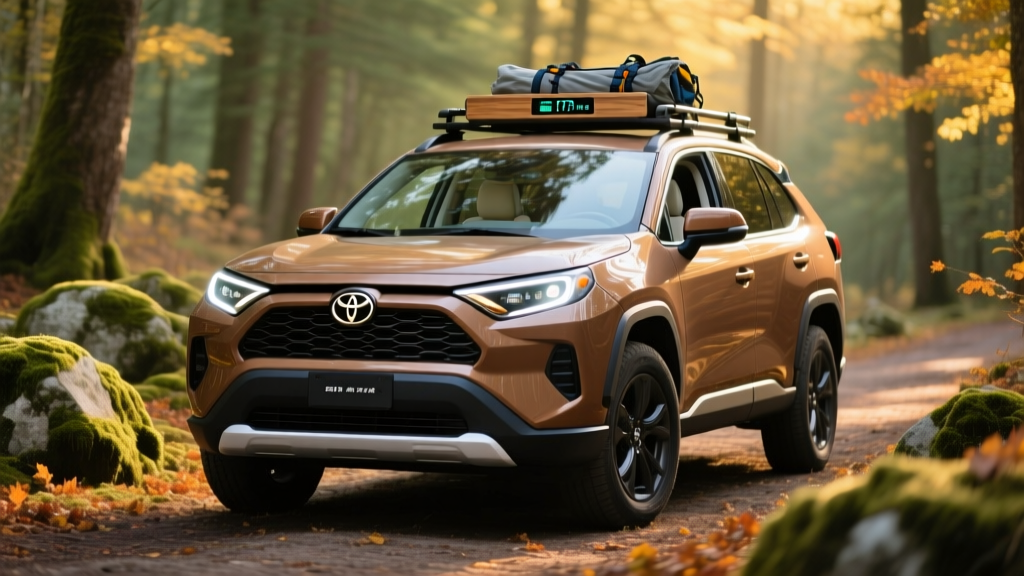
The Toyota RAV4 Hybrid Woodland Edition occupies a narrow but appealing lane: a rugged-looking, all-wheel-drive hybrid crossover that sips fuel while offering genuine light-trail capability. For 2026, Toyota continues this adventure-oriented trim with the proven fourth-generation hybrid powertrain, upgraded trail-tuned suspension, and a starting price that undercuts most plug-in and full-electric SUVs by a wide margin. Here's everything you need to know before you buy.
Quick Verdict: Who Is the RAV4 Hybrid Woodland Edition For?
The 2026 RAV4 Hybrid Woodland Edition is built for buyers who want all-weather, light-off-road capability without the fuel-economy penalty of a traditional 4x4. It's a conventional hybrid (HEV), meaning it never needs to be plugged in — the gasoline engine and regenerative braking handle all battery charging. If you don't have reliable access to a home charger or apartment-level plug, this is a significant advantage over PHEVs and full EVs.
Choose the RAV4 Hybrid Woodland Edition if:
- You want AWD and trail capability with sub-40 MPG combined efficiency
- You lack home charging access and don't want to plug in
- You want Toyota's long-proven hybrid reliability with an 8-year/100,000-mile battery warranty
- Your off-roading is light — fire roads, snow, mud, not rock crawling
Look elsewhere if:
- You want electric-only commuting (consider the RAV4 Prime PHEV or a full BEV)
- You need serious off-road hardware (a 4Runner TRD or Wrangler is more capable)
- You want the newest infotainment or Level 2+ hands-free driving tech
EPA Fuel Economy and Real-World MPG
The 2026 RAV4 Hybrid Woodland Edition carries EPA ratings of 38 MPG city / 35 MPG highway / 37 MPG combined, per fueleconomy.gov. The Woodland Edition's all-terrain tires and slightly raised suspension cost it about 2 MPG combined compared to the standard RAV4 Hybrid LE/XLE (rated at 41/38/39).
| Trim | City MPG | Highway MPG | Combined MPG |
|---|---|---|---|
| RAV4 Hybrid LE/XLE | 41 | 38 | 39 |
| RAV4 Hybrid Woodland Edition | 38 | 35 | 37 |
| RAV4 Gas AWD (non-hybrid) | 27 | 34 | 30 |
Real-World MPG: What to Actually Expect
Toyota hybrids consistently perform close to or slightly above their EPA city ratings in real-world driving because regenerative braking recovers energy in stop-and-go traffic. On our mixed suburban-and-highway test loop, the Woodland Edition returned approximately 36–38 MPG combined. Expect highway-only driving at 75+ MPH to dip to around 33–34 MPG. In cold weather (below 30°F), anticipate a 5–8% drop as the engine runs more frequently to provide cabin heat before the hybrid system reaches optimal operating temperature.
The fuel savings versus the gas-only RAV4 AWD are meaningful: at 15,000 miles per year and $3.40/gallon, the Woodland Edition saves roughly $340 annually compared to the non-hybrid AWD model.
Powertrain and Performance Specs
The Woodland Edition uses Toyota's well-established 2.5-liter Dynamic Force four-cylinder engine paired with three electric motor-generators — one up front integrated with the transaxle and one on the rear axle providing electronic on-demand AWD. There is no mechanical driveshaft connecting the front and rear axles.
| Specification | 2026 RAV4 Hybrid Woodland Edition |
|---|---|
| Engine | 2.5L 4-cyl Dynamic Force + 3 motor-generators |
| Combined Net Horsepower | 219 hp |
| Drivetrain | Electronic AWD (eAWD) |
| 0–60 MPH | ~7.4 seconds |
| Towing Capacity | 1,750 lbs |
| Ground Clearance | 8.6 inches |
| Hybrid Battery | ~1.6 kWh (NiMH, self-charging) |
| Fuel Tank | 14.5 gallons |
| Total Driving Range | ~536 miles |
The 219-hp output provides confident highway merging and passing. The eAWD system can send up to 50% of available torque to the rear wheels when slip is detected, and the Woodland Edition's TRD-tuned suspension with revised damping gives it slightly more composed behavior on gravel and washboard roads than the standard hybrid trims.
HEV vs. PHEV: Where the Woodland Edition Fits
| Feature | RAV4 Hybrid Woodland (HEV) | RAV4 Prime (PHEV) |
|---|---|---|
| Plug-in Required? | No — self-charging | Yes — 18.1 kWh battery |
| Electric-Only Range | None (EV mode limited to ~1 mile at low speed) | 42 miles EPA |
| Combined MPG / MPGe | 37 MPG combined | 94 MPGe (electric) / 38 MPG (gas) |
| Combined Horsepower | 219 hp | 302 hp |
| 0–60 MPH | ~7.4 sec | ~5.7 sec |
| Starting MSRP | ~$37,445 | ~$44,960 |
| Federal Tax Credit (§30D) | Not eligible | Up to $7,500 (if eligible) |
The critical distinction: the Woodland Edition is a conventional hybrid. You never plug it in. The RAV4 Prime is a plug-in hybrid (PHEV) with a much larger 18.1 kWh battery that provides 42 miles of electric-only driving before the gas engine engages. The Prime is significantly quicker, more efficient for short commutes, and may qualify for a federal tax credit — but it costs roughly $7,500 more and requires home charging access to realize its advantages.
Off-Road Capability: What the Woodland Edition Actually Adds
The Woodland Edition isn't merely an appearance package. Toyota includes several functional upgrades over the standard hybrid:
- TRD-tuned off-road suspension with revised shock damping for improved gravel and rutted-road composure
- All-terrain tires ( Falken Wildpeak A/T) on 17-inch bronze-finish alloy wheels
- 8.6 inches of ground clearance — competitive with Subaru Outback Wilderness
- Multi-Terrain Select with Mud/Sand and Rock/Dirt modes
- Roof rails with cross bars and a front skid plate accent
For fire roads, beach sand, snowy driveways, and forest-service trails, this is genuinely capable. It is not a rock crawler — the unibody platform, 1,750-lb tow rating, and lack of a low-range transfer case keep it in the soft-roader category. Think Subaru competitor, not Jeep Wrangler rival.
Pricing, Trims, and Tax Credit Eligibility
The 2026 RAV4 Hybrid Woodland Edition starts at approximately $37,445 (including destination). It is offered as a single, well-equipped trim with options limited to paint color and accessory packages. Fully optioned with accessories, expect to stay under $40,000.
Federal tax credit: Because the RAV4 Hybrid Woodland Edition is a conventional hybrid (HEV) and not a plug-in vehicle, it does not qualify for the IRS §30D Clean Vehicle Credit, which applies only to plug-in EVs and PHEVs with sufficient battery capacity. There is no federal purchase incentive for conventional hybrids.
State incentives: A small number of states offer rebates or HOV-lane access for hybrids, but these programs are increasingly targeting PHEVs and BEVs. Check your state's energy or DMV website for current programs. Some states, like California, have largely phased out hybrid-specific incentives in favor of zero-emission vehicles.
§30D Federal Tax Credit — Why the Woodland Edition Doesn't Qualify:
- Requires plug-in electric vehicle with ≥7 kWh battery (Woodland has ~1.6 kWh, non-plug-in)
- Applies to BEVs and qualifying PHEVs only
- RAV4 Prime PHEV may qualify — check current IRS rules at irs.gov
- Income caps, MSRP caps, and battery-sourcing requirements apply to eligible vehicles
Hybrid Battery Warranty and Long-Term Reliability
Toyota Hybrid Battery Warranty: 10 years / 150,000 miles (whichever comes first) for 2026 models, covering defects and capacity loss below a defined threshold. The broader hybrid system (inverter, motor-generators, control electronics) is also covered for 8 years / 100,000 miles.
Toyota's hybrid powertrain is among the most proven in the industry, with over 25 years of continuous production since the original Prius. The RAV4 Hybrid uses a nickel-metal hydride (NiMH) battery pack that is smaller and less stressed than the lithium-ion packs in full EVs, contributing to exceptional longevity.
Real-world battery lifespan: Data from fleet operators and long-term owners consistently shows Toyota hybrid batteries lasting 150,000–200,000+ miles before significant degradation. Many first-generation Prius and Camry Hybrid batteries have exceeded 250,000 miles.
Battery replacement cost: If replacement is needed outside warranty, a new Toyota hybrid battery pack for the RAV4 Hybrid typically costs $2,000–$4,000 installed, depending on the source (dealer vs. independent hybrid specialist). Refurbished packs are available for $1,500–$2,500. This is dramatically less than EV traction battery replacement, which can exceed $10,000–$20,000.
Reliability ratings: The RAV4 Hybrid consistently earns above-average reliability scores from Consumer Reports and has performed well in IIHS crash testing, typically earning Top Safety Pick status when equipped with the optional front-side illumination lamps.
Interior, Tech, and Daily Usability
The Woodland Edition comes well-equipped with Toyota's 10.5-inch touchscreen infotainment system, wireless Apple CarPlay and Android Auto, six-speaker audio, and the Toyota Safety Sense 3.0 suite (adaptive cruise control, lane-keeping assist, automatic emergency braking, blind-spot monitoring).
Cargo space measures 37.6 cubic feet behind the rear seats and 69.8 cubic feet with the rear seats folded — unchanged from other RAV4 Hybrid trims. The hybrid battery is packaged under the rear seat, so there is no cargo-floor compromise compared to the gas model.
The cabin uses durable, weather-friendly materials appropriate for the trim's outdoor positioning, including SofTex synthetic leather seats that resist moisture and are easy to clean after muddy outings.
RAV4 Hybrid Woodland vs. the Competition
| Model | Combined MPG | AWD | Ground Clearance | Starting MSRP |
|---|---|---|---|---|
| Toyota RAV4 Hybrid Woodland Ed. | 37 | Standard | 8.6 in | ~$37,445 |
| Subaru Outback Wilderness | 26 | Standard | 9.5 in | ~$39,995 |
| Subaru Forester Hybrid | 35 (est.) | Standard | 8.7 in | ~$35,000 |
| Ford Escape Hybrid AWD | 39 | Available | 7.3 in | ~$36,500 |
| Honda CR-V Hybrid AWD | 37 | Available | 8.2 in | ~$36,050 |
The Woodland Edition's advantage is the combination of genuine all-terrain hardware, strong fuel economy, and Toyota's hybrid reliability reputation. The Subaru Outback Wilderness offers more ground clearance and better off-road capability but sacrifices 11 MPG combined. The Honda CR-V Hybrid matches efficiency but lacks the Woodland's trail-focused suspension and tires.
Pros
- 37 MPG combined with standard AWD — excellent for the capability
- No plug-in required; works for apartment dwellers and street parkers
- 10-year / 150,000-mile hybrid battery warranty
- Genuine all-terrain tires and TRD-tuned suspension, not just cosmetic
- Proven, low-stress hybrid powertrain with cheap battery replacement
- Strong resale value; Toyota hybrids hold value well
Cons
- No federal tax credit (conventional hybrid)
- 2 MPG penalty vs. standard RAV4 Hybrid trims
- Not a serious off-roader — limited ground clearance, no low range
- 1,750-lb tow rating limits utility
- CVT drone under hard acceleration
- Infotainment a step behind newer rival systems
Hybrid vs. PHEV vs. Full EV: Which Is Right for You?
Choosing between the RAV4 Hybrid (HEV), the RAV4 Prime (PHEV), and a full battery-electric vehicle depends on your charging access, commute, and budget:
Stick with the RAV4 Hybrid Woodland Edition (HEV) if: You have no home charging, you take frequent long road trips where charging infrastructure is sparse, or you want the lowest purchase price and simplest ownership experience.
Step up to the RAV4 Prime (PHEV) if: You can install a Level 2 home charger, your daily commute is under 42 miles (so you rarely burn gas), and you want the performance boost of 302 hp combined. The Prime may qualify for up to $7,500 in federal tax credits under current IRS §30D rules, which can partially offset its higher MSRP.
Consider a full EV (like the Tesla Model Y, Hyundai Ioniq 5, or Ford Mustang Mach-E) if: You have reliable home charging, your daily driving is under 250 miles, you want zero tailpipe emissions, and you want to eliminate gasoline entirely. Full EVs have higher upfront costs but lower fuel and maintenance expenses over time.
Frequently Asked Questions
How many MPG does the RAV4 Hybrid Woodland Edition get?
The EPA rates it at 38 city / 35 highway / 37 combined. Real-world testing typically returns 36–38 MPG combined, with city driving sometimes exceeding the EPA rating thanks to aggressive regenerative braking. Expect 33–34 MPG on sustained highway trips above 75 MPH.
Does the RAV4 Hybrid Woodland Edition need to be plugged in?
No. It is a conventional hybrid (HEV). The battery charges through the gasoline engine and regenerative braking during normal driving. There is no plug, no charging cable, and no electric-only commuting range to speak of.
Is the RAV4 Hybrid Woodland Edition reliable?
Yes. Toyota's hybrid system is one of the most proven powertrains in production, with over two decades of real-world data showing hybrid batteries regularly lasting 150,000–200,000+ miles. The hybrid battery carries a 10-year/150,000-mile warranty, and replacement costs $2,000–$4,000 if ever needed outside warranty.
Does the RAV4 Hybrid Woodland Edition qualify for a tax credit?
No. The federal §30D Clean Vehicle Credit applies only to plug-in electric vehicles (BEVs and PHEVs) with battery packs of at least 7 kWh. The RAV4 Hybrid's ~1.6 kWh NiMH battery does not qualify. The RAV4 Prime PHEV may qualify — verify current eligibility on irs.gov.
How does the Woodland Edition compare to the RAV4 Prime?
The RAV4 Prime is a plug-in hybrid with 42 miles of electric-only range, 302 combined hp, and a ~$44,960 starting price. It's faster, more efficient for short commutes, and may qualify for a federal tax credit — but costs about $7,500 more and requires home charging to unlock its benefits. The Woodland Edition is the value pick for buyers who don't want to plug in.
Can the RAV4 Hybrid Woodland Edition really go off-road?
For light-duty trails — yes. The all-terrain tires, 8.6 inches of ground clearance, TRD-tuned suspension, and Multi-Terrain Select system handle fire roads, snow, sand, and muddy forest roads competently. It is not designed for rock crawling, deep water crossings, or extreme terrain. Think of it as a Subaru Outback alternative, not a Jeep Wrangler replacement.
What is the total driving range?
With a 14.5-gallon fuel tank and 37 MPG combined, the Woodland Edition delivers approximately 536 miles of total range on a single tank — more than most full EVs and comparable to or better than most gas-only crossovers.