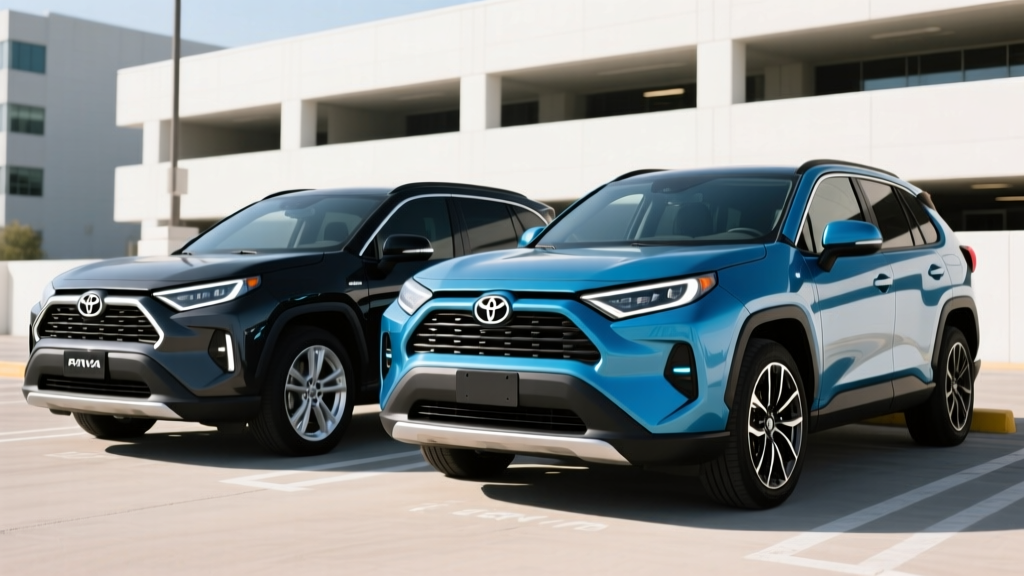
If you have been searching for a car Toyota hybrid that balances everyday fuel savings with practical SUV utility, the 2026 Toyota RAV4 lineup demands your attention. The RAV4 remains one of the best-selling vehicles in America, and its electrified variants—the conventional RAV4 Hybrid (HEV) and the plug-in RAV4 Prime (PHEV)—account for a growing share of those sales. But with two very different powertrains wearing the same badge, buyers need clarity on which one actually fits their routine.
This guide breaks down the 2026 RAV4 Hybrid and RAV4 Prime with exact EPA figures, real-world observations, battery warranty details, and tax-credit eligibility so you can choose confidently.
HEV vs PHEV: Understanding the Two RAV4 Hybrids
Before comparing numbers, it is essential to understand what separates a conventional hybrid from a plug-in hybrid. The distinction changes how you fuel the vehicle, what you pay at the pump, and whether any federal incentives apply.
Conventional Hybrid (RAV4 Hybrid — HEV)
- No plug required. The small battery recharges through regenerative braking and the gasoline engine.
- Operates as a gas-electric team at all times; the electric motor assists the engine and enables brief low-speed EV bursts.
- Lower purchase price; no charging infrastructure needed.
- Federal §30D tax credit: Not eligible (HEVs do not meet the plug-in requirement).
Plug-In Hybrid (RAV4 Prime — PHEV)
- Plugs in to charge a larger battery (Level 1 or Level 2 AC).
- Delivers a meaningful electric-only driving range before the gas engine engages.
- Higher purchase price but qualifies for federal and some state incentives.
- Once the battery depletes, it operates exactly like a conventional hybrid.
EPA MPG, Electric Range, and Real-World Efficiency
Fuel economy is the headline reason buyers cross-shop hybrids. Here is how the two RAV4 variants stack up according to EPA data at fueleconomy.gov, along with what you can expect in daily driving.
| Spec | 2026 RAV4 Hybrid (HEV) | 2026 RAV4 Prime (PHEV) |
|---|---|---|
| EPA City MPG | 41 MPG | 40 MPG (charge-sustaining) |
| EPA Highway MPG | 38 MPG | 36 MPG (charge-sustaining) |
| EPA Combined MPG | 39 MPG | 38 MPG (charge-sustaining) |
| Combined MPGe (electric + gas) | N/A | 94 MPGe |
| Electric-Only Range | N/A (no plug) | 42 miles |
| Total Combined Range | ~580 miles | ~600 miles (EV + gas) |
| Fuel Tank | 14.5 gal | 14.5 gal |
Real-World MPG vs. EPA Sticker
Toyota's hybrid system excels in stop-and-go city driving, where the electric motor handles low-speed propulsion and regenerative braking recaptures energy. Many RAV4 Hybrid owners report 42–44 MPG in city conditions, exceeding the EPA city estimate. Highway driving at 75+ MPH, however, typically drops to 34–36 MPG because the gasoline engine carries the full load and the boxy SUV shape works against aerodynamic efficiency.
For the RAV4 Prime, the 42-mile electric-only range is measured on a mixed driving cycle. In warm weather with moderate speeds, expect 38–44 miles of real-world EV range. In freezing temperatures with cabin heat running, that figure can shrink to 30–34 miles. Once the battery is depleted, the Prime operates as a conventional hybrid at roughly 36–38 combined MPG—slightly less than the HEV due to the extra weight of the larger battery pack.
Powertrain Specs and Performance
| Specification | RAV4 Hybrid (HEV) | RAV4 Prime (PHEV) |
|---|---|---|
| Engine | 2.5L 4-cyl Atkinson | 2.5L 4-cyl Atkinson |
| Combined Net Horsepower | 219 HP | 302 HP |
| Front Motor | Permanent-magnet AC | Higher-output PM AC |
| Rear Motor (AWD) | Independent rear e-motor | 40 kW rear e-motor |
| Drivetrain | AWD (Electronic On-Demand) | AWD (Electronic On-Demand) |
| 0–60 MPH | ~7.4 sec | ~5.7 sec |
| Traction Battery (Usable) | ~1.6 kWh (NiMH) | ~14.9 kWh (Lithium-ion) |
| Towing Capacity | 1,750 lbs | 1,750 lbs |
The RAV4 Prime's 302 combined horsepower makes it the quickest RAV4 Toyota sells—quicker, in fact, than many turbocharged gas-only compact SUVs. The HEV's 219 HP is adequate for merging and passing but never feels urgent. Both use Toyota's proven eCVT planetary-gear transmission, which is mechanically simpler and more durable than a traditional belt-driven CVT.
RAV4 Prime Charging: Times, Connectors, and DC Fast-Charge Reality
Charging the RAV4 Prime is straightforward, but there are limitations buyers should understand before purchasing.
| Charging Method | Power (kW) | 0–100% Time |
|---|---|---|
| Level 1 (120V household outlet) | ~1.4 kW | ~12 hours |
| Level 2 (240V, 3.3 kW onboard) | 3.3 kW | ~4.5 hours |
| Level 2 (240V, 6.6 kW onboard — available on select trims) | 6.6 kW | ~2.5 hours |
| DC Fast Charging | Not supported | N/A |
The RAV4 Prime uses a standard J1772 connector for AC charging. It does not support DC fast charging (no CCS or NACS inlet). This is typical for PHEVs: the battery is small enough that Level 2 AC charging fully replenishes it overnight or during a workday, making DC infrastructure unnecessary. If you need rapid road-trip charging, a full battery-electric vehicle is the appropriate choice.
Pricing, Trims, and Federal Tax Credit Eligibility
Pricing for the 2026 RAV4 Hybrid and RAV4 Prime reflects their different powertrain complexity. Here is the current MSRP landscape by key trim:
| Model / Trim | MSRP (approx.) | §30D Federal Credit |
|---|---|---|
| RAV4 Hybrid LE | $34,500 | Not eligible |
| RAV4 Hybrid XLE | $36,200 | Not eligible |
| RAV4 Hybrid Limited | $40,800 | Not eligible |
| RAV4 Prime SE | $45,500 | Up to $7,500* |
| RAV4 Prime XSE | $48,900 | Up to $7,500* |
*Eligibility for the IRS §30D Clean Vehicle Credit depends on multiple requirements that change periodically. Verify current status before purchasing.
§30D Federal Tax Credit Checklist (RAV4 Prime)
- MSRP cap: SUVs/vans must be ≤ $80,000 — RAV4 Prime qualifies.
- Buyer income cap: Modified AGI ≤ $150,000 (single) / $300,000 (joint).
- Battery sourcing: Critical minerals and battery components must meet phased-in domestic/free-trade-area thresholds. The exact percentage requirement increases each year — confirm with your dealer and the IRS Clean Vehicle Credit page.
- Point-of-sale transfer: As of 2024+, eligible buyers can transfer the credit to the dealer for an immediate price reduction rather than waiting for a tax refund.
- Assembly: Vehicle must undergo final assembly in North America. The RAV4 Prime is assembled in Japan — verify current eligibility status as this has historically disqualified some Toyota PHEVs from the new-vehicle credit.
Bottom line: The RAV4 Prime's Japan assembly has been a sticking point for §30D eligibility. Always confirm with your dealer and a tax professional before counting on the credit. The conventional RAV4 Hybrid is never eligible for §30D regardless of assembly location.
Battery Warranty, Reliability, and Replacement Costs
Toyota Hybrid Battery Warranty
- Hybrid battery coverage: 10 years / 150,000 miles (whichever comes first), transferable to subsequent owners.
- Hybrid system components (inverter, control module, etc.): 8 years / 100,000 miles.
- Capacity retention threshold: Toyota warrants the battery against defects and abnormal loss of capacity — if the battery cannot hold sufficient charge to operate the hybrid system, Toyota replaces it under warranty.
Toyota's hybrid reliability record is among the strongest in the industry. The Prius, which introduced Toyota's Hybrid Synergy Drive in 1997, demonstrated that nickel-metal-hydride and later lithium-ion hybrid batteries routinely last 200,000+ miles with minimal degradation. The RAV4 Hybrid's ~1.6 kWh NiMH pack is small and lightly stressed — it never deep-cycles the way a full EV battery does, which contributes to exceptional longevity.
The RAV4 Prime's 14.9 kWh lithium-ion pack sees deeper cycling but benefits from Toyota's conservative battery management strategy, which maintains a substantial buffer above and below the usable range to reduce cell stress.
Battery Replacement Cost
If you do need a hybrid battery replacement outside of warranty:
- RAV4 Hybrid (HEV): Approximately $3,000–$4,500 for a new OEM battery pack installed.
- RAV4 Prime (PHEV): Approximately $8,000–$12,000 for the larger lithium-ion pack, reflecting the higher capacity and more complex thermal management.
- Refurbished and third-party replacement options exist at 40–60% lower cost, though availability varies by model year.
These are worst-case scenarios. Based on Toyota's track record and data from fleet operators, hybrid battery failure before 150,000 miles is uncommon.
RAV4 Hybrid vs RAV4 Prime vs Full EV: Which Fits Your Life?
RAV4 Hybrid (HEV) — Pros
- No charging needed — fuel and go
- 39 MPG combined saves ~$800/yr vs. gas RAV4
- Lower MSRP than Prime
- Proven long-term reliability
- AWD standard on all trims
Cons
- No electric-only driving
- No federal tax credit
- 219 HP is adequate, not exciting
RAV4 Prime (PHEV) — Pros
- 42 miles EV-only covers most commutes
- 302 HP — quickest RAV4 available
- Potentially $7,500 federal credit (verify eligibility)
- 600+ mile total range for road trips
- Operates as hybrid after battery depletes
Cons
- ~$10,000 price premium over Hybrid
- No DC fast charging
- Japan assembly may affect credit eligibility
- Heavier — slightly lower MPG in hybrid mode
Decision Framework
Choose the RAV4 Hybrid (HEV) if: You lack home charging access, want the lowest purchase price, drive more than 50 miles daily in mixed conditions, and prefer a no-plug, no-fuss ownership experience.
Choose the RAV4 Prime (PHEV) if: You can charge at home (even a 120V outlet), your daily round-trip commute is under 40 miles, you want EV-like daily driving with gas-engine road-trip backup, and you value the performance bump to 302 HP.
Choose a full BEV (e.g., Toyota bZ4X or Tesla Model Y) if: You have reliable home Level 2 charging, rarely drive more than 250 miles without stopping, want to eliminate gasoline entirely, and prefer minimal drivetrain maintenance.
Real Ownership Costs: Hybrid vs Gas vs PHEV Over 5 Years
| Cost Factor (5 yr / 75K mi) | Gas RAV4 (28 MPG) | RAV4 Hybrid (39 MPG) | RAV4 Prime (PHEV) |
|---|---|---|---|
| Fuel / Energy | ~$9,375 | ~$6,730 | ~$4,200* |
| Maintenance | ~$3,500 | ~$3,000 | ~$2,800 |
| Federal Tax Credit | $0 | $0 | Up to $7,500* |
| Est. 5-Year Net Cost Delta | Baseline | Save ~$3,100 | Save ~$5,900+* |
*Prime fuel cost assumes 70% of daily miles driven on electricity at $0.14/kWh national average and 30% on gasoline. Tax credit assumes full eligibility — verify before purchase. Gas price assumed at $3.50/gal.
Frequently Asked Questions
How many MPG does the Toyota RAV4 Hybrid get?
The 2026 RAV4 Hybrid is EPA-rated at 41 city / 38 highway / 39 combined MPG. In real-world city driving with frequent stops, many owners achieve 42–44 MPG. Highway-only driving at higher speeds typically yields 34–36 MPG.
How far can the RAV4 Prime go on electric only?
The EPA rates the RAV4 Prime at 42 miles of electric-only range. Real-world results vary from about 34 miles in cold weather with heat on to 44+ miles in mild conditions at moderate speeds. Once depleted, the vehicle seamlessly switches to hybrid mode at roughly 38 MPG combined.
Does the RAV4 Hybrid or Prime qualify for a federal tax credit?
The conventional RAV4 Hybrid (HEV) does not qualify for the §30D federal tax credit — it is not a plug-in vehicle. The RAV4 Prime (PHEV) may qualify for up to $7,500, but eligibility depends on buyer income limits, battery sourcing requirements, and final assembly location. Because the RAV4 Prime is assembled in Japan, verify current eligibility with your dealer and the IRS before relying on the credit.
Is the Toyota hybrid system reliable? What does battery replacement cost?
Toyota's hybrid powertrain is one of the most proven in the automotive industry, with millions of units on the road since 1997. The hybrid battery is warranted for 10 years / 150,000 miles. Out-of-pocket replacement costs approximately $3,000–$4,500 for the HEV and $8,000–$12,000 for the Prime's larger pack, though most batteries outlast 200,000 miles.
Do I need to plug in the RAV4 Hybrid?
No. The conventional RAV4 Hybrid charges its battery entirely through regenerative braking and the gasoline engine. You never plug it in. Only the RAV4 Prime requires (and benefits from) plug-in charging.
Hybrid vs PHEV vs EV — which should I buy?
Choose the HEV if you cannot charge at home and want maximum simplicity. Choose the PHEV if you can charge at home and want electric daily commuting with gas-engine flexibility for longer trips. Choose a full BEV if you want zero tailpipe emissions, minimal maintenance, and have reliable charging access for your driving patterns.