Quick Verdict: The Benchmark Compact Hybrid SUV
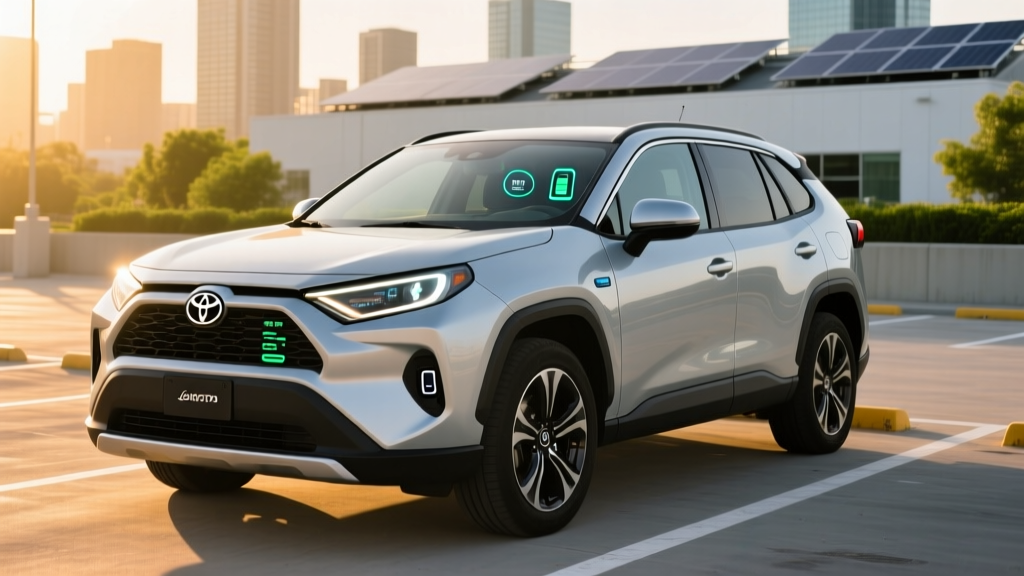
The Toyota RAV4 Hybrid remains the volume leader in the compact SUV segment for good reason. It pairs a 2.5-liter four-cylinder with Toyota's fifth-generation hybrid transaxle to deliver 219 combined horsepower and an EPA-estimated 39 MPG combined — figures that few competitors match simultaneously. For 2026, the RAV4 Hybrid continues across LE, XLE, XLE Premium, SE, Woodland Edition, and Limited trims, with pricing starting at $33,575 (including destination). It does not require plug-in charging, qualifies for no federal purchase credit, and carries a 10-year/150,000-mile hybrid battery warranty that addresses the most common buyer concern.
| Attribute | Value |
|---|---|
| Powertrain | 2.5L I4 + 3 electric motors (eAWD) |
| Combined Horsepower | 219 hp |
| EPA MPG (City / Hwy / Combined) | 41 / 38 / 39 |
| Fuel Tank | 14.5 gal |
| Total Range (est.) | ~565 miles |
| 0–60 mph | 7.4 sec |
| Cargo Volume (rear seats up / down) | 37.5 / 69.8 cu ft |
| Towing Capacity | 1,750 lb |
| Base MSRP (LE AWD) | $33,575 |
| Hybrid Battery Warranty | 10 yr / 150,000 mi |
HEV vs. PHEV: RAV4 Hybrid vs. RAV4 Prime Explained
Toyota sells two electrified RAV4 variants, and conflating them is the single most common buyer mistake. Here is the mechanical distinction:
| Feature | RAV4 Hybrid (HEV) | RAV4 Prime (PHEV) |
|---|---|---|
| Plug-in Required? | No — self-charging via regen & engine | Yes — plug in for EV-only driving |
| Battery Capacity | ~1.6 kWh (NiMH, buffer-limited) | 18.1 kWh (Li-ion usable) |
| EV-Only Range | <1 mile at low speed | 42 miles (EPA) |
| Combined HP | 219 hp | 302 hp |
| MPG (charge-sustaining) | 39 combined | 38 combined (after EV range) |
| MPGe (with full charge) | N/A | 94 MPGe |
| DC Fast Charge | N/A | No — Level 2 only (3.3 kW / 6.6 kW) |
| Federal §30D Credit | Not eligible | Phase-out: check IRS current eligibility |
| Base MSRP | $33,575 | $44,905 |
The RAV4 Hybrid is a conventional series-parallel hybrid. Its small nickel-metal hydride (NiMH) traction battery is replenished entirely by regenerative braking and the gasoline engine — you never plug it in. The RAV4 Prime is a plug-in hybrid (PHEV) with a substantially larger lithium-ion battery, an onboard charger, and 42 miles of EV-only range before the engine engages. The Prime commands an ~$11,300 premium and targets buyers with home Level 2 charging access and short commutes.
Fuel Economy: EPA Numbers and Real-World MPG
| Trim | City | Highway | Combined |
|---|---|---|---|
| LE | 41 | 38 | 39 |
| XLE / XLE Premium | 41 | 38 | 39 |
| SE | 40 | 37 | 39 |
| Woodland Edition | 38 | 35 | 37 |
| Limited | 41 | 38 | 39 |
Source: fueleconomy.gov
The Woodland Edition's all-terrain tires and slightly lifted suspension cost it 2 MPG combined — a meaningful trade for off-pavement credibility. All other trims share the 39 MPG combined figure.
Real-world MPG reality check: Toyota's hybrid system excels in stop-and-go urban driving, where the electric motors handle low-speed propulsion and regenerative braking recovers kinetic energy. Owners consistently report 42–45 MPG in city-dominant driving. Highway-only trips at 75+ mph, however, often yield 34–36 MPG because the gasoline engine carries the full load with less regen assistance. In cold weather (below 30°F), expect a 5–8% MPG reduction due to increased engine runtime for cabin heat and reduced battery efficiency. A mixed-use real-world average of 38–41 MPG is typical and aligns closely with the EPA sticker — unusual honesty for a hybrid.
Inside the Powertrain: How the Hybrid System Works
The RAV4 Hybrid uses Toyota's Hybrid Synergy Drive with a 2.5-liter Atkinson-cycle four-cylinder engine producing 176 hp and 163 lb-ft of torque on its own. Two front electric motor-generators (MG1 for starting/charging, MG2 for propulsion and regen) are integrated into the transaxle, and a third motor on the rear axle provides electronic all-wheel drive (eAWD) without a mechanical driveshaft.
Combined system output is 219 hp. The eAWD rear motor activates automatically during acceleration, low-traction conditions, and certain cornering scenarios, then disengages to eliminate driveline drag during cruising. This system adds roughly 130 lb vs. a FWD-only layout but costs only ~1 MPG on the EPA cycle — a negligible penalty for all-weather security.
The NiMH traction battery sits under the rear seat. Its gross capacity is approximately 1.6 kWh, but the hybrid control system maintains a tight state-of-charge window (roughly 40–80% SoC) to minimize degradation. This shallow-cycling strategy is why Toyota's NiMH packs routinely exceed 200,000 miles with minimal capacity loss.
Pricing, Trims, and Tax Credit Eligibility
The 2026 RAV4 Hybrid lineup (all AWD):
- LE: $33,575 — 8-inch touchscreen, wireless CarPlay/Android Auto, TSS 3.0
- XLE: $35,075 — blind-spot monitor, dual-zone climate, smart key
- XLE Premium: $37,575 — SofTex seats, moonroof, power liftgate
- SE: $37,075 — sport-tuned suspension, 19-inch wheels, paddle shifters
- Woodland Edition: $37,825 — TRD-tuned suspension, all-terrain tires, roof rails
- Limited: $40,575 — 12.3-inch display, JBL audio, heated/ventilated front seats
Federal tax credit status: The conventional RAV4 Hybrid (HEV) does not qualify for the IRS §30D Clean Vehicle Credit, which is reserved for plug-in vehicles with ≥7 kWh battery capacity. The RAV4 Prime (PHEV) may qualify for up to $7,500 depending on battery sourcing, buyer income caps ($150K single / $300K joint), and MSRP limits ($80K SUVs), but Toyota's credit allocation has been subject to phase-out and critical-mineral sourcing rules that shift annually. Verify current eligibility at irs.gov before purchasing. Some states offer separate hybrid rebates — check your state energy office.
Battery Longevity, Warranty, and Replacement Cost
Hybrid Battery Warranty: 10 years / 150,000 miles (whichever comes first) in all 50 states. Covers defects and capacity loss below a defined threshold. The broader hybrid system (inverter, control module, motors) carries an 8-year/100,000-mile warranty.
Toyota's NiMH hybrid batteries have one of the strongest longevity track records in the industry. Shallow cycling, conservative thermal management, and proven chemistry mean most original packs outlast 150,000 miles. Independent fleet data from taxi and rideservice operators using Toyota hybrids routinely shows 250,000+ miles on original batteries.
If replacement becomes necessary out of warranty, a refurbished NiMH module pack for the RAV4 Hybrid typically costs $2,000–$3,500 installed at a Toyota dealer. Third-party hybrid specialists often perform cell-level module replacement (swapping only degraded cells) for $800–$1,500. This is fundamentally different from a full EV battery replacement, which can exceed $10,000. The RAV4 Hybrid's battery cost-of-ownership over 10 years is effectively negligible for most buyers.
Who Should Choose the RAV4 Hybrid vs. a PHEV or Full EV?
Choose the RAV4 Hybrid (HEV) if:
- You lack access to home or workplace Level 2 charging
- You want EV-like city MPG without changing any habits
- Your budget tops out around $38K–$41K
- You drive 12,000–18,000 miles/year in mixed city/highway conditions
- You prioritize proven long-term reliability over maximum electrification
Choose the RAV4 Prime (PHEV) if:
- You can install a Level 2 (240V) charger at home
- Your daily commute is under 42 miles round-trip (full EV mode)
- You want 302 hp and the option of gasoline for road trips
- You may qualify for the §30D credit or state PHEV incentives
Choose a full BEV (e.g., Tesla Model Y, Hyundai Ioniq 5) if:
- You have reliable home Level 2 charging and access to DC fast-charging corridors
- You want zero tailpipe emissions and the lowest per-mile fuel cost
- You drive under 300 miles daily and can plan around charging stops on road trips
Pros
- 39 MPG combined with no plug-in behavior change required
- Standard eAWD across all trims — no FWD penalty
- 10-year/150,000-mile hybrid battery warranty
- 37.5 cu ft cargo with seats up; competitive with gas-only rivals
- Toyota Safety Sense 3.0 standard (pre-collision, lane tracing, adaptive cruise)
- Strong resale value; low depreciation vs. BEV competitors
Cons
- No federal tax credit eligibility (HEV)
- CVT-like drone under hard acceleration (no geared transmission)
- 1,750-lb towing limit — inadequate for most boat/camper trailers
- Infotainment UI lags behind Hyundai/Kia competitors in responsiveness
- Woodland Edition sacrifices 2 MPG for cosmetic/terrain upgrades
Ownership Economics: 5-Year Cost Snapshot
| Category | RAV4 Hybrid XLE | RAV4 Gas AWD (203 hp) |
|---|---|---|
| MSRP (approx.) | $35,075 | $33,075 |
| Fuel Cost (60K mi, $3.40/gal avg) | $5,230 (39 MPG) | $7,285 (28 MPG) |
| Maintenance (est.) | $2,100 | $2,800 |
| Insurance (avg.) | $7,800 | $7,200 |
| Depreciation (est. 5-yr) | $14,500 | $16,800 |
| Total 5-Yr Cost | $64,705 | $67,160 |
The hybrid's $2,000 MSRP premium is typically recovered within 3 years through fuel savings and stronger resale value. Source methodology: EPA MPG, AAA fuel-cost averages, and Kelley Blue Book depreciation projections.
Frequently Asked Questions
How many MPG does the RAV4 Hybrid actually get in real driving?
The EPA rates most trims at 41 city / 38 highway / 39 combined. Real-world city driving often yields 42–45 MPG thanks to regenerative braking. Highway-only driving at 75+ mph typically returns 34–36 MPG. Cold weather reduces economy by roughly 5–8%.
Does the RAV4 Hybrid need to be plugged in?
No. The RAV4 Hybrid is a conventional hybrid (HEV). Its battery recharges via regenerative braking and the gasoline engine. You fuel it exclusively at a gas station. Only the RAV4 Prime (PHEV) requires plug-in charging to access EV-only range.
How long will the hybrid battery last, and what does replacement cost?
Toyota warranties the hybrid battery for 10 years / 150,000 miles. Real-world data shows most NiMH packs exceed 200,000 miles with minimal degradation. Out-of-warranty replacement runs $2,000–$3,500 at a dealer, or $800–$1,500 for module-level repair at a hybrid specialist.
Does the RAV4 Hybrid qualify for any federal tax credit?
No. The IRS §30D Clean Vehicle Credit requires a plug-in vehicle with at least 7 kWh of battery capacity. The RAV4 Hybrid's ~1.6 kWh NiMH pack does not meet this threshold. Check irs.gov for current rules. Some states offer separate hybrid rebates.
RAV4 Hybrid vs. RAV4 Prime — which should I buy?
If you can charge at home and commute under 42 miles daily, the Prime's EV mode and 302 hp justify its ~$11,300 premium, especially if you qualify for incentives. If you lack charging access or want the lowest entry price, the Hybrid delivers excellent MPG with zero lifestyle change.
Is the RAV4 Hybrid reliable?
Toyota's hybrid powertrain has over 25 years of field-proven data. The RAV4 Hybrid consistently earns above-average reliability scores from Consumer Reports and J.D. Power. The eAWD system has no mechanical driveshaft to fail, and the NiMH battery chemistry is inherently stable. Safety ratings from NHTSA and IIHS should be checked for the current model year.