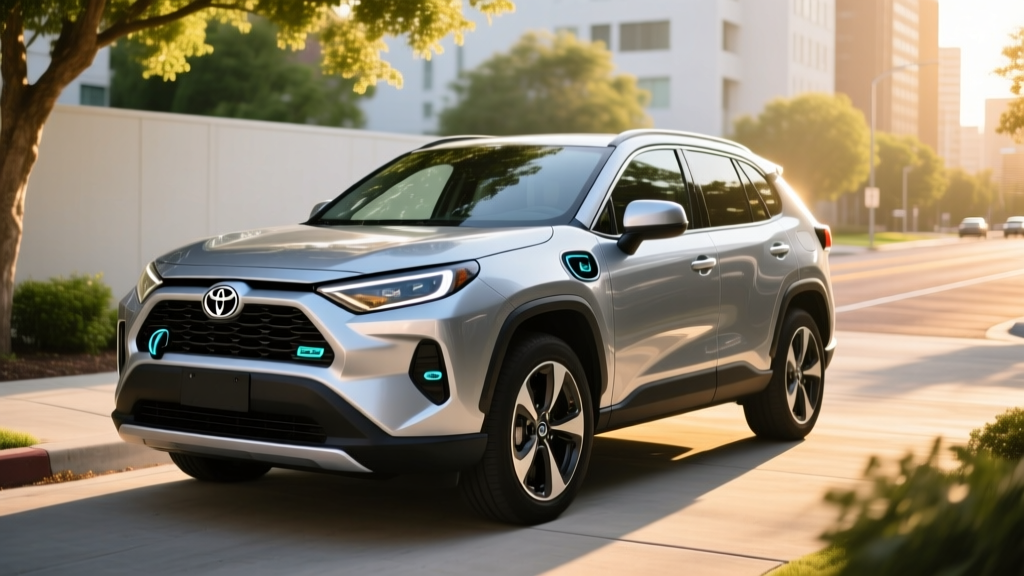
The Toyota RAV4 Hybrid remains one of the best-selling electrified vehicles in the United States for a simple reason: it delivers SUV practicality with fuel economy that undercuts most compact sedans — no plug required. For the 2026 model year, Toyota continues to offer the RAV4 in two electrified flavors: the conventional hybrid (HEV) and the plug-in hybrid variant sold as the RAV4 Prime (PHEV). Both share the same 2.5-liter four-cylinder foundation, but their fuel-economy stories diverge significantly depending on how and where you drive.
This guide breaks down every MPG figure, real-world efficiency data, powertrain spec, battery warranty detail, and tax-credit nuance you need before deciding which RAV4 — or whether a full EV — fits your garage.
HEV vs PHEV: Two RAV4 Hybrids, Very Different Math
Toyota sells two electrified RAV4 models, and confusing them is the most common buyer mistake. Here is the fundamental difference:
RAV4 Hybrid (HEV)
- No plug. The battery recharges through regenerative braking and the gas engine.
- No electric-only range beyond low-speed creep (~1 mile at parking-lot speeds).
- Always runs as a hybrid — you never need to think about charging.
- No federal tax credit under current IRS §30D rules (HEVs do not qualify).
RAV4 Prime (PHEV)
- Has a plug. Charges via Level 1 (120V) or Level 2 (240V); no DC fast charging.
- 42 miles EPA electric-only range before the gas engine engages.
- Operates as a full EV for daily commutes, then as a hybrid on longer trips.
- May qualify for federal/state incentives depending on income, sourcing, and local rules.
If you cannot charge at home or work, the HEV is the pragmatic choice. If you have reliable Level 2 access and a commute under 40 miles, the Prime unlocks dramatic fuel savings.
Toyota RAV4 Hybrid Fuel Economy: EPA Numbers and Real-World MPG
The conventional RAV4 Hybrid's efficiency varies slightly by trim and drivetrain. All 2026 RAV4 Hybrid trims come with electronic on-demand AWD (a separate rear electric motor), which carries a minor efficiency penalty versus the discontinued FWD-only trims of earlier model years.
| Model / Trim | City MPG | Highway MPG | Combined MPG |
|---|---|---|---|
| RAV4 Hybrid LE | 41 | 38 | 40 |
| RAV4 Hybrid XLE / XLE Premium | 41 | 38 | 40 |
| RAV4 Hybrid SE / Woodland Edition | 40 | 36 | 38 |
| RAV4 Hybrid Limited | 41 | 38 | 39 |
Source: EPA / fueleconomy.gov
Real-World MPG: Where Hybrids Surprise
Unlike full EVs — which often fall short of their EPA range on the highway — conventional hybrids frequently exceed their EPA city estimates in real-world driving. The reason is physics: at low speeds and in stop-and-go traffic, the electric motors do most of the work, regenerative braking recaptures energy constantly, and the gas engine shuts off entirely at stops.
In owner-reported data and independent testing, the RAV4 Hybrid LE commonly returns 42–45 MPG in city-heavy driving. Highway-only trips at 70+ mph tend to land closer to 35–37 MPG, as the gas engine carries a higher share of the load and aerodynamic drag increases. Cold-weather driving (below 35°F) can reduce combined MPG by 5–10%, primarily because the engine runs more frequently to provide cabin heat and maintain catalyst temperature.
RAV4 Prime PHEV: Electric Range, MPGe, and Total Range
The RAV4 Prime pairs the same 2.5L engine with a much larger battery pack and more powerful electric motors. The result is genuine EV commuting capability wrapped in an SUV that still works for a 600-mile road trip without stopping.
| Specification | RAV4 Prime (PHEV) |
|---|---|
| EPA Electric-Only Range | 42 miles |
| Combined MPGe (Electric + Gas) | 94 MPGe |
| Gas-Only MPG (Battery Depleted) | 38 MPG combined |
| Total Combined Range | ~600 miles |
| Battery Capacity | 18.1 kWh (total) / ~14.5 kWh usable |
| Level 1 Charge Time (120V, 12A) | ~12 hours (0–100%) |
| Level 2 Charge Time (240V, 32A) | ~2.5 hours (0–100%) |
| DC Fast Charging | Not available |
| Combined Horsepower | 302 hp |
| 0–60 mph | 5.7 seconds |
The 42-mile electric range covers the average American's one-way commute and daily errands entirely on electricity. If you charge nightly at home, you may go weeks without the gas engine starting — Toyota's system periodically runs the engine briefly to maintain lubrication and prevent fuel degradation.
One critical note: the RAV4 Prime does not support DC fast charging. Its charge port accepts only Level 1 (standard outlet) and Level 2 (240V) AC power. This is standard for PHEVs — their smaller batteries are not designed for high-power DC charging, and the added hardware cost would be difficult to justify given the battery size.
Powertrain Deep Dive: What Makes Both RAV4 Hybrids Tick
Both RAV4 variants use Toyota's Hybrid Synergy Drive system, but with different power outputs and motor configurations.
RAV4 Hybrid (HEV) Powertrain
- Engine: 2.5L Dynamic Force 4-cylinder (176 hp, 163 lb-ft)
- Front Electric Motor: 118 hp, 149 lb-ft
- Rear Electric Motor (AWD-i): 54 hp, 89 lb-ft
- Net Combined Horsepower: 219 hp
- Transmission: eCVT (planetary gearset, not a belt-driven CVT)
- Hybrid Battery: ~1.6 kWh lithium-ion (sealed, not user-serviceable)
RAV4 Prime (PHEV) Powertrain
- Engine: 2.5L Dynamic Force 4-cylinder (177 hp, 165 lb-ft)
- Front Electric Motor: 180 hp, 199 lb-ft
- Rear Electric Motor: 54 hp, 89 lb-ft
- Net Combined Horsepower: 302 hp
- Transmission: eCVT (same planetary design)
- Traction Battery: 18.1 kWh lithium-ion
The eCVT deserves emphasis. Unlike the rubber-belt CVTs in some competitors, Toyota's system uses a planetary gearset with no belts, no clutches, and no fixed gear ratios to wear. This design is a major contributor to the RAV4 Hybrid's long-term reliability record.
Pricing, Trims, and Tax Credit Eligibility
As of the 2026 model year, pricing for the RAV4 lineup positions the hybrid as a modest premium over the gas-only RAV4, while the Prime commands a significant step up.
| Model / Trim | MSRP (approx.) |
|---|---|
| RAV4 Hybrid LE | $33,575 |
| RAV4 Hybrid XLE | $35,075 |
| RAV4 Hybrid Limited | $40,225 |
| RAV4 Prime SE | $44,915 |
| RAV4 Prime XSE | $48,215 |
Pricing reflects approximate base MSRP including destination. Verify current pricing at Toyota.com.
Federal Tax Credit: The §30D Reality
RAV4 Hybrid (HEV): Does not qualify for the federal §30D clean vehicle credit. Conventional hybrids are excluded — the credit applies only to plug-in vehicles with sufficient battery capacity.
RAV4 Prime (PHEV): Eligibility for up to $7,500 under §30D depends on multiple factors that change frequently:
- Battery sourcing: Critical minerals and battery components must meet phased-in domestic/FTEA sourcing thresholds (increasing annually through 2026+).
- MSRP cap: SUVs must be under $80,000 MSRP — both Prime trims qualify.
- Buyer income cap: AGI must not exceed $150,000 (single), $225,000 (head of household), or $300,000 (joint).
- Point-of-sale transfer: Eligible buyers can transfer the credit to the dealer at purchase, reducing the out-of-pocket price immediately.
Verify current eligibility at IRS.gov before purchasing. Battery-sourcing rules have disqualified and re-qualified several PHEVs across model years.
Additionally, some states offer their own hybrid or PHEV rebates — California's CVRP, Colorado's innovative motor vehicle credit, and various utility company rebates can stack on top. Check your state energy office or utility provider for current programs.
Battery Warranty, Reliability, and Replacement Costs
Hybrid battery longevity is the single biggest concern among first-time hybrid buyers — and the area where Toyota has the strongest track record in the industry.
Toyota Hybrid Battery Warranty
- RAV4 Hybrid (HEV): 10 years / 150,000 miles (whichever comes first), transferable to subsequent owners.
- RAV4 Prime (PHEV): 10 years / 150,000 miles for the traction battery.
- Hybrid System Components (inverters, converters, eCVT): 8 years / 100,000 miles.
- Capacity Retention Threshold: Warranty covers the battery if it falls below approximately 70–80% of original capacity (varies by model year — confirm in your warranty booklet).
Real-World Reliability Data
Toyota's hybrid system has been in production since the 1997 Prius. The RAV4 Hybrid, introduced for the 2016 model year, benefits from over two decades of iterative refinement. Independent reliability surveys from Consumer Reports and J.D. Power consistently rank the RAV4 Hybrid among the top compact SUVs, with the hybrid powertrain being one of the least failure-prone components.
Real-world reports of RAV4 Hybrid battery failures before 150,000 miles are rare. When failures do occur outside warranty, replacement costs are a legitimate concern:
- RAV4 Hybrid (HEV) battery replacement: $2,000–$3,500 (refurbished/aftermarket) or $4,000–$6,000 (new OEM) at a dealership.
- RAV4 Prime (PHEV) battery replacement: $8,000–$12,000+ (new OEM) due to the larger 18.1 kWh pack. Third-party refurbished options are limited for the Prime given its newer platform.
For context, a full EV battery replacement (e.g., a 75–100 kWh pack) typically runs $12,000–$22,000. The RAV4 Hybrid's small battery makes replacement a manageable — if unwelcome — expense, and the 10-year warranty covers the vast majority of ownership periods.
RAV4 Hybrid vs RAV4 Prime vs Full EV: Which Fits You?
Choose the RAV4 Hybrid (HEV) If:
- You cannot install a home charger (apartment, street parking, no garage).
- Your daily driving is unpredictable — some days 10 miles, some days 400.
- You want maximum simplicity: no plug, no apps, no charging planning.
- Budget is a priority and you want the lowest entry price for an electrified SUV.
- You want proven 40 MPG without behavior changes.
Choose the RAV4 Prime (PHEV) If:
- You can charge at home (Level 2 strongly recommended for the 2.5-hour fill).
- Your daily round-trip commute is under 42 miles — you'll rarely burn gas.
- You want EV-like operating costs for daily driving but road-trip freedom on weekends.
- You want the 302 hp performance upgrade (0–60 in 5.7 seconds — the fastest RAV4 ever).
- You qualify for the federal tax credit or state PHEV incentives.
Choose a Full EV (e.g., Tesla Model Y, Hyundai Ioniq 5) If:
- You want zero tailpipe emissions and zero oil changes, spark plugs, or engine maintenance.
- You have reliable home Level 2 charging and access to DC fast chargers for road trips.
- Your budget accommodates a $40,000–$55,000+ purchase price.
- You drive primarily in urban/suburban areas with good charging infrastructure.
5-Year Fuel Cost Comparison: RAV4 Hybrid vs Gas vs PHEV vs EV
To put the RAV4 Hybrid's fuel economy in financial context, here is a 5-year / 75,000-mile fuel cost estimate assuming 15,000 miles per year, $3.50/gallon regular unleaded, and $0.16/kWh electricity (national averages as of early 2026):
| Vehicle | Efficiency | 5-Year Fuel Cost |
|---|---|---|
| RAV4 Gas (28 MPG combined) | 28 MPG | $9,375 |
| RAV4 Hybrid HEV (40 MPG combined) | 40 MPG | $6,563 |
| RAV4 Prime PHEV (70% electric, 30% gas) | 94 MPGe / 38 MPG gas | $3,800–$4,500 |
| Comparable EV (e.g., Ioniq 5, 3.5 mi/kWh) | 114 MPGe | $3,430 |
The RAV4 Hybrid saves roughly $2,800 over five years versus the gas RAV4 — enough to offset its modest price premium. The Prime, when charged regularly, saves $5,000+ — potentially covering its higher MSRP if you keep the vehicle long enough and qualify for incentives.
Frequently Asked Questions
How many MPG does the Toyota RAV4 Hybrid actually get?
The EPA rates most 2026 RAV4 Hybrid trims at 41 city / 38 highway / 40 combined MPG. In real-world city driving with frequent stops, owners commonly report 42–45 MPG. Highway-only driving at 75+ mph typically yields 35–37 MPG. Cold weather (below 35°F) reduces efficiency by 5–10%.
How far can the RAV4 Prime go on electric only?
The RAV4 Prime delivers 42 miles of EPA-rated electric-only range. This is sufficient for most daily commutes and errands. Once the battery is depleted, the vehicle operates as a conventional hybrid at 38 MPG combined, giving a total system range of approximately 600 miles.
Does the RAV4 Hybrid need to be plugged in?
No. The conventional RAV4 Hybrid (HEV) never needs to be plugged in. Its small battery recharges through regenerative braking and the gasoline engine. Only the RAV4 Prime (PHEV) benefits from plugging in — and requires it to access its 42-mile electric range.
Is the RAV4 Hybrid reliable, and what does a battery replacement cost?
The RAV4 Hybrid has one of the strongest reliability records in the compact SUV segment, backed by Toyota's 10-year/150,000-mile hybrid battery warranty. Battery failures before 150,000 miles are uncommon. If replacement is needed out of warranty, expect $2,000–$6,000 for the HEV depending on refurbished vs. new OEM parts. The Prime's larger battery costs $8,000–$12,000+ to replace.
Does the Toyota RAV4 Hybrid qualify for a tax credit?
The conventional RAV4 Hybrid (HEV) does not qualify for the federal §30D clean vehicle credit — only plug-in vehicles are eligible. The RAV4 Prime (PHEV) may qualify for up to $7,500 depending on battery-sourcing compliance, buyer income limits ($150K single / $300K joint), and the $80,000 MSRP cap for SUVs. Always verify current eligibility at IRS.gov before purchasing, as sourcing rules change annually.
How long does it take to charge the RAV4 Prime?
On a standard 120V household outlet (Level 1), a full charge takes approximately 12 hours — workable for overnight charging if your daily driving is light. On a 240V Level 2 charger (32A), a full charge takes about 2.5 hours. The RAV4 Prime does not support DC fast charging, which is typical for PHEVs.
Should I get the RAV4 Hybrid or just buy a full EV?
If you have reliable home charging, a predictable commute, and access to DC fast chargers for road trips, a full EV like the Hyundai Ioniq 5 or Tesla Model Y offers lower operating costs and zero tailpipe emissions. If you lack home charging, take frequent long road trips through areas with sparse charging infrastructure, or prefer not to think about charging at all, the RAV4 Hybrid delivers excellent efficiency with zero lifestyle changes.