Quick Verdict: The Benchmark Compact Hybrid SUV
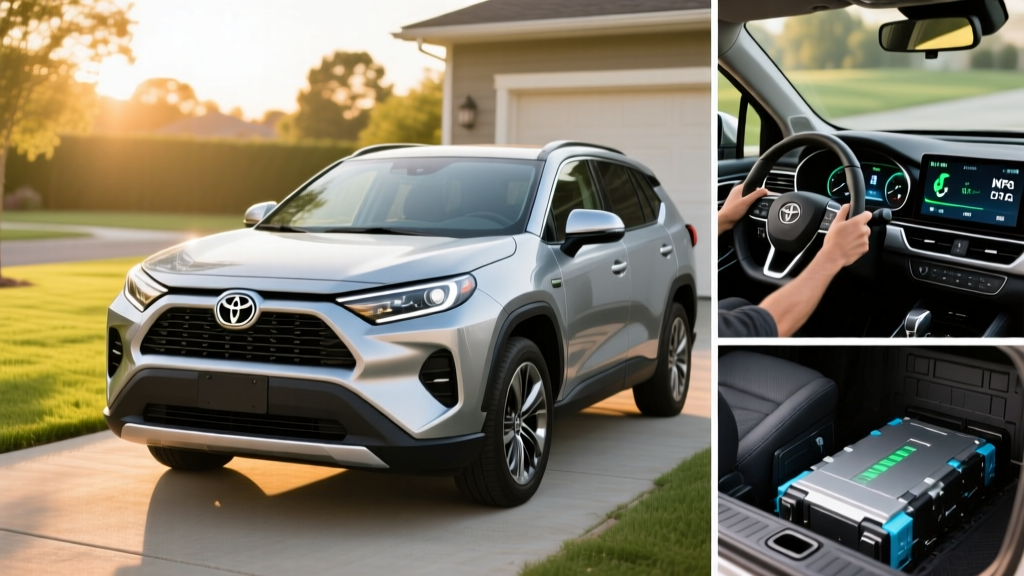
The 2024 Toyota RAV4 Hybrid remains the compact hybrid SUV to beat. With an EPA-estimated 41 MPG city and 38 MPG highway (39 combined), standard all-wheel drive, and a combined 219 horsepower, it delivers the fuel savings buyers want without requiring any change in daily habits — no plugs, no range anxiety, no charging apps. Starting at $31,725 (LE trim, including destination), it undercuts many gas-only competitors on cost-per-mile while offering the cargo space and ride height that make compact SUVs so popular.
But the RAV4 Hybrid lineup also includes the RAV4 Prime — a plug-in hybrid (PHEV) variant with 42 miles of electric-only range and 302 horsepower — that fundamentally changes the ownership equation if you can charge at home. This guide breaks down both versions so you can choose the right one.
HEV vs. PHEV: Which RAV4 Hybrid Is Right for You?
Toyota sells two distinct electrified RAV4 models, and confusing them is the most common buyer mistake. Here is the fundamental difference:
| Feature | RAV4 Hybrid (HEV) | RAV4 Prime (PHEV) |
|---|---|---|
| Plug-in charging required? | No — self-charging via engine and regenerative braking | Yes — plug in to access electric-only driving |
| EPA combined MPG / MPGe | 39 MPG combined | 94 MPGe (electric+gas) / 38 MPG (gas only) |
| Electric-only range | Not applicable (EV mode limited to ~1 mile at low speed) | 42 miles EPA |
| Battery capacity | 1.6 kWh (NiMH, small buffer) | 18.1 kWh (lithium-ion, usable ~14.5 kWh) |
| Combined horsepower | 219 hp | 302 hp |
| 0–60 mph | 7.4 seconds | 5.7 seconds |
| Starting MSRP | $31,725 (LE) | $43,690 (SE) |
| Federal tax credit (§30D) | Not eligible | Not eligible (discontinued credit eligibility for 2024 model year) |
The bottom line: If you cannot charge at home or at work, the conventional RAV4 Hybrid (HEV) is the correct choice. It operates exactly like a gas car — you fill it at a station and go — while delivering dramatically better fuel economy. If you have reliable Level 2 charging access and a commute under 42 miles, the RAV4 Prime lets you drive on electricity most days and only burns gas on longer trips.
Fuel Economy: EPA Numbers and Real-World MPG
RAV4 Hybrid (HEV)
| Driving Cycle | EPA Estimate | Real-World Expectation |
|---|---|---|
| City | 41 MPG | 40–45 MPG (hybrids excel in stop-and-go) |
| Highway | 38 MPG | 35–38 MPG (less regenerative braking benefit) |
| Combined | 39 MPG | 37–42 MPG depending on driving mix |
Toyota's hybrid system recovers energy during braking and low-speed driving, which is why city MPG actually exceeds highway MPG — the opposite of a conventional gas car. In real-world driving, owners who do a lot of city and suburban driving frequently report 42–44 MPG on forums and fueleconomy.gov user submissions. Highway-heavy drivers at 75+ mph should expect the lower end of the range.
RAV4 Prime (PHEV)
| Metric | EPA Estimate | Real-World Expectation |
|---|---|---|
| Electric-only range | 42 miles | 38–45 miles (varies with temperature and speed) |
| MPGe (electric+gas combined) | 94 MPGe | Depends heavily on charging frequency |
| Gas-only MPG (battery depleted) | 38 MPG combined | 36–40 MPG |
| Total range (full tank + full charge) | ~600 miles | 550–620 miles |
The 42-mile electric range is enough to cover the average American's daily round-trip commute (approximately 35 miles, per FHWA data). If you charge nightly, you may go weeks without visiting a gas station. When the battery depletes, the Prime seamlessly transitions to hybrid mode — there is no range anxiety because the gas engine takes over.
Powertrain and Performance Specs
| Specification | RAV4 Hybrid (HEV) | RAV4 Prime (PHEV) |
|---|---|---|
| Engine | 2.5L inline-4 (176 hp / 163 lb-ft) | 2.5L inline-4 (177 hp / 165 lb-ft) |
| Front electric motor | 118 hp / 149 lb-ft | 179 hp / 199 lb-ft |
| Rear electric motor | 54 hp / 89 lb-ft | 54 hp / 89 lb-ft |
| Net combined horsepower | 219 hp | 302 hp |
| Drivetrain | AWD (electronic on-demand rear axle) | AWD (electronic on-demand rear axle) |
| Transmission | eCVT | eCVT |
| 0–60 mph | 7.4 seconds | 5.7 seconds |
| Towing capacity | 1,750 lbs | 1,750 lbs |
| Cargo volume (rear seats up) | 37.6 cu ft | 33.5 cu ft (battery intrusion) |
Both models use Toyota's electronic AWD system, which employs a dedicated rear electric motor rather than a mechanical driveshaft. The rear motor engages automatically during acceleration and low-traction situations, then disconnects during cruising to minimize losses. This is not a heavy-duty off-road system, but it handles rain, snow, and light trails competently.
The RAV4 Prime's 302 horsepower makes it the quickest RAV4 Toyota sells — quicker than the gas-only RAV4 TRD Off-Road. That performance comes with a trade-off: the larger battery reduces cargo space by about 4 cubic feet, and the Prime is roughly 300 lbs heavier.
Charging the RAV4 Prime (PHEV)
The conventional RAV4 Hybrid (HEV) requires no charging infrastructure. For RAV4 Prime owners, here is what to expect:
| Charging Method | Power | 0–100% Time | Notes |
|---|---|---|---|
| Level 1 (120V household outlet) | ~1.4 kW | ~12 hours | Included cord; adequate for overnight if parked 12+ hours |
| Level 2 (240V, 16A) | ~3.3 kW | ~5.5 hours | Standard onboard charger; typical home wall charger |
| Level 2 (240V, 32A) | ~6.6 kW | ~2.5 hours | Available with optional upgraded onboard charger (XSE Premium trim and above) |
| DC fast charging | Not supported | N/A | No CCS or CHAdeMO port |
The RAV4 Prime does not support DC fast charging. This is typical for PHEVs — the battery is small enough that Level 2 charging replenishes it in a few hours, making DC infrastructure unnecessary for daily use. However, it means you cannot top up quickly on a road trip. For a 42-mile electric range, this limitation rarely matters in practice.
Home charging setup: Most Prime owners install a 240V Level 2 charger in their garage. A basic 16-amp unit (like the ChargePoint Home Flex or Emporia Level 2) costs $300–$500 for the equipment, with electrician installation adding $400–$1,200 depending on panel proximity and local permit requirements. Total home charging investment: roughly $700–$1,700.
Pricing, Trims, and Tax Credit Eligibility
RAV4 Hybrid (HEV) — 2024 MSRP
- LE: $31,725
- XLE: $33,235
- XLE Premium: $36,125
- SE: $35,725
- Woodland Edition: $36,425
- XSE: $37,225
- Limited: $40,325
RAV4 Prime (PHEV) — 2024 MSRP
- SE: $43,690
- XSE: $46,590
All prices include Toyota's $1,395 destination charge.
Federal Tax Credit Status
RAV4 Hybrid (HEV): Not eligible for the IRS §30D federal clean vehicle credit. Conventional hybrids do not qualify — only plug-in hybrids and battery-electric vehicles with sufficient battery capacity are eligible under current law.
RAV4 Prime (PHEV): As of the 2024 model year, the RAV4 Prime does not qualify for the $7,500 federal tax credit. Under the Inflation Reduction Act's battery sourcing and critical mineral requirements (effective January 1, 2024), the Prime's battery components and minerals did not meet the thresholds. Additionally, the RAV4 Prime is assembled in Japan, which can affect eligibility. Always verify current status at fueleconomy.gov and consult a tax professional before making a purchase decision based on credit eligibility.
State incentives: Some states offer rebates for PHEVs regardless of federal eligibility. Check your state's energy or environmental agency website for current programs.
Battery Warranty, Lifespan, and Replacement Cost
| Coverage | RAV4 Hybrid (HEV) | RAV4 Prime (PHEV) |
|---|---|---|
| Hybrid battery warranty | 10 years / 150,000 miles | 10 years / 150,000 miles |
| Hybrid system components | 8 years / 100,000 miles | 8 years / 100,000 miles |
| Battery chemistry | Nickel-metal hydride (NiMH) | Lithium-ion (NMC) |
| Capacity retention threshold | Warranty covers defects and significant capacity loss | Warranty covers defects and significant capacity loss |
Toyota's 10-year/150,000-mile hybrid battery warranty is among the best in the industry and applies in all 50 states (not just CARB states, as was previously the case). The hybrid battery is designed to last the life of the vehicle. Real-world data from Toyota's millions of hybrid vehicles on the road shows that hybrid battery failures before 150,000 miles are uncommon.
Replacement cost if out of warranty: A new RAV4 Hybrid battery pack costs approximately $3,000–$5,000 including labor at a Toyota dealer. The RAV4 Prime's larger lithium-ion pack is more expensive, estimated at $8,000–$12,000. Third-party refurbishers and used replacements can reduce these costs significantly. However, given Toyota's track record and the generous warranty, most owners will never face this expense.
Longevity context: Toyota's hybrid system is one reason the RAV4 Hybrid consistently earns top reliability scores. The eCVT transmission has no traditional gears or belts to wear — it uses a planetary gearset that is mechanically simple and durable. IIHS named the 2024 RAV4 a Top Safety Pick when equipped with specific headlights.
Who Should Choose the RAV4 Hybrid vs. a Full EV or Gas Car?
Choose the RAV4 Hybrid (HEV) if:
- You cannot install a home charger (apartment, street parking, no garage)
- You want maximum fuel savings with zero behavioral change
- Your budget is $31,000–$40,000 and you want a proven, reliable compact SUV
- You drive 12,000–15,000 miles per year and want to save $600–$900 annually on fuel vs. a gas RAV4
- You live in an area with limited public charging infrastructure
Choose the RAV4 Prime (PHEV) if:
- You can charge at home (Level 2) and your daily commute is under 42 miles round-trip
- You want to drive mostly on electricity but need gas flexibility for road trips
- You value the 302-hp performance upgrade
- You're willing to pay the ~$12,000 premium over the HEV for electric driving and power
- You want to reduce your gasoline consumption by 60–80% without range anxiety
Choose a full EV (like a Tesla Model Y, Hyundai Ioniq 5, or Toyota bZ4X) if:
- You have reliable home charging and want the lowest per-mile operating cost
- Your daily driving is under 250 miles and you can plan for road-trip charging
- You want to eliminate oil changes, engine maintenance, and tailpipe emissions entirely
- You qualify for the $7,500 federal tax credit on eligible EVs, narrowing the price gap
Stick with a gas-only SUV if:
- Your annual mileage is very low (under 8,000 miles) — the fuel savings won't offset the hybrid premium
- You tow frequently near the vehicle's maximum capacity (hybrids and EVs lose efficiency under heavy loads)
Pros and Cons
Pros
- Class-leading 39 MPG combined (HEV) with no plug-in required
- Standard AWD on every trim — rare at this price point
- 10-year / 150,000-mile hybrid battery warranty
- Strong resale value; Toyota RAV4 is consistently a top-selling vehicle in the US
- RAV4 Prime offers 42 miles of EV range and 302 hp for enthusiasts who also want efficiency
- Spacious cargo area (37.6 cu ft HEV) and comfortable ride quality
- Toyota Safety Sense 2.5+ standard on all trims (adaptive cruise, lane-keeping, auto emergency braking)
Cons
- No DC fast charging on the RAV4 Prime
- RAV4 Prime is expensive ($43,690+) and frequently marked up by dealers due to high demand
- No federal tax credit for either version in 2024
- eCVT drone under hard acceleration (common to Toyota hybrids)
- RAV4 Prime cargo space reduced to 33.5 cu ft due to larger battery
- Infotainment system, while updated for 2024, still lags behind competitors in responsiveness
- Long wait times for RAV4 Prime at many dealers (6–12 months in some markets)
Frequently Asked Questions
How many MPG does the 2024 Toyota RAV4 Hybrid get?
The 2024 RAV4 Hybrid is EPA-rated at 41 MPG city, 38 MPG highway, and 39 MPG combined. In real-world driving, city-heavy drivers often see 42–44 MPG, while highway-heavy drivers at higher speeds may see 35–38 MPG. The RAV4 Prime gets 38 MPG combined when operating as a hybrid (battery depleted) and 94 MPGe when factoring in electric driving.
How far can the RAV4 Prime go on electric only?
The EPA rates the RAV4 Prime at 42 miles of electric-only range. Real-world results vary from about 38 miles (highway driving in cold weather) to 45+ miles (moderate-speed city driving in mild temperatures). Once the battery depletes, the gas engine engages automatically and the vehicle operates as a conventional hybrid.
Does the RAV4 Hybrid need to be plugged in?
No. The conventional RAV4 Hybrid (HEV) charges its small battery through regenerative braking and the gas engine. You never plug it in — you simply refuel at a gas station like any other car. Only the RAV4 Prime (PHEV) benefits from being plugged in.
Is the Toyota RAV4 Hybrid reliable?
Toyota's hybrid system has been in production since 1997 (Prius), and the RAV4 Hybrid has been sold since 2016. It consistently earns above-average reliability ratings from Consumer Reports and J.D. Power. The eCVT transmission is mechanically simpler than a traditional automatic, and the hybrid battery carries a 10-year/150,000-mile warranty.
What does a RAV4 Hybrid battery replacement cost?
Out-of-warranty replacement for the RAV4 Hybrid (HEV) battery costs approximately $3,000–$5,000 at a Toyota dealer. The RAV4 Prime's larger lithium-ion battery is estimated at $8,000–$12,000. However, Toyota's 10-year/150,000-mile warranty covers the hybrid battery, and real-world data shows failures within that period are uncommon.
Does the 2024 RAV4 Hybrid qualify for a federal tax credit?
No. The conventional RAV4 Hybrid (HEV) does not qualify for the IRS §30D clean vehicle credit because it is not a plug-in vehicle. The RAV4 Prime (PHEV) also does not qualify for 2024 due to battery sourcing and critical mineral requirements under the Inflation Reduction Act. Verify current eligibility at fueleconomy.gov before purchasing.
How does the RAV4 Hybrid compare to a gas-only RAV4?
The gas-only 2024 RAV4 (2.5L, 203 hp, FWD) is EPA-rated at 30 MPG combined. The RAV4 Hybrid delivers 39 MPG combined — a 30% improvement — while also providing more horsepower (219 vs. 203) and standard AWD. At 12,000 miles per year and $3.50/gallon gas, the hybrid saves approximately $350–$500 annually in fuel costs, paying back its modest price premium within 2–4 years.