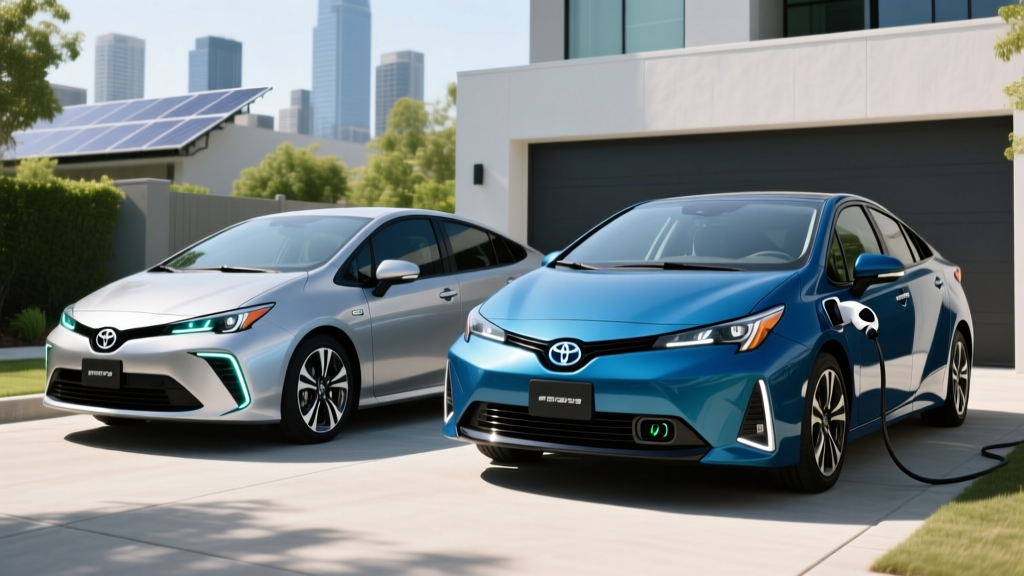
Toyota practically invented the hybrid hatchback segment, and the current-generation Prius lineup continues to defend that crown. For 2026, the Toyota Prius (conventional hybrid) and Prius Prime (plug-in hybrid) share a striking fastback design, a fifth-generation hybrid powertrain, and efficiency numbers that make them tough to beat at their price points. But with so many EVs and crossovers entering the market, does the Toyota hybrid hatchback formula still hold up for real buyers? We break down every spec that matters.
Prius vs. Prius Prime: HEV or PHEV — What's the Difference?
Before we get into the numbers, it's essential to understand that Toyota sells two fundamentally different versions of this hatchback:
Toyota Prius (HEV — Conventional Hybrid)
- No plug required. The battery recharges through regenerative braking and the gasoline engine.
- Small traction battery (~1.0 kWh usable) assists the engine for better fuel economy.
- Cannot drive on electric power alone for meaningful distances.
- Lower purchase price; no home charging infrastructure needed.
Toyota Prius Prime (PHEV — Plug-In Hybrid)
- Must be plugged in to access its full electric-only range (up to 44 miles EPA).
- Larger traction battery (13.6 kWh total, ~10.9 kWh usable) enables EV-mode commuting.
- Once the battery depletes, it operates as a conventional hybrid with excellent MPG.
- Higher purchase price but eligible for the full §30D federal tax credit (up to $7,500) if you meet eligibility requirements.
Neither vehicle is a full battery-electric vehicle (BEV). Both still have a gasoline engine and a fuel tank. The key decision is whether you can charge at home or work and want to eliminate most daily gasoline use.
Fuel Economy: EPA MPG and Real-World Numbers
Fuel efficiency is the entire reason this segment exists. Here's how the 2026 lineup breaks down according to fueleconomy.gov:
| Model / Trim | City MPG | Highway MPG | Combined MPG | MPGe (PHEV EV-mode) |
|---|---|---|---|---|
| Prius LE (FWD) | 57 | 56 | 57 | — |
| Prius XLE / Limited (FWD) | 52 | 52 | 52 | — |
| Prius AWD-e (LE/XLE) | 53 | 54 | 54 | — |
| Prius Prime SE | 53 (hybrid mode) | 51 (hybrid mode) | 52 (hybrid mode) | 127 MPGe |
| Prius Prime XSE / XSE Premium | 50 (hybrid mode) | 48 (hybrid mode) | 49 (hybrid mode) | 117 MPGe |
Real-world MPG reality check: Toyota's hybrid system excels in stop-and-go city driving where regenerative braking recovers energy constantly. Many owners report exceeding the EPA city figure in warm-weather urban commuting — 60+ MPG is achievable on the LE trim in moderate conditions. Highway driving at sustained 70–80 mph speeds typically drops efficiency to the mid-to-high 40s for the LE, and low-to-mid 40s for the heavier Prime and AWD-e trims. Cold weather (below 35°F) reduces efficiency by roughly 10–15% as the engine runs more frequently for cabin heat and battery conditioning.
Prius Prime Electric-Only Range and Charging
The 2026 Prius Prime offers up to 44 miles of EPA-rated electric-only range on the SE trim (with its lighter 17-inch wheels). The XSE and XSE Premium trims, equipped with 19-inch wheels and additional equipment, see that figure drop to approximately 39–40 miles.
Prius Prime: EPA vs. Real-World Electric Range
EPA sticker: 44 miles (SE) / 39–40 miles (XSE)
Real-world expectation: 36–42 miles in mild weather with mixed driving; as low as 28–32 miles in freezing temperatures or sustained highway speeds above 70 mph. The Prime's EV mode tops out at 84 mph, so highway driving is possible but range drops sharply at higher speeds.
Total combined range (electric + gasoline): Approximately 470–510 miles depending on trim and conditions.
Battery and Charging Specs
| Specification | Prius Prime SE | Prius Prime XSE / XSE Premium |
|---|---|---|
| Battery Capacity (total / usable) | 13.6 kWh / ~10.9 kWh | 13.6 kWh / ~10.9 kWh |
| Battery Chemistry | Lithium-ion (NMC) | Lithium-ion (NMC) |
| Level 1 Charging (120V, ~1.4 kW) | ~11 hours (0–100%) | ~11 hours (0–100%) |
| Level 2 Charging (240V, ~3.3 kW onboard) | ~4 hours (0–100%) | ~4 hours (0–100%) |
| DC Fast Charging | Not supported — J1772 AC only | |
Charging reality: The Prime's 3.3 kW onboard charger is modest by modern standards. It's perfectly adequate for overnight Level 2 replenishment — plug in when you get home and the battery is full by morning. But if you're hoping to top up at a public charger during the day, expect a slow experience. The lack of DC fast charging is a deliberate Toyota trade-off: it keeps cost and weight down, and for a 44-mile electric range, overnight charging is the intended use case. The conventional Prius HEV, of course, requires no charging at all — it refuels exclusively at the gas pump.
Powertrain and Performance
Both the Prius and Prius Prime use Toyota's fifth-generation hybrid system built around a 2.0-liter four-cylinder engine paired with electric motor-generators and a planetary gearset (e-CVT). The AWD-e trims add a rear-mounted electric motor for all-wheel drive.
| Specification | Prius (FWD) | Prius AWD-e | Prius Prime |
|---|---|---|---|
| Engine | 2.0L I4 + 2 motor-generators | 2.0L I4 + 3 motor-generators | 2.0L I4 + 2 motor-generators |
| Combined System Horsepower | 194 hp | 196 hp | 220 hp |
| 0–60 mph | ~7.2 sec | ~7.0 sec | ~6.6 sec |
| Drivetrain | FWD | AWD (electric rear axle) | FWD |
| Transmission | e-CVT | e-CVT | e-CVT |
The Prius Prime is genuinely the quickest of the bunch, with 220 combined horsepower delivering a 6.6-second 0–60 time — a number that would have seemed absurd for a Prius just one generation ago. The standard Prius at 194 hp is no slouch either. This is a hatchback that can merge onto a freeway with confidence, a welcome departure from the underpowered reputation of earlier models.
Pricing, Tax Credits, and Value
Here's what the 2026 Toyota hybrid hatchback lineup costs before incentives:
| Trim | MSRP (approx.) | Federal Tax Credit |
|---|---|---|
| Prius LE | $29,445 | Not eligible (HEV) |
| Prius XLE | $32,895 | Not eligible (HEV) |
| Prius Limited | $36,295 | Not eligible (HEV) |
| Prius Prime SE | $34,445 | Up to $7,500 (§30D) |
| Prius Prime XSE | $37,445 | Up to $7,500 (§30D) |
| Prius Prime XSE Premium | $40,445 | Up to $7,500 (§30D) |
§30D Federal Tax Credit — Eligibility Checklist for Prius Prime
- Vehicle type: Plug-in hybrid — qualifies as a new clean vehicle under §30D.
- MSRP cap: Must be under $55,000 for sedans/hatchbacks (all Prius Prime trims qualify).
- Buyer income cap: Modified AGI must not exceed $150,000 (single), $225,000 (head of household), or $300,000 (joint). Per IRS guidelines.
- Battery sourcing: Critical minerals and battery component requirements phase in annually. Confirm current-year compliance on the DOE/IRS qualifying vehicles list before purchasing.
- Point-of-sale transfer: As of 2024+, you can transfer the credit to the dealer at purchase for an immediate price reduction, rather than waiting to claim it on your tax return.
Important: The conventional Prius HEV does NOT qualify for the §30D federal tax credit. Only the plug-in Prius Prime is eligible. State incentives vary — check your local energy office or AFDC state incentive database.
Effective pricing with the credit: If you qualify for the full $7,500 credit and apply it at point of sale, the Prius Prime SE drops to an effective price of roughly $26,945 — making it one of the most affordable plug-in hybrids on the market and actually cheaper than the gas-only-equivalent Prius Limited trim. This is where the Prime's value proposition becomes compelling.
Reliability, Battery Warranty, and Long-Term Costs
Toyota's hybrid system is among the most proven in the industry, with over 25 years of continuous refinement since the original 1997 Prius. The fifth-generation system in the current model uses fewer moving parts than a conventional automatic transmission — there's no traditional gearbox, no torque converter, and no starter motor to fail.
Hybrid Battery Warranty
Coverage: 10 years / 150,000 miles (whichever comes first) on the hybrid battery and all hybrid system components, in all 50 states. This applies to both the Prius HEV and Prius Prime.
What's covered: The traction battery pack, inverter, motor-generators, and associated control electronics. If battery capacity drops below a defined threshold during the warranty period, Toyota will repair or replace it at no cost.
Out-of-warranty replacement cost: Based on current-generation Prius pricing, a dealer-installed hybrid battery replacement runs approximately $2,500–$4,000 depending on trim and labor rates. Independent hybrid specialists often offer refurbished units for $1,500–$2,500.
Longevity data: Real-world evidence from prior-generation Prius fleets (taxis, rideshare) shows many original batteries lasting 180,000–250,000+ miles before significant degradation. The lithium-ion packs in the current generation are expected to perform similarly or better.
Beyond the battery, the Prius uses a conventional 12V auxiliary battery (located in the rear cargo area) that will need replacement every 4–6 years like any other car — budget $150–$250 for that. Maintenance is minimal: oil changes every 10,000 miles, cabin air filter, brake pads that last 80,000+ miles thanks to regenerative braking doing most of the work.
Pros, Cons, and the Competition
Pros
- Class-leading fuel economy (57 MPG combined on LE)
- Prius Prime qualifies for up to $7,500 federal tax credit
- 220 hp (Prime) delivers genuinely quick acceleration
- 10-year/150,000-mile hybrid battery warranty
- Striking fastback design — no longer looks like a science experiment
- Standard Toyota Safety Sense 3.0 (adaptive cruise, lane centering, AEB)
- No home charger needed for the conventional HEV
Cons
- Prius Prime has no DC fast charging — slow public top-ups
- 3.3 kW onboard charger limits Level 2 speed
- Rear seat headroom is tight for passengers over 6'1"
- Cargo volume (~20 cu ft) trails crossover competitors
- AWD-e only available on conventional Prius, not the Prime
- Infotainment is functional but not class-leading in responsiveness
Competition context: The Hyundai Ioniq Hybrid (discontinued) left a gap, and the Kia Niro Hybrid is the closest direct rival — but it trails on combined MPG and horsepower. The Ford Maverick Hybrid is a compelling alternative if you need a truck bed. For buyers cross-shopping a full EV like the Chevrolet Equinox EV or Hyundai Kona Electric, the Prius Prime offers a compelling middle ground: electric commuting with gas-engine freedom for road trips, at a lower purchase price.
Who Should Buy the Toyota Hybrid Hatchback?
Choose the Prius (HEV) if:
- You cannot charge at home or work (apartment living, street parking).
- You want maximum MPG with zero behavior change — just fill up at any gas station.
- You drive a mix of city and highway and want proven, low-maintenance efficiency.
- Budget is a priority and you don't qualify for the §30D tax credit (income above caps).
Choose the Prius Prime (PHEV) if:
- Your daily round-trip commute is under 40 miles and you can charge at home (even a standard 120V outlet works overnight).
- You qualify for the $7,500 federal tax credit — the effective price becomes exceptional.
- You want EV-like daily driving but still take road trips where charging infrastructure is sparse.
- You want to reduce gasoline consumption by 70–90% on typical weekday driving without range anxiety.
Choose a full BEV instead if:
- Your daily driving exceeds 40 miles but you have reliable home Level 2 charging.
- You want zero tailpipe emissions and minimal maintenance (no oil changes, no gas engine).
- You're ready to commit to an EV lifestyle and your road trips are planned around charging stops.
Frequently Asked Questions
How many MPG does the Toyota Prius hybrid hatchback get?
The 2026 Toyota Prius LE achieves an EPA-estimated 57 MPG combined (57 city / 56 highway). Higher trims (XLE, Limited) rate at 52 MPG combined due to additional weight from larger wheels and more equipment. The AWD-e trims achieve 54 MPG combined. In real-world city driving with moderate temperatures, many owners report exceeding the EPA city figure. Highway cruising at 75+ mph typically returns 43–48 MPG depending on conditions.
How far can the Prius Prime go on electric only?
The 2026 Prius Prime SE achieves up to 44 miles of EPA-rated electric-only range. The XSE and XSE Premium trims, with larger wheels, achieve approximately 39–40 miles. In real-world conditions, expect 36–42 miles in mild weather and 28–32 miles in freezing temperatures. Once the battery is depleted, the Prime continues as a conventional hybrid at 49–52 MPG combined.
Does the Toyota Prius qualify for a federal tax credit?
The conventional Prius (HEV) does not qualify for the §30D federal tax credit — it is not a plug-in vehicle. The Prius Prime (PHEV) does qualify for up to $7,500 under current IRS rules, subject to buyer income limits ($150K single / $300K joint), MSRP caps (under $55K for this vehicle class), and battery sourcing requirements. The credit can be transferred to the dealer at point of sale for an immediate price reduction. Always verify current eligibility on irs.gov before purchasing.
Is the Toyota hybrid battery reliable and what does replacement cost?
Toyota's hybrid battery systems have an outstanding long-term reliability record spanning 25+ years of production. The hybrid battery is covered by a 10-year / 150,000-mile warranty in all states. Out-of-warranty replacement costs approximately $2,500–$4,000 at a dealer, or $1,500–$2,500 through independent hybrid specialists. Real-world data from fleet use shows many original batteries lasting 180,000–250,000+ miles. The Prius hybrid system has fewer wear-prone components than a conventional gasoline powertrain — no traditional transmission, no starter motor, and brake pads that last significantly longer due to regenerative braking.
Do I need to plug in the regular Toyota Prius?
No. The conventional Toyota Prius (HEV) never needs to be plugged in. Its small hybrid battery recharges automatically through regenerative braking and the gasoline engine. You simply fill it with gasoline like any other car. Only the Prius Prime (PHEV) benefits from being plugged in to access its electric-only range.
Hybrid vs. PHEV vs. EV — which is right for me?
It depends on your charging access and driving patterns. A conventional hybrid (HEV) like the Prius is ideal if you lack charging access and want maximum MPG with no lifestyle changes. A plug-in hybrid (PHEV) like the Prius Prime is ideal if you can charge at home, commute under 40 miles daily, but still want gas-engine flexibility for long trips. A full EV (BEV) is ideal if you have reliable home charging, want zero tailpipe emissions, and are comfortable planning road trips around DC fast-charging stops. The PHEV is often the lowest-risk entry point into electrification for first-time buyers.