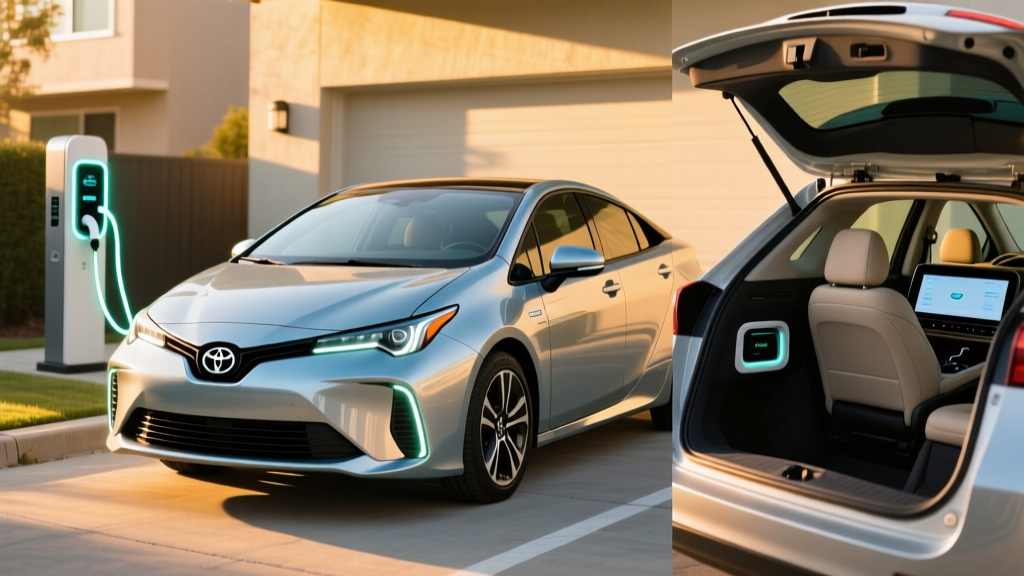
The phrase "performance hybrid" used to be an oxymoron. Toyota's fifth-generation Prius Prime shattered that perception, and the 2026 model refines the formula further. With 220 combined horsepower, a 44-mile electric-only range, and an EPA-rated 52 MPG combined once the battery depletes, the Prius Prime occupies a rare middle ground: a plug-in hybrid (PHEV) that genuinely rewards enthusiastic driving while delivering the efficiency hybrid buyers expect.
After spending time with the 2026 Prius Prime across city commutes, highway stretches, and back-to-back Level 2 charging sessions, here is the data-driven breakdown of what this PHEV actually delivers — and where its limitations live.
HEV vs PHEV: Where the Prius Prime Fits
Conventional Hybrid (HEV): The standard 2026 Prius uses a 1.8-liter engine paired with electric motors for a combined 194 HP. It cannot plug in. The battery recharges solely through regenerative braking and the engine. EPA rating: up to 57 MPG combined. You never change your fueling habits.
Plug-in Hybrid (PHEV): The Prius Prime adds a larger 13.6 kWh lithium-ion battery and a more powerful electric drive motor. You plug it in to access 44 miles of pure electric driving. Once that battery depletes, it operates exactly like a conventional hybrid — no range anxiety, no stranded scenarios. Combined output: 220 HP.
The distinction matters for your wallet and your commute. If your daily round trip falls under 44 miles and you have access to a standard 120V outlet at home (Level 1), you could drive months without visiting a gas station. If you can't plug in regularly, the standard Prius HEV delivers nearly identical fuel economy once the Prime's battery is depleted — at a lower purchase price.
Fuel Economy and Electric Range: The Numbers
| Metric | 2026 Prius Prime (PHEV) | 2026 Prius (HEV) |
|---|---|---|
| Electric-only range (EPA) | 44 miles | N/A |
| MPGe (electric + gas combined) | 127 MPGe | N/A |
| Gas-only MPG — City | 50 MPG | 57 MPG |
| Gas-only MPG — Highway | 47 MPG | 56 MPG |
| Gas-only MPG — Combined | 52 MPG | 57 MPG |
| Total range (electric + gas) | ~510 miles | ~620 miles |
| Fuel tank capacity | 10.6 gallons | 11.4 gallons |
Source: EPA fueleconomy.gov
Real-world MPG vs EPA: Toyota hybrids consistently exceed their EPA city estimates in stop-and-go traffic because regenerative braking recaptures energy the engine would otherwise waste. Expect 52-58 MPG in urban driving. Highway cruising at 75+ MPH typically yields 44-48 MPG as aerodynamic drag reduces efficiency. In cold weather (below 30°F), the engine runs more frequently for cabin heat, reducing electric-only range to roughly 34-38 miles.
Powertrain: How 220 HP Changes the Hybrid Experience
The 2026 Prius Prime pairs a 2.0-liter four-cylinder engine (150 HP, 139 lb-ft torque) with a permanent-magnet electric motor integrated into the transaxle. Combined system output is 220 HP — a substantial jump from the 121 HP of the fourth-generation car. Toyota's fifth-gen hybrid system uses a parallel hybrid architecture where both the engine and motor can drive the front wheels simultaneously.
| Specification | 2026 Prius Prime |
|---|---|
| Engine | 2.0L inline-4, 150 HP / 139 lb-ft |
| Electric motor | 161 HP (integrated transaxle) |
| Combined system output | 220 HP |
| 0-60 MPH | 6.6 seconds |
| Drivetrain | Front-wheel drive (AWD-e available on HEV) |
| Transmission | eCVT (planetary gearset, not belt-driven) |
| Battery (usable) | 13.6 kWh lithium-ion |
| Curb weight | ~3,530 lbs |
The 6.6-second 0-60 time places the Prius Prime in legitimate performance hybrid territory. Highway merging, passing maneuvers, and on-ramp acceleration feel confident — a stark contrast to the strained, high-RPM drone of older hybrid CVTs under hard throttle. Toyota's eCVT uses a planetary gearset rather than a belt-and-cone design, so there is no rubber-band sensation. The engine RPM correlates more naturally to vehicle speed.
Charging: What You Need to Know Before Plugging In
| Charging Level | Power (kW) | Time (0-100%) | Infrastructure Needed |
|---|---|---|---|
| Level 1 (120V household) | ~1.4 kW | ~11 hours | Standard outlet (15A/120V) |
| Level 2 (240V home/public) | ~3.3 kW | ~4 hours | 240V outlet or hardwired station |
| DC Fast Charge | Not supported | N/A | N/A |
The Prius Prime's onboard charger maxes out at 3.3 kW on Level 2. This is the PHEV's most notable limitation. A full recharge takes approximately 4 hours on a 240V Level 2 circuit — fine for overnight top-ups, but it means you cannot meaningfully "refuel" the battery during a quick stop on a road trip. There is no DC fast charging capability, which is typical for PHEVs in this price segment (the RAV4 Prime and Chrysler Pacifica PHEV share this constraint).
For most owners, Level 1 charging from a standard 120V outlet is sufficient. If you drive 30 miles round-trip and plug in each evening, 11 hours at 1.4 kW delivers roughly 15 miles of range — enough to partially replenish. For a full daily recharge, a Level 2 home installation is the practical solution. Expect $500-$1,200 for a basic Level 2 home setup if your electrical panel has capacity on a 240V circuit; a panel upgrade can add $1,500-$3,000. Always consult a licensed electrician for a site-specific assessment.
The Prius Prime uses a J1772 connector for AC charging — the universal standard for non-Tesla EVs and PHEVs in North America. No adapter is needed for public Level 2 stations.
Pricing, Trims, and Tax Credit Eligibility
| Trim | MSRP (2026) | Key Features |
|---|---|---|
| SE | $34,375 | 17" alloy wheels, 8" touchscreen, wireless CarPlay/Android Auto, TSS 3.0 |
| XSE | $37,225 | 19" alloy wheels, SofTex seats, heated front seats, 12.3" display |
| XSE Premium | $40,395 | Panoramic glass roof, JBL audio, digital rearview mirror, parking assist |
All prices include destination. The Prius Prime qualifies for a portion of the federal §30D clean vehicle credit, but eligibility is not guaranteed and depends on three factors that change periodically:
- MSRP cap: PHEV sedans must be priced under $55,000. All Prius Prime trims qualify.
- Buyer income cap: Modified AGI must not exceed $150,000 (single) / $300,000 (joint). Verify your situation with a tax professional.
- Battery sourcing requirements: The percentage of critical minerals and battery components sourced from the U.S. or FTA-partner countries determines whether you receive the full $7,500 or a partial $3,750 credit. Toyota's supply chain for the Prius Prime has historically met the partial credit threshold. Check the latest fueleconomy.gov tax credit listings for the current determination.
- Point-of-sale transfer: As of 2024, eligible buyers can transfer the credit to the dealer at purchase, reducing the out-of-pocket price immediately rather than waiting for a tax refund.
Several states offer additional PHEV rebates (California's CVRP, Colorado's state credit, etc.), but amounts and eligibility vary by jurisdiction. Check your state's energy office or DMV for current programs.
Battery Warranty, Reliability, and Long-Term Ownership
Hybrid battery warranty: Toyota covers the Prius Prime's 13.6 kWh traction battery for 10 years / 150,000 miles (whichever comes first) in all 50 states, with a capacity retention guarantee — if the battery falls below a specified threshold of its original capacity, Toyota replaces it at no cost. The standard powertrain warranty covers 5 years / 60,000 miles, and the hybrid system components (inverter, transaxle, control modules) are covered for 8 years / 100,000 miles.
Toyota's hybrid battery track record is among the strongest in the industry. Fourth-generation Prius batteries routinely exceed 200,000 miles with minimal degradation. The larger PHEV battery in the Prime operates within a conservative state-of-charge window (the system never allows a true 0% or 100% charge), which significantly extends cycle life.
If replacement is needed outside warranty, a new OEM Prius Prime battery currently costs approximately $4,000-$6,000 installed, depending on the dealer and region. Third-party refurbishment options exist for $2,000-$3,500. Given Toyota's historical degradation data, most owners will sell the vehicle before facing this expense.
The 2026 Prius Prime carries a strong reliability outlook. Toyota's hybrid synergy drive system has been in continuous production since 1997 with well-documented longevity. The IIHS typically rates the Prius line highly for crashworthiness; Toyota Safety Sense 3.0 includes automatic emergency braking, lane-keeping assist, adaptive cruise control, and road-sign assist as standard equipment.
Who Should Choose the Prius Prime vs a Full EV or Gas Car?
Choose the Prius Prime (PHEV) if:
- Your daily commute is 20-44 miles round-trip and you can charge at home (even on 120V overnight)
- You want electric commuting but take regular road trips exceeding 250 miles where charging infrastructure is uncertain
- You live in an apartment or rent and cannot install a Level 2 charger — the 120V Level 1 recharge is viable for this battery size
- You want 220 HP and responsive acceleration without sacrificing 50+ MPG on road trips
Choose the standard Prius (HEV) if:
- You cannot plug in at home or work — the HEV delivers 57 MPG combined without any behavior change
- You want the lowest purchase price and don't need electric-only driving
- Your driving is mostly long highway trips where PHEV electric range offers no benefit
Choose a full BEV (e.g., Tesla Model 3, Hyundai Ioniq 6) if:
- You have reliable Level 2 home charging and your daily driving stays under 250 miles
- You want zero tailpipe emissions and the lowest per-mile energy cost
- You want access to DC fast charging for 200+ mile road trips
- You're ready to eliminate gas station visits entirely
What the Prius Prime Gets Right — and Where It Falls Short
Pros
- 44-mile electric range covers most commutes entirely
- 52 MPG combined after battery depletion — best-in-class for a 220 HP vehicle
- 0-60 in 6.6 seconds; genuinely quick for the segment
- 10-year / 150,000-mile hybrid battery warranty nationwide
- Level 1 (120V) charging is practical for daily use
- Standard TSS 3.0 ADAS suite with no subscription required
Cons
- 3.3 kW Level 2 max charge rate — slow for public charging stops
- No DC fast charging capability
- FWD only on the Prime (AWD-e available only on HEV trim)
- Cargo space reduced vs HEV due to larger battery (20.3 cu ft vs 23.8 cu ft)
- XSE Premium trim pushes past $40K, eroding value proposition
- Federal tax credit amount uncertain due to battery sourcing rules
Frequently Asked Questions
How many MPG does the 2026 Prius Prime get?
The EPA rates the 2026 Prius Prime at 50 city / 47 highway / 52 combined MPG once the electric range is depleted. In real-world city driving with frequent regenerative braking, many owners report 54-58 MPG. Highway driving at sustained speeds above 70 MPH typically returns 44-48 MPG. The combined MPGe rating (factoring in electric driving) is 127 MPGe.
How far can the Prius Prime go on electric only?
The EPA rates the 2026 Prius Prime at 44 miles of electric-only range. In mild weather (50-80°F) at city speeds, expect 40-46 miles. In cold weather (below 30°F) or at sustained highway speeds, expect 34-40 miles as the system engages the engine for cabin heating and higher power demands.
Does the Prius Prime qualify for the $7,500 federal tax credit?
Eligibility depends on current IRS §30D rules, specifically battery-component and critical-mineral sourcing requirements, which are subject to change. The Prius Prime has historically qualified for a partial credit ($3,750). All trims fall under the $55,000 MSRP cap for sedans. Buyer income must not exceed $150,000 (single) or $300,000 (joint). Always verify current eligibility on irs.gov and consult a tax professional before purchasing.
Is the Prius Prime reliable, and what does battery replacement cost?
Toyota's hybrid systems have an exceptional reliability record spanning nearly three decades. The Prius Prime battery is warrantied for 10 years / 150,000 miles. Out-of-warranty replacement costs approximately $4,000-$6,000 for an OEM battery, but historical data suggests most Prius batteries exceed 200,000 miles before significant degradation.
Do I need to plug in the Prius Prime?
No — but you should if you want to maximize savings. The Prius Prime operates as a fully capable conventional hybrid even if you never plug it in, delivering 52 MPG combined. However, plugging in unlocks 44 miles of electric-only driving at roughly $0.04-$0.06 per mile (depending on your electricity rate) versus $0.12-$0.16 per mile on gasoline. The financial benefit comes from using the electric range as much as possible.
How does the Prius Prime compare to the RAV4 Prime?
The RAV4 Prime offers 42 miles of electric range, 302 combined HP, standard AWD, and a larger cargo area — but starts around $44,000 and achieves 38 MPG combined on gas. The Prius Prime is lighter, more efficient (52 MPG), quicker to charge (smaller battery), and significantly more affordable. Choose the RAV4 Prime if you need SUV cargo space and AWD; choose the Prius Prime for maximum efficiency and value.