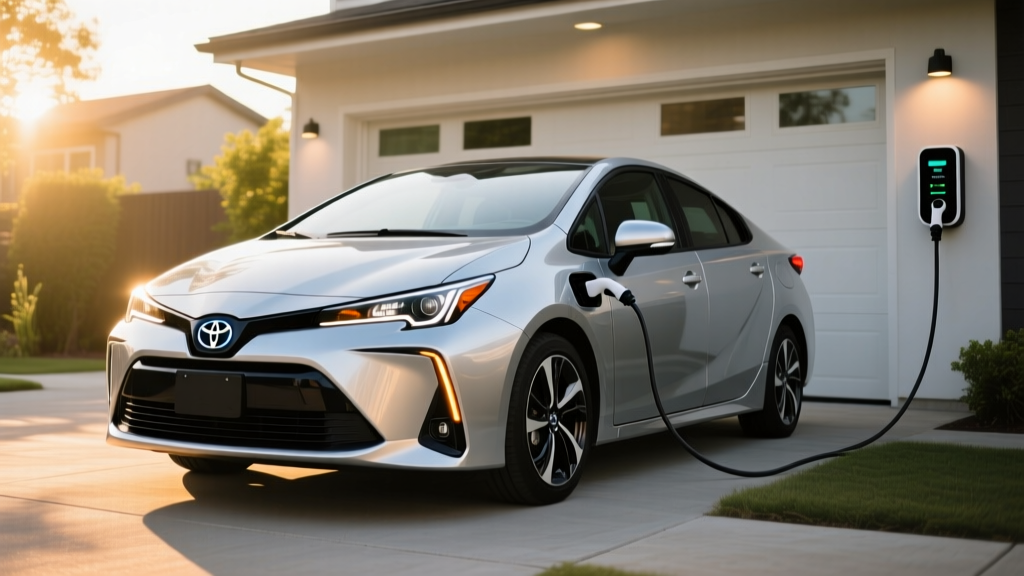
The Toyota Prius Plug-In Hybrid — now officially sold as the Prius Prime — has quietly become one of the most compelling bridge vehicles for buyers who want electric commuting without range anxiety. The SE trim sits at the value end of the Prime lineup, offering the longest electric-only range in the family and a compelling price point before incentives. If you've been searching for a Toyota Prius Plug-In Hybrid SE, this guide breaks down every number that matters: real-world MPG, electric range, charging logistics, powertrain output, and whether the federal tax credit still applies in 2026.
HEV vs PHEV: What the Prius Prime SE Actually Is
Toyota sells two Prius flavors, and confusing them is the most common buyer mistake. Here's the distinction:
| Feature | Prius (HEV — Conventional Hybrid) | Prius Prime SE (PHEV — Plug-In Hybrid) |
|---|---|---|
| Plug-in charging | No — charges via regenerative braking and engine | Yes — plug in to charge the larger battery |
| Battery size | ~1.0 kWh (small buffer) | 13.6 kWh usable (lithium-ion) |
| Electric-only driving | Brief low-speed EV mode (~1 mi) | EPA-rated 44 miles pure electric |
| Combined output | 194 HP (AWD) / 196 HP (FWD) | 220 HP combined |
| Fuel economy (hybrid mode) | 57 MPG combined (FWD LE) | 52 MPG combined (after battery depletes) |
| MSRP starting | ~$28,550 | ~$33,445 (SE trim) |
The Prius Prime SE is a plug-in hybrid (PHEV). You can — and should — plug it in nightly to capture the full 44-mile electric range. When the battery depletes, it seamlessly transitions to conventional hybrid operation, burning gasoline at an EPA-estimated 52 MPG combined. You never have to plug it in to drive, but doing so dramatically reduces fuel consumption for commutes under 44 miles round-trip.
Electric-Only Range: 44 Miles EPA, What to Expect in Reality
The Prius Prime SE carries a 13.6 kWh usable battery (gross capacity is slightly larger, with a buffer to protect longevity). The EPA rates it at 44 miles of electric-only range and 127 MPGe when operating in EV mode.
EPA Electric Range: 44 miles
Real-World Expectation: 38–46 miles depending on conditions
Cold Weather (below 32°F): Expect 28–35 miles — cabin heating and battery chemistry reduce usable capacity by 20–30%
Highway (75+ mph): ~36–38 miles — higher speeds drain the battery faster than the EPA's mixed-cycle test
In practice, owners with moderate commutes (20–35 miles round-trip) report running almost entirely on electricity during warmer months, only engaging the gasoline engine on longer weekend trips. The transition from EV to hybrid mode is imperceptible — the 2.0-liter four-cylinder engine starts smoothly and the car continues as a conventional hybrid.
Total combined range (electric + full tank of gasoline) exceeds 440 miles, eliminating any range anxiety for road trips.
Fuel Economy: EPA Numbers and Real-World MPG
| Mode | City | Highway | Combined |
|---|---|---|---|
| EV Mode (MPGe) | 127 MPGe | 127 MPGe | 127 MPGe |
| Hybrid Mode (MPG, after battery depletes) | 53 MPG | 51 MPG | 52 MPG |
Real-world MPG note: Toyota's hybrid synergy drive excels in stop-and-go traffic, where regenerative braking recaptures energy that would otherwise be lost. Many owners report exceeding the EPA city figure of 53 MPG in urban driving. Highway fuel economy tends to land closer to the sticker or slightly below, particularly at speeds above 70 mph or in hilly terrain. According to fueleconomy.gov, the Prius Prime's combined annual fuel cost is roughly $600 when driven 15,000 miles per year with regular charging — a fraction of a comparable gasoline-only compact.
Powertrain and Performance Specs
| Specification | Prius Prime SE (2025/2026 Model Year) |
|---|---|
| Engine | 2.0L 4-cylinder DOHC (150 HP) |
| Electric Motor | Permanent magnet AC synchronous (161 HP) |
| Combined System Output | 220 HP |
| Drivetrain | Front-wheel drive (FWD) |
| Transmission | Electronically controlled CVT (ECVT) |
| 0–60 mph | ~6.6 seconds |
| Battery Capacity (usable) | 13.6 kWh lithium-ion |
| EPA Electric Range | 44 miles |
| EPA Combined MPG (hybrid mode) | 52 MPG |
| MPGe (EV mode) | 127 MPGe |
| Cargo Volume (rear seats up) | 20.3 cu ft |
| Base MSRP (SE trim) | $33,445 (excl. destination) |
The 220 HP combined output is a meaningful jump over the standard Prius HEV (194 HP). The Prius Prime SE hits 60 mph in approximately 6.6 seconds — genuinely quick for an efficiency-focused compact. The electric motor delivers instant torque from a stoplight, making city acceleration feel eager. At highway speeds, the powertrain remains composed, though the CVT drones predictably under hard acceleration.
Charging: Speeds, Times, and What You Need at Home
The Prius Prime SE uses a J1772 connector for AC charging. It does not support DC fast charging — a deliberate engineering choice by Toyota. The battery is relatively small (13.6 kWh), so Level 2 charging fills it quickly enough that DC fast-charge capability would add cost and weight for marginal benefit.
| Charging Level | Power | Time to Full (0–100%) | Notes |
|---|---|---|---|
| Level 1 (120V household outlet) | ~1.4 kW | ~11 hours | Works with any standard outlet; adequate for overnight top-ups |
| Level 2 (240V home/public charger) | ~3.5 kW (onboard charger limit) | ~4 hours | Recommended for daily full charges; requires a 240V outlet or installed Level 2 station |
kW vs kWh reminder: kW (kilowatts) measures the rate of charging — how fast energy flows into the battery. kWh (kilowatt-hours) measures total energy stored — the battery's capacity. The Prius Prime SE's battery holds 13.6 kWh of energy and accepts up to 3.5 kW of charging power.
For most PHEV owners, Level 1 charging from a standard 120V garage outlet is sufficient. If you drive 44 miles and deplete the battery fully, an overnight Level 1 session (~11 hours) will recharge it completely. A Level 2 installation (~$500–$1,500 for equipment and electrician) cuts that to 4 hours, useful if you need a midday top-up or have a shorter parking window.
Pricing, Tax Credits, and Ownership Economics
The 2026 Prius Prime SE starts at approximately $33,445 (MSRP before destination charges). The XSE and XSE Premium trims climb to $37,000–$40,000+ but sacrifice some electric range (40 miles) due to larger wheels and added weight.
Federal §30D Tax Credit Eligibility (2026 Rules):
- Credit amount: Up to $7,500 — split between $3,750 for critical minerals sourcing and $3,750 for battery component sourcing
- MSRP cap: Vehicle must have an MSRP below $55,000 (sedans) — the Prius Prime SE qualifies
- Buyer income cap: AGI must not exceed $150,000 (single), $225,000 (head of household), or $300,000 (married filing jointly)
- Battery sourcing: Critical minerals and battery components must meet escalating domestic-content thresholds per IRS guidance. Toyota's supply chain for the Prius Prime has historically met partial or full requirements, but exact 2026 qualification varies by build date and battery lot
- Point-of-sale transfer: Eligible buyers can transfer the credit to the dealer at purchase, reducing the drive-off price immediately
Important: Tax credit eligibility depends on specific VIN battery sourcing. Always verify with your dealer and consult a tax professional before relying on the credit. Rules are subject to legislative change.
5-year ownership cost perspective: A Prius Prime SE driven 15,000 miles/year with regular home charging will consume roughly 300–400 gallons of gasoline annually (assuming most daily driving falls within the 44-mile electric window). At $3.50/gallon, that's $1,050–$1,400/year in fuel — compared to $2,100+ for a 25-MPG gasoline compact. Electricity costs for charging vary by region but average $0.15/kWh nationally, making a full charge roughly $2.00.
Reliability and Battery Warranty: What to Expect Long-Term
Toyota Hybrid Battery Warranty: 10 years / 150,000 miles (whichever comes first) in all 50 states, covering the hybrid battery pack against defects and excessive capacity loss.
Powertrain Warranty: 5 years / 60,000 miles
Basic Warranty: 3 years / 36,000 miles
Toyota's hybrid battery longevity is among the best-documented in the industry. The original Prius, introduced in the US in 2000, established a track record of hybrid batteries lasting 150,000–200,000+ miles with gradual capacity loss rather than sudden failure. The Prius Prime's larger lithium-ion pack benefits from conservative thermal management and a built-in buffer that prevents full charge/discharge cycles — the primary cause of battery degradation.
Battery replacement cost: If the hybrid battery requires replacement outside warranty, expect $3,000–$5,000 at a Toyota dealership (parts + labor). Third-party hybrid battery rebuild services can reduce this to $1,500–$2,500. However, given Toyota's 10-year/150,000-mile warranty and the pack's proven durability, most original owners will never face this expense.
According to NHTSA records and IIHS testing, the Prius Prime carries strong safety ratings, with Toyota Safety Sense 3.0 (pre-collision, lane departure, adaptive cruise, road sign assist) included as standard equipment on every trim.
Who Should Choose the Prius Prime SE — and Who Shouldn't
Choose the Prius Prime SE (PHEV) if:
- Your daily round-trip commute is under 45 miles and you can charge at home
- You want electric commuting but regularly take road trips exceeding 200+ miles
- You lack reliable public DC fast-charging infrastructure near your home or routes
- You want to reduce fuel costs without committing to a full BEV's charging logistics
- You value Toyota's reliability track record and 10-year hybrid battery warranty
Choose a full EV (BEV) instead if:
- You have home Level 2 charging and rarely drive more than 250 miles in a day
- You want zero tailpipe emissions and minimal maintenance (no oil changes, no gasoline engine)
- You're eligible for the full $7,500 federal credit on a BEV like the Chevrolet Equinox EV or Hyundai Ioniq 5
Choose the standard Prius (HEV) instead if:
- You cannot charge at home or at work (apartment, street parking)
- You want the lowest purchase price and don't want to manage plug-in logistics
- Your daily driving far exceeds 44 miles and you won't benefit from the PHEV's electric window
Pros
- 44-mile EPA electric range covers most daily commutes gasoline-free
- 52 MPG hybrid mode after battery depletes — no range anxiety on road trips
- 220 HP makes it genuinely quick for an efficiency car (6.6s 0–60)
- Level 1 charging from a standard outlet is practical overnight
- 10-year / 150,000-mile hybrid battery warranty across all states
- Toyota Safety Sense 3.0 standard (adaptive cruise, lane keep, pre-collision)
Cons
- No DC fast charging — not an issue for PHEVs, but limits quick public top-ups
- Only 20.3 cu ft cargo space (battery reduces trunk vs standard Prius)
- Rear seat headroom is tight for taller passengers due to sloping roofline
- SE trim uses cloth seats and basic infotainment (8-inch screen)
- Tax credit eligibility depends on battery sourcing — verify per VIN
Frequently Asked Questions
How many MPG does the Toyota Prius Plug-In Hybrid SE get?
Once the electric battery is depleted, the Prius Prime SE operates as a conventional hybrid and achieves an EPA-estimated 53 city / 51 highway / 52 combined MPG. In EV mode, it achieves 127 MPGe. Real-world city driving often exceeds the EPA estimate thanks to regenerative braking, while sustained highway driving at 75+ mph may return 48–50 MPG.
How far can the Prius Prime SE go on electric only?
The EPA rates the Prius Prime SE at 44 miles of electric-only range. In real-world conditions, expect 38–46 miles in mild weather, dropping to 28–35 miles in freezing temperatures due to cabin heating demand and reduced battery efficiency.
Does the Toyota Prius Prime qualify for a federal tax credit?
The Prius Prime may qualify for up to $7,500 in federal tax credits under IRS §30D, subject to buyer income limits (AGI caps of $150K single / $300K joint), the $55,000 MSRP cap (which the SE meets), and battery critical-mineral and component sourcing requirements. Eligibility varies by build date and VIN. Verify current qualification on the IRS clean vehicle credit page and with your dealer before purchase. The credit can be transferred at point-of-sale to reduce your purchase price directly.
Is the Prius Prime reliable, and what does battery replacement cost?
Toyota's hybrid systems are among the most reliable in the automotive industry, with decades of proven durability. The Prius Prime's hybrid battery is warrantied for 10 years / 150,000 miles. Out-of-warranty replacement costs $3,000–$5,000 at a dealer, though most batteries outlast the vehicle's usable life with gradual rather than catastrophic degradation.
Hybrid vs PHEV vs EV — which is right for me?
If you can charge at home and your commute is under 45 miles, the Prius Prime (PHEV) gives you electric daily driving with gasoline backup for long trips — the best of both worlds. A conventional hybrid (HEV) like the standard Prius is simpler (no plugging in) but always burns gasoline. A full EV (BEV) eliminates gasoline entirely but requires reliable charging access and route planning for trips beyond ~250–300 miles.
Can the Prius Prime SE charge at a public DC fast charger?
No. The Prius Prime SE does not have a DC fast-charge port. It charges via J1772 AC connection at up to 3.5 kW on Level 2, or ~1.4 kW on a standard 120V Level 1 outlet. This is typical for PHEVs — the battery is small enough that Level 2 fills it in about 4 hours, making DC fast charging unnecessary for most use cases.
Does the Prius Prime SE require premium gasoline?
No. The Prius Prime's 2.0-liter engine runs on regular 87-octane unleaded gasoline, keeping fuel costs low.