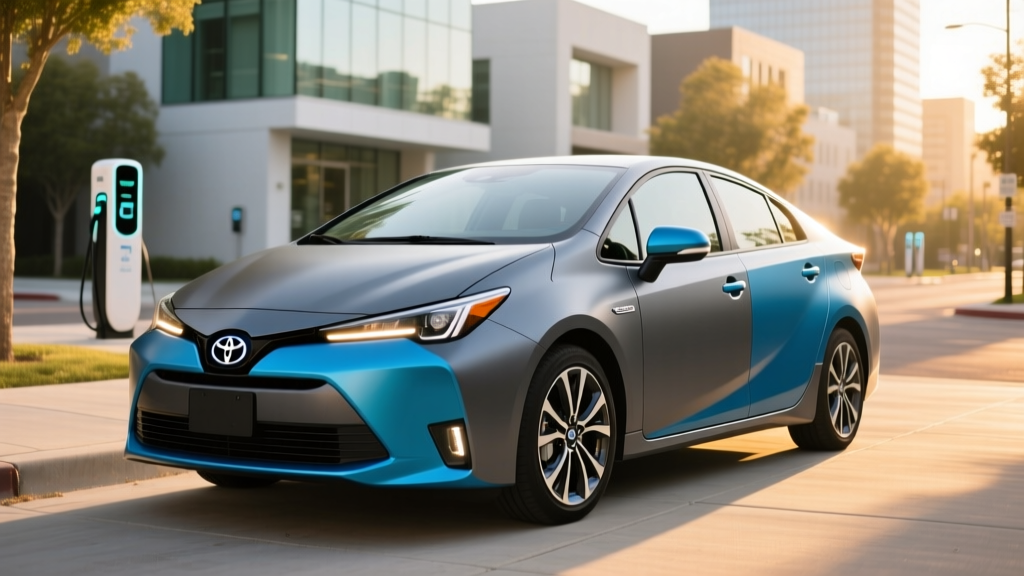
The Toyota Prius has been the benchmark hybrid for over two decades, and the 2026 model year continues to refine the formula. But for buyers drawn to the Prius's signature aesthetic — the available two-tone exterior paint schemes that pair a black roof with a body color — the question isn't just about looks. It's about whether the mechanicals underneath justify the premium. This guide breaks down every spec, from EPA fuel economy to battery warranty, so you can decide if the 2026 Prius hybrid two-tone is the right electrified vehicle for your garage.
2026 Toyota Prius Hybrid: Quick Verdict
The 2026 Toyota Prius is a conventional hybrid electric vehicle (HEV), meaning it generates all its own electricity through regenerative braking and its gasoline engine — you never plug it in. The two-tone paint option (typically a black roof over colors like Wind Chill Pearl, Supersonic Red, or Blueprint) is available on the XLE and Limited trims, adding visual distinction to an already sharp fifth-generation design. With up to 57 MPG combined on the EPA cycle, 196 combined horsepower, and a starting price around $29,945, the Prius remains one of the most efficient and affordable hybrids on the market.
| Spec | Value |
|---|---|
| Powertrain Type | Conventional Hybrid (HEV) |
| Combined Horsepower | 196 HP |
| Engine | 2.0L 4-cylinder + electric motor |
| Drivetrain | FWD standard; AWD-e available |
| EPA Fuel Economy (FWD LE) | 57 city / 56 highway / 57 combined MPG |
| EPA Fuel Economy (AWD-e) | 53 city / 54 highway / 54 combined MPG |
| Battery Type | Lithium-ion (1.0 kWh usable, HEV) |
| Plug-In Required? | No — self-charging via regen + engine |
| 0-60 mph | 7.0 seconds (FWD) |
| Starting MSRP (LE) | $29,945 |
| Two-Tone Available Trims | XLE ($32,695), Limited ($36,465) |
| Battery Warranty | 10 years / 150,000 miles |
HEV vs PHEV: Understanding What the Prius Hybrid Two-Tone Is
Before going further, it's essential to distinguish the standard Prius hybrid from the Prius Prime, which is Toyota's plug-in hybrid (PHEV) variant. They share a platform and nameplate, but their powertrains serve different use cases.
| Attribute | Prius Hybrid (HEV) | Prius Prime (PHEV) |
|---|---|---|
| Plug-In Charging | No — self-charging | Yes — Level 1 (120V) or Level 2 (240V) |
| Electric-Only Range | N/A (motor assists engine) | 44 miles (EPA, SE trim) |
| Battery Capacity | ~1.0 kWh (small, HEV buffer) | 13.6 kWh usable |
| Combined MPG / MPGe | 57 MPG combined | 127 MPGe (elec+gas) / 52 MPG (gas only) |
| Total Range | ~600+ miles | ~44 mi electric + ~400 mi gas |
| DC Fast Charging | N/A | No DC fast charge capability |
| Level 2 Charge Time | N/A | ~4 hours (240V, Level 2) |
| Federal Tax Credit (§30D) | Not eligible | Up to $3,750 (subject to sourcing rules) |
| Two-Tone Roof Available | Yes (XLE, Limited) | Limited availability by trim |
The conventional Prius HEV is for drivers who want maximum fuel efficiency without any change to their fueling routine. You fill up at the gas station and the hybrid system handles the rest. The Prius Prime PHEV suits drivers who can charge at home or work and want to handle short commutes on electricity alone, while still having a gas engine for longer trips.
Fuel Economy: EPA Ratings and Real-World MPG
| Trim / Drivetrain | City MPG | Highway MPG | Combined MPG |
|---|---|---|---|
| LE (FWD) | 57 | 56 | 57 |
| XLE (FWD) | 52 | 52 | 52 |
| Limited (FWD) | 52 | 52 | 52 |
| LE (AWD-e) | 53 | 54 | 54 |
| XLE (AWD-e) | 49 | 50 | 50 |
Source: EPA Fuel Economy Guide — Toyota Prius
The LE trim achieves the highest EPA numbers because it rides on lighter 17-inch wheels and lacks some of the power-drawing features on higher trims (heated/ventilated seats, larger infotainment screen, JBL audio). The XLE and Limited trims — the ones offering the two-tone roof — drop to 52 MPG combined on FWD due to added weight and equipment.
Real-World MPG: What to Actually Expect
Hybrids tend to exceed their EPA city ratings in real-world stop-and-go driving because regenerative braking recaptures energy that a gas-only car wastes as heat. On the flip side, sustained highway driving at 75+ mph reduces the hybrid advantage because the electric motor assists less at constant high speed.
- City driving (stop-and-go, under 45 mph): Expect 55-62 MPG in the LE, 50-56 MPG in XLE/Limited. Many owners report beating the EPA city number.
- Highway driving (70-80 mph sustained): Expect 48-54 MPG. Hybrids lose some advantage here compared to city use.
- Cold weather (below 30°F): Expect a 5-10% reduction. The engine runs more frequently to heat the cabin and bring the catalytic converter to operating temperature.
- Mountainous terrain: Regen on descents partially offsets the efficiency penalty of climbing. Net effect varies, but expect 45-50 MPG in hilly routes.
Powertrain and Performance: 196 HP Is a Different Prius
The fifth-generation Prius uses Toyota's fifth-generation hybrid system, pairing a 2.0-liter inline-four engine (150 HP, 139 lb-ft torque) with a front-mounted electric motor. Combined system output is 196 horsepower on FWD models. The AWD-e variant adds a rear-axle electric motor for all-wheel traction, though total output remains 196 HP.
The result is a 0-60 mph time of approximately 7.0 seconds for the FWD model — a dramatic improvement over the previous generation's 9.8-second figure. This puts the Prius in the same acceleration bracket as many turbocharged compact sedans and makes highway merging and passing confident and drama-free.
The hybrid battery in the conventional Prius is a small lithium-ion pack (roughly 1.0 kWh usable capacity). It's not designed for electric-only driving at any meaningful distance. Instead, it serves as a buffer: capturing regenerative braking energy and deploying it to assist the gasoline engine during acceleration, reducing fuel consumption. The engine and motor work in tandem seamlessly — there's no "EV mode" button to press on the HEV.
Pricing, Two-Tone Availability, and Tax Credit Eligibility
The two-tone roof option is bundled with specific exterior colors on the XLE and Limited trims for the 2026 model year:
- XLE with two-tone: Starting at approximately $32,695 MSRP. Available body colors with black roof include Wind Chill Pearl, Supersonic Red, and Blueprint.
- Limited with two-tone: Starting at approximately $36,465 MSRP. Adds premium features like a fixed glass roof, heated and ventilated front seats, and a 12.3-inch infotainment display.
Federal Tax Credit: Does the Prius Hybrid Qualify?
The conventional Prius HEV does not qualify for the federal §30D Clean Vehicle Credit. This credit applies only to plug-in electric vehicles (BEVs and PHEVs) that meet battery capacity, sourcing, MSRP cap, and buyer income requirements as defined by the IRS guidelines for new clean vehicles.
If the tax credit is a priority, the Prius Prime PHEV may qualify for up to $3,750 under current §30D rules, though eligibility depends on battery mineral sourcing requirements, your modified adjusted gross income (MAGI), and the vehicle's MSRP staying under the $55,000 sedan cap. Consult a tax professional and verify current-year sourcing compliance on the IRS website before purchasing.
Some states offer additional incentives for PHEVs (not conventional HEVs). Check your state energy office or Alternative Fuels Data Center for state-specific programs.
Battery Warranty, Reliability, and Replacement Cost
2026 Toyota Prius Hybrid Battery Warranty
- Hybrid Battery: 10 years or 150,000 miles (whichever comes first) — covers defects and capacity loss below a defined threshold
- Hybrid System Components: 8 years or 100,000 miles (inverter, transaxle, control module)
- Limited Vehicle Warranty: 3 years / 36,000 miles bumper-to-bumper; 5 years / 60,000 miles powertrain
Toyota's hybrid reliability track record is among the strongest in the industry. The Prius has been in continuous production since 1997 (globally), and real-world data from fleet operators and consumer surveys consistently show hybrid battery packs lasting well beyond the warranty period. Many first-generation Prius taxis surpassed 300,000 miles on the original hybrid battery.
That said, all lithium-ion batteries degrade over time. For a conventional HEV with a small ~1.0 kWh pack, degradation manifests as slightly reduced fuel economy rather than a dramatic range loss (since the engine is always available). Toyota's hybrid system is designed to keep the battery in a narrow state-of-charge window (roughly 40-60%), which minimizes stress and extends cycle life significantly.
Hybrid Battery Replacement Cost
If the hybrid battery does fail outside warranty, replacement costs for a Prius HEV battery typically range from $2,000 to $4,000 at a Toyota dealer (parts and labor). Independent hybrid specialists and refurbished battery options can reduce this to $1,000-$2,000. Given the 10-year/150,000-mile warranty coverage and the pack's proven longevity, out-of-pocket replacement during typical ownership is uncommon.
Who Should Buy the Prius Hybrid Two-Tone — and Who Shouldn't
Choose the Prius HEV Two-Tone If:
- You want 50+ MPG without plugging in or changing your fueling habits
- You live in an apartment or lack home charging access (no plug needed)
- You want proven hybrid reliability with a 10-year battery warranty
- You value a distinctive two-tone aesthetic without paying a luxury premium
- Your daily commute involves stop-and-go city driving where hybrids excel
- You want lower total cost of ownership versus a gas-only compact sedan
Look Elsewhere If:
- You want any electric-only driving capability (consider the Prius Prime PHEV or a full BEV)
- You need the federal §30D tax credit (HEVs don't qualify)
- You regularly tow — the Prius is not rated for meaningful towing
- You prioritize cargo space — the liftback is practical but offers ~24 cu ft, less than a compact SUV
- You want AWD with maximum efficiency (AWD-e drops MPG to 50 combined on XLE)
Prius HEV vs. Full EV: The Decision
A full battery electric vehicle (BEV) like the Hyundai Ioniq 6 or Tesla Model 3 offers zero tailpipe emissions, lower per-mile fuel cost (electricity vs. gasoline), and access to the full $7,500 federal tax credit (if eligible). However, BEVs require reliable charging access — ideally a Level 2 home charger — and involve range planning on road trips. If you can charge at home and your daily driving is under 250 miles, a BEV may save more long-term. If charging access is uncertain or you frequently drive 400+ miles between stops, the Prius HEV eliminates all charging logistics while still cutting fuel costs by roughly 40-50% versus a gas-only compact.
Frequently Asked Questions
How many MPG does the 2026 Toyota Prius hybrid two-tone get?
The two-tone roof is available on XLE and Limited trims, which achieve an EPA-estimated 52 city / 52 highway / 52 combined MPG on FWD models. The base LE trim (not available with two-tone) achieves 57 MPG combined. In real-world city driving, many owners report exceeding these EPA figures thanks to regenerative braking.
Does the Prius hybrid need to be plugged in?
No. The conventional Prius HEV is a self-charging hybrid. Its small lithium-ion battery is recharged through regenerative braking and the gasoline engine. You never plug it in — you simply fill up at a gas station as you would with any other car. Only the Prius Prime PHEV variant requires plug-in charging to access its electric-only range.
Is the Prius hybrid battery reliable, and what does replacement cost?
Toyota's hybrid batteries have an industry-leading reliability record, backed by a 10-year/150,000-mile warranty. Real-world data shows many Prius batteries lasting 200,000+ miles. If replacement is needed out of warranty, expect $2,000-$4,000 at a dealer, or $1,000-$2,000 through an independent hybrid specialist with a refurbished pack.
Does the 2026 Prius hybrid qualify for any tax credit?
The conventional Prius HEV does not qualify for the federal §30D Clean Vehicle Credit, which is reserved for plug-in vehicles (BEVs and PHEVs). The Prius Prime PHEV may qualify for up to $3,750 depending on battery sourcing, buyer income, and MSRP compliance. Some states offer separate hybrid incentives — check the Alternative Fuels Data Center for details.
How far can the Prius Prime PHEV go on electric only?
The 2026 Prius Prime SE achieves an EPA-estimated 44 miles of electric-only range on a full charge of its 13.6 kWh battery. Higher Prime trims (XSE, XSE Premium) achieve approximately 40 miles due to larger wheels and added weight. Once the battery is depleted, the Prime operates as a conventional hybrid at approximately 52 MPG combined.
What's the difference between the two-tone roof and a standard Prius?
The two-tone option is purely cosmetic — it pairs a gloss black roof with select body colors on XLE and Limited trims. Mechanically, the powertrain, battery, fuel economy, and warranty are identical to same-trim Prius models with a single-color roof. The two-tone adds approximately $400-$500 to the MSRP depending on the color combination.
Is the 2026 Prius safe?
The 2026 Prius comes standard with Toyota Safety Sense 3.0, which includes pre-collision braking with pedestrian detection, lane departure alert with steering assist, full-speed adaptive cruise control, lane tracing assist, and automatic high beams. The previous-generation Prius earned an IIHS Top Safety Pick+ designation, and the current generation maintains strong crash-test performance. For the latest ratings, check IIHS and NHTSA.
Bottom Line: The Two-Tone Prius Hybrid in 2026
The 2026 Toyota Prius hybrid two-tone is a compelling package for buyers who want exceptional fuel economy, zero plug-in hassle, proven reliability, and a design that stands out in the compact segment. At 52 MPG combined on the XLE and Limited trims that offer the two-tone roof, real-world fuel costs drop to roughly $900-$1,100 per year (at 15,000 miles and $3.40/gallon) — roughly half what a comparable 28 MPG gas sedan would cost. The 10-year/150,000-mile hybrid battery warranty provides long-term peace of mind, and the 196 HP powertrain means you're no longer sacrificing performance for efficiency. If you don't need electric-only driving and lack home charging access, the Prius HEV two-tone remains one of the smartest electrified-vehicle purchases available.