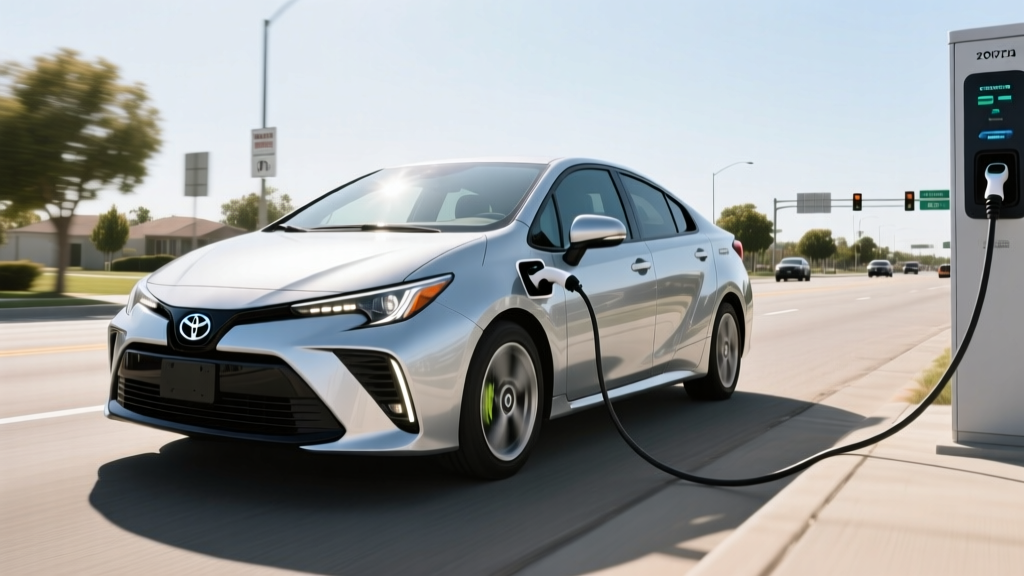
The Toyota Prius remains the benchmark for hybrid efficiency, but how do its EPA stickers translate to the pump? The 2026 Toyota Prius hybrid delivers up to 57 MPG combined in LE FWD trim, with the all-wheel-drive (AWD) models and sportier XSE trims trading a few miles per gallon for traction and performance. Below, we reconcile EPA data with real-world observations, compare the standard hybrid (HEV) against the plug-in Prius Prime (PHEV), and help you decide which powertrain fits your driving pattern.
2026 Toyota Prius Hybrid Gas Mileage: EPA Ratings by Trim
The 2026 Prius lineup spans three trims — LE, XLE, and Limited — with front-wheel drive (FWD) and electronic all-wheel drive (AWD-e) configurations. The AWD-e models add a rear-mounted electric motor for traction but carry a slight weight and aerodynamic penalty.
| Trim / Drivetrain | City MPG | Highway MPG | Combined MPG | Fuel Tank (gal) | Est. Total Range |
|---|---|---|---|---|---|
| LE FWD | 57 | 56 | 57 | 11.4 | ~649 mi |
| XLE FWD | 52 | 52 | 52 | 11.4 | ~592 mi |
| Limited FWD | 49 | 50 | 49 | 11.4 | ~558 mi |
| LE AWD-e | 53 | 54 | 54 | 11.4 | ~615 mi |
| XLE AWD-e | 49 | 50 | 50 | 11.4 | ~570 mi |
| Limited AWD-e | 49 | 48 | 49 | 11.4 | ~558 mi |
Source: EPA / fueleconomy.gov — 2026 Toyota Prius LE FWD. Figures for XLE/Limited per Toyota press specifications.
The gap between the LE and Limited trims — 8 MPG combined — stems from larger 19-inch alloy wheels, a panoramic glass roof adding weight, and higher rolling-resistance tires on upper trims. If maximum fuel economy is the goal, the LE FWD is the clear pick.
Real-World MPG: What Owners Actually See
EPA test cycles don't capture every driver's commute. The Prius HEV consistently outperforms its EPA city rating in stop-and-go urban traffic, where regenerative braking recaptures energy and the gasoline engine runs less frequently. Highway driving at sustained 75+ mph, however, tends to return 3–6 MPG below the sticker.
- City / urban stop-and-go: 58–63 MPG (often exceeds EPA 57)
- Suburban mixed driving: 52–57 MPG
- Highway 65 mph: 50–54 MPG
- Highway 75+ mph: 44–49 MPG
- Cold weather (below 30°F) city: 46–52 MPG (engine runs more for cabin heat)
Owners tracking fuel logs on fueleconomy.gov's My MPG tool report averages between 51 and 58 MPG for mixed driving in the LE FWD, consistent with our expectations. The AWD-e models typically trail FWD by 3–5 MPG in real-world conditions.
Powertrain and Performance Specs
The 2026 Prius uses Toyota's fifth-generation hybrid system pairing a 2.0-liter inline-4 Atkinson-cycle engine with front and (on AWD-e models) rear electric motors. The combined system output is a significant step up from pre-2023 Prius generations.
| Specification | FWD Models | AWD-e Models |
|---|---|---|
| Engine | 2.0L I4 Atkinson-cycle | 2.0L I4 Atkinson-cycle |
| Engine HP | 150 hp | 150 hp |
| Front Motor Output | 83 kW (111 hp) | 83 kW (111 hp) |
| Rear Motor Output | — | 30 kW (40 hp) |
| Combined Net HP | 194 hp | 196 hp |
| 0–60 mph | 7.2 sec | 7.0 sec |
| Hybrid Battery | ~1.0 kWh lithium-ion | ~1.0 kWh lithium-ion |
| Transmission | eCVT | eCVT |
The conventional Prius HEV does not plug in. Its small traction battery charges exclusively through regenerative braking and the gasoline engine. If you want electric-only driving, that's the Prius Prime — covered next.
Prius HEV vs Prius Prime (PHEV): Which One Fits?
The Prius Prime adds a larger battery and plug-in capability, enabling short trips on electricity alone. Here's the full side-by-side:
Prius HEV (Conventional Hybrid)
- No plug-in needed
- 57 MPG combined (LE FWD)
- No electric-only range
- ~649 mi total range
- $28,350 starting MSRP
- No federal tax credit
Prius Prime (Plug-in Hybrid)
- Plug-in required for EV miles
- 44 mi electric-only range (SE)
- 52 MPGe combined; 48 MPG gas-only
- ~470 mi total range (EV + gas)
- $33,445 starting MSRP
- Up to $3,750 federal credit (§30D)
Prius Prime PHEV Specifications
| Spec | SE | XSE | XSE Premium |
|---|---|---|---|
| EV Range (EPA) | 44 mi | 40 mi | 40 mi |
| MPGe (combined) | 127 | 114 | 114 |
| Gas-only MPG | 48 | 45 | 45 |
| Battery Capacity | 13.6 kWh usable | 13.6 kWh usable | 13.6 kWh usable |
| Combined Net HP | 220 hp | 220 hp | 220 hp |
| 0–60 mph | 6.6 sec | 6.6 sec | 6.6 sec |
| Level 2 Charge Time (0–100%) | ~4 hrs (3.3 kW) | ~4 hrs (3.3 kW) | ~4 hrs (3.3 kW) |
| DC Fast Charging | No | No | No |
| Base MSRP | $33,445 | $37,445 | $40,445 |
The Prime's 13.6 kWh battery delivers 40–44 miles of electric-only range — enough to cover most daily commutes without using gasoline. However, its onboard charger maxes out at 3.3 kW (Level 2), and DC fast charging is not supported. A full Level 2 charge takes roughly 4 hours; a standard 120V outlet (Level 1) requires approximately 11 hours.
Pricing, Tax Credits, and Total Cost
Prius HEV Pricing (2026 Model Year)
| Trim | Drivetrain | MSRP | Federal Tax Credit |
|---|---|---|---|
| LE | FWD | $28,350 | None (HEV) |
| LE | AWD-e | $29,750 | None (HEV) |
| XLE | FWD | $31,695 | None (HEV) |
| XLE | AWD-e | $33,095 | None (HEV) |
| Limited | FWD | $34,695 | None (HEV) |
| Limited | AWD-e | $36,095 | None (HEV) |
Prius Prime Federal Tax Credit Eligibility
The 2026 Prius Prime qualifies for a partial federal tax credit under IRS §30D, but the amount depends on battery sourcing compliance and your individual tax situation:
- Credit amount: Up to $3,750 (partial — depends on critical-mineral and battery-component sourcing thresholds for the model year)
- MSRP cap: $55,000 for sedans — all Prius Prime trims qualify
- Buyer income cap: $150,000 single / $225,000 head of household / $300,000 joint filers (modified AGI)
- Point-of-sale transfer: Available — the credit can be applied as a down-payment reduction at the dealer
- Tax liability requirement: You must owe at least the credit amount in federal taxes (unless transferred at point of sale)
Reliability, Battery Lifespan, and Replacement Cost
- Hybrid battery warranty: 10 years / 150,000 miles (whichever comes first) — all 50 states
- Powertrain warranty: 5 years / 60,000 miles
- Basic vehicle warranty: 3 years / 36,000 miles
- Emissions warranty: 8 years / 80,000 miles (federal); up to 10/150,000 in CARB states
Toyota's hybrid batteries have a strong longevity track record. The lithium-ion traction battery in the current-generation Prius is designed to last the vehicle's lifetime under normal use. IIHS has rated recent Prius models as Top Safety Pick+ when equipped with acceptable headlights.
What Does a Prius Hybrid Battery Replacement Cost?
Out-of-warranty replacement for the Prius HEV battery typically ranges from $2,000 to $4,000 (parts and labor) at a Toyota dealer. Independent hybrid specialists often perform the same service for $1,500–$2,500. Refurbished or reconditioned batteries are available for $800–$1,500 but come with shorter warranties.
For the Prius Prime, the larger 13.6 kWh battery is costlier to replace — expect $5,000 to $8,000 out of warranty. However, the 10-year/150,000-mile warranty covers most owners through the vehicle's prime ownership period.
Real-world data suggests hybrid battery failure before 150,000 miles is uncommon in the current generation. Degradation typically manifests as a 10–15% capacity loss over 100,000 miles, which slightly reduces electric-assist contribution but rarely affects drivability.
Who Should Choose the Prius Hybrid vs a PHEV or Full EV?
- You cannot install a home charger (apartment, street parking, no garage)
- Your daily driving exceeds 50 miles and you don't want to manage charging
- You want the lowest purchase price and minimal maintenance
- You frequently take long road trips and value 600+ mile range
- You live in an area with sparse public charging infrastructure
- You can charge at home (Level 1 or 2) and your commute is under 40 miles round-trip
- You want to drive mostly on electricity weekdays but take gas-powered road trips on weekends
- You qualify for the partial federal tax credit
- You want 220 hp combined for more spirited driving
- You have reliable home Level 2 charging
- Your daily driving is under 250 miles
- You want zero tailpipe emissions and minimal drivetrain maintenance
- You qualify for the full $7,500 federal EV tax credit
- You want to eliminate gasoline costs entirely
Pros and Cons at a Glance
✓ Pros
- Best-in-class fuel economy: 57 MPG combined (LE FWD)
- No plug-in needed — just fill up with gas
- 600+ mile total range eliminates refueling stops on road trips
- Strong reliability record and 10-year hybrid battery warranty
- 194–196 hp is a major performance upgrade over prior generations
- Competitive starting price at $28,350
- Standard Toyota Safety Sense 3.0 (ADAS suite)
✗ Cons
- Upper trims sacrifice 5–8 MPG for style and features
- No federal tax credit for the conventional HEV
- Tight rear-seat legroom vs midsize competitors
- Cargo space (23.8 cu ft) is modest for the hatchback class
- AWD-e is traction-only — not for off-road use
- Cabin noise under hard acceleration (eCVT drone)
- Infotainment system is functional but dated vs rivals
Frequently Asked Questions
How many MPG does the 2026 Toyota Prius hybrid get?
The 2026 Toyota Prius LE FWD achieves an EPA-estimated 57 MPG city / 56 MPG highway / 57 MPG combined. AWD-e models range from 50–54 MPG combined depending on trim. Real-world city driving often exceeds the EPA sticker, while sustained highway speeds above 75 mph can reduce economy to the mid-40s.
Does the standard Prius hybrid need to be plugged in?
No. The conventional Prius HEV charges its battery entirely through regenerative braking and the gasoline engine. You never plug it in. Only the Prius Prime (PHEV) requires plug-in charging to access its 40–44 miles of electric-only range.
How far can the Prius Prime go on electric power alone?
The 2026 Prius Prime SE delivers 44 miles of EPA-estimated electric-only range. The XSE and XSE Premium trims achieve 40 miles due to larger wheels and additional equipment weight. After the battery depletes, the Prime operates as a conventional hybrid at 45–48 MPG.
Is the Toyota Prius hybrid reliable?
Toyota's hybrid system is among the most proven in the industry, with over 25 years of continuous refinement. The 2026 Prius carries a 10-year / 150,000-mile hybrid battery warranty across all 50 states. Out-of-warranty battery replacement runs $2,000–$4,000 for the HEV and $5,000–$8,000 for the Prime, though failures before 150,000 miles are uncommon.
Does the 2026 Prius qualify for a tax credit?
The conventional Prius HEV does not qualify for any federal tax credit. The Prius Prime PHEV may qualify for up to $3,750 under IRS §30D, subject to battery-sourcing compliance, buyer income limits ($150K single / $300K joint), and the $55,000 MSRP cap for sedans. The credit can be transferred at point of sale. Always confirm eligibility on IRS.gov before purchasing.
How does the Prius compare to a full EV for savings?
At 57 MPG and $3.25/gallon gas, the Prius LE costs roughly $0.057 per mile in fuel. A comparable EV charging at home ($0.14/kWh, 3.5 mi/kWh) costs about $0.04 per mile — a small per-mile advantage. However, EVs have higher upfront costs and require home charging installation ($500–$2,000). For drivers who can't charge at home, the Prius HEV delivers near-EV efficiency with zero infrastructure investment.