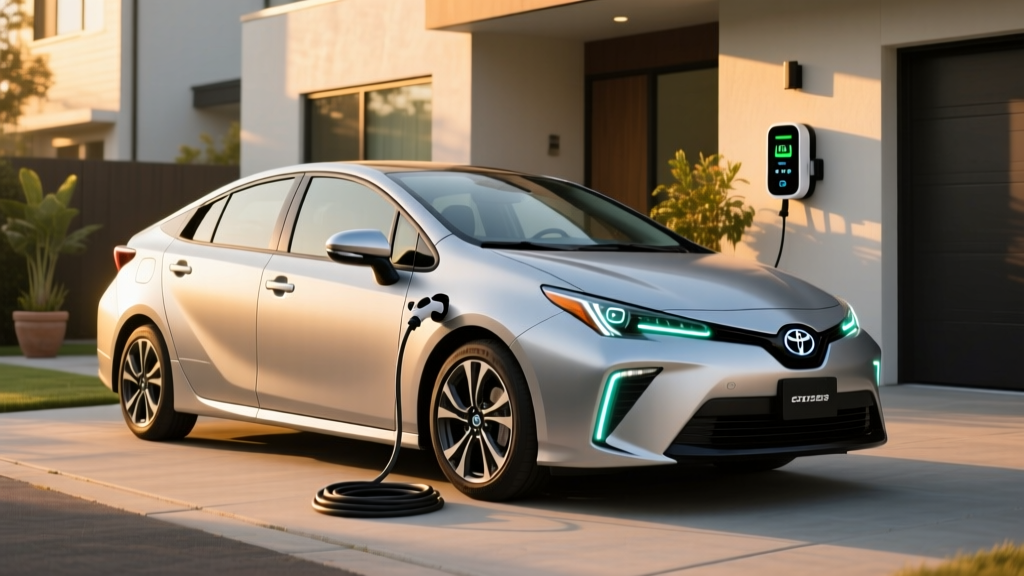
The Toyota Prius invented the mass-market hybrid segment, and the current fifth-generation platform (introduced for 2023 and refreshed through 2026) finally shed the "slow eco-box" reputation. With up to 57 MPG EPA combined, 196 horsepower on the AWD variant, and a design that no longer looks like a science experiment, the Prius is a genuinely compelling hybrid car for buyers who want serious efficiency without plugging in.
This guide covers the 2026 Toyota Prius (conventional HEV), compares it against the Prius Prime plug-in hybrid, and gives you the exact numbers — EPA fuel economy, real-world expectations, powertrain specs, battery warranty, and pricing — you need before heading to the dealer.
HEV vs PHEV: Which Prius Is Which?
Toyota sells two distinct Prius models. Confusing them is the most common buyer mistake, so let's be precise:
Prius (HEV — Conventional Hybrid)
- No plug required. The 1.3-kWh nickel-metal hydride (NiMH) traction battery charges entirely through regenerative braking and the gasoline engine.
- Always has fuel in the tank. You drive it exactly like a gas car — just fill up and go.
- Best for: Drivers without reliable home or workplace charging access who want maximum fuel savings with zero behavior change.
Prius Prime (PHEV — Plug-In Hybrid)
- Plugs in to charge. A larger 13.6 kWh lithium-ion battery delivers an EPA-estimated 44 miles of electric-only driving before the gas engine engages.
- Total combined range: approximately 440 miles (electric + gasoline).
- Best for: Drivers with home Level 2 charging who commute under 44 miles round-trip and want EV-like daily driving with a gas backup for road trips.
The rest of this article focuses on the standard Prius HEV. We address the Prime where comparisons matter — especially on pricing and tax credits.
Fuel Economy: EPA Ratings and Real-World MPG
The 2026 Prius carries over the fifth-generation hybrid powertrain that debuted in 2023, with no major mechanical changes. Here are the official EPA fuel economy figures from fueleconomy.gov:
| Trim / Drivetrain | City MPG | Highway MPG | Combined MPG |
|---|---|---|---|
| LE (FWD) | 57 | 56 | 57 |
| XLE / Limited (FWD) | 52 | 52 | 52 |
| LE / XLE (AWD-e) | 49 | 50 | 49 |
Real-world expectations: Toyota's hybrid synergy drive excels in city traffic, where regenerative braking recaptures energy at every stop. Many owners report exceeding the EPA city figure by 2–4 MPG in stop-and-go commutes. Highway driving is the opposite story — sustained 75+ mph speeds reduce efficiency to roughly 47–50 MPG on the LE FWD. In cold weather (below 35°F), expect a 5–10% drop across the board as the engine runs longer to heat the cabin and bring the catalytic converter up to temperature.
For context, the EPA combined 57 MPG translates to roughly 8.8 gallons per 1,000 miles. At $3.30/gallon (national average as of early 2026), that's about $2.90 per 100 miles — versus $11.00 per 100 miles for a 30-MPG compact gas car.
Powertrain Specs: What's Under the Hood
| Specification | 2026 Prius LE (FWD) | 2026 Prius AWD-e |
|---|---|---|
| Engine | 2.0L 4-cylinder DOHC | 2.0L 4-cylinder DOHC |
| Engine HP | 150 hp | 150 hp |
| Front Motor Output | 83 hp | 83 hp |
| Rear Motor (AWD-e) | — | 40 hp |
| Net Combined System HP | 194 hp | 196 hp |
| 0–60 mph | ~7.2 sec | ~7.0 sec |
| Transmission | eCVT | eCVT |
| Traction Battery | 1.3 kWh NiMH | 1.3 kWh NiMH |
| Curb Weight | ~3,097 lb | ~3,230 lb |
| Fuel Tank | 11.4 gal | 11.4 gal |
| Total Range (est.) | ~650 mi | ~560 mi |
The fifth-gen 2.0L Dynamic Force engine is a substantial upgrade over the old 1.8L. Combined output of 194–196 hp makes the Prius genuinely quick off the line — merging onto highways and passing on two-lane roads is confident, not white-knuckle. The eCVT is smooth and avoids the rubber-band feel of older Toyota hybrids thanks to revised software calibration.
The AWD-e system uses a separate rear-axle electric motor that engages automatically below 43 mph for traction in rain and light snow. It's not a trail system — think of it as confidence-enhancement for winter commuters, not off-road capability.
Pricing and Tax Credit Eligibility
Here is the 2026 Prius MSRP lineup by trim (destination charge included):
- LE FWD: $28,550
- LE AWD-e: $29,950
- XLE FWD: $31,700
- XLE AWD-e: $33,100
- Limited FWD: $35,200
- Limited AWD-e: $36,600
Does the Prius HEV Qualify for a Federal Tax Credit?
No. The conventional Prius HEV does not qualify for the IRS §30D federal clean vehicle tax credit. That credit applies exclusively to plug-in electric vehicles (BEVs and PHEVs) with a minimum battery capacity of 7 kWh. The Prius HEV's 1.3 kWh NiMH battery falls far short of that threshold.
If you want a Prius with federal credit eligibility, the Prius Prime PHEV (starting at $33,675 for 2026) may qualify for up to $3,750 under §30D, subject to the buyer's modified adjusted gross income limits ($150K single / $300K joint), the $55,000 MSRP cap for sedans, and critical-mineral/battery-component sourcing requirements that tighten each year. Always verify current eligibility on IRS.gov or consult a tax professional before relying on a credit at point of sale.
Some states offer their own hybrid purchase incentives or HOV-lane access for HEVs — check your state's energy office or DMV for current programs.
Battery Longevity, Warranty, and Replacement Cost
2026 Prius Hybrid Battery Warranty
Hybrid Battery: 10 years / 150,000 miles (whichever comes first) — applicable in all 50 states following California Air Resources Board (CARB) adoption of extended hybrid battery warranty requirements.
Hybrid System Components (inverter, transaxle, control module): 8 years / 100,000 miles.
Powertrain (engine): 5 years / 60,000 miles.
Is the Prius hybrid reliable? Toyota's hybrid system is among the most proven electrified powertrains in the world. The Prius has been in continuous production since 1997 (2000 in the US), and the hybrid synergy drive architecture is now in its fourth major iteration. Fleet data from taxi and rideshare operators routinely shows these systems lasting 200,000–300,000 miles with original hybrid batteries.
The NiMH battery in the HEV is less energy-dense than lithium-ion but has excellent thermal stability and cycle life. Unlike a full EV battery, it never undergoes deep discharge cycles — the system keeps the state of charge in a narrow 40–80% window, dramatically reducing degradation.
Battery replacement cost: If the hybrid battery fails out of warranty, a new OEM replacement from Toyota runs approximately $2,500–$3,500 including labor at a dealer. Refurbished or third-party replacement modules are available for $1,000–$1,800. Given the 10-year/150,000-mile warranty and the battery's proven longevity, unplanned replacement is uncommon within the typical ownership period.
Prius vs Prius Prime vs Full EV: Which Fits You?
Choose the Prius HEV If:
- You rent or live somewhere without reliable home charging access (apartment, street parking, no garage).
- You want the lowest purchase price in the Prius lineup ($28,550 vs. $33,675 for the Prime).
- You drive long highway stretches where PHEV electric range is irrelevant.
- You want zero behavior change — no apps, no charging cables, no preconditioning.
Choose the Prius Prime PHEV If:
- You have a garage or driveway where you can install a Level 2 charger (the Prime's 13.6 kWh battery charges in ~4 hours on a 240V/16A Level 2 circuit).
- Your daily round-trip commute is under 44 miles — you'd burn almost zero gasoline on weekdays.
- You want access to the potential $3,750 federal tax credit, narrowing the price gap with the HEV.
Choose a Full EV (BEV) If:
- You have home charging and your daily driving is under 250 miles.
- You want to eliminate gasoline entirely and access the full $7,500 federal credit (on qualifying models).
- You want lower long-term maintenance costs (no oil changes, no spark plugs, minimal brake wear from regen).
Driving Impressions and Daily Ownership
The current Prius rides on Toyota's TNGA-C platform, which gives it a lower center of gravity and sharper steering than any previous generation. It's not a sports sedan, but it holds a line through corners with composure that would have been unthinkable in the second-gen Prius. Cabin noise is well-managed at highway speeds — road noise is moderate on coarse asphalt but wind noise is minimal.
Inside, the 8-inch touchscreen (XLE/Limited get an optional 12.3-inch display) runs Toyota's latest multimedia interface with wireless Apple CarPlay and Android Auto. The digital gauge cluster is clean and configurable. Rear-seat legroom is adequate for adults on shorter trips but tight for anyone over 6 feet on long drives — the sloping roofline cuts into headroom. Cargo space behind the rear seats is approximately 23.8 cubic feet, competitive with compact hatchbacks like the Honda Civic Hatchback.
Toyota Safety Sense 3.0 is standard across all trims: full-speed adaptive cruise control, lane-tracing assist, pre-collision with pedestrian detection, automatic high beams, and road-sign assist. This is an SAE Level 2 driver-assistance system — the driver must remain attentive and keep hands on the wheel at all times.
Pros
- Class-leading 57 MPG EPA combined (LE FWD)
- 196 hp AWD-e is genuinely quick for a hybrid
- 10-year/150,000-mile hybrid battery warranty in all states
- Lowest starting price in the Prius lineup
- No charging infrastructure required
- Proven long-term reliability track record
Cons
- No federal tax credit for the HEV variant
- Rear-seat headroom limited by sloping roofline
- AWD-e fuel economy drops to 49 MPG combined
- Base LE interior feels budget-grade at $28K+
- 11.4-gallon fuel tank means more fill-up stops on road trips vs. larger-tank competitors
Frequently Asked Questions
How many MPG does the 2026 Toyota Prius hybrid get?
The EPA rates the Prius LE FWD at 57 city / 56 highway / 57 combined MPG. The XLE and Limited FWD trims are rated at 52 combined. The AWD-e versions are rated at 49 combined. In real-world city driving, many owners exceed the EPA city figure by 2–4 MPG; highway driving at 75+ mph typically drops 5–8 MPG below the EPA highway number.
Does the Prius hybrid need to be plugged in?
No. The conventional Prius HEV charges its 1.3 kWh hybrid battery entirely through regenerative braking and the gasoline engine. You never plug it in. If you want a plug-in Prius, that's the Prius Prime PHEV — a separate model with a larger 13.6 kWh battery and 44 miles of electric-only range.
How long does the Prius hybrid battery last?
Toyota warranties the hybrid battery for 10 years or 150,000 miles in all 50 states. Real-world data from fleet operators and long-term owners shows these NiMH batteries regularly lasting 200,000+ miles without replacement. The battery management system keeps the state of charge in a narrow window to minimize degradation.
What does it cost to replace a Prius hybrid battery?
An OEM replacement hybrid battery from Toyota costs approximately $2,500–$3,500 including dealer labor. Refurbished or aftermarket replacement modules are available for $1,000–$1,800. Given the warranty coverage and proven longevity, most owners never face this cost.
Does the Toyota Prius qualify for any federal tax credit?
The conventional Prius HEV does not qualify for the IRS §30D federal clean vehicle credit — that credit is limited to plug-in vehicles with at least 7 kWh of battery capacity. The Prius Prime PHEV may qualify for up to $3,750, depending on the buyer's income, MSRP limits, and battery-sourcing requirements. Verify current eligibility on IRS.gov.
Is the Prius AWD-e good in snow?
The AWD-e system provides meaningful traction improvement in rain and light-to-moderate snow thanks to its rear-axle electric motor that engages below 43 mph. It's not a substitute for winter tires in severe conditions, but it adds a layer of confidence for winter commuters who don't need a full SUV.
How does the Prius compare to a full EV on cost?
At 57 MPG and $3.30/gallon, the Prius LE costs about $0.029/mile in fuel. A comparable EV averaging 3.5 miles/kWh charged at home at $0.14/kWh costs about $0.040/mile — slightly more per mile on electricity (though EVs have lower maintenance costs). The Prius wins on upfront price: $28,550 vs. $35,000+ for most comparable EVs, and no home charging installation expense ($500–$2,000 for a Level 2 setup).