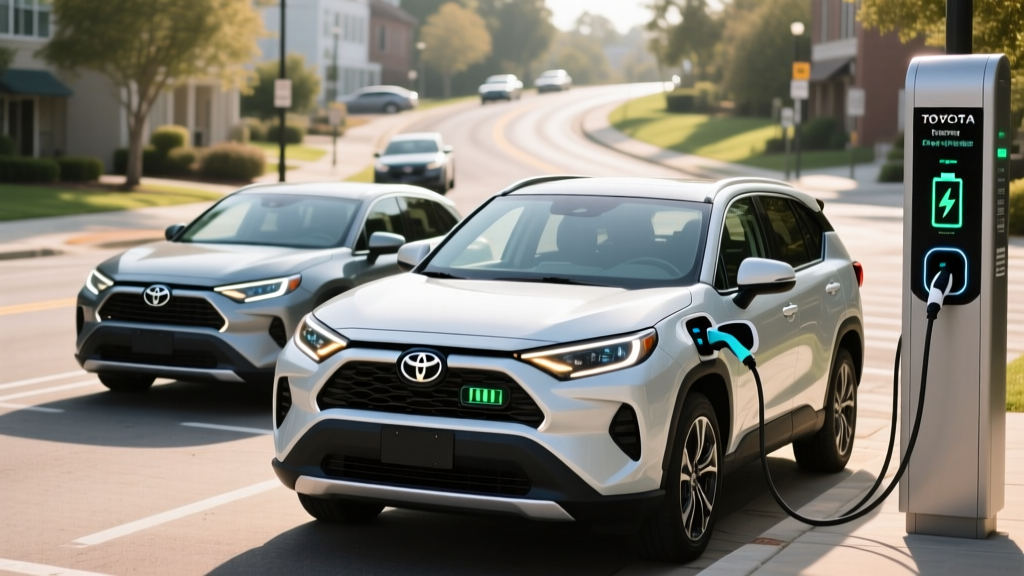
Toyota has bet heavily on electrification without forcing buyers into full battery-electric vehicles. Their bridge technology? The plug-in hybrid electric vehicle (PHEV). For 2026, Toyota offers several Toyota plugin hybrid models that combine meaningful electric-only range with the fuel-sipping efficiency the brand is known for — without any range anxiety.
If you've been searching for a Toyota plugin hybrid, you likely have questions: Which model offers the most electric range? Do any qualify for the federal tax credit? How does a PHEV differ from a conventional hybrid? This guide breaks down every current Toyota PHEV with exact EPA figures, pricing, battery specs, and real-world ownership data so you can make an informed decision.
HEV vs PHEV: What Toyota Plugin Hybrid Buyers Must Know
Before diving into specific models, it's critical to understand the distinction between Toyota's two hybrid categories. Conventional hybrids (HEVs) like the standard Prius or Camry Hybrid never plug in — they use a small battery recharged by regenerative braking and the gas engine. Plug-in hybrids (PHEVs) carry a larger battery you can charge from a wall outlet or charging station, enabling pure electric driving for a set distance before the gas engine kicks in.
| Feature | Conventional Hybrid (HEV) | Plug-in Hybrid (PHEV) |
|---|---|---|
| Plug-in charging | No — never plugs in | Yes — Level 1 or Level 2 |
| Electric-only range | 0 miles (EV assist only) | 25–44 miles (model dependent) |
| Battery size | ~1.0–1.6 kWh | 13.6–18.1 kWh usable |
| Federal tax credit | None | Up to $3,750 (§30D, varies) |
| Ideal for | No home charging access | Home chargers with short commutes |
The bottom line: if you can charge at home or work and your daily commute falls within the electric-only range, a Toyota PHEV lets you drive electric most days while retaining gas-engine flexibility for road trips. If you have no charging access, a conventional HEV is the better fit.
The 2026 Toyota Plugin Hybrid Lineup at a Glance
Toyota currently offers three PHEV models in the U.S. market. Here's how they stack up on paper:
| Spec | Prius Prime | RAV4 Prime | Crown Signia (PHEV variant) |
|---|---|---|---|
| Body style | 5-door hatchback | Compact SUV | Midsize wagon/SUV |
| EPA electric-only range | 44 mi (SE trim) | 42 mi | ~35 mi (est.) |
| Battery (usable) | 13.6 kWh, lithium-ion | 18.1 kWh, lithium-ion | ~15 kWh (est.) |
| Combined HP | 220 hp | 302 hp | ~240 hp (est.) |
| 0–60 mph | 6.6 sec | 5.7 sec | ~7.0 sec (est.) |
| EPA MPG (gas, combined) | 52 MPG combined | 38 MPG combined | ~40 MPG combined (est.) |
| MPGe (electric+gas) | 127 MPGe | 94 MPGe | ~95 MPGe (est.) |
| DC fast charging | No | No | No |
| Level 2 charge time (0–100%) | ~4 hours (3.3 kW) | ~2.5 hours (6.6 kW) | ~3.5 hours (est.) |
| Starting MSRP | $33,975 | $44,615 | $47,500 (est.) |
| Drivetrain | FWD (AWD available) | AWD standard | AWD standard |
Note: Crown Signia PHEV figures marked (est.) are based on preliminary manufacturer data for the 2026 model year. Confirm final specs at Toyota's official site before purchasing.
Real-World MPG and Electric Range: What to Actually Expect
EPA numbers set a baseline, but real-world results depend on your driving mix, climate, and charging habits. Here's what owners and testers consistently report:
Prius Prime: The 44-mile EPA electric range is achievable in mild weather with moderate speeds. Expect 36–40 miles in cold weather (below 40°F) due to cabin heating and battery resistance. Once the battery depletes, the 52 MPG combined figure holds up well — many owners report 54–58 MPG in city driving where regenerative braking shines, and 46–50 MPG on the highway.
RAV4 Prime: The 42-mile electric range is accurate for mixed driving. Highway-only electric range drops to roughly 32–35 miles at 70+ mph. In hybrid mode after depletion, expect 34–36 MPG combined in real-world driving — slightly below the 38 MPG EPA sticker, typical for an AWD SUV at highway speeds. City hybrid-mode driving can reach 38–40 MPG.
| Model | EPA Combined | Real-World City | Real-World Highway | EV Range (Cold Weather) |
|---|---|---|---|---|
| Prius Prime SE | 52 MPG / 127 MPGe | 54–58 MPG | 46–50 MPG | ~34–38 mi |
| RAV4 Prime | 38 MPG / 94 MPGe | 38–40 MPG | 34–36 MPG | ~32–35 mi |
Charging Your Toyota Plugin Hybrid: What You Need
One of the most common questions from new PHEV buyers: how do you actually charge these vehicles, and how long does it take?
No current Toyota PHEV supports DC fast charging. This is a deliberate engineering choice — the battery sizes (13.6–18.1 kWh) are small enough that Level 2 charging fills them quickly, and adding DC fast-charge hardware would increase cost, weight, and complexity for marginal benefit.
| Charging Method | Prius Prime (13.6 kWh) | RAV4 Prime (18.1 kWh) |
|---|---|---|
| Level 1 (120V, 1.4 kW) | ~10.5 hours | ~12 hours |
| Level 2 (240V, 3.3 kW) | ~4 hours | ~5.5 hours (3.3 kW onboard) |
| Level 2 (240V, 6.6 kW) | N/A (3.3 kW max onboard) | ~2.5 hours (SE/XSE trim) |
| DC Fast Charge | Not supported | Not supported |
Home charging setup: Most PHEV owners find Level 1 (standard 120V outlet) sufficient if the car sits parked for 10+ hours overnight. A full overnight charge easily replenishes 40+ miles of electric range. Upgrading to a 240V Level 2 home charger ($300–$600 for the unit, $500–$1,500 for electrician installation) is worthwhile if you need midday top-ups or own the RAV4 Prime with its larger battery.
Connector type: All Toyota PHEVs use the standard J1772 connector for AC charging. No adapter is needed for any public Level 2 station in North America.
Pricing, Trims, and Federal Tax Credit Eligibility
Here's the 2026 pricing breakdown by model and trim, along with the critical tax credit question.
| Model / Trim | MSRP | Federal Tax Credit (est.) |
|---|---|---|
| Prius Prime SE | $33,975 | Up to $3,750* |
| Prius Prime XSE | $37,225 | Up to $3,750* |
| Prius Prime XSE Premium | $40,670 | Up to $3,750* |
| RAV4 Prime SE | $44,615 | Up to $3,750* |
| RAV4 Prime XSE | $48,540 | Up to $3,750* |
*Federal tax credit details (IRS §30D): Under current IRS rules, the clean vehicle credit for PHEVs can reach up to $7,500, split between a $3,750 critical minerals requirement and a $3,750 battery components requirement. Most Toyota PHEVs currently qualify for up to $3,750 (the critical minerals portion) due to battery component sourcing rules that phase out vehicles with components from foreign entities of concern. Eligibility also depends on:
- Buyer income caps: Modified AGI ≤ $150,000 (single), $225,000 (head of household), $300,000 (joint)
- MSRP caps: Vans/SUVs/pickups ≤ $80,000; sedans ≤ $55,000 (all Toyota PHEVs qualify)
- Point-of-sale transfer: You can transfer the credit to the dealer at purchase for an immediate price reduction
Tax credit rules change frequently. Always verify current eligibility on fueleconomy.gov and consult a tax professional before relying on credit amounts for your purchase decision.
Battery Longevity, Warranty, and Replacement Costs
Toyota's hybrid battery track record is among the strongest in the industry. The original Prius, launched in the U.S. in 2000, has countless examples exceeding 200,000 miles on the original hybrid battery. Modern lithium-ion PHEV batteries benefit from conservative state-of-charge buffers — Toyota never lets the battery charge to true 100% or discharge to true 0%, which dramatically slows degradation.
Expected degradation: Most Toyota PHEV owners report less than 10% electric-range loss over the first 5 years / 75,000 miles. A 2020 RAV4 Prime owner in 2026 might see 38–39 miles of electric range instead of the original 42 — a barely noticeable difference.
Replacement cost if out of warranty: Based on current parts pricing and labor, a Toyota PHEV hybrid battery replacement runs approximately $4,000–$7,000 depending on the model and whether you use a new OEM battery, a refurbished unit, or a third-party replacement. The Prius Prime battery is on the lower end; the RAV4 Prime's larger pack is on the higher end. For context, this is comparable to a major transmission repair on a conventional vehicle.
Toyota Plugin Hybrid vs Full EV vs Gas Car: Which Fits You?
Choosing between a Toyota PHEV, a full battery-electric vehicle (BEV), and a conventional gas car depends on your specific situation. Here's a practical decision framework:
- You can charge at home (even a standard 120V outlet works)
- Your daily commute is under 40 miles round-trip
- You take road trips where charging infrastructure is sparse
- You want EV-like daily driving without range anxiety
- You live in a cold climate where EV range loss is significant
- You have reliable Level 2 home charging
- Your daily driving is predictable and within 250+ miles
- You want zero tailpipe emissions and minimal maintenance
- You want the lowest per-mile fuel cost (electricity vs gas)
- You cannot charge at home or work
- You want maximum simplicity — no charging cables, no plugs
- Your budget is tighter and the PHEV premium (~$4,000–$6,000 over HEV) doesn't pencil out
The financial case for a PHEV over a gas car strengthens dramatically if your commute fits within the electric-only range. A Prius Prime driver commuting 30 miles daily and charging at home may use gasoline only on weekend road trips, achieving effective "fuel economy" of 100+ MPGe for daily driving while spending roughly $0.04–$0.06 per mile on electricity versus $0.12–$0.15 per mile on gasoline.
Pros and Cons of Toyota's Plugin Hybrids
- Class-leading reliability and 10-yr/150k-mi battery warranty
- 42–44 mi electric range covers most commutes
- 52 MPG hybrid mode (Prius Prime) after battery depletion
- No range anxiety — gas engine for long trips
- Level 1 charging sufficient for overnight top-ups
- Strong resale value and proven drivetrain longevity
- No DC fast charging on any model
- RAV4 Prime limited availability / dealer markups common
- Federal tax credit capped at ~$3,750 (not full $7,500)
- 3.3 kW onboard charger (Prius Prime) limits Level 2 speed
- AWD Prius Prime reduces EV range by ~4 miles
- PHEV premium over conventional HEV: $4,000–$6,000
Frequently Asked Questions
How many MPG does the Toyota Prius Prime get?
The 2026 Prius Prime SE achieves an EPA-rated 52 MPG combined (57 city / 46 highway) in hybrid mode after the battery is depleted, plus 127 MPGe when factoring in electric driving. The XSE trim drops slightly to 50 MPG combined due to wider wheels. Real-world city driving frequently exceeds the EPA figure — 54–58 MPG is common thanks to regenerative braking in stop-and-go traffic.
How far can the RAV4 Prime go on electric only?
The 2026 RAV4 Prime delivers an EPA-rated 42 miles of electric-only range. In real-world conditions, expect 35–38 miles at highway speeds or in cold weather, and the full 40–42 miles in mild weather with moderate city/suburban driving. Once the battery is depleted, the gas engine provides 38 MPG combined for unlimited range with a 14.5-gallon fuel tank — roughly 550+ total miles between fill-ups.
Does a Toyota plugin hybrid qualify for a tax credit?
Yes, but not the full $7,500. Under current IRS §30D rules, Toyota PHEVs typically qualify for up to $3,750 (the critical minerals portion). The battery components portion is currently not met due to sourcing restrictions. Eligibility also depends on buyer income limits and MSRP caps. The credit can be transferred to the dealer at point of sale for an immediate purchase-price reduction.
Is a Toyota PHEV reliable, and what does battery replacement cost?
Toyota's hybrid systems are among the most proven in the automotive industry, with over 25 years of continuous refinement. The hybrid battery carries a 10-year/150,000-mile warranty across all states. Expected battery degradation is under 10% over the first five years. Out-of-warranty replacement costs range from approximately $4,000 to $7,000 depending on the model, comparable to a major repair on any conventional vehicle. Many first-generation Prius batteries have exceeded 200,000 miles.
Do I need to install a home charger for a Toyota PHEV?
Not necessarily. All Toyota PHEVs come with a Level 1 charging cable that plugs into a standard 120V household outlet. An overnight charge (10–12 hours) fully replenishes the battery for 40+ miles of electric range. A dedicated Level 2 (240V) home charger is optional but reduces charge time to 2.5–4 hours — useful if you need midday top-ups or drive the RAV4 Prime with its larger battery. Installation costs for Level 2 range from $800 to $2,100 depending on your electrical panel capacity.
Hybrid vs PHEV vs EV — which Toyota should I buy?
If you have home charging and a sub-40-mile commute: Prius Prime or RAV4 Prime (PHEV) gives you electric daily driving with gas-engine backup. If you can't charge at home: a conventional Prius or Camry Hybrid (HEV) delivers excellent MPG with zero behavior change. If you want full electric and have reliable charging: look beyond Toyota to the bZ4X or competitors like the Hyundai Ioniq 5 or Tesla Model Y, as Toyota's BEV lineup remains limited in 2026.