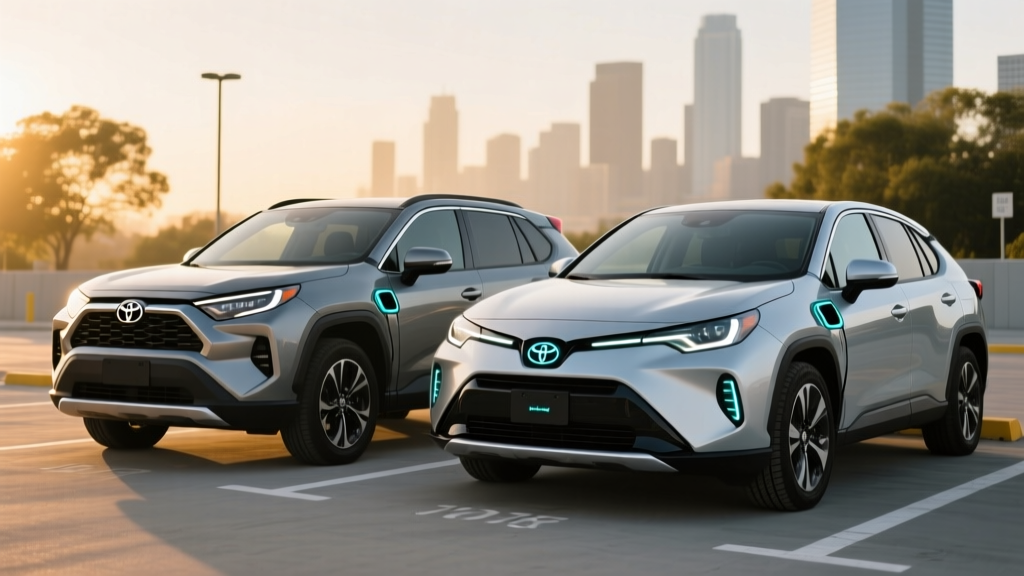
Toyota's plug-in hybrid (PHEV) strategy in 2026 comes down to two models that cover most buyer needs: the RAV4 Prime SUV and the Prius Prime liftback. Both pair a gasoline engine with a larger battery and more powerful electric motor than their conventional hybrid siblings, giving them meaningful electric-only range for daily commuting while preserving the gas engine for road trips. If you've been searching for a "toyota plug in" option, these are the two vehicles that fit the bill—and they serve very different buyers.
This guide breaks down exactly what each 2026 Toyota plug-in hybrid delivers in range, efficiency, charging, powertrain output, pricing, and tax credit eligibility, then helps you decide which one—or whether a full EV or conventional hybrid—makes sense for your situation.
Toyota Plug-In Hybrids vs. Conventional Hybrids: What's the Difference?
HEV (Conventional Hybrid) vs. PHEV (Plug-In Hybrid)
| Feature | HEV (e.g., RAV4 Hybrid, Prius) | PHEV (e.g., RAV4 Prime, Prius Prime) |
|---|---|---|
| Plugs in to charge? | No — charges via regenerative braking and engine | Yes — plug in for full electric range |
| Battery size | ~1.0–1.6 kWh | 13.6–18.1 kWh |
| Electric-only driving | Very short distances at low speed | 40–44 miles EPA |
| Gas engine | Always available, seamlessly blended | Always available once battery depletes |
| Federal tax credit | None (no §30D eligibility) | Up to $3,750 (subject to rules) |
| Starting price premium | Base | +$5,000–$9,000 over HEV equivalent |
The key distinction: a conventional Toyota hybrid like the standard RAV4 Hybrid never plugs in. Its small battery recharges through regenerative braking and the gas engine. A Toyota plug-in hybrid (the Prime models) has a much larger battery you charge from a wall outlet or charging station, giving you 40+ miles of pure electric driving before the gas engine kicks in. Once the electric range depletes, a PHEV operates exactly like a regular hybrid.
2026 Toyota RAV4 Prime: Specs, Range, and Efficiency
The RAV4 Prime remains Toyota's most powerful RAV4 and one of the quickest compact SUVs in its class, combining a 2.5-liter four-cylinder engine with front and rear electric motors.
| Spec | Value |
|---|---|
| Powertrain | 2.5L I4 + 2 electric motors (AWD) |
| Combined horsepower | 302 hp |
| 0–60 mph | 5.7 seconds |
| Battery capacity | 18.1 kWh (lithium-ion) |
| EPA electric-only range | 42 miles |
| EPA combined MPGe (electric + gas) | 94 MPGe |
| EPA MPG (gas-only, after depletion) | 38 city / 35 hwy / 36 combined |
| Total combined range | ~600 miles |
| Level 1 charging (120V) | ~12 hours (0–100%) |
| Level 2 charging (240V, 3.3 kW onboard) | ~4.5 hours |
| DC fast charging | Not available |
| Drivetrain | Electronic AWD (standard) |
| Cargo volume | 33.5 cu ft (rear seats up) |
| Base MSRP (SE trim) | $44,785 |
| XSE trim MSRP | $48,115 |
Real-World Electric Range vs. EPA
The EPA rates the RAV4 Prime at 42 miles of electric-only range. In real-world mixed driving at moderate temperatures, expect 36–42 miles. Highway-heavy routes at 70+ mph can drop this to around 32–35 miles. In cold weather (below 30°F), plan on 28–34 miles as the cabin heater and battery thermal losses reduce efficiency. Once the battery depletes, real-world gas MPG typically lands in the 33–37 combined range depending on driving style—slightly below the EPA's 36 combined, as is common with AWD hybrids at highway speeds.
2026 Toyota Prius Prime: Specs, Range, and Efficiency
The redesigned Prius Prime is lower, sleeker, and significantly more engaging to drive than prior generations. It trades some cargo space for style and efficiency, making it the more affordable entry into Toyota's plug-in lineup.
| Spec | Value |
|---|---|
| Powertrain | 2.0L I4 + single electric motor (FWD) |
| Combined horsepower | 220 hp |
| 0–60 mph | 6.6 seconds |
| Battery capacity | 13.6 kWh (lithium-ion) |
| EPA electric-only range | 44 miles (SE trim) / 40 miles (XSE/XSE Premium) |
| EPA combined MPGe | 127 MPGe (SE) / 114 MPGe (XSE) |
| EPA MPG (gas-only, after depletion) | 52 city / 48 hwy / 50 combined (SE) |
| Total combined range | ~610 miles (SE) |
| Level 1 charging (120V) | ~11 hours |
| Level 2 charging (240V, 3.3 kW onboard) | ~4 hours |
| DC fast charging | Not available |
| Drivetrain | FWD |
| Cargo volume | 20.3 cu ft (rear seats up) |
| Base MSRP (SE trim) | $34,285 |
| XSE trim MSRP | $37,585 |
| XSE Premium MSRP | $40,785 |
Real-World Electric Range vs. EPA
The Prius Prime SE's 44-mile EPA electric rating is among the best in any PHEV. Real-world testing shows 38–44 miles in mixed suburban and city driving. The heavier XSE trims with larger wheels sacrifice 4 miles of rated range (40 mi EPA). Cold weather can reduce electric range to 30–36 miles. In gas-only mode, the Prius Prime SE routinely achieves 48–53 MPG combined in real-world city driving—sometimes exceeding its EPA rating, as Toyota hybrids tend to do in stop-and-go traffic where regenerative braking shines.
Side-by-Side: RAV4 Prime vs. Prius Prime
| Attribute | 2026 RAV4 Prime XSE | 2026 Prius Prime XSE |
|---|---|---|
| Body style | Compact SUV | Liftback sedan |
| Drivetrain | AWD (standard) | FWD |
| Horsepower | 302 hp | 220 hp |
| 0–60 mph | 5.7 sec | 6.6 sec |
| Battery | 18.1 kWh | 13.6 kWh |
| Electric range (EPA) | 42 mi | 40 mi (XSE) |
| Gas-only MPG (combined) | 36 MPG | 48 MPG |
| Total range | ~600 mi | ~570 mi |
| Cargo | 33.5 cu ft | 20.3 cu ft |
| MSRP | $48,115 | $37,585 |
| Towing capacity | 1,500 lbs | Not rated |
The Prius Prime wins on efficiency, affordability, and electric range per dollar. The RAV4 Prime wins on power, cargo space, AWD capability, and towing. Neither offers DC fast charging—a deliberate Toyota decision reflecting the reality that most PHEV owners charge overnight at home on Level 2, where the ~4-hour charge time is more than sufficient for daily use.
Charging a Toyota Plug-In Hybrid: What You Need to Know
Both Toyota plug-in models use a standard J1772 connector for AC charging. Neither supports DC fast charging, which is typical for PHEVs given their smaller batteries.
| Charging Level | Power | RAV4 Prime (18.1 kWh) | Prius Prime (13.6 kWh) |
|---|---|---|---|
| Level 1 (120V household outlet) | ~1.2 kW | ~12 hours (full) | ~11 hours (full) |
| Level 2 (240V home/public) | 3.3 kW (onboard max) | ~4.5 hours (full) | ~4 hours (full) |
| DC fast charging | N/A | Not supported | Not supported |
kW vs. kWh reminder: kW (kilowatts) measures charging power—the rate electricity flows into the battery. kWh (kilowatt-hours) measures battery energy capacity—how much the battery holds. The RAV4 Prime has an 18.1 kWh battery and accepts up to 3.3 kW of AC charging power.
For most owners, a standard 120V outlet provides enough overnight charge to replenish a day's worth of electric driving (20–30 miles of use = roughly 8–10 hours on Level 1). A Level 2 home charger at 240V ensures a full battery every morning and is recommended if your daily commute exceeds 30 miles round-trip. Installation costs for a Level 2 circuit typically range from $500–$2,000 depending on panel proximity and local electrical codes—consult a licensed electrician for your specific setup.
Federal Tax Credit Eligibility for Toyota Plug-In Hybrids
Under current IRS §30D rules, the Toyota plug-in lineup faces significant limitations for the federal tax credit:
- Final assembly requirement: Both the RAV4 Prime and Prius Prime are assembled in Japan. This disqualifies them from the §30D new clean vehicle credit, which requires North American final assembly.
- MSRP caps: Even if assembly location weren't a barrier, SUVs must be under $80,000 MSRP and sedans under $55,000 to qualify. The RAV4 Prime and Prius Prime both fall within these limits.
- Battery sourcing requirements: Current rules require increasing percentages of battery critical minerals and components to be sourced from the U.S. or free-trade-agreement countries—a hurdle for most Japanese-built PHEVs.
- Buyer income caps: AGI limits of $150,000 (single) / $300,000 (joint) apply regardless of vehicle eligibility.
- Used EV credit (§25E): If you purchase a qualifying used RAV4 Prime or Prius Prime (at least 2 model years old, under $25,000, from a dealer), you may be eligible for up to $4,000 or 30% of the sale price (whichever is less). This credit has its own income caps ($75,000 single / $150,000 joint) and is subject to different sourcing rules.
Bottom line: as of 2026, neither Toyota plug-in model qualifies for the $7,500 federal new-vehicle tax credit due to the final assembly requirement. Some states offer their own rebates or HOV lane access for PHEVs—check your state's energy office or the AFDC state incentives database for local programs. Always consult a tax professional before making purchase decisions based on credit eligibility. Current rules can be verified at IRS.gov.
Battery Warranty, Reliability, and Replacement Costs
Toyota PHEV Battery Warranty
Toyota covers the hybrid battery in both the RAV4 Prime and Prius Prime with a 10-year / 150,000-mile warranty (whichever comes first) in all 50 states. This covers defects and capacity loss below a defined threshold. The broader hybrid system (inverter, control modules, electric motors) is also covered for 10 years/150,000 miles.
Toyota's hybrid battery track record is among the best in the industry. The conventional Prius has been on U.S. roads since 2000, and widespread battery failures before 150,000 miles are rare. PHEV batteries are larger and experience deeper cycling, but Toyota's thermal management and conservative buffer strategy (the system never fully charges or discharges the battery to protect longevity) mitigate degradation.
Battery replacement cost: If a replacement is needed out of warranty, expect approximately $3,500–$5,500 for a Prius Prime battery and $5,000–$7,500 for a RAV4 Prime battery, including labor. Refurbished or third-party replacement options can reduce this by 30–40%. Given the 10-year/150,000-mile warranty coverage, most original owners will never face this cost.
Toyota consistently ranks at or near the top in long-term reliability surveys from J.D. Power and Consumer Reports, and the PHEV powertrains share core components with conventional Toyota hybrids that have proven durable over hundreds of thousands of miles.
Who Should Buy a Toyota Plug-In Hybrid?
Pros
- 40+ miles of electric range covers most daily commutes without using gas
- No range anxiety—gas engine provides 600+ total miles for road trips
- Proven Toyota hybrid reliability with 10yr/150k-mi battery warranty
- RAV4 Prime offers 302 hp and standard AWD in a practical SUV
- Prius Prime achieves 50+ MPG in gas mode—best-in-class efficiency
- No DC fast-charging dependency; home charging is sufficient
- Strong resale value typical of Toyota nameplate
Cons
- No federal §30D tax credit due to Japan assembly
- No DC fast charging limits public-charging utility
- RAV4 Prime is expensive ($44,785+); long dealer wait times common
- Prius Prime cargo space is modest (20.3 cu ft)
- 3.3 kW onboard charger is slow compared to some PHEV competitors
- Electric-only top speed limited (~84 mph for RAV4 Prime)
Decision Framework: Which Toyota Plug-In Fits You?
Choose the RAV4 Prime if: You need AWD, cargo space, towing capability, and want a quick, practical family SUV that handles snow and road trips while still covering your commute on electricity. Budget $45,000–$50,000.
Choose the Prius Prime if: You prioritize maximum efficiency, lowest cost of ownership, and a fun-to-drive commuter car. You don't need AWD or large cargo capacity. Budget $34,000–$41,000.
Choose a conventional Toyota HEV (RAV4 Hybrid, Prius) if: You can't charge at home or work. Without plug-in access, a PHEV's electric range goes unused, and you're paying a premium for battery capacity you never leverage.
Choose a full EV (e.g., Tesla Model Y, Hyundai Ioniq 5) if: You have reliable home Level 2 charging, your daily driving is under 250 miles, and you want zero tailpipe emissions with minimal maintenance. A BEV eliminates oil changes, spark plugs, and exhaust systems entirely.
Frequently Asked Questions
How many MPG does the Toyota RAV4 Prime get?
The RAV4 Prime achieves an EPA-estimated 38 city / 35 highway / 36 combined MPG in gas-only hybrid mode after the electric range is depleted. In real-world driving, expect 33–37 MPG combined, with city driving trending higher and sustained highway driving trending lower. When factoring in electric-mode driving, the combined rating is 94 MPGe.
How many MPG does the Toyota Prius Prime get?
The Prius Prime SE achieves 52 city / 48 highway / 50 combined MPG in hybrid mode. The XSE trim is rated at 50 city / 47 highway / 48 combined. Real-world city MPG often exceeds the EPA rating, sometimes reaching 53–55 MPG in stop-and-go traffic thanks to aggressive regenerative braking.
How far can a Toyota plug-in hybrid go on electric only?
The RAV4 Prime provides 42 miles of EPA-rated electric-only range. The Prius Prime SE provides 44 miles; the XSE and XSE Premium trims provide 40 miles due to larger wheels and additional equipment. Real-world range varies with temperature, speed, and terrain—plan on 85–100% of the EPA figure in moderate conditions and 70–85% in cold weather.
Does the Toyota RAV4 Prime or Prius Prime qualify for the federal tax credit?
No. Under current IRS §30D rules, both vehicles are assembled in Japan, which disqualifies them from the new clean vehicle credit that requires North American final assembly. The used-vehicle credit (§25E) may apply if purchasing a qualifying pre-owned model under $25,000. State incentives may be available separately.
Is the Toyota plug-in hybrid reliable?
Toyota's hybrid systems have an extensive reliability track record spanning over two decades. The PHEV powertrain shares core architecture with conventional Toyota hybrids, which are widely regarded as among the most durable on the market. The hybrid battery is warranted for 10 years/150,000 miles. Out-of-warranty replacement costs range from approximately $3,500 to $7,500 depending on model.
Do I need to install a Level 2 charger for a Toyota plug-in hybrid?
It's recommended but not mandatory. A standard 120V household outlet (Level 1) can fully charge either model overnight in 11–12 hours, which is adequate if your daily electric driving is under 30 miles. A 240V Level 2 installation reduces charge time to about 4–4.5 hours and ensures a full battery every morning. Neither model supports DC fast charging.
Hybrid vs. PHEV vs. EV — which is right for me?
If you can charge at home and your daily commute is under 45 miles round-trip, a Toyota PHEV lets you drive mostly on electricity while keeping the gas engine for longer trips—eliminating range anxiety entirely. If you can't charge at home, a conventional HEV gives you excellent MPG without plugging in. If you have home charging, drive under 250 miles daily, and want zero emissions and minimal maintenance, a full BEV may be the better long-term choice.
For official efficiency data, consult fueleconomy.gov, the EPA's authoritative source for MPG and MPGe ratings across all trims and model years.