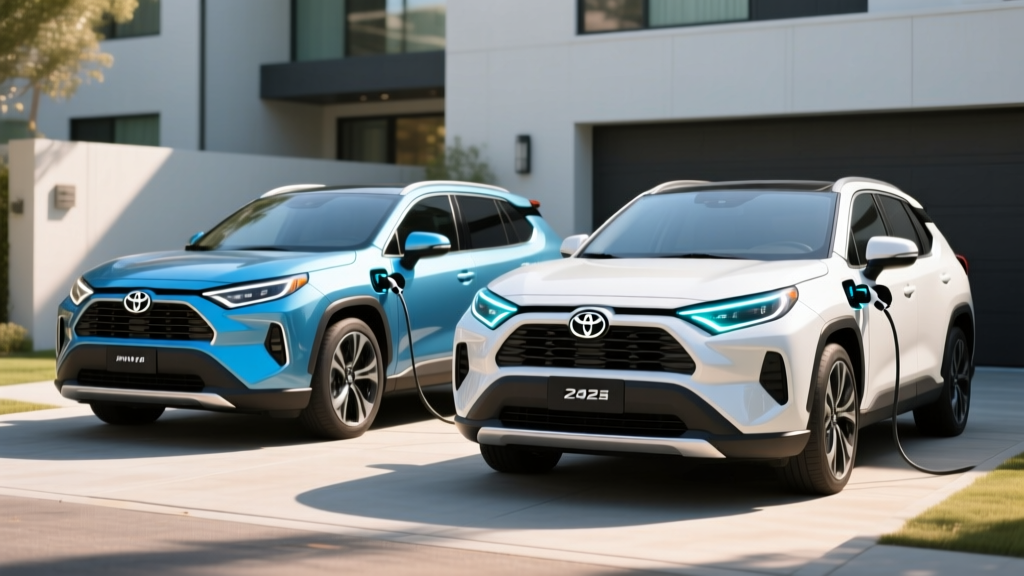
Toyota's plug-in hybrid lineup in 2026 comes down to two distinct vehicles with very different missions: the RAV4 Prime SUV and the Prius Prime liftback. Both pair a gasoline engine with a larger battery and electric motor than their conventional hybrid siblings, enabling 40+ miles of pure electric driving before the gas engine takes over. But their powertrains, pricing, and ideal buyers diverge sharply.
This guide breaks down every spec that matters — EPA range, real-world MPG, battery chemistry, charging speeds, §30D tax credit eligibility, and long-term reliability — so you can decide which Toyota PHEV fits your commute, or whether a full BEV or conventional hybrid makes more sense.
Toyota's 2026 PHEV Lineup at a Glance
| Spec | 2026 RAV4 Prime | 2026 Prius Prime |
|---|---|---|
| Body Style | Compact SUV (AWD) | Liftback (FWD) |
| Powertrain | 2.5L 4-cyl + 2 electric motors | 2.0L 4-cyl + 1 electric motor |
| Combined Horsepower | 302 hp | 220 hp |
| Battery (usable) | 18.1 kWh, lithium-ion | 13.6 kWh, lithium-ion |
| EPA Electric-Only Range | 42 miles | 44 miles (SE trim) |
| EPA MPGe (electric+gas) | 94 MPGe | 127 MPGe (SE trim) |
| EPA MPG (gas-only, combined) | 38 MPG | 52 MPG (SE trim) |
| Total Combined Range | ~600 miles | ~620 miles |
| 0–60 mph | 5.7 seconds | 6.6 seconds |
| Max AC Charge Rate | 6.6 kW (Level 2) | 6.6 kW (Level 2) |
| DC Fast Charging | Not available | Not available |
| Level 2 Charge Time (0–100%) | ~2.5 hours | ~2 hours |
| Level 1 Charge Time (120V) | ~10 hours | ~8 hours |
| Base MSRP | $44,900 (SE) | $33,975 (SE) |
| Battery Warranty | 10 yr / 150,000 mi | 10 yr / 150,000 mi |
HEV vs PHEV: What's the Actual Difference?
Conventional Hybrid (HEV) — The standard RAV4 Hybrid and Prius use a small battery (~1–2 kWh) that recharges solely through regenerative braking and the gas engine. You never plug in. The electric motor assists at low speeds and during acceleration, but the car cannot drive on electricity alone for meaningful distances. Think of it as a gas car that sips fuel rather than gulps it.
Plug-in Hybrid (PHEV) — The RAV4 Prime and Prius Prime carry a much larger battery (13–18 kWh) and a more powerful electric motor. You plug them in (Level 1 or Level 2) to charge the battery, which gives you 40+ miles of genuine zero-gas driving. Once the battery depletes, the car seamlessly operates as a conventional hybrid. No range anxiety — the gas engine is always there as backup.
Key distinction: A PHEV only delivers its efficiency advantage if you plug it in regularly. If you never charge a RAV4 Prime, you're carrying 400+ pounds of extra battery weight and getting roughly the same 38 MPG as a standard RAV4 Hybrid — at a $10,000+ premium. The PHEV math works when your daily driving falls within its electric range and you charge at home or work.
Fuel Economy: EPA Numbers vs Real-World MPG
| Metric | RAV4 Prime | Prius Prime (SE) | Prius Prime (XSE) |
|---|---|---|---|
| EPA City MPG (gas-only) | 40 | 53 | 50 |
| EPA Highway MPG (gas-only) | 36 | 51 | 47 |
| EPA Combined MPG (gas-only) | 38 | 52 | 48 |
| EPA Combined MPGe | 94 | 127 | 114 |
| Real-World Combined (owner reports) | 36–40 MPG | 48–55 MPG | 45–50 MPG |
Real-world note on MPG: Toyota hybrids, including PHEVs in charge-depleted (gas-only) mode, tend to match or slightly exceed their EPA city ratings in stop-and-go traffic because regenerative braking recovers energy that gas cars waste as heat. Highway driving is where real-world numbers dip — aerodynamic drag at 75+ mph and cold-weather engine operation reduce efficiency by 5–10%. According to fueleconomy.gov, Prius Prime owners report an average of 52 MPG combined in gas-only mode, right at the EPA sticker.
Electric-mode efficiency: In EV mode, the RAV4 Prime consumes roughly 35 kWh/100 mi and the Prius Prime about 25 kWh/100 mi. For context, that's about 2–4 cents per mile on average US residential electricity rates ($0.16/kWh), versus 12–15 cents per mile on gasoline for a 30 MPG car at $3.50/gallon.
Electric-Only Range and Battery Specs
The RAV4 Prime's 18.1 kWh battery delivers an EPA-rated 42 miles of electric-only driving. The Prius Prime's smaller 13.6 kWh pack achieves 44 miles (SE trim with lighter wheels) or 39 miles (XSE trim with larger alloy wheels and more equipment weight). Total combined range — electric plus a full tank of gas — exceeds 600 miles in both vehicles.
Battery Warranty: Toyota covers the hybrid/PHEV battery for 10 years or 150,000 miles (whichever comes first) in all 50 states. This applies to both the RAV4 Prime and Prius Prime. The warranty guarantees the battery will retain sufficient capacity; Toyota does not publish a specific percentage threshold publicly, but dealer diagnostics trigger replacement if capacity drops below functional limits during the warranty period.
Charging: Both PHEVs accept up to 6.6 kW on Level 2 (240V), meaning a full charge takes roughly 2–2.5 hours. On a standard 120V household outlet (Level 1, ~1.4 kW), expect 8–10 hours — feasible for overnight charging but tight if you need a midday top-up. Neither Toyota PHEV supports DC fast charging, which is standard practice in the PHEV segment. The batteries are simply too small to benefit from DCFC infrastructure, and the added hardware cost wouldn't justify the minimal time savings on a 13–18 kWh pack.
Real-world electric range caveat: EPA electric range is tested at moderate temperatures with mixed city/highway driving. Expect 35–38 miles from the RAV4 Prime and 37–40 miles from the Prius Prime SE in sustained highway driving at 70 mph. In freezing temperatures (below 32°F), the engine may activate for cabin heat even with a full battery, cutting electric range by 20–30% unless you precondition while plugged in.
Tax Credits and Pricing Breakdown
Under the current IRS §30D Clean Vehicle Credit, the Prius Prime qualifies for a $3,750 federal tax credit (meeting critical minerals requirements but not the full battery-component sourcing threshold as of 2026). The RAV4 Prime's eligibility has been more volatile due to battery sourcing rules and the MSRP cap for SUVs ($80,000 — the RAV4 Prime clears this). Verify current eligibility on the IRS clean vehicle credit page before purchasing, as sourcing requirements tighten annually.
Both vehicles can apply the credit as a point-of-sale transfer through a registered dealer, reducing your purchase price at the dealership rather than waiting for a tax refund. Income caps apply: $150,000 single / $225,000 head of household / $300,000 joint filers (modified AGI).
| Model & Trim | MSRP | Est. Federal Credit | Effective Price |
|---|---|---|---|
| Prius Prime SE | $33,975 | $3,750 | ~$30,225 |
| Prius Prime XSE | $37,225 | $3,750 | ~$33,475 |
| Prius Prime XSE Premium | $40,670 | $3,750 | ~$36,920 |
| RAV4 Prime SE | $44,900 | $3,750* | ~$41,150 |
| RAV4 Prime XSE | $48,800 | $3,750* | ~$45,050 |
*RAV4 Prime credit amount subject to annual sourcing-rule changes. Confirm with your dealer and the IRS before purchase. State incentives (California, Colorado, New York, etc.) may stack on top — check your state's energy office for current programs.
Reliability and Battery Replacement Costs
Toyota's hybrid synergy drive system is among the most proven electrified powertrains on the road, with over two decades of real-world deployment since the original Prius. The PHEV variants use the same fundamental architecture with a larger battery and more powerful motor. Long-term reliability data from the Consumer Reports Annual Auto Survey consistently ranks Toyota hybrids at or near the top for predicted reliability.
Battery replacement cost: If your PHEV battery fails outside the 10-year/150,000-mile warranty, expect a replacement cost of approximately $3,500–$5,500 for the Prius Prime and $5,000–$8,000 for the RAV4 Prime (parts and labor, dealer-installed). These figures have trended downward as supply chains mature. Third-party hybrid battery rebuilders offer refurbished packs for $2,000–$3,500, though this may affect remaining warranty coverage.
Degradation reality: Toyota PHEV batteries use a conservative charge buffer — the car never uses the top ~15% or bottom ~15% of the pack's total capacity. This software-level protection significantly extends cycle life. Owner reports on forums like PriusChat indicate most Toyota PHEV batteries retain 85–90% of original capacity after 100,000 miles, well within the warranty threshold.
RAV4 Prime vs Prius Prime: Which One Fits You?
Choose the RAV4 Prime If:
- You need SUV cargo space (33.5 cu ft behind rear seats) and AWD capability
- You want 302 hp and 5.7-second 0–60 times — it's one of the quickest vehicles in Toyota's lineup
- Your household has a second car and you want the PHEV to serve as the primary family hauler
- You tow occasionally (1,500-lb towing capacity)
- You live in a snowy climate where AWD traction matters year-round
Choose the Prius Prime If:
- Maximum fuel efficiency is your priority (127 MPGe, 52 MPG gas-only)
- Your budget is under $40,000 and you want the lowest cost per mile
- Your commute is under 45 miles round-trip and you can charge at home
- You don't need AWD or significant cargo volume (20.3 cu ft behind rear seats)
- You want the lowest possible operating cost short of a full BEV
PHEV vs Full EV vs Conventional Hybrid: The Decision Framework
Choose a Toyota PHEV if: You can charge at home (Level 1 or 2), your daily driving is under 45 miles, but you regularly take longer road trips where you don't want to plan around DC fast chargers. A PHEV gives you electric commuting with gas-engine freedom. It's also the right call if your household has only one car and you can't risk charging-desert downtime.
Choose a full BEV (like a Tesla Model Y or Hyundai Ioniq 5) if: You have reliable home Level 2 charging, your daily driving is under 250 miles, you want zero tailpipe emissions, and you're comfortable with DC fast charging on road trips. A BEV eliminates oil changes, has fewer moving parts, and — with current federal credits — can achieve a lower total cost of ownership over 5 years.
Choose a conventional Toyota HEV (RAV4 Hybrid, Prius) if: You cannot charge at home (apartment, street parking, no garage), you want hybrid efficiency without the PHEV price premium, or your daily driving pattern is unpredictable. A conventional hybrid delivers 40–57 MPG with zero behavior change — just fill up with gas as usual.
Frequently Asked Questions
How many MPG do Toyota PHEV models get?
In gas-only (charge-depleted) mode, the RAV4 Prime gets 38 MPG combined (40 city / 36 highway) and the Prius Prime SE gets 52 MPG combined (53 city / 51 highway). When factoring in electric-only driving, the RAV4 Prime achieves 94 MPGe and the Prius Prime SE achieves 127 MPGe. Real-world results closely track EPA figures, with city driving often matching or slightly exceeding ratings thanks to regenerative braking.
How far can the Toyota PHEVs drive on electric only?
The RAV4 Prime delivers an EPA-rated 42 miles of electric-only range. The Prius Prime SE achieves 44 miles, while the XSE trim gets 39 miles due to heavier wheels and equipment. In real-world highway driving at 70 mph, expect about 35–40 miles. In cold weather below freezing, range may drop to 28–35 miles as the engine activates for cabin heating.
Do Toyota PHEVs qualify for a federal tax credit?
As of 2026, the Prius Prime qualifies for a $3,750 federal tax credit under IRS §30D, and the RAV4 Prime's eligibility is similar but subject to annual battery-sourcing rule changes. Both credits can be applied as a point-of-sale transfer at a registered dealer. Income caps apply ($150K single / $300K joint). Always verify current eligibility at irs.gov before purchasing.
Is the Toyota PHEV battery reliable, and what does replacement cost?
Toyota's hybrid battery warranty covers 10 years or 150,000 miles. Real-world degradation data shows most Toyota PHEV batteries retain 85–90% capacity at 100,000 miles. Out-of-warranty replacement costs approximately $3,500–$5,500 for the Prius Prime and $5,000–$8,000 for the RAV4 Prime at a dealer. Toyota's conservative charge buffers (never using the full battery capacity) are the primary reason for this longevity.
Can I charge a Toyota PHEV at a DC fast charger?
No. Neither the RAV4 Prime nor the Prius Prime supports DC fast charging. They accept up to 6.6 kW on Level 2 (240V), fully recharging in 2–2.5 hours. On a standard 120V outlet (Level 1), a full charge takes 8–10 hours. This is standard for PHEVs — the battery packs are too small to benefit from DCFC speeds, and the added hardware would increase cost and weight without meaningful time savings.
Do I have to plug in a Toyota PHEV, or does it charge itself?
You must plug in a PHEV to access its electric-only range. While regenerative braking and the gas engine maintain a small charge buffer, you cannot achieve 40+ miles of electric driving without plugging in via Level 1 or Level 2. If you never plug in, the car operates as a conventional hybrid — functional but negating the PHEV's efficiency advantage and price premium. If you can't plug in regularly, a conventional Toyota HEV is a better financial choice.